Math in Focus Kindergarten Workbook Answer Key Online | Math in Focus Grade K Answers

Math in Focus Kindergarten Workbook Answer Key present here is created using a unique approach. Singapore Math in Focus Grade K Answers is designed on basis of powerful visual models, engaging hands-on activities. With Consistent Practice using Math in Focus Answer Key for Kindergarten, one can develop critical thinking skills as well as build confidence needed for achieving good grades.  Math in Focus Grade K Workbook Answer Key for 1A & 1B will ensure you master the concepts and apply mathematics to real-life situations.

Singapore Math in Focus Kindergarten Answer Key | Math in Focus Grade K Workbook 1A & 1B Answers

Explore new concepts of Kindergarten using the Math in Focus Kindergarten Answer Key and enhance your fundamentals. Comprehensive and easy-to-use resources for both the parts 1A & 1 B will help you develop a foundational understanding. A Consistent and Clear Teaching Path will foster your focus on new content as well as encourage mathematical thinking.  Access the Singapore Homeschool Math Grade K Workbook Answer Key PDFs of all chapters through the quick links below and ace up your preparation like never before.

Math in Focus Kindergarten Workbook A Part 1 Answers Key

Chapter 1 Numbers to 5

  • Lesson 1 All About 1 and 2
  • Lesson 2 Finding Matches
  • Lesson 3 Not the Same but Different: All About 3
  • Lesson 4 Why Is This Different? All About 4
  • Lesson 5 All About 5
  • Lesson 6 Spotting Small Differences

Chapter 2 Numbers to 10

  • Lesson 1 All About 6
  • Lesson 2 All About 7
  • Lesson 3 All About 8
  • Lesson 4 Numbers 0 to 9
  • Lesson 5 Pairing Sets with Numbers
  • Lesson 6 Pairing One-to-One

Math in Focus Grade K Workbook A Part 2 Answers Key

Chapter 3 Order by Size, Length, or Weight

  • Lesson 1 Ordering Things by Size
  • Lesson 2 Comparing Sizes
  • Lesson 3 Ordering Things by Length
  • Lesson 4 Ordering Things by Weight

Chapter 4 Counting and Numbers 0 to 10

  • Lesson 1 Composing and Decomposing 5
  • Lesson 2 Counting and Ordering Up to 10
  • Lesson 3 Using Your Fingers and Toes to Count On
  • Lesson 4 Same Number and More
  • Lesson 5 Fewer Than
  • Lesson 6 How Many in All?

Chapter 5 Size and Position

  • Lesson 1 Big and Small Things
  • Lesson 2 Does It Fit?
  • Lesson 3 Positions
  • Lesson 4 ‘Before’ and ‘After’

Chapter 6 Numbers 0 to 20

  • Lesson 1 All About 10
  • Lesson 2 Numbers 10 to 12
  • Lesson 3 Numbers 13 to 16
  • Lesson 4 Numbers 17 to 20
  • Lesson 5 Compare and Order

Math in Focus Kindergarten Workbook B Part 1 Answers Key

Chapter 7 Solid and Flat Shapes

  • Lesson 1 Solid Shapes
  • Lesson 2 Flat Shapes in Solid Shapes
  • Lesson 3 Flat Shapes
  • Lesson 4 Flat Shape Pictures
  • Lesson 5 Shape Patterns

Chapter 8 Numbers to 100

  • Lesson 1 Counting by 2s
  • Lesson 2 Counting by 5s
  • Lesson 3 Counting by 10s to 100
  • Lesson 4 Numbers 20 to 49
  • Lesson 5 Numbers 50 to 79
  • Lesson 6 Numbers 80 to 100
  • Lesson 7 Numbers 1 to 100

Chapter 9 Comparing Sets

  • Lesson 1 Comparing Sets of Up to 10
  • Lesson 2 Comparing Sets of 11 to 20
  • Lesson 3 Comparing Sets to Find the Difference
  • Lesson 4 Combining Sets

Chapter 10 Ordinal Numbers

  • Lesson 1 Sequencing Events
  • Lesson 2 Physical Position
  • Lesson 3 Showing Your Preferences

Chapter 11 Calendar Patterns

  • Lesson 1 Days of the Week
  • Lesson 2 Months of the Year

Chapter 12 Counting On and Counting Back

  • Lesson 1 Counting On to 10
  • Lesson 2 Counting Back Using Fingers
  • Lesson 3 Finding Differences Using Fingers

Chapter 13 Patterns

  • Lesson 1 Repeating Patterns

Chapter 14 Number Facts

  • Lesson 1 Number Facts to 10
  • Lesson 2 Combining Sets
  • Lesson 3 Composing and Decomposing Numbers to 20
  • Lesson 4 Counting On

Math in Focus Grade K Workbook B Part 2 Answers Key

Chapter 15 Length and Height

  • Lesson 1 Comparing Lengths
  • Lesson 2 Comparing Lengths Using Nonstandard Units
  • Lesson 3 Comparing Heights Using Nonstandard Units

Chapter 16 Classifying and Sorting

  • Lesson 1 Classifying Things by One Attribute
  • Lesson 2 Classifying and Sorting Things by Two Attributes

Chapter 17 Addition Stories

  • Lesson 1 Writing Addition Sentences and Representing Addition Stories
  • Lesson 2 Addition Facts to 5

Chapter 18 Subtraction Stories

  • Lesson 1 Writing Subtraction Sentences and Representing Subtraction Stories
  • Lesson 2 Comparing Sets
  • Lesson 3 Subtraction Facts to 5

Chapter 19 Measurement

  • Lesson 1 Comparing Weights Using Nonstandard Units
  • Lesson 2 Comparing Capacities
  • Lesson 3 Comparing Events in Time

Chapter 20 Money

  • Lesson 1 Coin Values
  • Lesson 2 Counting Coins

Features of Math in Focus Homeschool Kindergarten Workbook Answer Key PDF

Below are some of the key features of Math in Focus Grade K Workbook Answers given by us. They are along the lines

  • The Pictorial Abstract Approach i.e. hands-on diagrams, models, symbols, and manipulatives used in explaining the concepts makes it easy for students to have a deeper conceptual understanding.
  •  All the questions in the Homeschool Singapore Math Grade K Textbook are explained step by step so that you can grasp the concepts easily.
  • Math in Focus Grade K Workbook 1A & 1B Answers provided here will guide students in acquiring and applying concepts and skills to real-world problems too.
  • Kindergarten Math in Focus Workbook Answer Key PDF available follows the consistent k-8 pedagogical approach and is in accordance with the Latest Singapore Math Curriculum.
  • Interactive exercises and fun learning activities used in the Singapore Math Grade K Workbook Answer Key will ensure the overall growth of a student.

Final Words

We as a team believe the knowledge shared on our page regarding the Singapore Math in Focus Workbook Answer Key for Kindergarten is true and genuine. If you feel any information is to be needed do write us so that we can get back to you. Bookmark our site for the latest updates on Gradewise Math in Focus Workbook Answer Keys.

Math in Focus Grade 4 Workbook Answer Key Online | Math in Focus 4th Grade Answers

Math in Focus Grade 4 Workbook Answer Key

Math in Focus Grade 4 Workbook Answer Key uses the widely used Singapore Approach to Math. Practice using the Singapore Math in Focus Homeschool Grade 4 Answer Key available and test your knowledge of the concepts. Become formidable problem solvers in real life using the Math in Focus 4th Grade Workbook Solution Key by solving the questions in it on a regular basis. Student workbooks give you ample practice and can be used as an assessment based on the text lessons.

Grade 4 Math in Focus Answer Key: The Singapore Approach includes answers to the practice tests, review tests, exercises based on the textbook lessons. Easy to understand approach used will provide a fun atmosphere for students to work with and a simple way to understand the math concepts.

Singapore Math in Focus Grade 4 Answer Key | Math in Focus Grade 4 Workbook 4A & 4B Answers

Singapore Math Standards Edition Grade 4 Workbook Answer Key for 4A & 4B can be an extremely helpful resource for those who need extra support. Chapterwise Math in Focus features a problem-solving approach that builds on concrete-to-pictorial-to-abstract progression.

All the topics and subtopics in the Singapore Math Homeschool Grade 4 Workbook Answers are taught on a deeper level with visual representations, modeling strategies so that you will develop conceptual understanding. Simply click on the quick links available below to access the concerned chapter or subtopic within.

Math in Focus Grade 4 Workbook 4A Answers Key

Singapore Math Math in Focus Grade 4 Workbook Answer Key Chapter 1 Place Value of Whole Numbers

Marshall Cavendish Math in Focus 4th Grade Answers Chapter 2 Estimation and Number Theory

Math in Focus Grade 4 Cumulative Review Chapters 1 and 2 Answer Key

Math in Focus Grade 4 Answer Key Chapter 3 Whole Number Multiplication and Division

Math in Focus 4A Workbook Answers Chapter 4 Tables and Line Graphs

Math in Focus Grade 4 Cumulative Review Chapters 3 and 4 Answer Key

Math in Focus Grade 4A Workbook Answer Key Chapter 5 Data and Probability

Math in Focus Grade 4 Workbook 4A Answer Key Chapter 6 Fractions and Mixed Numbers

Math in Focus Grade 4 Cumulative Review Chapters 5 and 6 Answer Key

Math in Focus Grade 4 Mid Year Review Answer Key

Math in Focus Grade 4 Workbook 4B Answers Key

Math in Focus 4B Answer Key Chapter 7 Decimals

Math in Focus Workbook 4B Answers Chapter 8 Adding and Subtracting Decimals

Math in Focus Grade 4 Cumulative Review Chapters 7 and 8 Answer Key

Math in Focus 4B Answers Chapter 9 Angles

Math in Focus Workbook 4B Answer Key Chapter 10 Perpendicular and Parallel Line Segments

Math in Focus Grade 4 Workbook Answers Chapter 11 Squares and Rectangles

Math in Focus Grade 4 Cumulative Review Chapters 9 to 11 Answer Key

Math in Focus Answer Key Grade 4 Chapter 12 Area and Perimeter

Math in Focus Grade 4 Teacher Edition Chapter 13 Symmetry

Math in Focus 4B Workbook Answer Key Chapter 14 Tessellations

Math in Focus Grade 4 Cumulative Review Chapters 12 to 14 Answer Key

Math in Focus Grade 4 End of Year Review Answer Key

Importance of Math in Focus Grade 4th Online Textbook Answer Key PDF Download

Math in Focus Singapore Math Homeschool Answer Key Grade 4 has got some of the features. They are as under

  • If students practice questions regularly from this Math in Focus Singapore Math Homeschool Answer Key they can work independently.
  • Hands-on Activity used in Grade 4th Math in Focus Answers reinforces skills and develops problem-solving approaches in you.
  • The fun and Interactive Approach used in the explanation of answers makes it easy for them to grasp the concepts as well as to retain them for a long time.
  • All the answers developed here are in accordance with the Singapore Approach k-8.

Final Words

We wish the knowledge shared above in accordance with the 4th Grade Math in Focus Workbook Answer Key has been helpful to you. In case of any further queries or suggestions do write us through the comment section so that we can respond. Bookmark our site to avail latest updates on the Gradewise Math in Focus Answer Key.

శ్రీ మాధవ నగర సాయి క్షేత్రము

Math in Focus Grade 5 Chapter 13 Practice 2 Answer Key Measures of Angles of a Triangle

This handy Math in Focus Grade 5 Workbook Answer Key Chapter 13 Practice 2 Measures of Angles of a Triangle provides detailed solutions for the textbook questions.

Math in Focus Grade 5 Chapter 13 Practice 2 Answer Key Measures of Angles of a Triangle

Complete.

Question 1.
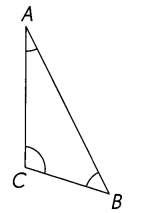
Math in Focus Grade 5 Chapter 13 Practice 2 Answer Key Measures of Angles of a Triangle 1
m∠A + m∠B + m∠C = ____
Answer:
m∠A + m∠B + m∠C =180°
Explanation:
The property of a triangle is : The sum of all internal angles of a triangle is always equal to 180°.
m∠A + m∠B + m∠C = 180°

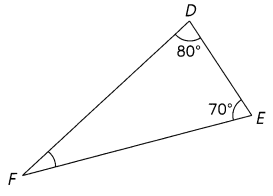
Question 2.
Math in Focus Grade 5 Chapter 13 Practice 2 Answer Key Measures of Angles of a Triangle 2
80° + 70° + m∠F = ___
m∠F = ___
Answer:
80° + 70° + m∠F = 180°
m∠F = 30°
Explanation:
The property of a triangle is : The sum of all internal angles of a triangle is always equal to 180°.
80° + 70° + m∠F = 180°
m∠F = 180°- 80° + 70° = 30°

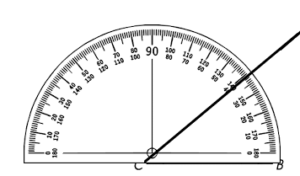
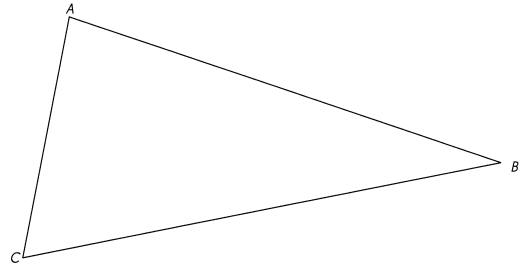
Measure the angles of the triangle. Then fill in the blanks.

Question 3.
Math in Focus Grade 5 Chapter 13 Practice 2 Answer Key Measures of Angles of a Triangle 3
m∠A = ___
m∠B = ___
m∠C = ____
m∠A + m∠B + m∠C = __ + ___ + ___
= ____
The sum of the angle measures in the triangle is ___
Answer:
m∠C = 40°

m∠B = 60°

The sum of angles in a triangle are 180°
40 + 60 = 100
180 – 100 = 80°
m∠A = 80°

m∠A = 80°
m∠B = 40°
m∠C = 60°
m∠A + m∠B + m∠C = 80°+ 40°+ 60° = 180°

These triangles are not drawn to scale. Find the unknown angle measures.

Question 4.
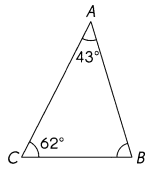
Find the measure of ∠B.
Math in Focus Grade 5 Chapter 13 Practice 2 Answer Key Measures of Angles of a Triangle 4
Answer:
m∠B = 75°
Explanation:
The property of a triangle is : The sum of all internal angles of a triangle is always equal to 180°.
43° + 62° + m∠B = 180°
m∠B = 180° – 43° + 62° = 75°

Question 5.
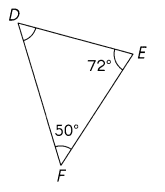
Find the measure of ∠D.
Math in Focus Grade 5 Chapter 13 Practice 2 Answer Key Measures of Angles of a Triangle 5
Answer:
m∠D = 68°
Explanation:
The property of a triangle is : The sum of all internal angles of a triangle is always equal to 180°.
72° + 50° + m∠D = 180°
m∠D = 180° – 72° + 50° = 68°

Question 6.
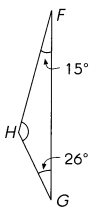
Find the measure of ∠H.
Math in Focus Grade 5 Chapter 13 Practice 2 Answer Key Measures of Angles of a Triangle 6
Answer:
m∠H  = 139°
Explanation:
The property of a triangle is : The sum of all internal angles of a triangle is always equal to 180°.
15° + 26° + m∠H = 180°
m∠H = 180° – 15° + 26° = 139°

Question 7.
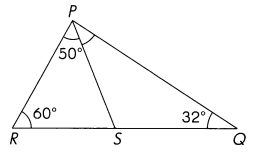
Find the measure of ∠QPS.
Math in Focus Grade 5 Chapter 13 Practice 2 Answer Key Measures of Angles of a Triangle 7
Answer:
m∠QPS =   38°
Explanation:
The property of a triangle is : The sum of all internal angles of a triangle is always equal to 180°.
In Triangle PQR
60° + 32° + m∠QPR = 180°
m∠QPR = 180° – 60° + 32° = 88°
then as per the diagram
m∠QPS =  m∠QPR – m∠RPS  = 88° – 50° = 38°

Math in Focus Grade 5 Chapter 13 Practice 3 Answer Key Right, Isosceles, and Equilateral Triangles

This handy Math in Focus Grade 5 Workbook Answer Key Chapter 13 Practice 3 Right, Isosceles, and Equilateral Triangles provides detailed solutions for the textbook questions.

Math in Focus Grade 5 Chapter 13 Practice 3 Answer Key Right, Isosceles, and Equilateral Triangles

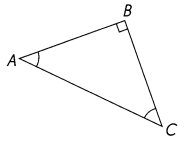
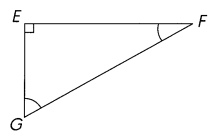
Complete. ABC and EFG are right triangles.

Question 1.
Math in Focus Grade 5 Chapter 13 Practice 1 Answer Key Right, Isosceles, and Equilateral Triangles 1
m∠B =___
m∠A + m∠C = ___
= ____
Answer:
m∠B =90°
m∠A + m∠C = 90°
Explanation:
Properties of Right – Angled Triangle

  • One angle of the triangle always measures 90degree.
  • The hypotenuse is the longest side of the right-angle triangle.
  • The side that is opposite to the 90degree angle is the hypotenuse.
  • The Sum of two interior angles of the right-angled triangle is always 90degree.

Question 2.
Math in Focus Grade 5 Chapter 13 Practice 1 Answer Key Right, Isosceles, and Equilateral Triangles 2
m∠E = ___
m∠F + m∠G = ___
Answer:
m∠E = 90°
m∠F + m∠G = 90°

Explanation:
Properties of Right – Angled Triangle

  • One angle of the triangle always measures 90°.
  • The hypotenuse is the longest side of the right-angle triangle.
  • The side that is opposite to the 90° angle is the hypotenuse.
  • The Sum of two interior angles of the right-angled triangle is always 90degree.

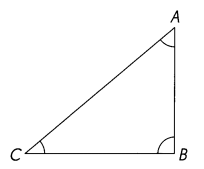
Measure the angles of the triangle. Then fill in the blanks.

Question 3.
Math in Focus Grade 5 Chapter 13 Practice 1 Answer Key Right, Isosceles, and Equilateral Triangles 3
m∠A _____
m∠B ______
m∠C ______
m∠A + m∠C ______
Answer:
m∠B = 90°

m∠C = 40°

m∠A = 50°
Explanation:
Sum of angles in a triangle are 180°
40 + 90 = 130
180 – 130 = 50
m∠A = 50°
m∠A + m∠C = 50° + 40° = 90°

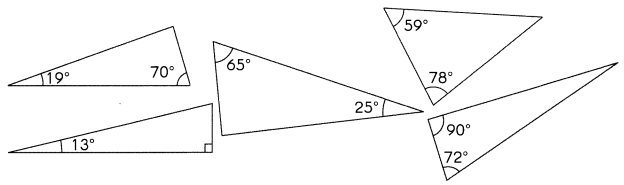
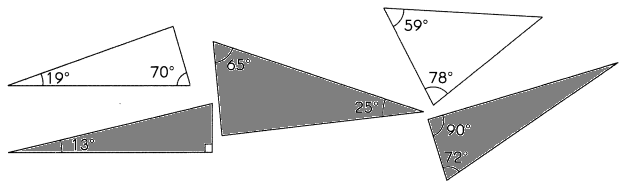
These triangles are not drawn to scale. Identify and shade the right triangles.

Question 4.
Math in Focus Grade 5 Chapter 13 Practice 1 Answer Key Right, Isosceles, and Equilateral Triangles 4
Answer:

Explanation:

Properties of Right – Angled Triangle
  • One angle of the triangle always measures 90°.
  • The hypotenuse is the longest side of the right-angle triangle.
  • The side that is opposite to the 90° angle is the hypotenuse.
  • The Sum of two interior angles of the right-angled triangle is always 90degree.

These triangles are not drawn to scale. Find the unknown angle measures.

Question 5.
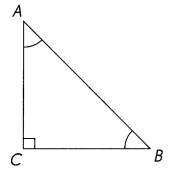
Find the sum of the measures of ∠A and ∠B.
Math in Focus Grade 5 Chapter 13 Practice 1 Answer Key Right, Isosceles, and Equilateral Triangles 5
Answer:
∠A  + ∠B = 90°
Explanation:
Properties of Right – Angled Triangle

  • One angle of the triangle always measures 90°.
  • The hypotenuse is the longest side of the right-angle triangle.
  • The side that is opposite to the 90° angle is the hypotenuse.
  • The Sum of two interior angles of the right-angled triangle is always 90degree.

Question 6.
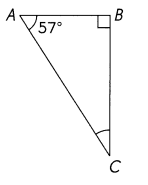
Find the measure of ∠C.
Math in Focus Grade 5 Chapter 13 Practice 1 Answer Key Right, Isosceles, and Equilateral Triangles 6
Answer:
33°
Explanation:
Properties of Right – Angled Triangle

  • The Sum of two interior angles of the right-angled triangle is always 90degree.
    So in right angle triangle, Sum of other two angles is 90°.
    So ∠C = 90 – 57 = 33

Question 7.
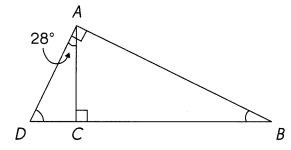
Find the measure of ∠ADC and ∠ABC.
Math in Focus Grade 5 Chapter 13 Practice 1 Answer Key Right, Isosceles, and Equilateral Triangles 7
Answer:
∠ADC =62°
∠ABC =28°
Explanation:
In Triangle DAB, ∠DAB =90°
In Triangle ABC, ∠ACB=90°
In Triangle ACD, ∠ACD=90°
and ∠DAC=28°
So ∠ADC = 180° -(∠ACD +∠DAC) = 180° -(90°+28°) = 180° -(118°) =62°
∠BAC = ∠DAB – ∠DAC = 90° -28° = 62°
∠ABC =180° -(∠ACB +∠BAC) = 180° -(90°+62°) = 180° -(152°) =28°

Question 8.
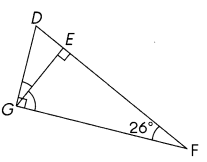
Find the measures of ∠EGF and ∠DGE.
Math in Focus Grade 5 Chapter 13 Practice 1 Answer Key Right, Isosceles, and Equilateral Triangles 8
Answer:
∠EGF  =64°
∠DGE = 26°
Explanation:
In Triangle DGF, ∠DGF=90°
In Triangle GEF, ∠GEF=90° and ∠EFG=26°
In Triangle DEG, ∠DEG=90°
So ∠EGF= 180° -(∠GEF+∠EFG) = 180° -(90°+26°) = 180° -(116°) =64°
∠DGE= ∠DGF- ∠EGF= 90° -64° = 26°
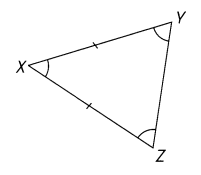
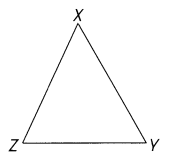
Complete. XYZ and PQR are isosceles triangles.

Question 9.
Math in Focus Grade 5 Chapter 13 Practice 1 Answer Key Right, Isosceles, and Equilateral Triangles 9
Which two sides are of equal length?
________
Which two angles have equal measures?
_________
Answer:
XY and XZ  sides are equal length.
∠Z and ∠Y angles have equal measures.
Explanation:

An Isosceles Triangle has the Following Properties:
  • It has two sides of equal length.
  • The angles opposite to equal sides are equal in measure

Question 10.
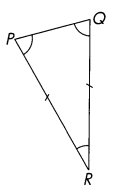
Math in Focus Grade 5 Chapter 13 Practice 1 Answer Key Right, Isosceles, and Equilateral Triangles 10
Which two sides are of equal length?
_________
Which two angles have equal measures?
________
Answer:
PR and QR sides are of equal length.
∠P and ∠Q angles have equal measures.
Explanation:
An Isosceles Triangle has the Following Properties:

  • It has two sides of equal length.
  • The angles opposite to equal sides are equal in measure

These triangles are not drawn to scale. Find the unknown angle measures.

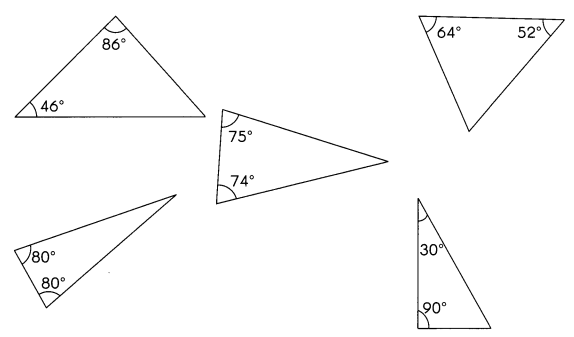
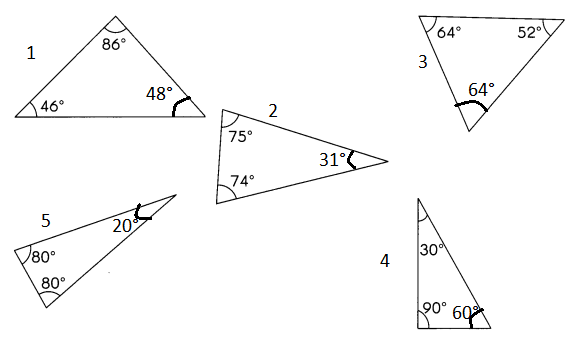
Question 11.
Math in Focus Grade 5 Chapter 13 Practice 1 Answer Key Right, Isosceles, and Equilateral Triangles 11
Answer:

Explanation:
The properties of a triangle are:

  • The sum of all internal angles of a triangle is always equal to 180°. This is called the angle sum property of a triangle. So,

1.  180 – (46 + 86) = 48
2. 180 – (75+74) = 31
3. 180  – (64 +52) = 64
4. 180 – (90 + 30 ) = 60
5. 180 – (80 + 80 ) = 20

These triangles are not drawn to scale. Find the unknown angle measures.

Question 12.
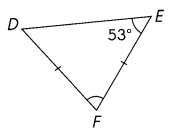
Find the measure of ∠F.
Math in Focus Grade 5 Chapter 13 Practice 1 Answer Key Right, Isosceles, and Equilateral Triangles 12
Answer:
∠F = 74°
Explanation:
The property of a triangle is : The sum of all internal angles of a triangle is always equal to 180°.
∠D + ∠F = 180 – 53 = 127 °

An Isosceles Triangle has the Following Property: The angles opposite to equal sides are equal in measure
So ∠D = ∠E Then ∠D = 53 °
then ∠F = 127 – 53 =74°

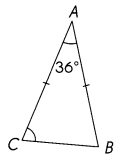
Question 13.
Find the measure of ∠C.
Math in Focus Grade 5 Chapter 13 Practice 1 Answer Key Right, Isosceles, and Equilateral Triangles 13
Answer:
∠C  =72°

Explanation:
The property of a triangle is: The sum of all internal angles of a triangle is always equal to 180°.
∠C + ∠B = 180 – 36 = 144°
An Isosceles Triangle has the Following Property: The angles opposite to equal sides are equal in measure
So ∠C = ∠B Then 144/2 =72°
then ∠C  =72°

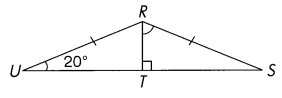
Question 14.
Find the measure of ∠TRS.
Math in Focus Grade 5 Chapter 13 Practice 1 Answer Key Right, Isosceles, and Equilateral Triangles 14
Answer:
∠TRS = 180 – (∠RST+∠RTS)=180 – (20+90) = 70°
Explanation:
Triangle URS is a Isosceles Triangle.
An Isosceles Triangle has the Following Property: The angles opposite to equal sides are equal in measure Then
∠U= ∠S = 20°
The property of a triangle is : The sum of all internal angles of a triangle is always equal to 180°.
In Triangle TRS ,
∠RST = 20°
∠RTS = 90°
∠TRS = 180 – (∠RST+∠RTS)=180 – (20+90) = 70°

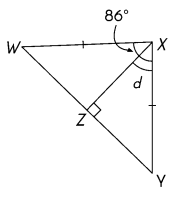
Question 15.
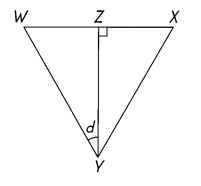
Find the measure of ∠d.
Math in Focus Grade 5 Chapter 13 Practice 1 Answer Key Right, Isosceles, and Equilateral Triangles 15
Answer:
∠d =  172°
Explanation:
Triangle WXY is a Isosceles Triangle.
An Isosceles Triangle has the Following Property: The angles opposite to equal sides are equal in measure Then
then ∠W= ∠Y
Triangle WXZ a Right angle Triangle.
then ∠WZX = 90°
∠WXZ=86°
The property of a triangle is : The sum of all internal angles of a triangle is always equal to 180°.
In Triangle WZX,
∠XWZ = 180 – (∠WZX+∠WXZ )=180 – (90+86) = 4°
In Triangle WXY , ∠W= ∠Y  = 4°
∠d = 180 – (4+4) = 172°

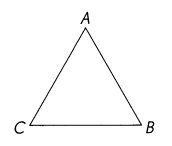
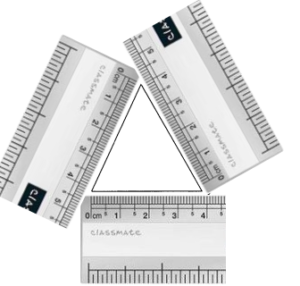
Complete. Use your protractor and centimeter ruler to measure the sides and angles. Which figure is an equilateral triangle? Check the box.

Question 16.
Math in Focus Grade 5 Chapter 13 Practice 1 Answer Key Right, Isosceles, and Equilateral Triangles 16
AB = __ cm
BC = __ cm
AC = ___ cm
m∠A = ___
m∠B = ___
m∠C = ____ Math in Focus Grade 5 Chapter 13 Practice 1 Answer Key Right, Isosceles, and Equilateral Triangles 17
Answer:

Question 17.
Math in Focus Grade 5 Chapter 13 Practice 1 Answer Key Right, Isosceles, and Equilateral Triangles 18
XY = __ cm
YZ = __ cm
XZ = ___ cm
m∠X = ___
m∠Y = ___
m∠Z = ____ Math in Focus Grade 5 Chapter 13 Practice 1 Answer Key Right, Isosceles, and Equilateral Triangles 17
Answer:

Explanation:
XY = 4 cm
YZ = 4 cm
XZ = 4 cm
m∠X = 60°
m∠Y = 60°
m∠Z = 60°
Explanation:
The angles and sides are equal

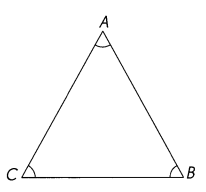
Complete. ABC is an equilateral triangle.

Math in Focus Grade 5 Chapter 13 Practice 1 Answer Key Right, Isosceles, and Equilateral Triangles 19

Question 18.
Which angles have measures equal to the measure of ∠A?
Answer:
∠A = ∠B = ∠C
Explanation:

Properties of an Equilateral Triangle
  • Three sides are equal.
  • Three angles are equal i.e 60° each.

Question 19.
Which sides have lengths equal to the length of \(\overline{A B}\)?
Answer:
\(\overline{A B}\)= \(\overline{B C}\) = \(\overline{A C}\)
Explanation:

Properties of an Equilateral Triangle
  • Three sides are equal.
  • Three angles are equal i.e 60° each.

Question 20.
What can you say about the angles of triangle ABC ?
Answer:
All angles are equal and 60° each.

Explanation:

Properties of an Equilateral Triangle
  • Three sides are equal.
  • Three angles are equal i.e 60° each.

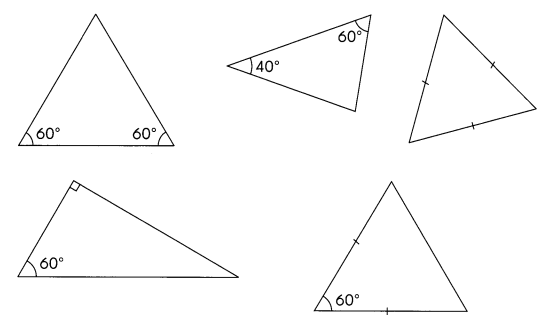
These triangles are not drawn to scale. Identify and shade the equilateral triangles.

Question 21.
Math in Focus Grade 5 Chapter 13 Practice 1 Answer Key Right, Isosceles, and Equilateral Triangles 20
Answer:

Explanation:
Properties of an Equilateral Triangle

  • Three sides are equal.
  • Three angles are equal i.e 60° each.

These triangles are not drawn to scale. Find the unknown angle measures.

Question 22.
Find the measure of ∠Q.
Math in Focus Grade 5 Chapter 13 Practice 1 Answer Key Right, Isosceles, and Equilateral Triangles 21
Answer:
∠Q = 60°
Explanation:
The property of a triangle is : The sum of all internal angles of a triangle is always equal to 180°.
∠Q  = 180 – ∠P + ∠R = 180 – 60 + 60 = 60°

Question 23.
Find the measures of ∠Y and ∠Z
Math in Focus Grade 5 Chapter 13 Practice 1 Answer Key Right, Isosceles, and Equilateral Triangles 22
Answer:
∠Y =∠Z= 60°
Explanation:
The property of a triangle is : The sum of all internal angles of a triangle is always equal to 180°.
∠Z + ∠Y  = 180 – ∠X  = 180 – 60  = 120°
As per diagram Triangle XYZ is a Isosceles Triangle.
An Isosceles Triangle has the Following Property: The angles opposite to equal sides are equal in measure Then
∠Y =∠Z
then ∠Y =∠Z= 120°/2 = 60°

These triangles are not drawn to scale. Find the unknown angle measures.

Question 24.
WX = XY = YW. Find the measure of ∠d.
Math in Focus Grade 5 Chapter 13 Practice 1 Answer Key Right, Isosceles, and Equilateral Triangles 23
Answer:
Explanation:
WX = XY = YW So Triangle WXY is a Equilateral Triangle So Three angles are equal
∠WXY = 60°
∠XWY= 60°
∠WYX= 60°
So In Triangle XYZ,
∠ZXY= 60°
∠XZY= 90°
∠XYZ= 180 – 90 + 60=30°
∠d = ∠WYX -∠XYZ  =60 – 30 =30°

Question 25.
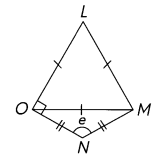
Find the measure of ∠e.
Math in Focus Grade 5 Chapter 13 Practice 1 Answer Key Right, Isosceles, and Equilateral Triangles 24
Answer:
∠e = 120°
Explanation:
∠LON = 90° given
As the triangle is equalateral the angles are equal
so the measure of ∠LOE = 60°
∠LMO = 60°
NOM triangle is an isosceles triangle
90 – 60 = 30°
∠MON = 30°
∠OMN = 30°
30° + 30° = 60°
180° – 60° = 120°
∠e = 120°

Question 26.
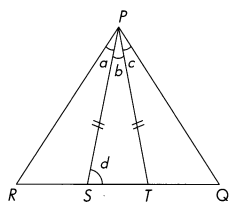
Triangle PQR is an equilateral triangle. Triangle PST is an isosceles triangle. The measures of ∠a, ∠b, and ∠c are the same. Find the measure of ∠d.
Math in Focus Grade 5 Chapter 13 Practice 1 Answer Key Right, Isosceles, and Equilateral Triangles 25
Answer:
∠d. = 80°
Explanation:
Triangle PQR is an equilateral triangle.
In equilateral triangle all angles are equal
sum of angles in a triangle are 180°
Triangle PST is an isosceles triangle.
The measures of ∠a, ∠b, and ∠c are the same.
so, ∠a, ∠b, and ∠c = 60°
20° + 20° + 20° = 60°
In isosceles triangle
The isosceles triangle property states that when two sides are equal, the base angles are also equal
so, 180° – 20° = 160°
80° + 80 °= 160°
∠d. = 80°

Math in Focus Grade 5 Chapter 13 Practice 4 Answer Key Triangle Inequalities

This handy Math in Focus Grade 5 Workbook Answer Key Chapter 13 Practice 4 Triangle Inequalities provides detailed solutions for the textbook questions.

Math in Focus Grade 5 Chapter 13 Practice 4 Answer Key Triangle Inequalities

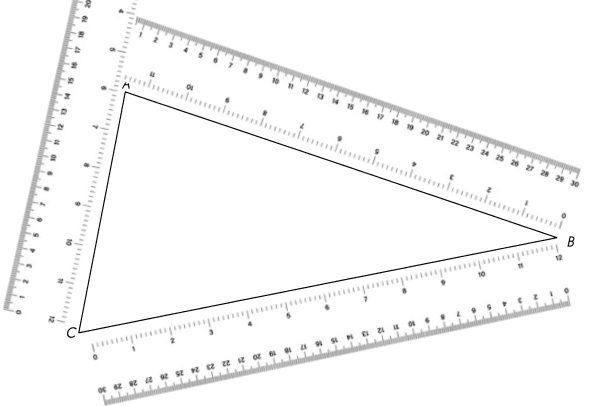
Complete. Measure the sides of the triangle to the nearest half-inch. Then fill in the blanks.

Math in Focus Grade 5 Chapter 13 Practice 4 Answer Key Triangle Inequalities 1
Explanation:

Question 1.
AB = _________ in.
Answer:
AB = 12 in.
Explanation:
With the help of ruler measured the length and updated

Question 2.
BC = _________ in.
Answer:
BC = 12 in.
Explanation:
With the help of ruler measured the length and updated

Question 3.
AC = ________ in.
Answer:
AC = 7 in.
Explanation:
With the help of ruler measured the length and updated

Question 4.
AB + BC = ________ in.
Answer:
AB + BC = 12 + 12 = 24 in.
Explanation:
With the help of ruler measured the length and updated
AB + BC = 12 + 12 = 24 in.

Question 5.
BC + AC = ________ in.
Answer: 12 + 7 = 19 in.
Explanation:
BC + AC =12 + 7 = 19 in.
With the help of ruler measured the length and updated

Question 6.
AB + AC = ________ in.
Answer:12 + 7 = 19 in.
Explanation:
AB + AC = 12 + 7 = 19 in.
With the help of ruler measured the length and updated

Use your answers ¡n Exercises 4 to 6. Fill ¡n the blanks with Yes or No.

Question 7.
Is AB + BC > AC? ______
Answer: Yes
Explanation:
AB + BC = 12 + 12 = 24
AC= 7
24 > 7

Question 8.
Is BC + AC > AB? ______
Answer: Yes
Explanation:
BC + AC = 12 + 7 = 19 in.
AB = 12 in.
19 > 7

Question 9.
Is AB + AC > BC? _______
Answer: Yes
Explanation:
AB + AC = 12 + 7 = 19 in.
BC = 12 in.
19 > 12

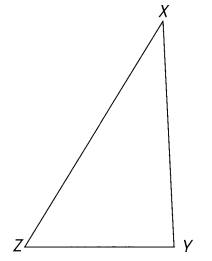
Complete. Measure the sides of the triangle to the nearest centimeter. Then fill in the blanks.

Math in Focus Grade 5 Chapter 13 Practice 4 Answer Key Triangle Inequalities 2
Explanation:

Question 10.
XY = ___ cm
Answer:
XY = 6 cm
Explanation:
With the help of ruler measured the length and updated

Question 11.
YZ = __ cm
Answer:
YZ = 4 cm
Explanation:
With the help of ruler measured the length and updated

Question 12.
XZ = __ cm
Answer:
XZ = 7 cm
Explanation:
With the help of ruler measured the length and updated

Question 13.
XY + YZ = __ cm
Answer:
XY + YZ = 6 + 4 = 10 cm
Explanation:
XY + YZ =6 + 4 = 10 cm
With the help of ruler measured the length and updated

Question 14.
YZ + XZ = __ cm
Answer:
YZ + XZ = 4 + 7 = 11 cm
Explanation:
YZ + XZ = 4 + 7 = 11 cm
With the help of ruler measured the length and updated

Question 15.
XY + XZ = __ cm
Answer:
XY + XZ = 6 + 7 = 13 cm
Explanation:
XY + XZ = 6 + 7 = 13 cm
With the help of ruler measured the length and updated

Use your answers in Exercises 10 to 15. Write the sides of the triangle to make the inequalities true.

Question 16.
XY + YZ > ______
Answer:
XY + YZ > XZ
Explanation:
XY + YZ > XZ
XY + YZ = 6 + 4 = 10 cm
XZ = 7
10 > 7

Question 17.
YZ + XZ > ______
Answer:
YZ + XZ > XY
Explanation:
YZ + XZ > XY
YZ + XZ = 4 + 7 = 11 cm
XY = 6
11 > 6

Question 18.
XY + XZ > ___
Answer:
XY + XZ > YZ
Explanation:
XY + XZ > YZ
XY + XZ = 6 + 7 = 13 cm
YZ = 4
13 > 4

Show whether it is possible to form triangles with these lengths.

Question 19.
6 in., 8 in., 12 in.
Answer:
Yes
Explanation:
6+ 8 > 12
6 + 12 > 8
12 + 8 > 6
sum of two sides should be greater than other side. so its possible to form triangle.

Question 20.
9 in., 13 in., 3 in.
Answer:
No
Explanation:
9 + 13 > 3
13  + 3  > 9
9  + 3 <   13 – sum of two sides should be greater than other side. so not possible to form triangle.

Question 21.
2 cm, 4 cm, 7 cm
Answer:
No
Explanation:
2 + 4 < 7
– sum of two sides should be greater than other side. so not possible to form triangle.

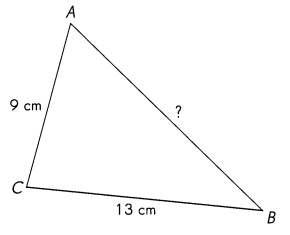
The lengths of two sides of each triangle are given. Name a possible length for the third side. The lengths are in whole centimeters or whole inches.

Question 22.
Math in Focus Grade 5 Chapter 13 Practice 4 Answer Key Triangle Inequalities 3
AB is greater than 10 centimeters. A possible length for \(\overline{A B}\) is
____ centimeters.
Answer:
15 centimeters
Explanation:
the sum of any 2 sides of a triangle must be greater than the measure of the third side.
13 + 9 > 15
13 + 15  > 9
15 + 9 > 13

Question 23.
Math in Focus Grade 5 Chapter 13 Practice 4 Answer Key Triangle Inequalities 4
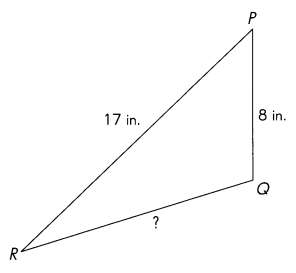
QR is greater than 9 inches. A possible length for \(\overline{Q R}\) is
____________ inches.
Answer:
11 inches
Explanation:
the sum of any 2 sides of a triangle must be greater than the measure of the third side.
17 + 8 > 11
17 + 11  > 8
8  + 11  > 17

Solve.

Question 24.
In the triangle EFG, EF = 21 centimeters, FG = 11 centimeters. The length of \(\overline{E G}\) is in whole centimeters and is greater than 25 centimeters. What is a possible length of \(\overline{E G}\) ?
Answer:  \(\overline{E G}\)  = 26 centimeters
Explanation:
the sum of any 2 sides of a triangle must be greater than the measure of the third side.
21 + 11 > 26
21 + 26  > 11
26  + 11  > 21

Math in Focus Grade 5 Chapter 13 Practice 5 Answer Key Parallelogram, Rhombus, and Trapezoid

This handy Math in Focus Grade 5 Workbook Answer Key Chapter 13 Practice 5 Parallelogram, Rhombus, and Trapezoid provides detailed solutions for the textbook questions.

Math in Focus Grade 5 Chapter 13 Practice 5 Answer Key Parallelogram, Rhombus, and Trapezoid

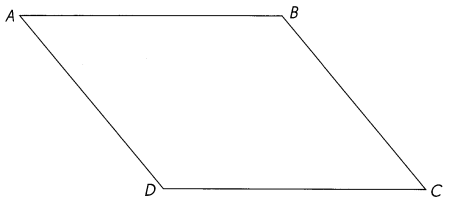
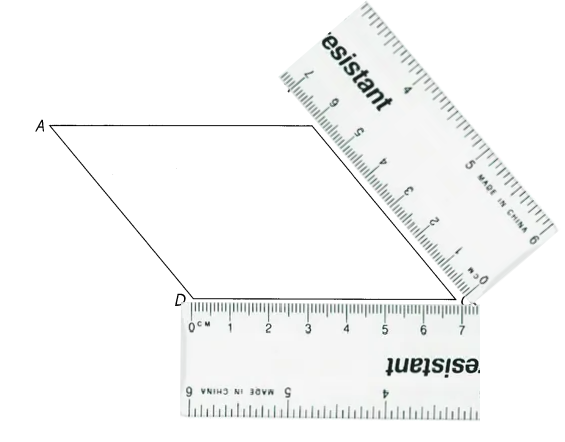
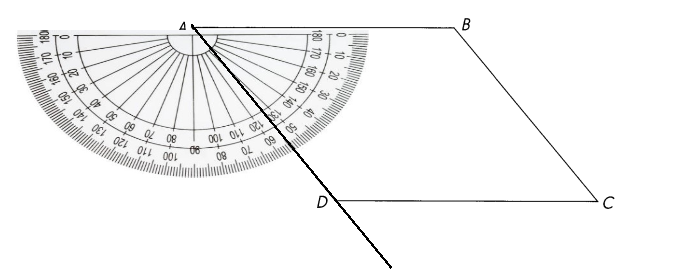
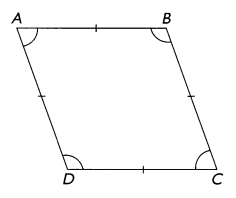
Complete. Figure ABCD is a parallelogram. Measure the sides and angles of the figure.

Math in Focus Grade 5 Chapter 13 Practice 5 Answer Key Parallelogram, Rhombus, and Trapezoid 1
Explanation:

Question 1.
AD = ___ cm
Answer: AD = 6 cm
Explanation:
Property of a Parallelogram:

  • Opposite sides are equal and parallel.

Question 2.
AB _______ cm
Answer:
AB = 7 cm
Explanation:
Property of a Parallelogram:

  • Opposite sides are equal and parallel.

Question 3.
BC = __ cm
Answer:
BC = 6 cm
Explanation:
Property of a Parallelogram:

  • Opposite sides are equal and parallel.

Question 4.
DC = ______ cm
Answer:
DC = 7 cm
Explanation:
Property of a Parallelogram:

  • Opposite sides are equal and parallel.

Question 5.
m∠A = ____
Answer:
m∠A = 55°
Explanation:
Property of a Parallelogram:

  • Opposite angles are equal.

Question 6.
m∠B = ___
Answer:
m∠B = 120°

Explanation:
Property of a Parallelogram:

  • Opposite angles are equal.

Question 7.
m∠C = ___
Answer:
m∠C = 55°

Explanation:
Property of a Parallelogram:

  • Opposite angles are equal.

Question 8.
m∠D = ___
Answer:
m∠D = 120°

Explanation:
Property of a Parallelogram:

  • Opposite angles are equal.

Question 9.
Name the parallel sides of the figure. ______
Answer:
\(\overline{A B}\) || \(\overline{D C}\)
\(\overline{A D}\) || \(\overline{B C}\)

Question 10.
Name the opposite angles that are equal. ______
Answer:
m∠A = m∠C
m∠B = m∠D

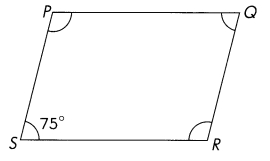
This parallelogram is not drawn to scale. Fill in the blanks.
Math in Focus Grade 5 Chapter 13 Practice 5 Answer Key Parallelogram, Rhombus, and Trapezoid 2

Question 11.
m∠Q = m∠___
= _____
Answer:
m∠Q = m∠S = 75°

Explanation:
Property of a Parallelogram:

  • Opposite angles are equal.

Question 12.
m∠P = 180° – ___
= ____
Answer:
m∠P = 180° – m∠S =180° – 75° = 105°

Explanation:
Property of a Parallelogram:

  • Sum of any two adjacent angles is 180°

Question 13.
m∠R = m∠___
= ____
Answer:
m∠R = m∠P =  105°

Explanation:
Property of a Parallelogram:

  • Opposite angles are equal.

These parallelograms are not drawn to scale. Find the unknown angle measures.

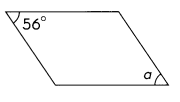
Question 14.
Math in Focus Grade 5 Chapter 13 Practice 5 Answer Key Parallelogram, Rhombus, and Trapezoid 3
Answer:
m∠a =  56°
Explanation:
Property of a Parallelogram:

  • Opposite angles are equal.
    m∠a =  56°

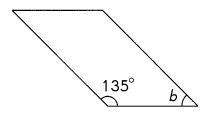
Question 15.
Math in Focus Grade 5 Chapter 13 Practice 5 Answer Key Parallelogram, Rhombus, and Trapezoid 4
Answer:
m∠b = 45°

Explanation:
Property of a Parallelogram:

  • Sum of any two adjacent angles is 180°
    m∠b = 180-135 =45°

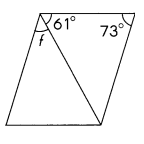
Question 16.
Math in Focus Grade 5 Chapter 13 Practice 5 Answer Key Parallelogram, Rhombus, and Trapezoid 5
Answer:
m∠f = 46°

Explanation:
Property of a Parallelogram:

  • Sum of any two adjacent angles is 180°
    180-73=107°
    m∠f = 107 – 61 =46°

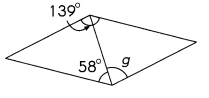
Question 17.
Math in Focus Grade 5 Chapter 13 Practice 5 Answer Key Parallelogram, Rhombus, and Trapezoid 6
Answer:
m∠g =  81°
Explanation:
Property of a Parallelogram:

  • Opposite angles are equal.
    So opposite angle is 139°
    m∠g =  139 -58 = 81°

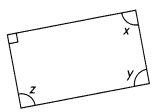
Question 18.
Math in Focus Grade 5 Chapter 13 Practice 5 Answer Key Parallelogram, Rhombus, and Trapezoid 7
Answer:
m∠x = 90°
m∠y = 90°
m∠z = 90°

Property of a Parallelogram:

  • Opposite angles are equal.
  • Sum of any two adjacent angles is 180°
    m∠y = 90°
    m∠x = 180 -90° =90°
    m∠z = m∠x = 90°

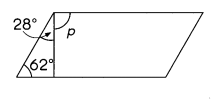
Question 19.
Math in Focus Grade 5 Chapter 13 Practice 5 Answer Key Parallelogram, Rhombus, and Trapezoid 9
Answer:
m∠p = 90°

Property of a Parallelogram:

  • Sum of any two adjacent angles is 180°
    m∠p = 180-62+28= 90°

Complete. Write the name of another side or angle of each rhombus.

Question 20.
AB = BC
= ___ = ____
Answer:

Math in Focus Grade 5 Chapter 13 Practice 5 Answer Key Parallelogram, Rhombus, and Trapezoid 10
AB = BC= CD= DA
Explanation:
property of a Rhombus:

  • All sides are equal and, opposite sides are parallel to each other.
    AB = BC= CD= DA

Question 21.
m∠B = m∠______
Answer:
m∠B = m∠D
Explanation:
property of a Rhombus:

  • Opposite angles are equal.
    m∠B = m∠D

Question 22.
m∠A = m∠____
Answer:
m∠A = m∠C
Explanation:
property of a Rhombus:

  • Opposite angles are equal.
    m∠A = m∠C
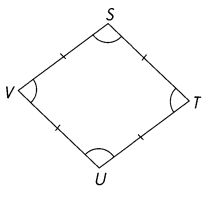
    Math in Focus Grade 5 Chapter 13 Practice 5 Answer Key Parallelogram, Rhombus, and Trapezoid 11

Question 23.
UV = _______
= ___ = ___
Answer:
UV = VS= ST = TU

Explanation:
property of a Rhombus:

  • All sides are equal and, opposite sides are parallel to each other.
    UV = VS= ST = TU

Question 24.
m∠S = m∠____
Answer:

Math in Focus Grade 5 Chapter 13 Practice 5 Answer Key Parallelogram, Rhombus, and Trapezoid 11
m∠S = m∠U

Explanation:
property of a Rhombus:

  • Opposite angles are equal.
    m∠S = m∠U

Question 25.
m∠T = m∠______
Answer:
m∠T = m∠V

Explanation:
property of a Rhombus:

  • Opposite angles are equal.
    m∠T = m∠V

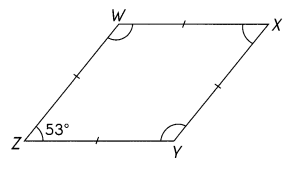
This rhombus is not drawn to scale. Fill in the blanks.

Math in Focus Grade 5 Chapter 13 Practice 5 Answer Key Parallelogram, Rhombus, and Trapezoid 12

Question 26.
m∠X = m∠__ = ____
Answer:
m∠X = m∠Z= 53°

Explanation:
property of a Rhombus:

  • Opposite angles are equal.
    m∠X = m∠Z= 53°

Question 27.
m∠W = ____ – ___ = ____
Answer:
m∠W = 180 – 53° = 127°

Explanation:
property of a Rhombus:

  • Sum of any two adjacent angles is 180°
    m∠W = 180 – m∠Z = 180 – 53° = 127°

Question 28.
m∠Y = m∠___ = ____
Answer:
m∠Y = m∠W = 127°

Explanation:
property of a Rhombus:

  • Opposite angles are equal.
    m∠Y = m∠W = 127°

These rhombuses are not drawn to scale. Find the unknown angle measures.

Question 29.
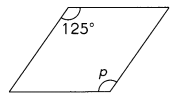
Math in Focus Grade 5 Chapter 13 Practice 5 Answer Key Parallelogram, Rhombus, and Trapezoid 13
Answer:
m∠p =  125°

Explanation:
property of a Rhombus:

  • Opposite angles are equal.
    m∠p= 125°

Question 30.
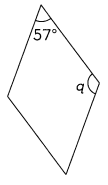
Math in Focus Grade 5 Chapter 13 Practice 5 Answer Key Parallelogram, Rhombus, and Trapezoid 14
Answer:
m∠q = 180 – 57° = 123°

Explanation:
property of a Rhombus:

  • Sum of any two adjacent angles is 180°
    m∠q = 180 – 57° = 123°

Question 31.
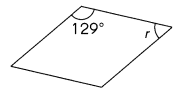
Math in Focus Grade 5 Chapter 13 Practice 5 Answer Key Parallelogram, Rhombus, and Trapezoid 15
Answer:

m∠r = 180 – 129° = 51°

Explanation:
property of a Rhombus:

  • Sum of any two adjacent angles is 180°
    m∠r = 180 – 129° = 51°

Question 32.
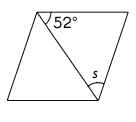
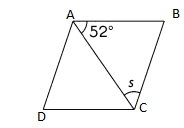
Math in Focus Grade 5 Chapter 13 Practice 5 Answer Key Parallelogram, Rhombus, and Trapezoid 16
Answer:
m∠s =  52°

Explanation:

property of a Rhombus:
  • All sides are equal and, opposite sides are parallel to each other.
    AB=BC=CD=DA

then in Triangle ABC AB= BC. then it is isosceles Triangle .
The isosceles triangle property states that when two sides are equal, the base angles are also equal.
So, m∠s =  52°

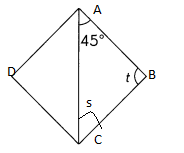
Question 33.
Math in Focus Grade 5 Chapter 13 Practice 5 Answer Key Parallelogram, Rhombus, and Trapezoid 17
Answer:
m∠t =  90°

Explanation:

property of a Rhombus:
  • All sides are equal and, opposite sides are parallel to each other.
    AB=BC=CD=DA

then in Triangle ABC AB= BC. then it is isosceles Triangle .
The isosceles triangle property states that when two sides are equal, the base angles are also equal.
So, m∠s =  45°
in triangle sum of three angles is 180°
So, m∠t = 180 -45+  45° = 90°

Question 34.
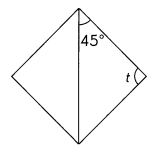
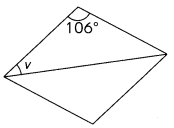
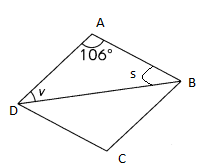
Math in Focus Grade 5 Chapter 13 Practice 5 Answer Key Parallelogram, Rhombus, and Trapezoid 18
Answer:
m∠s =  37°

Explanation:

in triangle ABC  sum of three angles is 180°
m∠s  + m∠v = 180°- 106°=  74°

property of a Rhombus:
  • All sides are equal and, opposite sides are parallel to each other.
    AB=BC=CD=DA

then in Triangle ABC AB= BC. then it is isosceles Triangle .
The isosceles triangle property states that when two sides are equal, the base angles are also equal.
So, m∠s =m∠v  =  74° divided by 2 = 37°

Measure the unknown angles. Then fill in the blanks. ABCD is a trapezoid where \(\overline{A B}\) || \(\overline{D C}\).
Math in Focus Grade 5 Chapter 13 Practice 5 Answer Key Parallelogram, Rhombus, and Trapezoid 19

Question 35.
m∠A = ____
Answer:

Question 36.
m∠B = ___
Answer:
m∠B = 110

Question 37.
m∠C = ____
Answer:
m∠C = 70

Question 38.
m∠D = ___
Answer:
m∠D = 80

Question 39.
m∠A + m∠D = m∠___ + m∠___ = ____
Answer:
m∠A + m∠D = m∠100+ m∠80= 180
Supplementary angles = 180°

These trapezoids are not drawn to scale. Find the unknown angle measures.

Question 40.
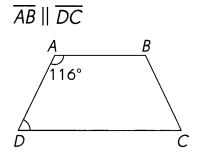
Math in Focus Grade 5 Chapter 13 Practice 5 Answer Key Parallelogram, Rhombus, and Trapezoid 20
Answer:
m∠A  = m∠116°
m∠D = m∠64°
m∠D  = 180 – 116
= 64°
Explanation:
Supplementary angles = 180°
m∠64° + m∠116° = 180°

Trapezium and Its Properties
  • Angle: The sum of angles in a trapezoid-like other quadrilateral is 360°. …
  • Two angles on the same side are supplementary, that is the sum of the angles of two adjacent sides is equal to 180°.

Question 41.
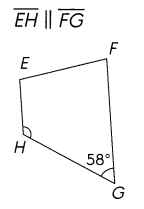
Math in Focus Grade 5 Chapter 13 Practice 5 Answer Key Parallelogram, Rhombus, and Trapezoid 21
Answer:
m∠G = m∠58°
m∠F = m∠122°
m∠F  = 180 – 58 = 122
Explanation:
Supplementary angles = 180°
m∠58° + m∠122° = 180°

Question 42.
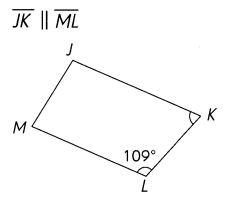
Math in Focus Grade 5 Chapter 13 Practice 5 Answer Key Parallelogram, Rhombus, and Trapezoid 22
Answer:
m∠L = m∠109°
m∠K = m∠71°
m∠K  = 180 – 109 = 71
Explanation:
Supplementary angles = 180°
m∠71° + m∠109° = 180°

Question 43.
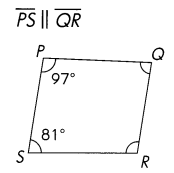
Math in Focus Grade 5 Chapter 13 Practice 5 Answer Key Parallelogram, Rhombus, and Trapezoid 23
Answer:
m∠P = m∠97°
m∠Q = m∠83°
m∠Q  = 180 – 97 = 83°
Explanation:
Supplementary angles = 180°
m∠83° + m∠97° = 180°
Explanation:
m∠S = m∠81°
m∠R = m∠99°
m∠R  = 180 – 81 = 99°
Explanation:
Supplementary angles = 180°
m∠81° + m∠99° = 180°

These trapezoids are not drawn to scale. Find the unknown angle measures.

Question 44.
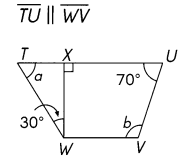
Math in Focus Grade 5 Chapter 13 Practice 5 Answer Key Parallelogram, Rhombus, and Trapezoid 24
Answer:
m∠a = 60°
Explanation:
m∠w = 30°
m∠x = 90
90 + 30 = 120
m∠a = 180 – 120 = 60°
Sum of the angles of a triangle = 180°
m∠b = 110°
m∠u = 70° given
m∠u + m∠b  = 180°
180 – 70 = 110°
110 + 70 = 180°
Supplementary angles = 180°

Question 45.
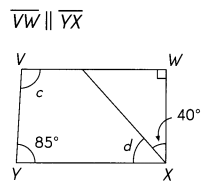
Math in Focus Grade 5 Chapter 13 Practice 5 Answer Key Parallelogram, Rhombus, and Trapezoid 25
Answer:
∠d = 55°
∠c = 90°
Explanation:
In quadrilateral the sum of angles = 360°
∠w = 90°
∠Y = 85°
YX = 180°
85° + 40° = 125°
180° – 125° = 55°
∠d = 55°
125° + 55° + 90° = 270°
360° – 270° = 90°
∠c = 90°

Question 46.
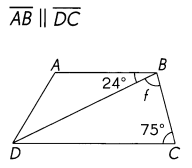
Math in Focus Grade 5 Chapter 13 Practice 5 Answer Key Parallelogram, Rhombus, and Trapezoid 26
Answer:
Explanation:

Question 47.
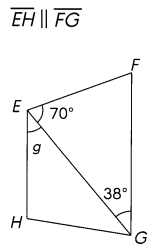
Math in Focus Grade 5 Chapter 13 Practice 5 Answer Key Parallelogram, Rhombus, and Trapezoid 27
Answer:
Explanation:
The sum of angles in a triangle = 180
70 + 38 = 98
180 – 98 = 82

Math in Focus Grade 2 Chapter 3 Practice 3 Answer Key Subtraction with Regrouping in Tens and Ones

Go through the Math in Focus Grade 2 Workbook Answer Key Chapter 3 Practice 3 Subtraction with Regrouping in Tens and Ones to finish your assignments.

Math in Focus Grade 2 Chapter 3 Practice 3 Answer Key Subtraction with Regrouping in Tens and Ones

Regroup the tens and ones. Then subtract.

Question 1.
Math in Focus Grade 2 Chapter 3 Practice 3 Answer Key Subtraction with Regrouping in Tens and Ones 1
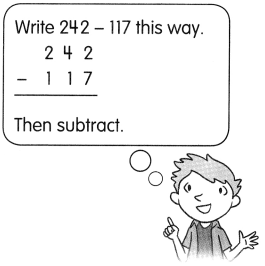
242 – 117 = ?
242 – 117
= 2 hundreds 4 tens 2 ones – 1 hundred 1 ten 7 ones
= 2 hundreds 3 tens _________ ones – 1 hundred 1 ten 7 ones
= ________ hundred ________ tens ________ ones
= _____
242 – 117 = ____
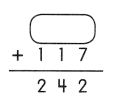
Math in Focus Grade 2 Chapter 3 Practice 3 Answer Key Subtraction with Regrouping in Tens and Ones 2
Use addition to check your answer.
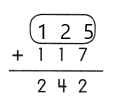
Answer:
242 – 117 = 125,
117+125 = 242.

Explanation:
Given that 242 – 117 which is 125. So to check the answer we will perform addition, which is
117+125 = 242.
= 2 hundreds 4 tens 2 ones – 1 hundred 1 ten 7 ones
= 2 hundreds 3 tens 12 ones – 1 hundred 1 ten 7 ones
= 1 hundred 2 tens 5 ones
= 125.
Math-in-Focus-Grade-2-Chapter-3-Practice-3-Answer-Key-Subtraction-with-Regrouping-in-Tens-and-Ones-2-1

Question 2.
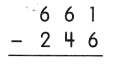
Math in Focus Grade 2 Chapter 3 Practice 3 Answer Key Subtraction with Regrouping in Tens and Ones 3
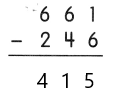
Answer:
661-246 = 415,
415+246 = 661.

Explanation:
Given that 661-246 which is 415. So to check the answer we will perform addition, which is
415+246 = 661.
Math-in-Focus-Grade-2-Chapter-3-Practice-3-Answer-Key-Subtraction-with-Regrouping-in-Tens-and-Ones-3-1

Question 3.
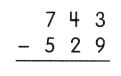
Math in Focus Grade 2 Chapter 3 Practice 3 Answer Key Subtraction with Regrouping in Tens and Ones 4
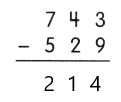
Answer:
743-529 = 214,
214+529 = 743.

Explanation:
Given that 743-529 which is 214. So to check the answer we will perform addition, which is
214+529 = 743.
Math-in-Focus-Grade-2-Chapter-3-Practice-3-Answer-Key-Subtraction-with-Regrouping-in-Tens-and-Ones-4-1

Question 4.
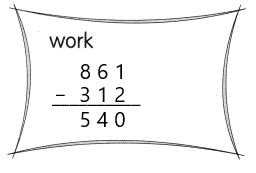
861 – 312 = ___
Math in Focus Grade 2 Chapter 3 Practice 3 Answer Key Subtraction with Regrouping in Tens and Ones 5
Answer:
861-312 = 540,
312+540 = 861.

Explanation:
Given that 861-312 which is 540. So to check the answer we will perform addition, which is
312+540 = 861.
Math-in-Focus-Grade-2-Chapter-3-Practice-3-Answer-Key-Subtraction-with-Regrouping-in-Tens-and-Ones-5-1

Question 5.
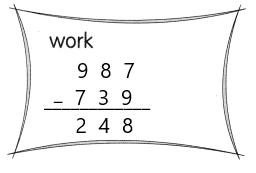
987 – 739 = ___
Math in Focus Grade 2 Chapter 3 Practice 3 Answer Key Subtraction with Regrouping in Tens and Ones 6
Answer:
987-739 = 248,
248+739 = 987.

Explanation:
Given that 987-739 which is 248. So to check the answer we will perform addition, which is
248+739 = 987.
Math-in-Focus-Grade-2-Chapter-3-Practice-3-Answer-Key-Subtraction-with-Regrouping-in-Tens-and-Ones-5-2

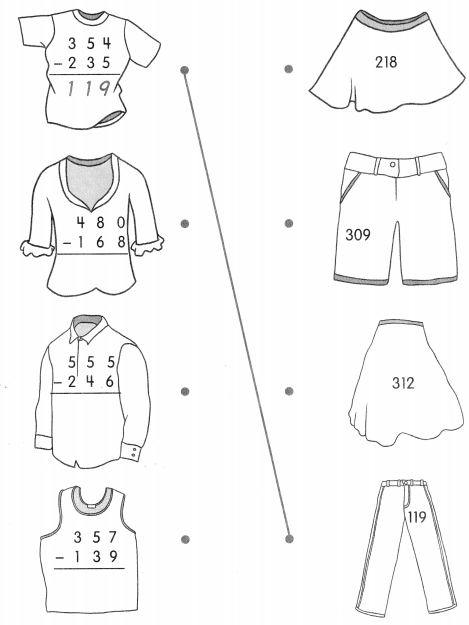
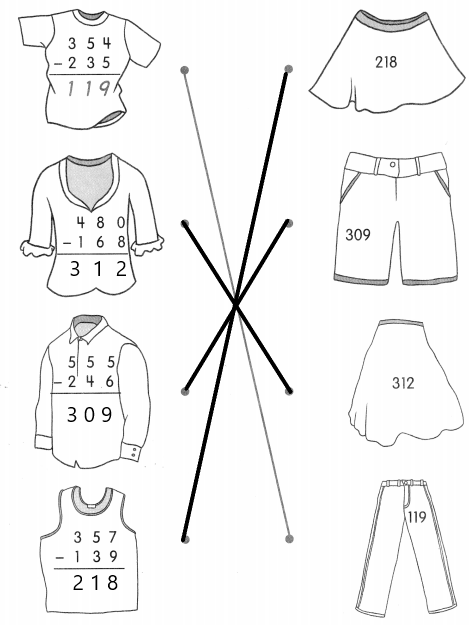
Question 6.
Subtract and match. The first one is done for you.
Math in Focus Grade 2 Chapter 3 Practice 3 Answer Key Subtraction with Regrouping in Tens and Ones 7
Answer:
Math-in-Focus-Grade-2-Chapter-3-Practice-3-Answer-Key-Subtraction-with-Regrouping-in-Tens-and-Ones-7-1

Math in Focus Grade 2 Chapter 4 Practice 4 Answer Key Real-World Problems: Two-Step Problems

Go through the Math in Focus Grade 2 Workbook Answer Key Chapter 4 Practice 4 Real-World Problems: Two-Step Problems to finish your assignments.

Math in Focus Grade 2 Chapter 4 Practice 4 Answer Key Real-World Problems: Two-Step Problems

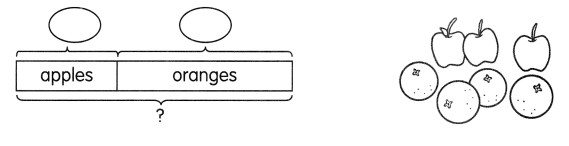
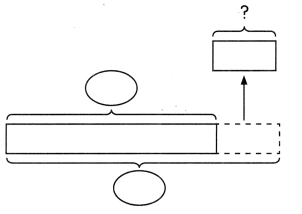
Solve.

Complete the bar models to help you.

Question 1.
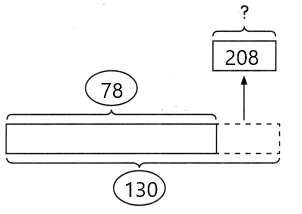
Mr. Kim has 78 boxes of apples and 130 boxes of oranges. He sells some boxes of oranges. Now he has 159 boxes of apples and oranges left.
a. How many boxes of apples and oranges did Mr. Kim have at first?

b. How many boxes of oranges did Mr. Kim sell?

Math in Focus Grade 2 Chapter 4 Practice 4 Answer Key Real-World Problems Two-Step Problems 1

Answer:
a. Kim has 208 boxes of apples and oranges at first.
b. The number of boxes of oranges is 130-49 which is 81 boxes.

Explanation:
Given that Mr. Kim has 78 boxes of apples and 130 boxes of oranges. So the total number of boxes of apples and oranges is 78+130 which is 208 boxes. So Kim has 208 boxes of apples and oranges at first. As he sells some boxes of oranges and now he has 159 boxes of apples and oranges left. So the number of boxes of oranges did Mr. Kim sells is 208-159 which is 49 boxes are remaining. So the number of boxes of oranges is 130-49 which is 81 boxes.
Math-in-Focus-Grade-2-Chapter-4-Practice-4-Answer-Key-Real-World-Problems-Two-Step-Problems-1-1

a. Mr. Kim had ___ boxes of apples and oranges at first.

Math in Focus Grade 2 Chapter 4 Practice 4 Answer Key Real-World Problems Two-Step Problems 2

Answer:
Mr. Kim has 78 boxes of apples and 130 boxes of oranges.

Explanation:
Mr. Kim has 78 boxes of apples and 130 boxes of oranges.
Math-in-Focus-Grade-2-Chapter-4-Practice-4-Answer-Key-Real-World-Problems-Two-Step-Problems-2-1

b. Mr. Kim sold ___ boxes of oranges.

Answer:
Mr. Kim sold 81 boxes of oranges.

Solve.

Complete the bar models to help you.

Question 2.
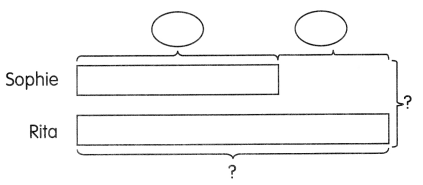
Sophie has 356 stamps in her collection. Rita has 192 stamps more than Sophie.
Math in Focus Grade 2 Chapter 4 Practice 4 Answer Key Real-World Problems Two-Step Problems 3

a. How many stamps does Rita have?
Answer:
Rita has 548 stamps.

Explanation:
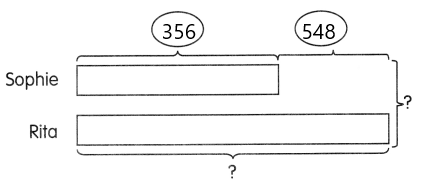
Given that Sophie has 356 stamps in her collection and Rita has 192 stamps more than Sophie. So the number of stamps does Rita has is 356+192 which is 548 stamps.

b. How many stamps do they have in all?
Math in Focus Grade 2 Chapter 4 Practice 4 Answer Key Real-World Problems Two-Step Problems 4

a. Rita has ____ stamps.

Answer:
Rita has 548 stamps.

Explanation:
Rita has 548 stamps.
Math-in-Focus-Grade-2-Chapter-4-Practice-4-Answer-Key-Real-World-Problems-Two-Step-Problems-4-1

b. They have ___ stamps in all.

Answer:
They have 904 stamps in all.

Explanation:
Sophie has 356 stamps and Rita has 548 stamps. So the total stamps they have is 356+548 which is 904 stamps.

Solve.

Draw bar models to help you.

Question 3.
Kennedy Elementary School has 784 students. 325 students are boys.

a. How many girls are in the school?

b. How many more girls than boys are in the school?

a. ____ girls are in the school.

b. ___ more girls are in the school than boys.

Answer:
a. 459 girls are in the school.
b. 134 more girls are in the school than boys.

Explanation:
Given that Kennedy Elementary School has 784 students and 325 students are boys. So the number of girls is 784-325 which is 459 girls. So the number of girls more in the school than boys is 459-325 which is 134 girls more.

Solve.

Draw bar models to help you.

Question 4.
Club A has 235 male members, and 172 female members. 45 new members join the club.

a. How many members were in the club at first?

b. How many members are in the club now?

a. ____ members were in the club at first.

b. ___ members are in the club now.

Answer:
a. 407 members were in the club at first.
b. 452 members are in the club now.

Explanation:
Given that Club A has 235 male members and 172 female members and 45 new members join the club. So the number of members who were in the club at first is 235+172 which is 407 members. And the number of members are in the club now is 407+45 which is 452 members.

Question 5.
Kate’s grandmother had $245. She spends $78. Then she gives $36 to Kate. How much money does Kate’s grandmother have now?
Math in Focus Grade 2 Chapter 4 Practice 4 Answer Key Real-World Problems Two-Step Problems 5
She has ___ now.
Answer:
She has 131 now.

Explanation:
Given that Kate’s grandmother had $245 and she spends $78 which is $167 and then she gives $36 to Kate. So $167-$36 which is $131.

Solve.

Draw bar models to help you.

Question 6.
There are 147 daisy plants and 32 tulip plants in Nursery X. Nursery Y has 66 fewer daisy and tulip plants than Nursery X. How many daisy and tulip plants are there in Nursery Y?
There are ____ daisy and tulip plants in Nursery Y.
Answer:
There are 113 daisy and tulip plants in Nursery Y.

Explanation:
Given that there are 147 daisy plants and 32 tulip plants in Nursery X, so the total number of plants is 147+32 which is 179 plants and Nursery Y has 66 fewer daisy which is 179-66 = 113 daisy and tulip plants than Nursery X.

Math in Focus Grade 3 Chapter 16 Practice 1 Answer Key Telling Time

This handy Math in Focus Grade 3 Workbook Answer Key Chapter 16 Practice 1 Telling Time provides detailed solutions for the textbook questions.

Math in Focus Grade 3 Chapter 16 Practice 1 Answer Key Telling Time

Tell the time. Use past.

Example
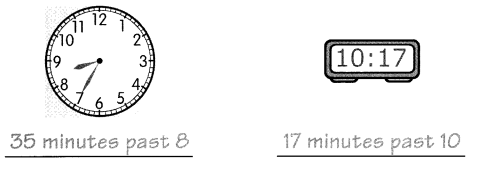
Math in Focus Grade 3 Chapter 16 Practice 1 Answer Key Telling Time 1

Question 1.
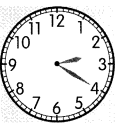
Math in Focus Grade 3 Chapter 16 Practice 1 Answer Key Telling Time 2
Answer: Twenty minutes past 2.
A Clock is a circular device provided with three hands viz. an hour hand, minute and second hand. The study of the clock is known as “horology”.
First of all, we need to learn the definition of time: In math, time can be defined as the ongoing and continuous sequence of events that occur in succession, from the past through the present to the future. Time is used to quantify, measure or compare the duration of events or the intervals between them, and even, sequence events.
We measure time in seconds, minutes, hours, days, weeks, months and years with clocks and calendars.
– The shorthand is the hour hand.
– The long hand is a minute hand.
In the given question, the shorthand is on 2. And the long hand is on 4.
Now we can say the time is 2 hours 20 minutes. In another, we can say twenty minutes past 2.
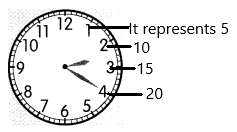
Math in Focus Grade 3 Chapter 16 Practice 1 Answer Key Telling Time q1

Question 2.
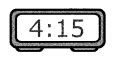
Math in Focus Grade 3 Chapter 16 Practice 1 Answer Key Telling Time 3
Answer: 15 minutes past 4.
This can be represented in the below diagram:
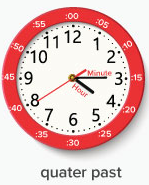
Math in Focus Grade 3 Chapter 16 Practice 1 Answer Key Telling Time q2

We measure time in seconds, minutes, hours, days, weeks, months and years with clocks and calendars.
– The shorthand is the hour hand.
– The long hand is a minute hand.
In the given question, the shorthand is on 4. And the long hand is on 3.
Now we can say the time is 4 hours 15 minutes. In another, we can say fifteen minutes past 4.

Question 3.
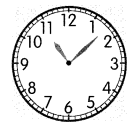
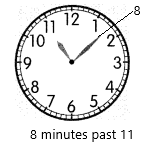
Math in Focus Grade 3 Chapter 16 Practice 1 Answer Key Telling Time 4
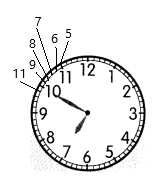
Answer: 8 minutes past 11
Math in Focus Grade 3 Chapter 16 Practice 1 Answer Key Telling Time q3
Count the small hands in between 1 and 2 which represents the minutes.
1 represents 5.
2 represents 10.
In between 5 and 10, there are 6, 7, 8, 9 hands also there. That I represented in the above diagram.

Tell the time. Use to.

Example
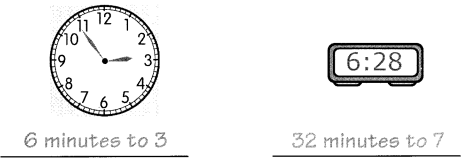
Math in Focus Grade 3 Chapter 16 Practice 1 Answer Key Telling Time 5

Question 4.
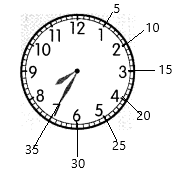
Math in Focus Grade 3 Chapter 16 Practice 1 Answer Key Telling Time 6
Answer: 35 minutes to 8
Explanation:
Math in Focus Grade 3 Chapter 16 Practice 1 Answer Key Telling Time q4
The shorthand represents the hour.
The long hand represents minutes.
The shorthand is on 8 and the long hand is on 7.
In the clock 7 represents 35. So the answer is 35 minutes to 8.

Question 5.
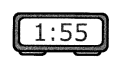
Math in Focus Grade 3 Chapter 16 Practice 1 Answer Key Telling Time 7
Answer: 5 minutes to 2.
Explanation: The minute hand is pointing to 11. This means that it is 5 minutes to the next hour. The hour hand is moving towards two. The representation is done in the below diagram.
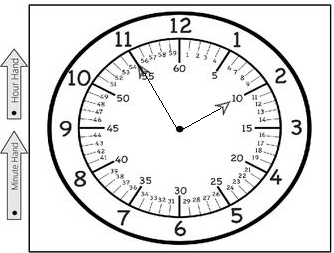
Math in Focus Grade 3 Chapter 16 Practice 1 Answer Key Telling Time q5

Question 6.
Math in Focus Grade 3 Chapter 16 Practice 1 Answer Key Telling Time 8
Answer: 31 minutes to 4
Math in Focus Grade 3 Chapter 16 Practice 1 Answer Key Telling Time q6
The minute hand of our clock is on 31.
Count clock-wise direction in one’s 25, 26, 27, 28, 29, 30, 31.
This means that it is 31 minutes to the next hour.
The hour hand is moving towards 4.

Tell the time. Use past or to.

Question 7.
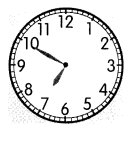
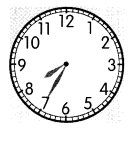
Math in Focus Grade 3 Chapter 16 Practice 1 Answer Key Telling Time 9
Answer: 11 minutes to 7
Math in Focus Grade 3 Chapter 16 Practice 1 Answer Key Telling Time q7
– Each increment on the clock face is one minute.
– Looking at the left-hand side of the clock, moving anti-clockwise from 12, each number is multiple of 5 minutes to the next hour.
– So, from 12 we can count in fives to find out how many minutes there are until the next hour is reached.
– We can count the minute up to 25, but not including 30. We don’t say 30 minutes to. Instead, we say half-past.
– According to the above diagram from 12 we can count 0, 1, 2, 3, 4, 5, 6, 7, 8, 9, 10, 11, 12, and so on… up to 30 in the anti-clockwise direction.
– In the diagram, the representation is 11 minutes to 7.

Question 8.
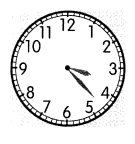
Math in Focus Grade 3 Chapter 16 Practice 1 Answer Key Telling Time 10
Answer:23 minutes past 3
Math in Focus Grade 3 Chapter 16 Practice 1 Answer Key Telling Time q8
– Each increment on the clock face is one minute.
– Looking at the right-hand side of the clock, moving clockwise from 12, each number is multiple of 5 minutes to the next hour.
– So, from 12 we can count in fives to find out how many minutes there are until the next hour is reached.
– We can count the minute up to 25, but not including 30. We don’t say 30 minutes to. Instead, we say half-past.
– According to the above diagram from 12 we can count 0, 1, 2, 3, 4, 5, 6, 7, 8, 9, 10, 11, 12, and so on… up to 30 in the clockwise direction.
– In the diagram, the representation is 23 minutes past 3.

Question 9.
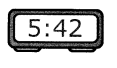
Math in Focus Grade 3 Chapter 16 Practice 1 Answer Key Telling Time 11
Answer: 18 minutes to 6.
Math in Focus Grade 3 Chapter 16 Practice 1 Answer Key Telling Time q9
Explanation:
The actual time gave 5:42.
1 hour is equal to 60 minutes.
5:42 can be written as 5 hours 42 minutes.
If we subtract 42 from 60: 60-42=18.
So what is this mean, 18 minutes left to the next hour.
The next hour is 6. So I wrote 18 minutes to 6.

Question 10.
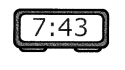
Math in Focus Grade 3 Chapter 16 Practice 1 Answer Key Telling Time 12
Answer: 17 minutes to 8
Explanation:
The actual time gave 7:43.
1 hour is equal to 60 minutes.
7:43 can be written as 7 hours 43 minutes.
If we subtract 43 from 60: 60-43=17.
So what is this mean, 17 minutes left to the next hour.
The next hour is 8. So I wrote 17 minutes to 8.

Question 11.
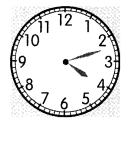
Math in Focus Grade 3 Chapter 16 Practice 1 Answer Key Telling Time 13
Answer: 12 minutes past 4.
Math in Focus Grade 3 Chapter 16 Practice 1 Answer Key Telling Time q11
– Each increment on the clock face is one minute.
– Looking at the right-hand side of the clock, moving clockwise from 12, each number is multiple of 5 minutes to the next hour.
– So, from 12 we can count in fives to find out how many minutes there are until the next hour is reached.
– We can count the minute up to 25, but not including 30. We don’t say 30 minutes to. Instead, we say half-past.
– According to the above diagram from 12 we can count 0, 1, 2, 3, 4, 5, 6, 7, 8, 9, 10, 11, 12, and so on… up to 30 in the clockwise direction.
– In the diagram, the representation is 12 minutes past 4.

Question 12.
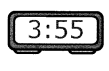
Math in Focus Grade 3 Chapter 16 Practice 1 Answer Key Telling Time 14
Answer: 5 minutes to 4
Explanation:
The actual time gave 3:55.
1 hour is equal to 60 minutes.
3:55 can be written as 3 hours 55 minutes.
If we subtract 55 from 60: 60-55=5.
So what is this mean, 5 minutes left to the next hour.
The next hour is 4. So I wrote 5 minutes to 4.

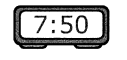
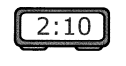
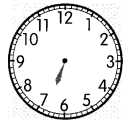
Tell the time in two ways.

Example
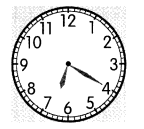
Math in Focus Grade 3 Chapter 16 Practice 1 Answer Key Telling Time 15
6:20
20 minutes past 6

Math in Focus Grade 3 Chapter 16 Practice 1 Answer Key Telling Time 16
4:55
5 minutes to 5

Math in Focus Grade 3 Chapter 16 Practice 1 Answer Key Telling Time 17

Math in Focus Grade 3 Chapter 16 Practice 1 Answer Key Telling Time 18
10 minutes to 8
50 minutes past 7

Math in Focus Grade 3 Chapter 16 Practice 1 Answer Key Telling Time 19
50 minutes to 3
10 minutes past 2

Question 13.
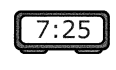
Math in Focus Grade 3 Chapter 16 Practice 1 Answer Key Telling Time 20
Answer:
First way:
25 minutes past 7
– Each increment on the clock face is one minute.
– Looking at the right-hand side of the clock, moving clockwise from 12, each number is multiple of 5 minutes to the next hour.
– So, from 12 we can count in fives to find out how many minutes there are until the next hour is reached.
– We can count the minute up to 25, but not including 30. We don’t say 30 minutes to. Instead, we say half-past.
– According to the above diagram from 12 we can count 0, 1, 2, 3, 4, 5, 6, 7, 8, 9, 10, 11, 12, and so on… up to 30 in the clockwise direction.
– In the diagram, the representation is 25 minutes past 7.
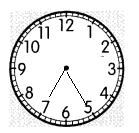
Math in Focus Grade 3 Chapter 16 Practice 1 Answer Key Telling Time q13
Second way:
35 minutes to 8:
The actual time gave 7:25.
1 hour is equal to 60 minutes.
7:25 can be written as 7 hours 25 minutes.
If we subtract 25 from 60: 60-25=35.
So what is this mean, 35 minutes left to the next hour.
The next hour is 8. So I wrote 35 minutes to 8.

Question 14.
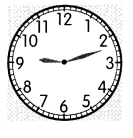
Math in Focus Grade 3 Chapter 16 Practice 1 Answer Key Telling Time 21
Answer:
We can write in two ways:
1. 12 minutes past 9
2. 48 minutes to 10
First way:
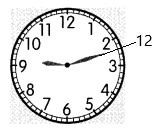
Math in Focus Grade 3 Chapter 16 Practice 1 Answer Key Telling Time q14
– Each increment on the clock face is one minute.
– Looking at the right-hand side of the clock, moving clockwise from 12, each number is multiple of 5 minutes to the next hour.
– So, from 12 we can count in fives to find out how many minutes there are until the next hour is reached.
– We can count the minute up to 25, but not including 30. We don’t say 30 minutes to. Instead, we say half-past.
– According to the above diagram from 12 we can count 0, 1, 2, 3, 4, 5, 6, 7, 8, 9, 10, 11, 12, and so on… up to 30 in the clockwise direction.
– In the diagram, the representation is 12 minutes past 9.
Second way:
48 minutes to 10.
The actual time gave 9:12.
1 hour is equal to 60 minutes.
9:12 can be written as 9 hours 12 minutes.
If we subtract 55 from 60: 60-12=48.
So what is this mean, 48 minutes left to the next hour.
The next hour is 10. So I wrote 48 minutes to 10.

Question 15.
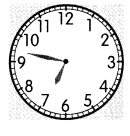
Math in Focus Grade 3 Chapter 16 Practice 1 Answer Key Telling Time 22
Answer:
We can say time in two ways:
1. 47 minutes past 6
2. 13 minutes to 7.
First way:
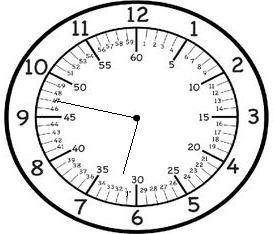
Math in Focus Grade 3 Chapter 16 Practice 1 Answer Key Telling Time q15
– Each increment on the clock face is one minute.
– Each number is multiple of 5 minutes to the next hour.
– So, from 12 we can count in fives to find out how many minutes there are until the next hour is reached.
– We can count the minute up to 25, but not including 30. We don’t say 30 minutes to. Instead, we say half-past.
– According to the above diagram from 12. 1, 2, 3, 4, 5, and so on… up to 60.
– In the diagram, the representation is 47 minutes past 6.
Second way:
17 minutes to 7.
The actual time gave 6:47.
1 hour is equal to 60 minutes.
6:47 can be written as 6 hours 47 minutes.
If we subtract 47 from 60: 60-47=13.
So what is this mean, 13 minutes left to the next hour.
The next hour is 7. So I wrote 13 minutes to 7.

Question 16.
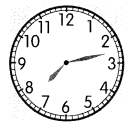
Math in Focus Grade 3 Chapter 16 Practice 1 Answer Key Telling Time 23
Answer:
we can say two ways in time.
13 minutes past 7
47 minutes to 8
First way:
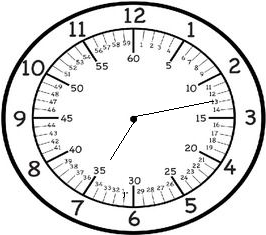
Math in Focus Grade 3 Chapter 16 Practice 1 Answer Key Telling Time q16
– Each increment on the clock face is one minute.
– Each number is multiple of 5 minutes to the next hour.
– So, from 12 we can count in fives to find out how many minutes there are until the next hour is reached.
– We can count the minute up to 25, but not including 30. We don’t say 30 minutes to. Instead, we say half-past.
– According to the above diagram from 12. 1, 2, 3, 4, 5, and so on… up to 60.
– In the diagram, the representation is 13 minutes past 7.
Second way:
47 minutes to 8.
The actual time gave 7:13.
1 hour is equal to 60 minutes.
7:13 can be written as 6 hours 47 minutes.
If we subtract 13 from 60: 60-13=47.
So what is this mean, 47 minutes left to the next hour.
The next hour is 8. So I wrote 47 minutes to 8.

Question 17.
Math in Focus Grade 3 Chapter 16 Practice 1 Answer Key Telling Time 24
Answer:
1. 39 minutes past 4
2. 21 minutes to 5
First way:
39 minutes past 4
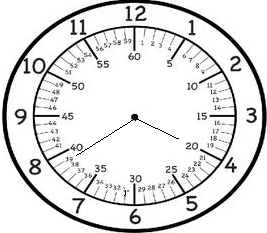
Math in Focus Grade 3 Chapter 16 Practice 1 Answer Key Telling Time q17
– Each increment on the clock face is one minute.
– Each number is multiple of 5 minutes to the next hour.
– So, from 12 we can count in fives to find out how many minutes there are until the next hour is reached.
– We can count the minute up to 25, but not including 30. We don’t say 30 minutes to. Instead, we say half-past.
– According to the above diagram from 12. 1, 2, 3, 4, 5, and so on… up to 60.
– In the diagram, the representation is 39 minutes past 4.
Second way:
21 minutes to 5
The actual time gave 4:39.
1 hour is equal to 60 minutes.
4:39 can be written as 6 hours 47 minutes.
If we subtract 39 from 60: 60-39=21.
So what is this mean, 21 minutes left to the next hour.
The next hour is 5. So I wrote 21 minutes to 5.

Question 18.
Math in Focus Grade 3 Chapter 16 Practice 1 Answer Key Telling Time 25
Answer:
1. 52 minutes past 10
2. 8 minutes to 11
First way:
52 minutes past 10
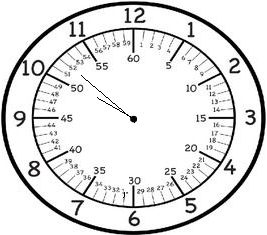
Math in Focus Grade 3 Chapter 16 Practice 1 Answer Key Telling Time q18
– Each increment on the clock face is one minute.
– Each number is multiple of 5 minutes to the next hour.
– So, from 12 we can count in fives to find out how many minutes there are until the next hour is reached.
– We can count the minute up to 25, but not including 30. We don’t say 30 minutes to. Instead, we say half-past.
– According to the above diagram from 12. 1, 2, 3, 4, 5, and so on… up to 60.
– In the diagram, the representation is 52 minutes past 10.
Second way:
21 minutes to 5
The actual time gave 10:52.
1 hour is equal to 60 minutes.
10:52 can be written as 10 hours 52 minutes.
If we subtract 52 from 60: 60-52=8.
So what is this mean, 8 minutes left to the next hour.
The next hour is 11. So I wrote 8 minutes to 11.

Draw the minute hand to show the time.

Question 19.
25 minutes past 11
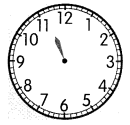
Math in Focus Grade 3 Chapter 16 Practice 1 Answer Key Telling Time 26
Answer:
We measure time in seconds, minutes, hours, days, weeks, months and years with clocks and calendars.
– The shorthand is the hour hand.
– The long hand is a minute hand.
In the given question, the shorthand is on 11. And the long hand is on 25.
Now we can say the time is 11 hours 25 minutes. In another, we can say 25 minutes past 11.
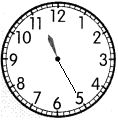
Math in Focus Grade 3 Chapter 16 Practice 1 Answer Key Telling Time q19

Question 20.
18 minutes to 7
Math in Focus Grade 3 Chapter 16 Practice 1 Answer Key Telling Time 27
Answer:
Math in Focus Grade 3 Chapter 16 Practice 1 Answer Key Telling Time q20
– Each increment on the clock face is one minute.
– Looking at the left-hand side of the clock, moving anti-clockwise from 12, each number is multiple of 5 minutes to the next hour.
– So, from 12 we can count in fives to find out how many minutes there are until the next hour is reached.
– We can count the minute up to 25, but not including 30. We don’t say 30 minutes to. Instead, we say half-past.
– According to the above diagram from 12 we can count 0, 1, 2, 3, 4, 5, 6, 7, 8, 9, 10, 11, 12, and so on… up to 30 in the anti-clockwise direction.
– In the diagram, the representation is 18 minutes to 7.

Write the time on the clock.

Question 21.
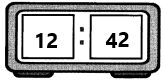
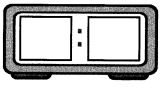
18 minutes to 1
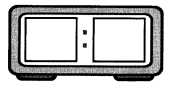
Math in Focus Grade 3 Chapter 16 Practice 1 Answer Key Telling Time 28
Answer: 12:48
Math in Focus Grade 3 Chapter 16 Practice 1 Answer Key Telling Time q21.1
18 minutes to 1
The actual time is 12:42.
1 hour is equal to 60 minutes.
12:42 can be written as 10 hours 52 minutes.
If we subtract 42 from 60: 60-42=18.
So what is this mean, 18 minutes left to the next hour.
The next hour is 1. So I wrote 18 minutes to 1.

Question 22.
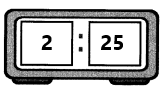
25 minutes past 2
Math in Focus Grade 3 Chapter 16 Practice 1 Answer Key Telling Time 29
Answer: 2:25
Math in Focus Grade 3 Chapter 16 Practice 1 Answer Key Telling Time q23
– Each increment on the clock face is one minute.
– Looking at the right-hand side of the clock, moving clockwise from 12, each number is multiple of 5 minutes to the next hour.
– So, from 12 we can count in fives to find out how many minutes there are until the next hour is reached.
– We can count the minute up to 25, but not including 30. We don’t say 30 minutes to. Instead, we say half-past.
– According to the above diagram from 12 we can count 0, 1, 2, 3, 4, 5, 6, 7, 8, 9, 10, 11, 12, and so on… up to 30 in the clockwise direction.
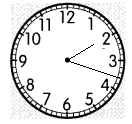
– In the diagram, the representation is 25 minutes past 2.

Fill in the blanks with the correct time.

Question 23.
18 minutes past 2 is ___________.
Answer: 2:18
– Each increment on the clock face is one minute.
– Looking at the right-hand side of the clock, moving clockwise from 12, each number is multiple of 5 minutes to the next hour.
– So, from 12 we can count in fives to find out how many minutes there are until the next hour is reached.
– We can count the minute up to 25, but not including 30. We don’t say 30 minutes to. Instead, we say half-past.
– According to the above diagram from 12 we can count 0, 1, 2, 3, 4, 5, 6, 7, 8, 9, 10, 11, 12, and so on… up to 30 in the clockwise direction.
Math in Focus Grade 3 Chapter 16 Practice 1 Answer Key Telling Time q23
– In the diagram, the representation is 18 minutes past 2.

Question 24.
15 minutes to 1 is __________.
Answer: 12:45
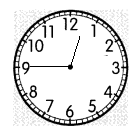
Math in Focus Grade 3 Chapter 16 Practice 1 Answer Key Telling Time q24.1
The actual time is 12:45.
1 hour is equal to 60 minutes.
12:45 can be written as 12 hours 45 minutes.
If we subtract 55 from 60: 60-45=15.
So what is this mean, 15 minutes left to the next hour.
The next hour is 1. So I wrote 15 minutes to 1.

Question 25.
8:25 is __________ minutes past __________.
Answer: 25 minutes past 8
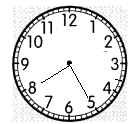
Math in Focus Grade 3 Chapter 16 Practice 1 Answer Key Telling Time q24
– Each increment on the clock face is one minute.
– Looking at the right-hand side of the clock, moving clockwise from 12, each number is multiple of 5 minutes to the next hour.
– So, from 12 we can count in fives to find out how many minutes there are until the next hour is reached.
– We can count the minute up to 25, but not including 30. We don’t say 30 minutes to. Instead, we say half-past.
– According to the above diagram from 12 we can count 0, 1, 2, 3, 4, 5, 6, 7, 8, 9, 10, 11, 12, and so on… up to 30 in the clockwise direction.

Question 26.
6:50 is __________ minutes to ___________.
Answer: 10 minutes to 7
The actual time is 6:50.
1 hour is equal to 60 minutes.
6:50 can be written as 6 hours 50 minutes.
If we subtract 50 from 60: 60-50=10.
So what is this mean, 10 minutes left to the next hour.
The next hour is 7. So I wrote 10 minutes to 7.
Math in Focus Grade 3 Chapter 11 Practice 1 Answer Key Meters and Centimeters

Practice the problems of Math in Focus Grade 3 Workbook Answer Key Chapter 11 Practice 1 Meters and Centimeters to score better marks in the exam.

Math in Focus Grade 3 Chapter 11 Practice 1 Answer Key Meters and Centimeters

Complete.

Example
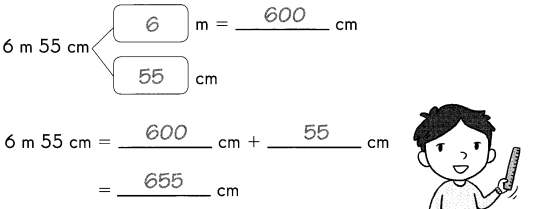
Math in Focus Grade 3 Chapter 11 Practice 1 Answer Key Meters and Centimeters 1

Question 1.
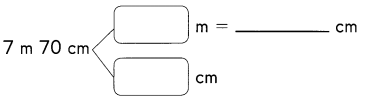
Math in Focus Grade 3 Chapter 11 Practice 1 Answer Key Meters and Centimeters 2
7 m 70 cm = __________ cm + __________ cm
= ___________ cm
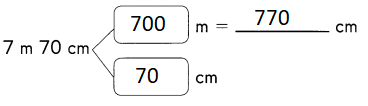
Answer:

Explanation:
Converting meter to centimeter
1 meter = 100 centimeter
7 m 70 cm = 700 cm + 70 cm
= 770 cm

Question 2.
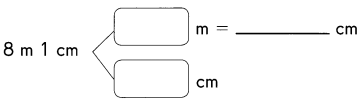
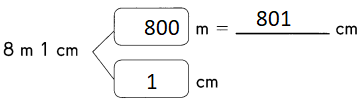
Math in Focus Grade 3 Chapter 11 Practice 1 Answer Key Meters and Centimeters 3
8 m 1 cm = __________ cm + __________ cm
= ___________ cm
Answer:

Explanation:
Converting meter to centimeter
1 meter = 100 centimeter

Write in centimeters.

Question 3.
6 m 96 cm = ___________ cm + ___________ cm = ___________ cm
Answer:
6 m 96 cm = 600 cm + 96 cm = 696 cm
Explanation:
Converting meter to centimeter
1 meter = 100 centimeter

Question 4.
8 m 90 cm = _________ cm + _________ cm = _________ cm
Answer:
8 m 90 cm = 800 cm + 90 cm = 890 cm
Explanation:
Converting meter to centimeter
1 meter = 100 centimeter

Question 5.
9 m 20 cm = ___________ cm + __________ cm = __________ cm
Answer:
9 m 20 cm = 900 cm + 20 cm = 920 cm
Explanation:
Converting meter to centimeter
1 meter = 100 centimeter

Question 6.
9 m 2 cm = ___________ cm + ___________ cm = ___________ cm
Answer:
9 m 2 cm = 900 cm + 2 cm = 902 cm
Explanation:
Converting meter to centimeter
1 meter = 100 centimeter

Complete.

Example
Math in Focus Grade 3 Chapter 11 Practice 1 Answer Key Meters and Centimeters 4

Question 7.
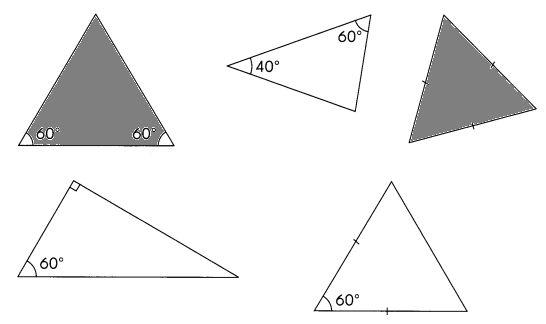
Math in Focus Grade 3 Chapter 11 Practice 1 Answer Key Meters and Centimeters 5
428 cm = ___________ m ___________ cm
Answer:

Question 8.
Math in Focus Grade 3 Chapter 11 Practice 1 Answer Key Meters and Centimeters 6
903 cm = ___________ m ___________ cm
Answer:

Write in meters and centimeters.

Question 9.
123 cm = ___________ cm + ___________cm = ___________ m ___________ cm
Answer:
123 cm = 100 cm + 23 cm = 1 m 23 cm
Explanation:
Converting given  centimeter to meter  and centimeter
1 meter = 100 centimeter

Question 10.
390 cm = ___________ cm + ___________cm = ___________ m ___________ cm
Answer:
390 cm = 300 cm + 90 cm = 3 m 90 cm
Explanation:
Converting given  centimeter to meter  and centimeter
1 meter = 100 centimeter

Question 11.
365 cm = ___________ cm + ___________cm = ___________ m ___________ cm
Answer:
365 cm = 300 cm + 65 cm = 3 m 65 cm
Explanation:
Converting given  centimeter to meter  and centimeter
1 meter = 100 centimeter

Question 12.
909 cm = ___________ cm + ___________cm = ___________ m ___________ cm
Answer:
909 cm = 900 cm + 9 cm = 9 m 9 cm
Explanation:
Converting given  centimeter to meter  and centimeter
1 meter = 100 centimeter

Choose the unit you would use to measure each. Write meters or centimeters.

Question 13.
Math in Focus Grade 3 Chapter 11 Practice 1 Answer Key Meters and Centimeters 7
This pine tree is about 2 _________________ tall.
Answer:
This pine tree is about 2 meters tall.
Explanation:
The height of the tree will be more
we cannot measure in centimeters
so, it might be 2 meters

Question 14.
Math in Focus Grade 3 Chapter 11 Practice 1 Answer Key Meters and Centimeters 8
The insect is about 10 _____________ long.
Answer:
The insect is about 10 centimeters long.
Explanation:
The height of the Insects will be small
we cannot measure in meters
so, it might be 10 centimeters

Fill in the blanks. Color the banner with the longest measurement.

Example
Math in Focus Grade 3 Chapter 11 Practice 1 Answer Key Meters and Centimeters 9

Question 15.
Math in Focus Grade 3 Chapter 11 Practice 1 Answer Key Meters and Centimeters 10
Answer:

Explanation:
Converting meter to centimeter
1 meter = 100 centimeter

Question 16.
Math in Focus Grade 3 Chapter 11 Practice 1 Answer Key Meters and Centimeters 11
Answer:

Explanation:
Converting meter to centimeter
1 meter = 100 centimeter

Question 17.
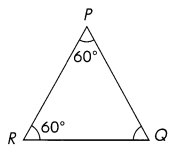
Math in Focus Grade 3 Chapter 11 Practice 1 Answer Key Meters and Centimeters 12
Answer:

Explanation:
Converting given  centimeter to meter  and centimeter
1 meter = 100 centimeter

Color the boxes with equal measurements.
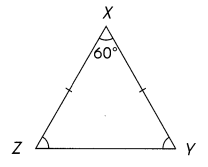
Question 18.
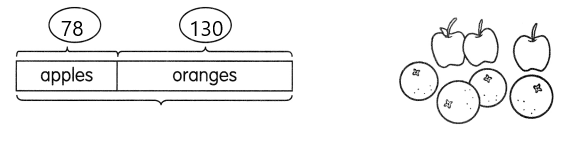
Math in Focus Grade 3 Chapter 11 Practice 1 Answer Key Meters and Centimeters 13
Answer:

Explanation:
1 meter = 100 cm
5 m 5cm = 500 + 5 = 505 cm

Question 19.
Math in Focus Grade 3 Chapter 11 Practice 1 Answer Key Meters and Centimeters 14
Answer:

Explanation:
1 meter = 100 cm
9 m 9 cm = 900 + 9 = 909 cm

Question 20.
Math in Focus Grade 3 Chapter 11 Practice 1 Answer Key Meters and Centimeters 15
Answer:

Explanation:
1 meter = 100 cm
100 cm + 30 cm = 130 cm = 1 m 30 cm

Question 21.
Math in Focus Grade 3 Chapter 11 Practice 1 Answer Key Meters and Centimeters 16
Answer:

Explanation:
1 meter = 100 centimeter
300 cm + 67 cm = 3 m + 67 cm = 367 cm