Math in Focus Grade 3 Chapter 4 Answer Key Subtraction up to 10,000

Go through the Math in Focus Grade 3 Workbook Answer Key Chapter 4 Subtraction up to 10,000 to finish your assignments.

Math in Focus Grade 3 Chapter 4 Answer Key Subtraction up to 10,000

Put on Your Thinking
Challenging Practice
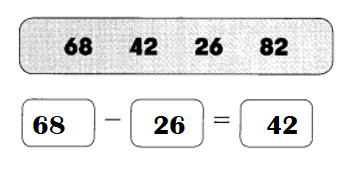
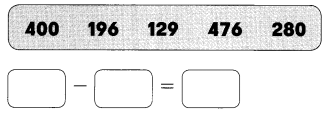
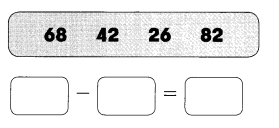
Fill in the blanks in each number sentence. Use the numbers in the box.

Question 1.
The difference between two numbers is 42.
Math in Focus Grade 3 Chapter 4 Answer Key Subtraction up to 10,000 1
Answer:
The difference between two numbers is 42 are 68 and 26.
Math-in-Focus-Grade-3-Chapter-4-Answer-Key-Subtraction-up-to-10,000-Put on Your Thinking-1

Explanation:
Difference:
1. 68 – 42 = 26.       68 – 26 = 42.       82 – 68 = 14.
2. 42 – 26 = 26.
3. 26
4. 82 – 68 = 14.        82 – 42 = 40.       82 – 26 = 56.

Question 2.
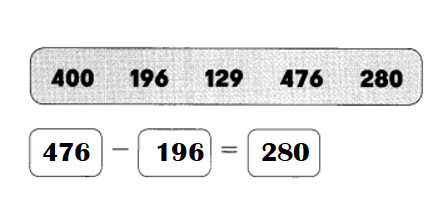
The difference between two numbers is 280.
Math in Focus Grade 3 Chapter 4 Answer Key Subtraction up to 10,000 2
Answer:
The difference between two numbers is 280 are 476 and 196.
Math-in-Focus-Grade-3-Chapter-4-Answer-Key-Subtraction-up-to-10,000-Put on Your Thinking-2

Explanation:
Difference:
1. 400 – 196 = 204.         400 – 129 = 271.           400 – 280 = 120.
2. 196 – 129 = 67.
3. 129
4. 476 – 400 = 76.       476 – 196 = 280.       476 – 129 = 347.        476 – 280 = 196.
5. 280 – 196 =          280 – 129 = 151.

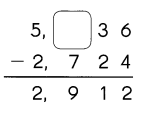
Fill in the missing numbers.
Question 3.
Math in Focus Grade 3 Chapter 4 Answer Key Subtraction up to 10,000 3
Answer:
Math-in-Focus-Grade-3-Chapter-4-Answer-Key-Subtraction-up-to-10,000-Put on Your Thinking-Fill in the missing numbers-3

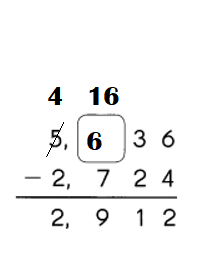
Explanation:
Ones place number: 6 – 4 = 2.
Tens place number: 3 – 2 = 1.
Hundreds place number: ?? – 7 = 9
=> ?? = 9 + 7
=> ?? = 16(10 + 6).
Thousand place number: 5 – 1 = 4.
=> 4 – 2 = 2.

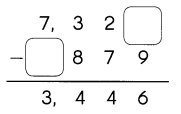
Question 4.
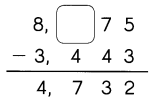
Math in Focus Grade 3 Chapter 4 Answer Key Subtraction up to 10,000 4
Answer:
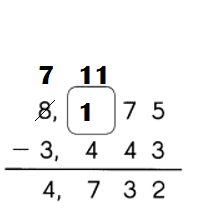
Math-in-Focus-Grade-3-Chapter-4-Answer-Key-Subtraction-up-to-10,000-Put on Your Thinking-Fill in the missing numbers-4

Explanation:
Ones place number: 5 – 3 = 2.
Tens place number: 7 – 4 = 3.
Hundreds place number: ?? – 4 = 7
=> ?? = 7 + 4
=> ?? = 11(1 + 10).
Thousand place number: 8 – 1 = 7.
=> 7 – 3 = 4.

Fill in the missing numbers.

Question 5.
Math in Focus Grade 3 Chapter 4 Answer Key Subtraction up to 10,000 5
Answer:
Math-in-Focus-Grade-3-Chapter-4-Answer-Key-Subtraction-up-to-10,000-Put on Your Thinking-Fill in the missing numbers-5

Explanation:
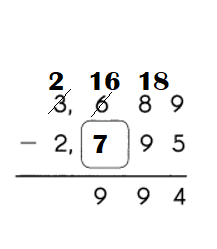
Ones place number: 9 – 5 = 4.
Tens place number: 8 – 9 = 9.
=> (10 + 8) – 9 = 9.
Hundreds place number: 6 – ?? = 9.
=> ?? = 9 + 6
=> ?? = 15(5 + 10).
=> 15 – ?? = 9
=> ?? = 15 – 9
=> ?? = 6.
Thousand place number:
3 – 1 = 2.
=> 2 – 2 = 0.

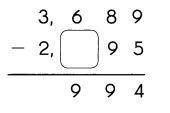
Question 6.
Math in Focus Grade 3 Chapter 4 Answer Key Subtraction up to 10,000 6
Answer:
Math-in-Focus-Grade-3-Chapter-4-Answer-Key-Subtraction-up-to-10,000-Put on Your Thinking-Fill in the missing numbers-6

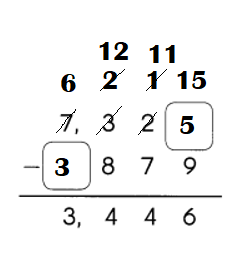
Explanation:
Ones place number: ?? – 9 = 6.
=> ?? = 6 + 9
=> ?? = 15. 15 = (10 + 5)
Tens place number: 2 – 1 = 1.
=> 1 – 7 = 4.(NO)
=> 11 (10 + 1) – 7 = 4.
Hundreds place number: 3 – 1 = 2.
=> 2 – 8 = 4(NO)
=> (2 + 10 )12 – 8 = 4.
Thousand place number: 7 – 1 = 6.
=> 6 – 3 = 3.

Solve. Use the digits to make 4-digit numbers. Show your work. Do not begin any number with ‘0’.

Question 7.
Subtract the least 4-digit number from the greatest 4-digit number.
_____ – ____ = ____
Answer:
9999 – 1000
= 8999.

Explanation:
Least 4-digit number = 1000.
Greatest 4-digit number = 9999.
Difference:
Greatest 4-digit number – Least 4-digit number
= 9999 – 1000
= 8999.

Solve.
Question 8.
Write a number greater than 5,632 using the digits 0, 1, 4, 7. Then subtract 5,632 from the number.
____ – ____ = _____
Answer:
7410 – 5632
= 1778.

Explanation:
Number greater than 5,632 using the digits 0, 1, 4, 7.
Number greater than 5,632 = 7410.
Then subtract 5,632 from the number.
=> Difference:
=> Number greater than 5,632 – 5,632
=> 7410 – 5632
=> 1778.

Put On Your Thinking Cap!
Problem Solving
Solve. Show your work.
Question 1.
The difference between two numbers is 100. One number is more than 90 but less than 100. The other number is between 190 and 200. What are the two possible numbers?
____ and ____
Answer:
The two possible numbers are 199 and 99.

Explanation:
Let the two numbers be X and Y.
The difference between two numbers is 100.
=> X – Y = 100.
One number is more than 90 but less than 100.
=> One Number = 99.
The other number is between 190 and 200.
=> Other number = 199.
Difference:
199 – 99 = 100.

Question 2.
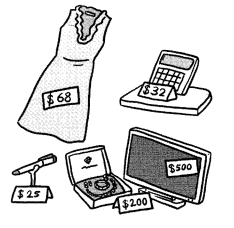
Lilian went shopping with $1,000. She saw five items on display in a shop window. After buying two items, she had $732 left. Which two items did she buy?
___ and ____
Math in Focus Grade 3 Chapter 4 Answer Key Subtraction up to 10,000 7
Answer:
Two items she bought are frock and necklace set.

Explanation:
Cost of frock = $68.
Cost of calculator = $32.
Cost of mick = $25.
Cost of necklace set = $200.
Cost of Television = $500.
Amount of money Lilian went shopping = $1000.
After buying two items, she had $732 left.
Amount of money spent = Amount of money Lilian went shopping – Amount of money left after buying 2 items
= $1000 – $732
= $268. ($68 + $200) (Cost of frock + Cost of necklace set)

Solve.
Question 3.
Nick and Isaac are at a school fair.
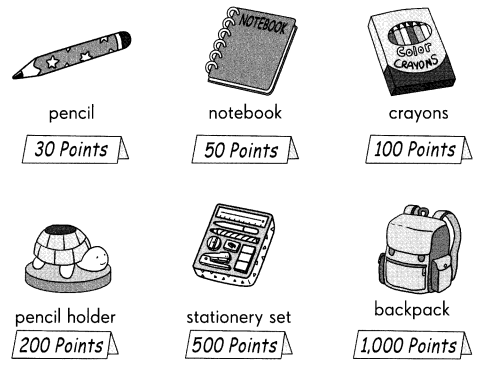
They want to collect points to exchange for these prizes.
Math in Focus Grade 3 Chapter 4 Answer Key Subtraction up to 10,000 8
At the fair games, Nick has 215 points and Isaac has 78 points. They combine their points to exchange for three prizes.
What are the two sets of three prizes they can get?

a. ________________
Answer:
Three prizes = 2(Pencils) and Pencil holder.

Explanation:
Points of Nick has = 215.
Points of Isaac has = 78.
Total combined points of Nick and Isaac = Points of Nick has  + Points of Isaac has
= 215 + 78
= 293.
Points of pencil = 30.
Points of pencil holder = 200.
Total points of three items  = 2(Points of pencil) + Points of pencil holder
= 2(30) + 200
= 60 + 200
= 260.

b. ________________
Answer:
Three things are Pencil, Notebook and pencil holder.

Explanation:
Points of Nick has = 215.
Points of Isaac has = 78.
Total combined points of Nick and Isaac = Points of Nick has  + Points of Isaac has
= 215 + 78
= 293.
Points of pencil holder = 200.
Points of Pencil  = 30.
Points of Notebook = 50.
Total points of three items  = Points of pencil holder + Points of Pencil  + Points of Notebook
= 200 + 30 + 50
= 230 + 50
= 280.

Read More:

ICICIPRULI Pivot Point Calculator

Math in Focus Grade 3 Chapter 19 Practice 5 Answer Key More Perimeter

This handy Math in Focus Grade 3 Workbook Answer Key Chapter 19 Practice 5 More Perimeter detailed solutions for the textbook questions.

Math in Focus Grade 3 Chapter 19 Practice 5 Answer Key More Perimeter

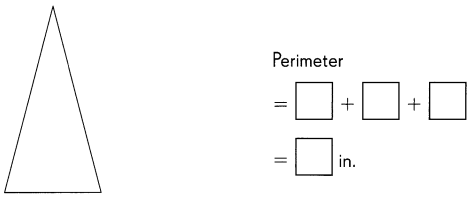
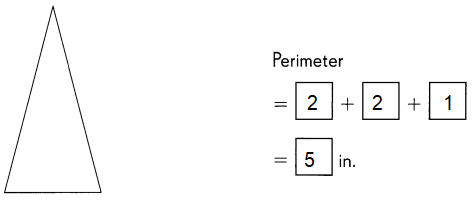
Measure the sides of each figure with a ruler. Then find the perimeter.

Question 1.
Math in Focus Grade 3 Chapter 19 Practice 5 Answer Key More Perimeter 1
Answer:
5 inches.

Explanation:
Perimeter  of a triangle is the sum of the lengths of the triangle.
the lengths are measured with ruler and the total is  perimeter (P) = 5 inches

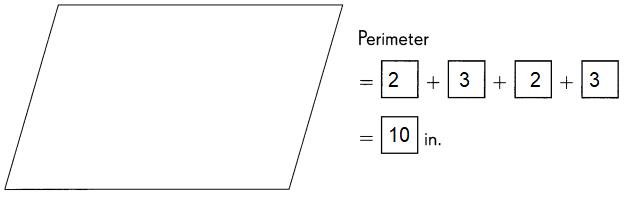
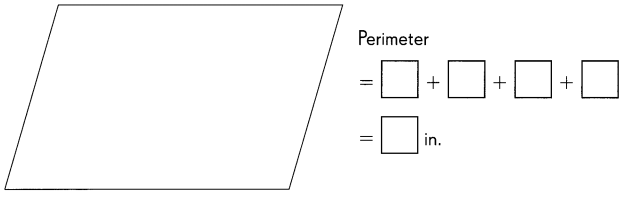
Question 2.
Math in Focus Grade 3 Chapter 19 Practice 5 Answer Key More Perimeter 2
Answer:
10 inches

Explanation:
Perimeter  of a parallelogram is the sum of the lengths of the parallelogram
the lengths are measured with ruler and the total is  perimeter (P) = 10 inches

Question 3.
Math in Focus Grade 3 Chapter 19 Practice 5 Answer Key More Perimeter 3
Answer:
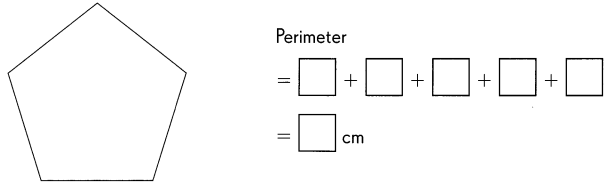
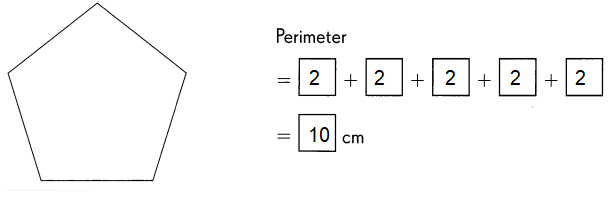
10 cm

Explanation:
Perimeter  of a pentagon is the sum of the sides length of the pentagon
the lengths are measured with ruler and the total is  perimeter (P) = 10 cm

Complete. Find the perimeter of each figure. Remember to show the correct unit in your answer.

Question 4.
Math in Focus Grade 3 Chapter 19 Practice 5 Answer Key More Perimeter 4
Perimeter
= _______ + _______ + _______ + _______
= ______________
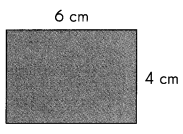
Answer: 20 cm
Explanation:
The perimeter P of a rectangle is given by the formula, P=l + w + l + w ,
where l is the length and w is the width of the rectangle.
Perimeter of a rectangle = l + w + l + w ,
= 6 + 4 + 6 + 4
= 20 cm

Question 5.
Math in Focus Grade 3 Chapter 19 Practice 5 Answer Key More Perimeter 5
Perimeter
= _______ + _______ + _______ + _______
= ______________
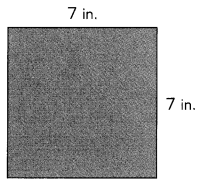
Answer: 28 in.
Explanation:
Perimeter of area = 4s
= 7 + 7 + 7 + 7
= 28 in.

Question 6.
Math in Focus Grade 3 Chapter 19 Practice 5 Answer Key More Perimeter 6
Perimeter
= _______ + _______ + _______ + _______
= ______________
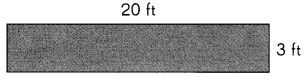
Answer: 46 ft
Explanation:
The perimeter P of a rectangle is given by the formula, P= l + w + l + w ,
where l is the length and w is the width of the rectangle.
Perimeter of area = l + w + l + w ,
= 20 + 3 + 20 + 3
= 46 ft

Question 7.
Math in Focus Grade 3 Chapter 19 Practice 5 Answer Key More Perimeter 7
Perimeter
= _______ + _______ + _______ + _______
= _______________
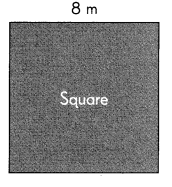
Answer: 32 m
Explanation:
Perimeter of square = 4s
=8 + 8 + 8 + 8
= 32 in.

Complete. Find the perimeter of each figure. Remember to show the correct unit in your answer.

Question 8.
Perimeter = _______ + _______ + _______
= ______________
Math in Focus Grade 3 Chapter 19 Practice 5 Answer Key More Perimeter 8
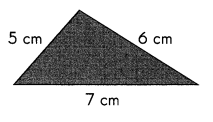
Answer: 18 cm
Explanation:
Perimeter of triangle = l + b + h
5 + 6 + 7 = 18 cm
Perimeter  of a triangle is the sum of the lengths of the triangle,
the lengths are measured with ruler and the total is  perimeter (P)

Question 9.
Perimeter = _______ + _______ + _______ + _______
= ______________
Math in Focus Grade 3 Chapter 19 Practice 5 Answer Key More Perimeter 9
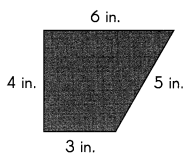
Answer: 18 in.
Explanation:
Perimeter = 3 + 4 + 5 + 6 =18 in
Perimeter  of a parallelogram is the sum of the lengths of the parallelogram,
the lengths are measured with ruler and the total is  perimeter (P)

Question 10.
Math in Focus Grade 3 Chapter 19 Practice 5 Answer Key More Perimeter 10
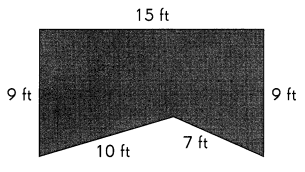
Perimeter = ____________
Answer: 50 ft
Explanation:
Perimeter
= 10 + 9 + 15 + 9 + 7
= 50 ft

Question 11.
Math in Focus Grade 3 Chapter 19 Practice 5 Answer Key More Perimeter 11
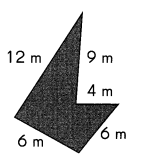
Perimeter = _____________
Answer: 37 m
Explanation:
Perimeter:
12 + 9 + 4 + 6 +6 = 37 m

Question 12.
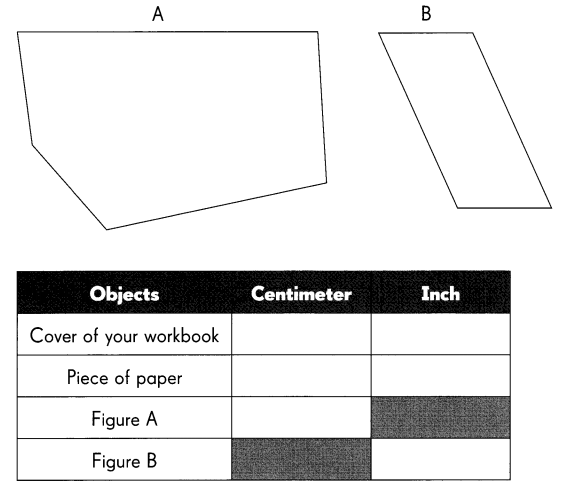
Use your ruler or a measuring tape to find the perimeter of each figure or object.
Math in Focus Grade 3 Chapter 19 Practice 5 Answer Key More Perimeter 12
Answer:

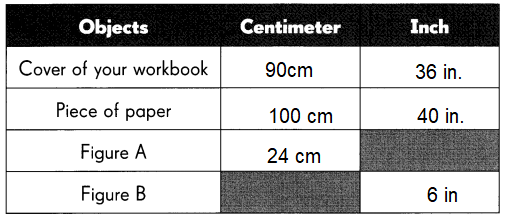
Explanation:
The measurements may vary from one to one,
depends upon the size and shape of the object.
So, we use the square centimeter and inch to estimate the perimeter of the objects.

Question 13.
Use your meterstick or yardstick to measure the perimeter of each object.
Math in Focus Grade 3 Chapter 19 Practice 5 Answer Key More Perimeter 13
Answer:

Explanation:
Measurements may vary from one to one,
depending upon the size, shape of the objects.
So, we use the square meter and square feet to estimate the perimeter of the objects in our house.

Solve.

Question 14.
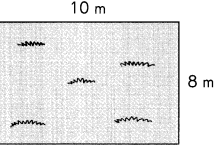
Sean walks along the edge of a rectangular field once to look for his lost keychain. How far does he walk?
Math in Focus Grade 3 Chapter 19 Practice 5 Answer Key More Perimeter 14
Answer: 36m
Explanation:
Perimeter of a rectangle (P) = 2(Length + Width)
P = 2(10+8)
=2(18)
= 36 m

Question 15.
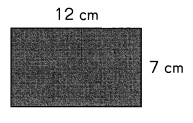
Alyssa wants to decorate this birthday card by pasting ribbon around it. What is the length of ribbon she needs?
Math in Focus Grade 3 Chapter 19 Practice 5 Answer Key More Perimeter 15
Answer:
38 cm length of ribbon she needs.
Explanation:
Perimeter of a rectangle (P) = 2(Length + Width)
P = 2(12 + 7)
= 38 cm

Question 16.
Owen has two square cardboard pieces. Each side is 6 inches. He places them side by side to make a rectangle. What is the perimeter of the rectangle?
Math in Focus Grade 3 Chapter 19 Practice 5 Answer Key More Perimeter 16
Answer: 48 in.
Explanation:
The perimeter P of a rectangle is given by the formula, P= l + w + l + w ,
where l is the length and w is the width of the rectangle.
Perimeter of area = l + w + l + w ,
= 12 + 6 + 12 + 6 = 48 in.

Solve.

Question 17.
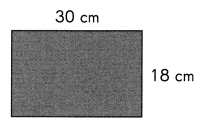
Theo wraps tape around the top of this rectangular box twice. What is the length of sticky tape he uses?
Math in Focus Grade 3 Chapter 19 Practice 5 Answer Key More Perimeter 17
Answer: 96 cm
Explanation:
The perimeter P of a rectangle is given by the formula, P= l + w + l + w ,
where l is the length and w is the width of the rectangle.
Perimeter of area = l + w + l + w ,
= 30 + 18 + 30 + 18 = 96 cm.

Question 18.
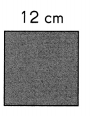
Each student in a group glued a string around a square with a side of 12 centimeters. There are 5 students in the group. What was the total length of string they used?
Math in Focus Grade 3 Chapter 19 Practice 5 Answer Key More Perimeter 18
Answer: 240 cm
Explanation:
one student glued a string around a square with a side of 12 centimeters
lets calculated Perimeter of a square P= 4x s
P = 4 x 12
= 48 cm
5 students glued a string around a square with a side of 12 centimeters
5 x 48 cm = 240 cm the total length of string they used

Question 19.
The length of a rectangular pool is 4 times its width. If the perimeter of the pool is 140 meters, find the length and width of the pool.
Math in Focus Grade 3 Chapter 19 Practice 5 Answer Key More Perimeter 19
Answer:
length is 56 meters and width is 14 meters
Explanation:
Perimeter of a rectangle P=2(l + w)
let width is x and the length is 4x as per the given information
140 = 2(4x + x)
140 = 2(5x)
140 = 10x
x = 14 meters width
length = 4 x = 4 x 14 = 56 m

Question 20.
Four square tables are arranged next to each other to form one large rectangular table. The perimeter of the large rectangular table is 20 meters. What is the perimeter of each square table?
Math in Focus Grade 3 Chapter 19 Practice 5 Answer Key More Perimeter 19
Answer: 8 meters
Explanation:
the perimeter of a rectangle P = 2(l+b)
P = 2(4x+x)
=10 x
20 = 10x
x = 2m
the perimeter of each square table
P = 4 s = 4 x 2 = 8 meters.

Read More:

EICHERMOT Pivot Point Calculator

Math in Focus Grade 5 Chapter 1 Practice 4 Answer Key Comparing Numbers to 10,000,000

Go through the Math in Focus Grade 5 Workbook Answer Key Chapter 1 Practice 4 Comparing Numbers to 10,000,000 to finish your assignments.

Math in Focus Grade 5 Chapter 1 Practice 4 Answer Key Comparing Numbers to 10,000,000

Complete the place-value chart. Then use it to compare the numbers.

Question 1.
Which is greater, 197,210 or 225,302?
Compare the values of the digits, working from left to right.
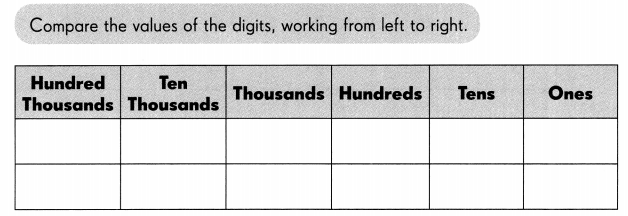
Math in Focus Grade 5 Chapter 1 Practice 4 Answer Key Comparing Numbers to 10,000,000 20
___ hundred thousands is greater than ___ is greater than
So, ___ is greater than ____
Answer:
Place value in Maths describes the position or place of a digit in a number. Each digit has a place in a number. When we represent the number in general form, the position of each digit will be expanded. Those positions start from a unit place or we also call it one’s position. The order of place value of digits of a number of right to left is units, tens, hundreds, thousands, ten thousand, a hundred thousand, and so on.
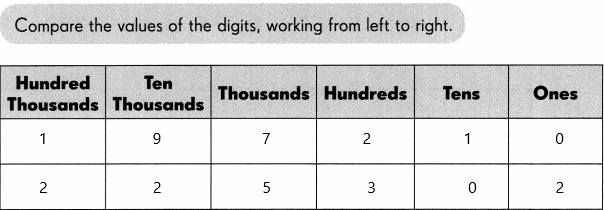
Math in Focus Grade 5 Chapter 1 Practice 4 Answer Key Comparing Numbers to 10,000,000 q1
A whole number is larger than another if it has more digits. If the number of digits in each number is the same, then look at the digits from left to right. If the left digit is larger in one number, then this is the largest number. If this digit is the same, compare the next digit along to the right.
Now compare the numbers: 197,210 and 222,302
1 is less than 2 so 197,210 is less than 222,302. Because In hundred thousand place 1 is smaller than 2.
197,210<222,302

Fill each Math in Focus Grade 5 Chapter 1 Practice 4 Answer Key Comparing Numbers to 10,000,000 21 with >or <.

Question 2.
128,758 Math in Focus Grade 5 Chapter 1 Practice 4 Answer Key Comparing Numbers to 10,000,000 21 74,906
Answer:>
A whole number is larger than another if it has more digits. If the number of digits in each number is the same, then look at the digits from left to right. If the left digit is larger in one number, then this is the largest number. If this digit is the same, compare the next digit along to the right.
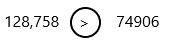
Math in Focus Grade 5 Chapter 1 Practice 4 Answer Key Comparing Numbers to 10,000,000 q2
1. We are comparing the numbers 128,758 and 74,906.
2. The order of digits from smallest to largest is 0, 1, 2, 3, 4, 5, 6, 7, 8 and 9.
3. We start with the place value column on the left.
4. 1 is greater than o because in the first number the hundred thousand place is 1 and in the second number there is no hundred thousand place so it becomes zero.
5. Therefore, 128,758 is greater than 74,906.
6. The comparison symbol for greater than is >, pointing to the smaller number of 74,906.

Question 3.
523,719 Math in Focus Grade 5 Chapter 1 Practice 4 Answer Key Comparing Numbers to 10,000,000 21 523,689
Answer: >
A whole number is larger than another if it has more digits. If the number of digits in each number is the same, then look at the digits from left to right. If the left digit is larger in one number, then this is the largest number. If this digit is the same, compare the next digit along to the right.
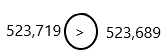
Math in Focus Grade 5 Chapter 1 Practice 4 Answer Key Comparing Numbers to 10,000,000 q3
1. We are comparing the numbers 523,719 and 523,689.
2. The order of digits from smallest to largest is 0, 1, 2, 3, 4, 5, 6, 7, 8 and 9.
3. We start with the place value column on the left.
4. Both numbers are having the same digit in the hundred thousand, ten thousand, thousands column.
5. Now we compare the next digit. It means now we have to compare hundreds place and the digits are 7 and 6.
6. 7 is greater than 6 in order of digits.
7. Therefore, 523,719 is greater than 523,689.
8. The comparison symbol for greater than is >, pointing to the smaller number of 523,689.

Question 4.
89,000 Math in Focus Grade 5 Chapter 1 Practice 4 Answer Key Comparing Numbers to 10,000,000 21 712,758
Answer:
A whole number is larger than another if it has more digits. If the number of digits in each number is the same, then look at the digits from left to right. If the left digit is larger in one number, then this is the largest number. If this digit is the same, compare the next digit along to the right.
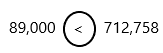
Math in Focus Grade 5 Chapter 1 Practice 4 Answer Key Comparing Numbers to 10,000,000 q4
1. We are comparing the numbers 89,000 and 712,758.
2. The order of digits from smallest to largest is 0, 1, 2, 3, 4, 5, 6, 7, 8 and 9.
3. We start with the place value column on the left.
4. 0 is less than 7 because the first number in the hundred thousand place is 0 because there is no digit in that place and in the second number the digit of hundred thousand place is 7.
5. Therefore, 89,000 is less than 712,758.
6. The comparison symbol for less than is <, pointing to the greater number of 712,758.

Question 5.
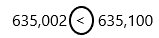
635,002 Math in Focus Grade 5 Chapter 1 Practice 4 Answer Key Comparing Numbers to 10,000,000 21 635,100
Answer:
A whole number is larger than another if it has more digits. If the number of digits in each number is the same, then look at the digits from left to right. If the left digit is larger in one number, then this is the largest number. If this digit is the same, compare the next digit along to the right.
Math in Focus Grade 5 Chapter 1 Practice 4 Answer Key Comparing Numbers to 10,000,000 q5
1. We are comparing the numbers 635,002 and 635,100.
2. The order of digits from smallest to largest is 0, 1, 2, 3, 4, 5, 6, 7, 8 and 9.
3. We start with the place value column on the left.
4. Both numbers are having the same digit in the hundred thousand, ten thousand, thousands column.
5. Now we compare the next digit. It means now we have to compare hundreds place and the digits are 0 and 1.
6. 0 is less than 1 in order of digits.
7. Therefore, 635,002 is less than 635,100.
8. The comparison symbol for less than is <, pointing to the bigger number of 635,100.

Circle the least number and cross out the greatest number.

Question 6.

Math in Focus Grade 5 Chapter 1 Practice 4 Answer Key Comparing Numbers to 10,000,000 22
Answer:
The least to greatest is a concept in a number system where the given set of numbers is arranged in an ascending order or least value to the greatest value.
In the given numbers we need to find out the least number and greatest number and then we need to circle for the least number and cross mark for the greatest number.
1. Apply the comparison method to get the least number and greatest number.
2. Compare each digit present in the place values.

Math in Focus Grade 5 Chapter 1 Practice 4 Answer Key Comparing Numbers to 10,000,000 q6

Order the numbers from least to greatest.

Question 7.

Math in Focus Grade 5 Chapter 1 Practice 4 Answer Key Comparing Numbers to 10,000,000 23
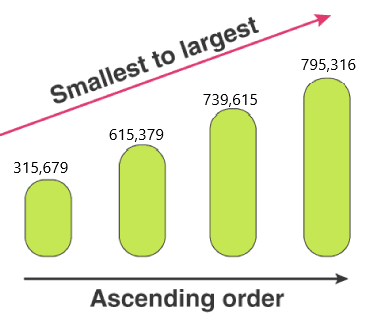
Answer: 315,679, 615,379, 739,615, 795,316.
Note: Least to greatest means ascending order.
Ascending order definition: Ascending order is a method of arranging numbers from smallest value to largest value. The order goes from left to right. Ascending order is also sometimes named as increasing order.
For example, a set of natural numbers are in ascending order, such as 1 < 2 < 3 < 4 < 5 < 6 < 7 < 8… and so on. The less than symbol (<), is used to denote the increasing order.
Math in Focus Grade 5 Chapter 1 Practice 4 Answer Key Comparing Numbers to 10,000,000 q7
The word ‘ascending’ means going up. Hence, in the case of Mathematics, if the numbers are going up, then they are arranged in ascending order.
The other terms used for ascending order are:
1. Lowest value to highest value
2. Bottom value to Top value
These numbers can be written by using the ascending symbol: 315,679< 615,379< 739,615< 795,316.
The symbol represents that the succeeding number is greater than the preceding number in the arrangement.

Question 8.

Math in Focus Grade 5 Chapter 1 Practice 4 Answer Key Comparing Numbers to 10,000,000 24
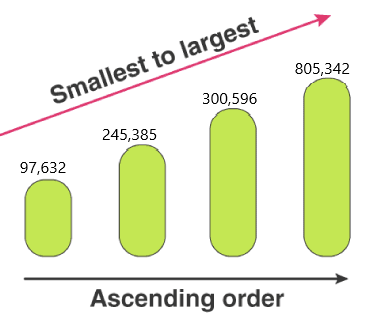
Answer: 97,632, 245,385, 300,596, 805,342.
Ascending order definition: Ascending order is a method of arranging numbers from smallest value to largest value. The order goes from left to right. Ascending order is also sometimes named as increasing order.
For example, a set of natural numbers are in ascending order, such as 1 < 2 < 3 < 4 < 5 < 6 < 7 < 8… and so on. The less than symbol (<), is used to denote the increasing order.
Math in Focus Grade 5 Chapter 1 Practice 4 Answer Key Comparing Numbers to 10,000,000 q8
The word ‘ascending’ means going up. Hence, in the case of Mathematics, if the numbers are going up, then they are arranged in ascending order.
The other terms used for ascending order are:
1. Lowest value to highest value
2. Bottom value to Top value
These numbers can be written by using the ascending symbol: 97,632< 245,385< 300,596< 805,342.
The symbol represents that the succeeding number is greater than the preceding number in the arrangement.

Compare the numbers. Use the place-value chart to help you.

Question 9.
Math in Focus Grade 5 Chapter 1 Practice 4 Answer Key Comparing Numbers to 10,000,000 25
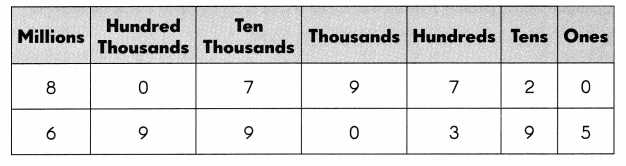
_______ millions is less than ____________________ millions.
_______ is less than ___________________ .
Answer: 6 million is less than 8 million
6,990,395 is less than 8,079,720.
A whole number is larger than another if it has more digits. If the number of digits in each number is the same, then look at the digits from left to right. If the left digit is larger in one number, then this is the largest number. If this digit is the same, compare the next digit along to the right.
1. We are comparing the numbers 8,079,720 and 6,990,395
2. The order of digits from smallest to largest is 0, 1, 2, 3, 4, 5, 6, 7, 8 and 9.
3. We start with the place value column on the left.
4. 6 is less than 8 because the digits of the millions place 6 and 8
5. Therefore, 6,990,395 is less than 8,079,720.
6. The comparison symbol for less than is <, pointing to the greater number of 8,079,720.

Question 10.
Math in Focus Grade 5 Chapter 1 Practice 4 Answer Key Comparing Numbers to 10,000,000 26
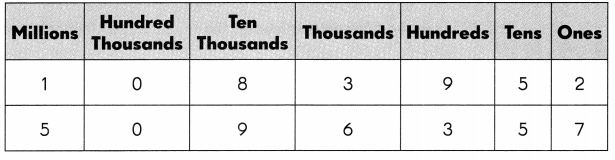
___ is greater than ____
Answer:5,096,357 is greater than 1,083,952.
A whole number is larger than another if it has more digits. If the number of digits in each number is the same, then look at the digits from left to right. If the left digit is larger in one number, then this is the largest number. If this digit is the same, compare the next digit along to the right.
1. We are comparing the numbers 5,096,357 and 1,083,952
2. The order of digits from smallest to largest is 0, 1, 2, 3, 4, 5, 6, 7, 8 and 9.
3. We start with the place value column on the left.
4. 5 is greater than 1 because the digits of the millions place 5 and 1
5. Therefore, 5,096,357 is less than 1,083,952.
6. The comparison symbol for greater than is >, pointing to the less number of 1,083,952.

Question 11.
Math in Focus Grade 5 Chapter 1 Practice 4 Answer Key Comparing Numbers to 10,000,000 27
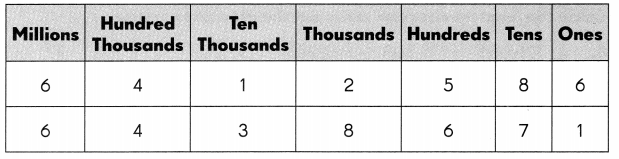
___ is greater than ____
Answer:6,438,671 is greater than 6,412,586.
A whole number is larger than another if it has more digits. If the number of digits in each number is the same, then look at the digits from left to right. If the left digit is larger in one number, then this is the largest number. If this digit is the same, compare the next digit along to the right.
1. We are comparing the numbers 6,438,671 and 6,412,586
2. The order of digits from smallest to largest is 0, 1, 2, 3, 4, 5, 6, 7, 8 and 9.
3. We start with the place value column on the left. The digits of millions and hundred thousands place are the same.
4. Now compare the next digits.
5. 3 is greater than 1 because the digits of the ten thousands  place 3 and 1
6. Therefore, 6,438,671 is less than 6,412,586.
7. The comparison symbol for greater than is >, pointing to the less number of 6,412,586.

Fill each Math in Focus Grade 5 Chapter 1 Practice 4 Answer Key Comparing Numbers to 10,000,000 28 with > or <.

Question 12.
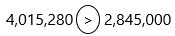
4,015,280 Math in Focus Grade 5 Chapter 1 Practice 4 Answer Key Comparing Numbers to 10,000,000 28 2,845,000
Answer: >
The greater than symbol in maths is placed between two values in which the first number is greater than the second number. In inequality, greater than symbol is always pointed to the greater value and the symbol consists of two equal length strokes connecting at an acute angle at the right. ( >).
Math in Focus Grade 5 Chapter 1 Practice 4 Answer Key Comparing Numbers to 10,000,000 q12
1. We are comparing the numbers 4,015,280 and 2,845,000
2. The order of digits from smallest to largest is 0, 1, 2, 3, 4, 5, 6, 7, 8 and 9.
3. We start with the place value column on the left.
5. 4 is greater than 2 because the digits of the millions  place 4 and 2
6. Therefore, 4,015,280 is greater than 2,845,000.
7. The comparison symbol for greater than is >, pointing to the less number of 2,845,000.

Question 13.
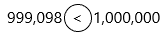
999,098 Math in Focus Grade 5 Chapter 1 Practice 4 Answer Key Comparing Numbers to 10,000,000 28 1,000,000
Answer:
A less than symbol is placed between two numbers where the first number is less than the second number. In inequality, less than symbol points to the smaller value where the two equal length strokes connect at an acute angle at the left (<).
Math in Focus Grade 5 Chapter 1 Practice 4 Answer Key Comparing Numbers to 10,000,000 q13
1. We are comparing the numbers 999,098 and 1,000,000
2. The order of digits from smallest to largest is 0, 1, 2, 3, 4, 5, 6, 7, 8 and 9.
3. We start with the place value column on the left.
5. 0 is less than 1 because the digits of the millions  place 0 and 1
6. Therefore, 999,098 is less than 1,000,000.
7. The comparison symbol for less than is <, pointing to the greater number of 1,000,000.

Question 14.
2,007,625 Math in Focus Grade 5 Chapter 1 Practice 4 Answer Key Comparing Numbers to 10,000,000 28 2,107,625
Answer:
A less than symbol is placed between two numbers where the first number is less than the second number. In inequality, less than symbol points to the smaller value where the two equal length strokes connect at an acute angle at the left (<).

Math in Focus Grade 5 Chapter 1 Practice 4 Answer Key Comparing Numbers to 10,000,000 q14
1. We are comparing the numbers 2,007,625 and 2,107,625.
2. The order of digits from smallest to largest is 0, 1, 2, 3, 4, 5, 6, 7, 8 and 9.
3. We start with the place value column on the left.
5. 0 is less than 1 because the digits of the hundred thousand  place 0 and 1
6. Therefore, 2,007,625 is less than 2,107,625.
7. The comparison symbol for less than is <, pointing to the greater number of 2,107,625.

Question 15.
7,405,319 Math in Focus Grade 5 Chapter 1 Practice 4 Answer Key Comparing Numbers to 10,000,000 28 905,407
Answer:
The greater than symbol in maths is placed between two values in which the first number is greater than the second number. In inequality, greater than symbol is always pointed to the greater value and the symbol consists of two equal length strokes connecting at an acute angle at the right. ( >).

Math in Focus Grade 5 Chapter 1 Practice 4 Answer Key Comparing Numbers to 10,000,000 q15
1. We are comparing the numbers 7,405,319 and 905,407
2. The order of digits from smallest to largest is 0, 1, 2, 3, 4, 5, 6, 7, 8 and 9.
3. We start with the place value column on the left.
5. 7 is greater than 0 because the digits of the millions place 7 and 0. In the second number, there is no millions place. So it becomes zero.
6. Therefore, 7,405,319 is greater than 905,407.
7. The comparison symbol for greater than is >, pointing to the less number of 905,407.

Order the numbers from greatest to least.

Question 16.

Math in Focus Grade 5 Chapter 1 Practice 4 Answer Key Comparing Numbers to 10,000,000 29
Answer: 3,190,000  2,720,000  2,432,000  480,000
Note: Greatest to least means descending order.
Descending order definition: In simple words, descending order is defined as an arrangement in the highest to lowest format. These concepts are related to decimals, numbers, fractions or amounts of money. This is also known as decreasing the order of numbers.
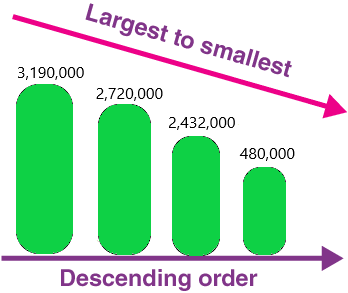
Math in Focus Grade 5 Chapter 1 Practice 4 Answer Key Comparing Numbers to 10,000,000 q16
The symbol used to represent the order in descending form is ‘ > ‘. The given numbers can be represented in this form using the descending symbol as 3,190,000>2,720,000>2,432,000>480,000.

Question 17.

Math in Focus Grade 5 Chapter 1 Practice 4 Answer Key Comparing Numbers to 10,000,000 30
Answer:3,150,000  2,020,000  913,000   513,900
Descending order definition: In simple words, descending order is defined as an arrangement in the highest to lowest format. These concepts are related to decimals, numbers, fractions or amounts of money. This is also known as decreasing the order of numbers.
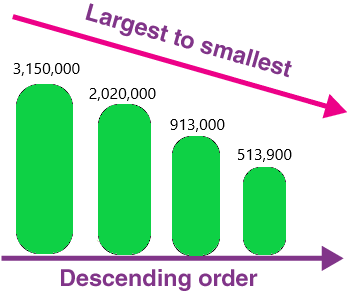
Math in Focus Grade 5 Chapter 1 Practice 4 Answer Key Comparing Numbers to 10,000,000 q17
The symbol used to represent the order in descending form is ‘ > ‘. The given numbers can be represented in this form using the descending symbol as 3,150,000>2,020,000>913,000>513,900.

Find the missing numbers.

Question 18.
738,561 938,561 1,138,561 …

a. 938,561 is ___ more than 738,561.
Answer: 200,000
Explanation:
To get the answer we need to subtract 938,561 and 738,561.
Math in Focus Grade 5 Chapter 1 Practice 4 Answer Key Comparing Numbers to 10,000,000 q18
Therefore, 200,000 is more than 738,561.

b. 1,138,561 is ___ more than 938,561.
Answer: 200000
Explanation:
To get the answer we need to subtract 1,138,561 and 938,561.
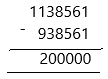
Math in Focus Grade 5 Chapter 1 Practice 4 Answer Key Comparing Numbers to 10,000,000 q18.b
Therefore, 200,000 is more than 938,561.
c. ____ more than 1,138,561 is ____
Answer: 200,000
We are looking for a new number which is 200000 more than 1138561.
We will get the new number by adding 200000 to 1138561.
We write it down as:
1138561+200000=1338561

d. The next number in the pattern is ____
Answer:1,338,561
In Mathematics, number patterns are the patterns in which a list number follows a certain sequence. Generally, the patterns establish the relationship between two numbers. It is also known as the sequence of series in numbers.
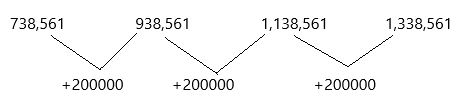
Math in Focus Grade 5 Chapter 1 Practice 4 Answer Key Comparing Numbers to 10,000,000 q18.d
Observation of number patterns can guide to simple processes and make the calculations easier.
By adding 200000 to the number we get the next number.
738,561+200000=938,561
938,561+200000=1,138,561
1,138,561+200000=1,338,561.
Therefore, the next number in the pattern is 1,338,561.

Question 19.
4,655,230 4,555,230 4,455,230 …

a. 4,555,230 is ___ less than 4,655,230.
Answer: 100000
Explanation:
To get the answer to add 100000 to the 4,555,230
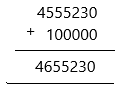
Math in Focus Grade 5 Chapter 1 Practice 4 Answer Key Comparing Numbers to 10,000,000 q19
Therefore, 100000 less to the 4,555,230 from the 4,6555,230.

b. 4,455,230  is ___ less than 4,555,230.
Answer: 100000
To get the answer to add 100000 to the 4,455,230
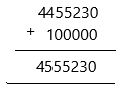
Math in Focus Grade 5 Chapter 1 Practice 4 Answer Key Comparing Numbers to 10,000,000 q19.b
Therefore, 100000 less to the 4,455,230 from the 4,555,230.

c. ___ less than 4,455,230 is ____
Answer: We are looking for a new number which is 4455230 less than 100000.
We will get the new number by subtracting 4455230 from 100000.
We write it down as:
4455230-100000=4355230

d. The next number in the pattern is ____
Answer:
In Mathematics, number patterns are the patterns in which a list number follows a certain sequence. Generally, the patterns establish the relationship between two numbers. It is also known as the sequence of series in numbers.
Observation of number patterns can guide to simple processes and make the calculations easier.

Math in Focus Grade 5 Chapter 1 Practice 4 Answer Key Comparing Numbers to 10,000,000 q19.c
By subtracting 100000 to the number we get the next number.
4,655,230-100000=4,555,230
4,555,230-100000=4,455,230
4,455,230-100000=4,355,230.
Therefore, the next number in the pattern is 4,355,230.

Find the rule. Then complete the number patterns.

Question 20.

Math in Focus Grade 5 Chapter 1 Practice 4 Answer Key Comparing Numbers to 10,000,000 31
Answer: 233,180    234,180
It is an arithmetic pattern.
Definition: The arithmetic pattern is also known as the algebraic pattern. In an arithmetic pattern, the sequences are based on the addition or subtraction of the terms. If two or more terms in the sequence are given, we can use addition or subtraction to find the arithmetic pattern.

Math in Focus Grade 5 Chapter 1 Practice 4 Answer Key Comparing Numbers to 10,000,000 q20
The given terms are 230,180    231,180    232, 180    –    –  Now find the missing term in the sequence.
Here, we can use the addition process to figure out the missing terms in the patterns.
In the pattern, the rule used is “Add 1 to the previous term to get the next term”.
Now take the second term 231, 180  If we add 1 to the second term (231), we get the third term (232) and the 180 repeats like that.
Similarly, we can find the unknown terms in the sequence.
First missing term: The previous term is 232. Therefore, 232+1 = 233.
Second missing term: The previous term is 233. So, 233+1 = 234.
Hence, the complete arithmetic pattern is 230, 180  231, 180  232, 180  233, 180  234,180.

Question 21.

Math in Focus Grade 5 Chapter 1 Practice 4 Answer Key Comparing Numbers to 10,000,000 32
Answer: 835, 400      830, 400
It is an arithmetic pattern.
Definition: The arithmetic pattern is also known as the algebraic pattern. In an arithmetic pattern, the sequences are based on the addition or subtraction of the terms. If two or more terms in the sequence are given, we can use addition or subtraction to find the arithmetic pattern.

Math in Focus Grade 5 Chapter 1 Practice 4 Answer Key Comparing Numbers to 10,000,000 q21
The given terms are 850, 400   845, 400    840, 400    –    –  Now find the missing term in the sequence.
Here, we can use the subtraction process to figure out the missing terms in the patterns.
In the pattern, the rule used is “subtract 5 to the previous term to get the next term”.
Now take the second term 845, 400  If we subtract 5 to the second term (845), we get the third term (840) and the 400 repeats like that.
Similarly, we can find the unknown terms in the sequence.
First missing term: The previous term is 840. Therefore, 840-5 = 835.
Second missing term: The previous term is 835. So, 835-5 = 830.
Hence, the complete arithmetic pattern is 850, 400  845, 400  840, 400,  835, 400  830, 400.

Question 22.

Answer: 5,650,719   6,650,719
It is an arithmetic pattern.
Definition: The arithmetic pattern is also known as the algebraic pattern. In an arithmetic pattern, the sequences are based on the addition or subtraction of the terms. If two or more terms in the sequence are given, we can use addition or subtraction to find the arithmetic pattern.

Math in Focus Grade 5 Chapter 1 Practice 4 Answer Key Comparing Numbers to 10,000,000 q22
The given terms are 2,650,719  3,650,719  4,650,719    –    –  Now find the missing term in the sequence.
Here, we can use the addition process to figure out the missing terms in the patterns.
In the pattern, the rule used is “Add 1,000,000 to the previous term to get the next term”.
Now take the second term 3,650,719  If we add 1,000,000 to the second term (3,650,719), we get the third term (4,650,719).
Similarly, we can find the unknown terms in the sequence.
First missing term: The previous term is 4,650,719. Therefore, 4,650,719+1,000,000=5,650,719.
Second missing term: The previous term is 5,650,719. So, 5,650,719+1,000,000=6,650,719.
Hence, the complete arithmetic pattern is 2,650,719   3,650,719    4,650,719    5,650,719    6,650,719.

Question 23.

Math in Focus Grade 5 Chapter 1 Practice 4 Answer Key Comparing Numbers to 10,000,000 34
Answer:
It is an arithmetic pattern.
Definition: The arithmetic pattern is also known as the algebraic pattern. In an arithmetic pattern, the sequences are based on the addition or subtraction of the terms. If two or more terms in the sequence are given, we can use addition or subtraction to find the arithmetic pattern.

Math in Focus Grade 5 Chapter 1 Practice 4 Answer Key Comparing Numbers to 10,000,000 q23
The given terms are 6,298,436   5,198,436  4,098,436   –    –  Now find the missing term in the sequence.
Here, we can use the subtraction process to figure out the missing terms in the patterns.
In the pattern, the rule used is “subtract 1,100,000 to the previous term to get the next term”.
Now take the second term 5,198,436  If we subtract 1,100,000 to the second term (5,198,436), we get the third term (4,098,436).
Similarly, we can find the unknown terms in the sequence.
First missing term: The previous term is 4,098,436. Therefore, 4,098,436-1,100,000=2,998,436.
Second missing term: The previous term is 2,998,436. So, 2,998,436-1,100,000=1,898,436.
Hence, the complete arithmetic pattern is 6,298,436  5,198,436  4,098,436  2,998,436  1,898,436.

Complete.

Question 24.
5,083,000 = 5,000,000 + ___ + 3,000 Math in Focus Grade 5 Chapter 1 Practice 4 Answer Key Comparing Numbers to 10,000,000 35
Answer:80,000
Place value in Maths describes the position or place of a digit in a number. Each digit has a place in a number. When we represent the number in general form, the position of each digit will be expanded. Those positions start from a unit place or we also call it one’s position. The order of place value of digits of a number of right to left is units, tens, hundreds, thousands, ten thousand, a hundred thousand, and so on.
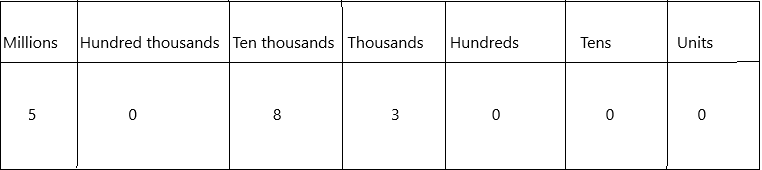
Math in Focus Grade 5 Chapter 1 Practice 4 Answer Key Comparing Numbers to 10,000,000 q24
The value of digit for the given number 5,083,000:
: 5×1,000,000+0x100,000+8×10,000+3×1000+0x100+0x10+0x1
: 5,000,000+0+80,000+3000+0+0+0
: 5,000,000+80,000+3,000.

Question 25.
5,000,000 + 600,000 + 2,000 = ___ Math in Focus Grade 5 Chapter 1 Practice 4 Answer Key Comparing Numbers to 10,000,000 36
Answer: 5,602,000
Place value in Maths describes the position or place of a digit in a number. Each digit has a place in a number. When we represent the number in general form, the position of each digit will be expanded. Those positions start from a unit place or we also call it one’s position. The order of place value of digits of a number of right to left is units, tens, hundreds, thousands, ten thousand, a hundred thousand, and so on.
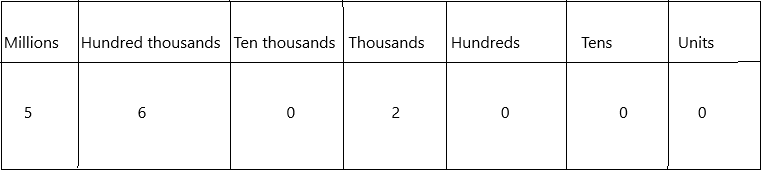
Math in Focus Grade 5 Chapter 1 Practice 4 Answer Key Comparing Numbers to 10,000,000 q25
The value of digit for the given number 5,602,000:
: 5×1,000,000+6×100,000+0x10,000+2×1000+0x100+0x10+0x1
: 5,000,000+600,000+0+2000+0+0+0
: 5,000,000+600,000+2,000.
The number is 5,602,000.

Question 26.
Which is greater, 509,900 or 562,000? ___ Math in Focus Grade 5 Chapter 1 Practice 4 Answer Key Comparing Numbers to 10,000,000 37
Answer: 562,000 is greater.
Explanation:
A whole number is larger than another if it has more digits. If the number of digits in each number is the same, then look at the digits from left to right. If the left digit is larger in one number, then this is the largest number. If this digit is the same, compare the next digit along to the right.
1. We are comparing the numbers 509,900 and 562,000
2. The order of digits from smallest to largest is 0, 1, 2, 3, 4, 5, 6, 7, 8 and 9.
3. We start with the place value column on the left.
4. The hundred thousand place digits are the same in both numbers. Now compare the next digits.
5. 6 is greater than 0 because of the digits of the ten thousand place 0 and 6.
6. Therefore, 562,000 is greater than 509,900.
7. The comparison symbol for greater than is >, pointing to the less number of 509,900.

Question 27.
Which is less, 1,020,000 or 1,002,000? ___ Math in Focus Grade 5 Chapter 1 Practice 4 Answer Key Comparing Numbers to 10,000,000 38
Answer: 1,002,000 is less.
Here already asked which number is less than another number.
1. We are comparing the numbers 1,020,000 and 1,002,000.
2. The order of digits from smallest to largest is 0, 1, 2, 3, 4, 5, 6, 7, 8 and 9.
3. We start with the place value column on the left.
4. The millions, hundred thousand place digits are the same in both numbers. Now compare the next digits.
5. 0 is less than 2 because the digits of the ten thousand  place 0 and 2
6. Therefore, 1,002,000 is less than 1,020,000.
7. The comparison symbol for less than is <, pointing to the greater number of 1,020,000.

Question 28.
The value of the digit 1 in 7,1 20,000 is _100,000 and the place value is a hundred thousand.___ Math in Focus Grade 5 Chapter 1 Practice 4 Answer Key Comparing Numbers to 10,000,000 39

What goes around the world but remains in one corner? Write the letters that match the answers below to find out.

Math in Focus Grade 5 Chapter 1 Practice 4 Answer Key Comparing Numbers to 10,000,000 40
Answer: Stamp.
Math in Focus Grade 5 Chapter 1 Practice 4 Answer Key Comparing Numbers to 10,000,000 q28
Why I choose 80,000:
Explanation:
Math in Focus Grade 5 Chapter 1 Practice 4 Answer Key Comparing Numbers to 10,000,000 q28.1
For the given question the answer: stamp.
1. The stamp is having 5 letters.
2. In the given numbers check for the place values which is having up to 5 places.
3. Now check all the numbers and when coming to the 80,000, the place values are 8 in ten thousand, 0’s is in thousands, hundreds, tens and units place.
4. So, I think 80,000 will be the correct match to those 5 letters.
5. The five letters are ‘s’ ‘t’ ‘a’ ‘m’ ‘p’.

Read More:

BPCL Pivot Point Calculator
Math in Focus Grade 1 Chapter 8 Practice 3 Answer Key Ways to Add

Practice the problems of Math in Focus Grade 1 Workbook Answer Key Chapter 8 Practice 3 Ways to Add to score better marks in the exam.

Math in Focus Grade 1 Chapter 8 Practice 3 Answer Key Ways to Add

Complete each addition sentence.

Example
What is double 1?
Math in Focus Grade 1 Chapter 8 Practice 3 Answer Key Ways to Add 1
Double 1 means to add 1 more to 1.
1 + 1 = 2

Question 1.
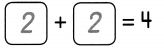
What is double 2?
Math in Focus Grade 1 Chapter 8 Practice 3 Answer Key Ways to Add 2
Double 2 means to add ___ more to 2.
___ + ___ = ____
Answer:
Double 2 means to add 2 more to 2.
2 + 2 = 4

Question 2.
What is double 3?
Math in Focus Grade 1 Chapter 8 Practice 3 Answer Key Ways to Add 3
Double 3 means to add ___ more to 3.
____ + ___ = ___
Answer:
Double 3 means to add 3 more to 3.
3 + 3 = 6

Question 3.
4 + 4 = ____
Answer: 8

Question 4.
5 + 5 = ____
Answer: 10

Complete each addition sentence.

Question 5.
a. 3 + 3 = ____
3 + 4 = ____
Answer:
3 + 3 = 6
3 + 4 = 7

b. 3 + 3 is double ____
3 + 4 is double ____ plus ____
Answer:
3 + 3 is double 6
3 + 4 is double 6 plus 1

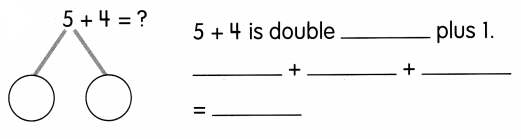
Complete the number bonds. Then fill in the blanks.

Example
Math in Focus Grade 1 Chapter 8 Practice 3 Answer Key Ways to Add 4

Question 6.
Math in Focus Grade 1 Chapter 8 Practice 3 Answer Key Ways to Add 5
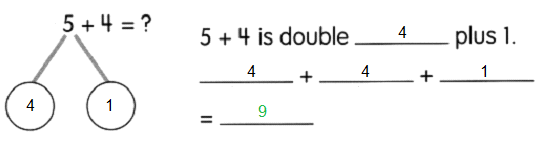
Answer:
Math in Focus Grade 1 Chapter 8 Practice 3 Answer Key Ways to Add_1

Question 7.
Math in Focus Grade 1 Chapter 8 Practice 3 Answer Key Ways to Add 6
Answer:
Math in Focus Grade 1 Chapter 8 Practice 3 Answer Key Ways to Add_2

Use doubles facts to complete the addition sentences.

Example
Math in Focus Grade 1 Chapter 8 Practice 3 Answer Key Ways to Add 7

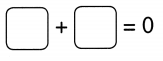
Question 8.
Math in Focus Grade 1 Chapter 8 Practice 3 Answer Key Ways to Add 8
Answer: 0 + 0 = 0

Question 9.
Math in Focus Grade 1 Chapter 8 Practice 3 Answer Key Ways to Add 9
Answer: 6 + 6 = 12

Question 10.
Math in Focus Grade 1 Chapter 8 Practice 3 Answer Key Ways to Add 10
Answer: 5 + 5 = 10

Question 11.
Math in Focus Grade 1 Chapter 8 Practice 3 Answer Key Ways to Add 11
Answer: 8 + 8 = 16

Question 12.
Math in Focus Grade 1 Chapter 8 Practice 3 Answer Key Ways to Add 12
Answer: 9 + 9 = 18

Question 13.
Math in Focus Grade 1 Chapter 8 Practice 3 Answer Key Ways to Add 13
Answer: 10 + 10 = 20

Add the doubles-plus one numbers. Use doubles facts to help you. Then write the doubles fact you used.

Example
5 + 6 = 11
Doubles fact: 5 + 5 = 10

Question 14.
7 + 6 = ____
Doubles fact: ___ + ____ = _____
Answer:
7 + 6 = 13
Doubles fact: 6 + 6 = 12

Question 15.
7 + 8 = ____
Doubles fact: ___ + ____
Answer:
7 + 8 = 15
Doubles fact: 7 + 7 = 14

Question 16.
9 + 10 = ____
Doubles fact: ___ + ____
Answer:
9 + 10 = 19
Doubles fact: 9 + 9 = 18

Question 17.
8 + 9 = ____
Doubles fact: ___ + ____
Answer:
8 + 9 = 17
Doubles fact: 8 + 8 = 16

Read More:

Apollohosp Pivot Calculator

Math in Focus Grade 5 Chapter 6 Practice 1 Answer Key Finding the Area of a Rectangle with Fractional Side Lengths

Practice the problems of Math in Focus Grade 5 Workbook Answer Key Chapter 6 Practice 1 Finding the Area of a Rectangle with Fractional Side Lengths to score better marks in the exam.

Math in Focus Grade 5 Chapter 6 Practice 1 Answer Key Finding the Area of a Rectangle with Fractional Side Lengths

Example
Math in Focus Grade 5 Chapter 6 Practice 1 Answer Key Finding the Area of a Rectangle with Fractional Side Lengths 1

Question 1.
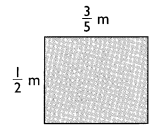
Math in Focus Grade 5 Chapter 6 Practice 1 Answer Key Finding the Area of a Rectangle with Fractional Side Lengths 2
A = ____ × width
= ____ × \(\frac{1}{2}\)
= ___ m2
The area of the rectangle is ____ square meters.
Answer:
Area = length × width
A = 3/5 × 1/2
A = 3/10 m2
Explanation:
In the above image we can observe that length is 3/5 m and width is 1/2 m. The area of the rectangle is 3/10 square meters.

Question 2.
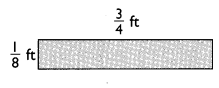
Math in Focus Grade 5 Chapter 6 Practice 1 Answer Key Finding the Area of a Rectangle with Fractional Side Lengths 3
Answer:
Area = length × width
A = 3/4 × 1/8
A = 3/32 ft2
Explanation:
In the above image we can observe that length is 3/4 feet and width is 1/8 feet. The area of the rectangle is 3/32 square feet.

Find the area of each rectangle.

Question 3.
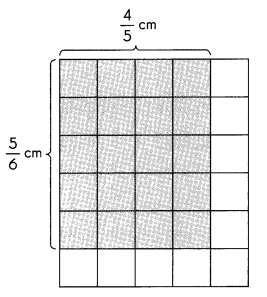
Math in Focus Grade 5 Chapter 6 Practice 1 Answer Key Finding the Area of a Rectangle with Fractional Side Lengths 4
Answer:
Area = length × width
A = 4/5 × 5/6
A = 2/3 cm2
Explanation:
In the above image we can observe that length is 4/5 cm and width is 5/6 cm. The area of the rectangle is 2/3 square centimeters.

Question 4.
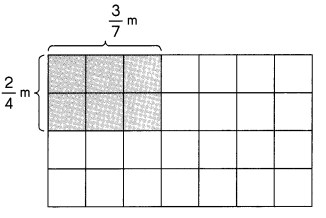
Math in Focus Grade 5 Chapter 6 Practice 1 Answer Key Finding the Area of a Rectangle with Fractional Side Lengths 5
Answer:
Area = length × width
A = 3/7 × 2/4
A = 3/14 m2
Explanation:
In the above image we can observe that length is 3/7 m and width is 2/4 m. The area of the rectangle is 3/14 square meters.

Question 5.
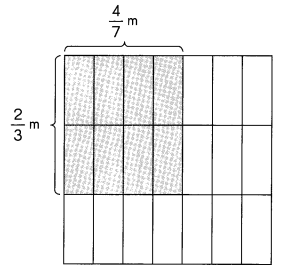
A 1 -meter square plot of land is covered by a rectangular patch of grass that measures \(\frac{4}{7}\) meter by \(\frac{2}{3}\) meter. What is the area of the patch of grass?
Math in Focus Grade 5 Chapter 6 Practice 1 Answer Key Finding the Area of a Rectangle with Fractional Side Lengths 6
Answer:
Area = length × width
A = 4/7 × 2/3
A =8/21 m2
Explanation:
In the above image we can observe that length is 4/7 m and width is 2/3 m. The area of the rectangular patch of grass is 8/21 square meters.

Question 6.
Find the area of the top of a rectangle bedside table with a length of \(\frac{3}{4}\) yard and width that is \(\frac{1}{6}\) yard less than the length.
Answer:
Length = 3/4 yard
width = (3/4 – 1/6) yard
= 7/12 yard
Area = length × width
A = 3/4× 7/12
A = 7/16 yard2
Explanation:
The area of the top of a rectangle bedside table with a length of 3/4 yard and width of 7/12 yard is 7/16 square yards.

Find the area of each composite figure.

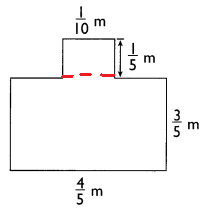
Question 7.
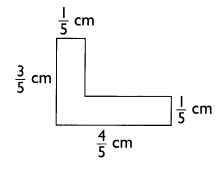
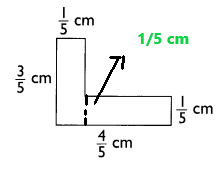
Math in Focus Grade 5 Chapter 6 Practice 1 Answer Key Finding the Area of a Rectangle with Fractional Side Lengths 7
Answer:
Math-in-Focus-Grade-5-Chapter-6-Practice-1-Answer-Key-Finding-the-Area-of-a-Rectangle-with-Fractional-Side-Lengths-7
Area of the rectangle = length ×  width
A = (3/5 ×  1/5) + (3/5 ×  1/5)
A = 3/25 + 3/25
A = 6/25 cm2
Explanation:
To calculate the area we have divided the image into two rectangles.
Length and width of first rectangle are 3/5 cm and 1/5 cm.
So, Area of first rectangle = 3/5 × 1/5 = 3/25 cm2
Length of second rectangle is 3/5 cm (4/5 – 1/5 ) and width is 1/5 cm.
So, Area of second rectangle = 3/5 × 1/5 = 3/25 cm2
Hence, total area of the image = 3/25 + 3/25 = 6/25 cm2
Question 8.
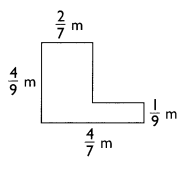
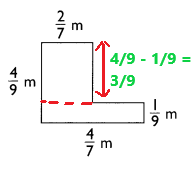
Math in Focus Grade 5 Chapter 6 Practice 1 Answer Key Finding the Area of a Rectangle with Fractional Side Lengths 8
Answer:
Math-in-Focus-Grade-5-Chapter-6-Practice-1-Answer-Key-Finding-the-Area-of-a-Rectangle-with-Fractional-Side-Lengths-8
Explanation:
Area of the rectangle = length ×  width
A = (3/9 ×  2/7) + (4/7 ×  1/9)
A = 6/63 + 4/63
A = 10/63 m2
Explanation:
To calculate the area we have divided the image into two rectangles.
Length of first rectangle is 3/9 m (4/9 – 1/9 ) and width is 2/7 m.
So, Area of first rectangle = 3/9 × 2/7 = 6/63 m2
Length and width of second rectangle are 4/7 m and 1/9 m.
So, Area of second rectangle =4/7 × 1/9 = 4/63 m2
Hence, total area of the image = 6/63 + 4/63 = 10/63 m2

Question 9.
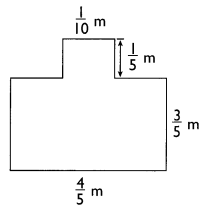
Math in Focus Grade 5 Chapter 6 Practice 1 Answer Key Finding the Area of a Rectangle with Fractional Side Lengths 9
Answer:
Math-in-Focus-Grade-5-Chapter-6-Practice-1-Answer-Key-Finding-the-Area-of-a-Rectangle-with-Fractional-Side-Lengths-9

Area of the rectangle = length ×  width
A = (4/5 ×  3/5) + (1/10×  1/5)
A = 12/25 + 1/50
A = (24 + 1)/ 50
A = 1/2 m2
Explanation:
To calculate the area we have divided the image into two rectangles.
Length of first rectangle is 4/5 m and width is 3/5 m.
So, Area of first rectangle = 4/5 × 3/5 = 12/25 m2
Length and width of second rectangle are 1/10 m and 1/5 m.
So, Area of second rectangle = 1/10 × 1/5 = 1/50 m2
Hence, total area of the image = 12/25+ 1/50 = (24 + 1)/50 = 1/2 m2

Question 10.
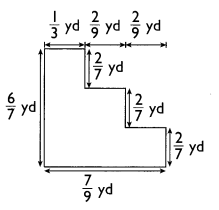
Math in Focus Grade 5 Chapter 6 Practice 1 Answer Key Finding the Area of a Rectangle with Fractional Side Lengths 10
Answer:
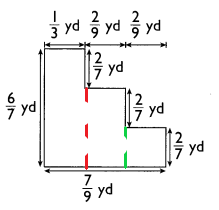
Math-in-Focus-Grade-5-Chapter-6-Practice-1-Answer-Key-Finding-the-Area-of-a-Rectangle-with-Fractional-Side-Lengths-10
Area of the rectangle = length ×  width
A = (6/7 ×  1/3) + (4/7 ×  2/9) + (2/7 ×  2/9)
A = 2/7 + 8/63 + 4/63
A = (18 + 8 + 4)/63
A = 30/63 Yd2
Explanation:
To calculate the area we have divided the image into three rectangles.
Length and width of first rectangle are 6/7 yard and 1/3 yard.
So, Area of first rectangle =6/7 × 1/3 = 2/7 yd2
Length and width of second rectangle are 4/7 yard and 2/9 yard.
So, Area of second rectangle = 4/7 × 2/9 = 8/63 yd2
Length of third rectangle is 2/7 yard and width is 2/9 yard.
So, Area of third rectangle = 2/7 × 2/9 = 4/63 yd2
Hence, total area of the image = 2/7 + 8/63 + 4/63 = 30/63 yd2

Find the area of the shaded part.

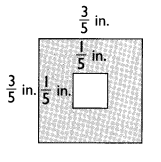
Question 11.
Math in Focus Grade 5 Chapter 6 Practice 1 Answer Key Finding the Area of a Rectangle with Fractional Side Lengths 11
Answer:
Area of the square = length ×  width
A = (3/5 ×  3/5) – (1/5 × 1/5)
A = 9/25 – 1/25
A = 8/25 in2
Explanation:
To calculate the area we have subtract inner square from outer square.
Length and width of outer square are 3/5 in and 3/5 in.
So, Area of outer square = 3/5 × 3/5 = 9/25 in2
Length and width of inner square are 1/5 in and 1/5 in.
So, Area of inner square = 1/5 × 1/5 = 1/25 in2
Hence, area of the shaded part = 9/25 – 1/25 = 8/25 in2

Question 12.
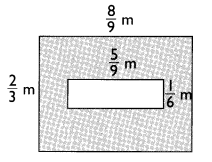
Math in Focus Grade 5 Chapter 6 Practice 1 Answer Key Finding the Area of a Rectangle with Fractional Side Lengths 12
Answer:
Area of the rectangle = length ×  width
A = (8/9 × 2/3) – (5/9 × 1/6)
A = 16/27 – 5/54
A = (32 – 5)/54
A = 1/2 m2
Explanation:
To calculate the area we have subtract inner rectangle from outer rectangle.
Length and width of outer rectangle are 8/9 m and 2/3 m.
So, Area of outer rectangle =8/9 × 2/3 = 16/27 m2
Length and width of inner rectangle are 5/9 m and 1/6 m.
So, Area of inner rectangle = 5/9 × 1/6 = 5/54 m2
Hence, area of the shaded part = 16/27 – 5/54 = 27/54 = 1/2m2

Read More:

Easy Pivot Point Calculator
Math in Focus Grade 2 Cumulative Review Chapters 7 to 9 Answer Key

Practice the problems of Math in Focus Grade 2 Workbook Answer Key Cumulative Review Chapters 7 to 9 to score better marks in the exam.

Math in Focus Grade 2 Cumulative Review Chapters 7 to 9 Answer Key

Concepts and Skills

Fill in the blank.

Question 1.
Which is longer, 3 meters or 5 meters? ___ m
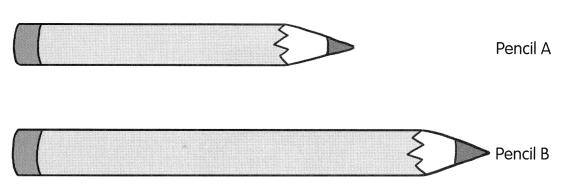
Measure the pencils.
Then fill in the blanks.
Math in Focus Grade 2 Cumulative Review Chapters 7 to 9 Answer Key 1
Answer: 5 meters is long.
meter is a SI unit scientifically accepted as the base unit of distance and length. Along with other units like a kilometre or an inch, a meter is one of the fundamental units in SI. One meter equals the length of the path that a light travels in a vacuum for the time of 1/299,792,458 seconds. SI symbol for meter is m, and one meter is 100 centimetres or 1/1000th (10-3) of a kilometre.
5>3 so 5 metres is long.

Question 2.
Pencil A is ___ centimetres.
Answer: 300 centimetres.
Definition: Centimeter is considered a common unit of length used in SI. It is equivalent to 10 millimetres or 1/100th (10-2) of a meter. Years ago it was a basic unit in formerly used CGS (centimetre-gram-second) unit system, but in modern times the role of the basic unit of length is played by a meter. The symbol of centimetre is cm.
This is very easy to use a metre to centimetre converter. First of all, just type the meter (m) value in the text field of the conversion form to start converting m to cm, then select the decimals value and finally hit the convert button if auto calculation didn’t work. Centimetre value will be converted automatically as you type. The decimals value is the number of digits to be calculated or rounded of the result of meter to centimetre convert.
1 metre=100 centimetres.
Use the formula below to convert any value from meters to cm:
Centimetres=metres×100
To from meters to centimetres, you just need to multiply the value in meters by 100. (It is called the conversion factor)
Therefore, centimetres=3×100=300.
Math in Focus Grade 2 Cumulative Review Chapters 7 to 9 Answer Key q2


Question 3.
Pencil B is ___ centimetres.
Answer: 500 centimetres.
Explanation:
1 metre=100 centimetres.
Use the formula below to convert any value from meters to cm:
Centimetres=metres×100
To from meters to centimetres, you just need to multiply the value in meters by 100. (It is called the conversion factor)
Therefore, centimetres=5×100=500.
Math in Focus Grade 2 Cumulative Review Chapters 7 to 9 Answer Key q3

Question 4.
Which pencil is shorter? Pencil ______
Answer: Pencil A is shorter.
Math in Focus Grade 2 Cumulative Review Chapters 7 to 9 Answer Key q2
Because it is 300 cms which is lesser than pencil B.

Question 5.
How much shorter is it? ___ cm
Answer: 300 cms.
Pencil A is 300 cm shorter.

Draw. Then label.

Question 6.
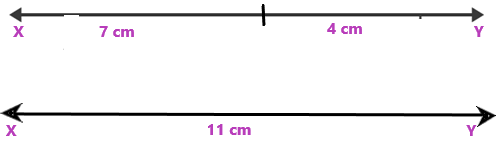
Draw a line 7 centimetres long. Label it Line X.
__________
Answer:
– Construct a line L on a paper and mark A on it.
– Now place the metal point of the compass at the zero mark of the ruler.
– Make adjustments in the compass such that the pencil point is at the 7 cm mark on the ruler.
– Take compass on L such that its metal point is on A.
– Now mark a small mark as B on L which is corresponding to the pencil point of the compass.
– Here, AB is the required line segment of length 7 cm.
– The line is marked with X.
Math in Focus Grade 2 Cumulative Review Chapters 7 to 9 Answer Key q4

Question 7.
Draw a line 4- centimetres longer than Line X. Label it Line Y.
______________
Answer: 11 cm.
– Construct a line L on a paper and mark X on it.
– Now place the metal point of the compass at the zero mark of the ruler.
– Make adjustments in the compass such that the pencil point is at the 7 cm mark on the ruler and then mark 4 cms.
– Take compass on L such that its metal point is on X.
– Now mark a small mark as Y on L which is corresponding to the pencil point of the compass.
– Here, XY is the required line segment of length 11 cm.
– The line is marked with X and Y. And the total is 7+4=11 cm.
Math in Focus Grade 2 Cumulative Review Chapters 7 to 9 Answer Key q5

Fill in the blanks.

Question 8.
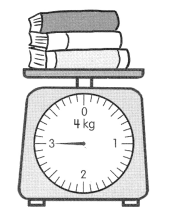
Math in Focus Grade 2 Cumulative Review Chapters 7 to 9 Answer Key 2
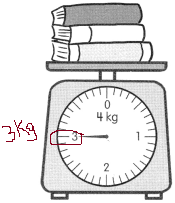
The books have a mass of ____ kilograms.
Answer: 3 kilograms.
Definition: kilogram (kg), the basic unit of mass in the metric system. A kilogram is very nearly equal (it was originally intended to be exactly equal) to the mass of 1,000 cubic cm of water. The pound is defined as equal to 0.45359237 kg, exactly. It is defined as being equal to the mass of the international prototype of the kilogram.
Explanation:
– It is showing the hand on 3.
– So it is 3 kgs.
Math in Focus Grade 2 Cumulative Review Chapters 7 to 9 Answer Key q6

Question 9.
Math in Focus Grade 2 Cumulative Review Chapters 7 to 9 Answer Key 3
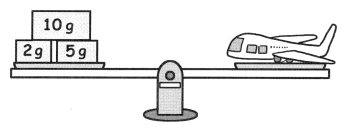
The toy aeroplane has a mass of ___ grams.
Answer: 17 grams.
Explanation:
The weights are 10, 2, 5.
Add all the grams to get total mass. 10+2+5=17 grams.
Therefore, the toy aeroplane has a mass of 17 grams.

Fill in the blanks.

Math in Focus Grade 2 Cumulative Review Chapters 7 to 9 Answer Key 4

Question 10.
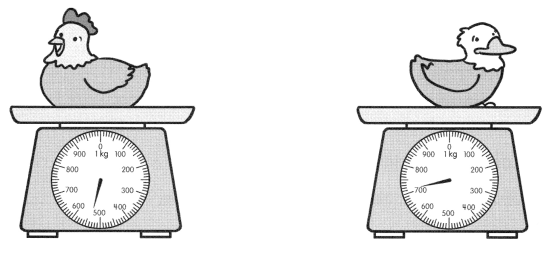
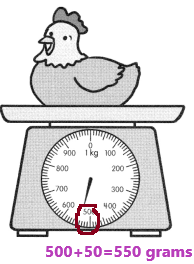
The chicken has a mass of ___ grams.
Answer: 550 grams.
Math in Focus Grade 2 Cumulative Review Chapters 7 to 9 Answer Key q10
– The gram is a unit of mass.
– One gram is one-thousandth the mass of one kilogram. The previous definition of the gram was the absolute weight of a 1-centimetre cube of pure water at 4 °C.
– The symbol for the gram is g.
– The gram is a small unit of mass. It is approximately the mass of one small paper clip.
Explanation:
– The hand is showing on after 500. And the small measurements can be written as 10,20, 20, 40, 50, 60, 70, 80, 90, and 100.
– The hand is showing on 50. So it is 550 grams.(500+50=550).

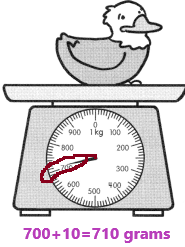
Question 11.
The duck has a mass of ____ grams.
Answer: 710 grams.
– The gram is a unit of mass.
– One gram is one-thousandth the mass of one kilogram. The previous definition of the gram was the absolute weight of a 1-centimetre cube of pure water at 4 °C.
– The symbol for the gram is g.
– The gram is a small unit of mass. It is approximately the mass of one small paper clip.
Explanation:
Math in Focus Grade 2 Cumulative Review Chapters 7 to 9 Answer Key q11
– The hand is showing on after 700. And the small measurements can be written as 10,20, 20, 40, 50, 60, 70, 80, 90, and 100.
– The hand is showing on 10. So it is 710 grams. (700+10=710).

Question 12.
Which is lighter? ____
Answer: Chicken.
Explanation:
The mass of chicken is 550 grams and the mass of duck is 710 grams. By comparing both grams chicken is lighter than duck because the weight of duck is more than chicken.
550<710.

Question 13.
How much lighter is it? ___ g
Answer:160 grams lighter.
Explanation:
By comparing both duck is having higher mass and the chicken is 550 gms.
To know how much lighter the chicken we need to subtract duck mass and chicken mass. Assume it as X.
X= 710-550
X=160 grams.

Fill in the blank.

Question 14.
Math in Focus Grade 2 Cumulative Review Chapters 7 to 9 Answer Key 5
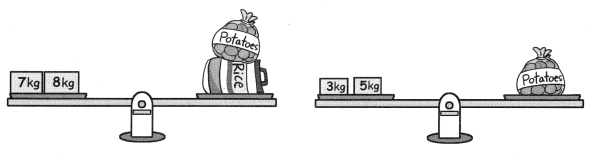
What is the mass of the bag of rice? __ kg
Answer:7 kgs.
Definition: kilogram (kg), the basic unit of mass in the metric system. A kilogram is very nearly equal (it was originally intended to be exactly equal) to the mass of 1,000 cubic cm of water. The pound is defined as equal to 0.45359237 kg, exactly. It is defined as being equal to the mass of the international prototype of the kilogram.
Explanation:
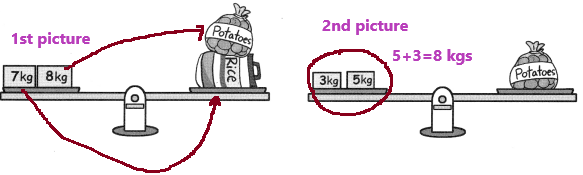
How do I choose the bag of rice that is 7 kgs? I will explain below:
Math in Focus Grade 2 Cumulative Review Chapters 7 to 9 Answer Key q12
– Observe the 2nd picture, In that the total weight of potatoes are given.
– The weight of potatoes are 3kg+5kg=8kg.
– In the first picture, two different masses are there. Those are rice and potatoes.
– We already know the potatoes weight that is 8 kgs and the remaining 7 kgs are rice.

Look at the pictures. Then fill in the blank.

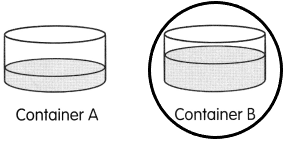
Question 15.
Math in Focus Grade 2 Cumulative Review Chapters 7 to 9 Answer Key 6
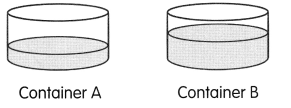
Containers A and B are the same size. Which container has a greater volume of water? Container ____
Answer: container B
Math in Focus Grade 2 Cumulative Review Chapters 7 to 9 Answer Key q15
Observe the pictures carefully. Containers are equal but the water in them is different volumes. Container B is having more water than Container A. So I circles Container B.

Fill in the blanks.

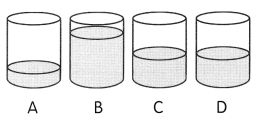
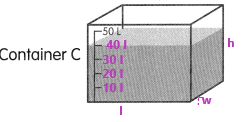
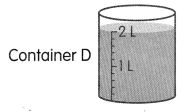
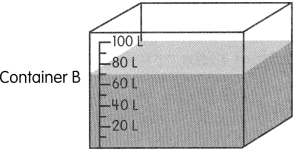
Math in Focus Grade 2 Cumulative Review Chapters 7 to 9 Answer Key 7
Containers A, B, C, and D are the same size.

Question 16.
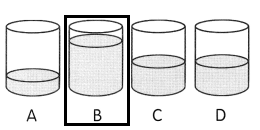
Which container has the most water? Container ____
Answer: Container B.
Definition of volume:
– Volume is the number of shares of security traded during a given period of time.
– Generally, securities with more daily volume are more liquid than those without, since they are more “active”.
– Volume is an important indicator in technical analysis because it is used to measure the relative significance of a market move.
– The higher the volume during a price move, the more significant the move and the lower the volume during a price move, the less significant the move.
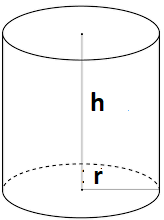
– Formula: Volume of cylinder=π · r2 · h

Math in Focus Grade 2 Cumulative Review Chapters 7 to 9 Answer Key q16
Observe the pictures carefully. Containers are equal but the water in them is different volumes. Container B is having more water than Container A, c, and D. So I circled the B container.
Question 17.
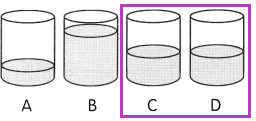
Container ___ contains the same amount as Container ____
Answer: C and D.
Container C and Container D have the same amount of water.
– If the water is in a cylindrical container, then the volume of that water is calculated using the formula to calculate the volume of the cylinder.
– If the water is only halfway high in the container, then you’ll need to use half the height of the cylinder in the formula.
Formula: Volume=π · r2 · h
Math in Focus Grade 2 Cumulative Review Chapters 7 to 9 Answer Key q17

Find the volume of water in each container.

Example
Math in Focus Grade 2 Cumulative Review Chapters 7 to 9 Answer Key 8

Question 18.
Math in Focus Grade 2 Cumulative Review Chapters 7 to 9 Answer Key 9
Volume of water = ___ or ____
Answer: 70 litres.
The volume of water is 70 litres or 70l.
Explanation:
– The volume of water is as good as the shape of the reservoir (container) it’s in. Often, the containers have a circular, rectangular or square cross-section.
– For a rectangular based container, we use the formula to calculate the volume of a rectangular prism also known as a cuboid.
– Formula: volume=l × b × h
Math in Focus Grade 2 Cumulative Review Chapters 7 to 9 Answer Key q18.1
– The volume of water is 70 l and each litre difference in between them is 10.

Question 19.
Math in Focus Grade 2 Cumulative Review Chapters 7 to 9 Answer Key 10
Volume of water = ___ or ____
Answer: 40 l
Explanation:
– The volume of water is as good as the shape of the reservoir (container) it’s in. Often, the containers have a circular, rectangular or square cross-section.
– For a rectangular based container, we use the formula to calculate the volume of a rectangular prism also known as a cuboid.
– Formula: volume=l × b × h
Math in Focus Grade 2 Cumulative Review Chapters 7 to 9 Answer Key q19
The volume of water is 40 litres or 40 l.

Question 20.
Math in Focus Grade 2 Cumulative Review Chapters 7 to 9 Answer Key 11
Volume of water = ___ or ____
Answer: 2 litres.
– If the water is in a cylindrical container, then the volume of that water is calculated using the formula to calculate the volume of the cylinder.
– If the water is only halfway high in the container, then you’ll need to use half the height of the cylinder in the formula.
Formula: Volume=π · r2 · h
Math in Focus Grade 2 Cumulative Review Chapters 7 to 9 Answer Key q20
From the given question, the volume of water is 2 litres.

Fill in the blanks.
Use your answers for Exercises 18 to 20.

Question 21.
Which container has the greatest volume of water?
Container ____
Answer: Container B.
Explanation:
Math in Focus Grade 2 Cumulative Review Chapters 7 to 9 Answer Key q21
– For a rectangular based container, we use the formula to calculate the volume of a rectangular prism also known as a cuboid.
– Formula: volume=l × b × h
By comparing containers B, C, and D. Container D have the highest volume of water and is a cuboid in shape.
The volume of water is 70 litres.

Question 22.
Which container has the least volume of water?
Container ____
Answer: Container D.
– If the water is in a cylindrical container, then the volume of that water is calculated using the formula to calculate the volume of the cylinder.
– If the water is only halfway high in the container, then you’ll need to use half the height of the cylinder in the formula.
Formula: Volume=π · r2 · h
Math in Focus Grade 2 Cumulative Review Chapters 7 to 9 Answer Key 11
It has 2 litres of water which is least to compare all the containers.

Look at the pictures.
The containers are filled with water.
Which containers contain less than 1 liter of water each? Circle each answer.

Question 23.
Math in Focus Grade 2 Cumulative Review Chapters 7 to 9 Answer Key 12
Answer:
Math in Focus Grade 2 Cumulative Review Chapters 7 to 9 Answer Key q22
Explanation:
In the above picture, the last 3 cups will have less volume because 1 litre is divided into 3 parts. So the volume is less in those 3 cups.

Problem Solving

Solve.

Draw bar models to help you.

Question 24.
Mrs. Kim’s empty suitcase has a mass of 5 kilograms. After she packs some books into the suitcase, her suitcase has a mass of 21 kilograms. What is the mass of the books?
The mass of the books is ___ kilograms.
Answer: 16 kilograms.
Math in Focus Grade 2 Cumulative Review Chapters 7 to 9 Answer Key q23
The mass of empty suitcase=5 kgs
The mass of filled suitcase after packing books=21 kgs.
The mass of books=X
X=21-5
X=16 kgs.

Question 25.
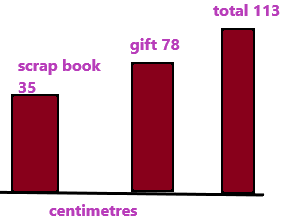
Seth has a ball of string. He uses 35 centimetres of string to decorate his scrapbook. He uses another 78 centimetres of string to decorate a gift.
a. How much string does he use in all?

b. If he had 200 centimetres of string at first how much string does he have now?

a. He uses ___ centimetres of string in all.

b. He has ___ centimetres of string now.
Answer:
a. He uses 113 centimetres of string in all.
Explanation:
Math in Focus Grade 2 Cumulative Review Chapters 7 to 9 Answer Key q24
The number of cms he used string to decorate book=35
The number of cms he used string to decorate gift=78
The total string he used for decorating book and gift=X
Add both the cms to get the total cms of string.
X=35+78
X=113 cms.
b. He has 87 centimetres of string now.
Explanation:
The total string =113 cms
If he had 200 cms at first, now the string cms are how much?. Assume it as X.
Subtract supposed cms-actual cms. Then we get the answer.
X=200-113
X=87 cms.

Question 26.
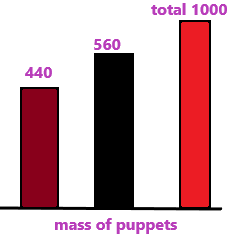
Tania’s hand puppet has a mass of 440 grams. It is 120 grams heavier than Hector’s hand puppet. What is the total mass of the two hand puppets?
The total mass of the two hand puppets is ___ grams.
Answer: 1000 grams.
Explanation:
Math in Focus Grade 2 Cumulative Review Chapters 7 to 9 Answer Key q26
The mass of Hector’s hand puppet=440
The mass of Tania’s hand puppet which is 120 grams more than Hector’s hand puppet=440+120=560
The total mass of two hand puppets is 560+440=1000 grams.

Question 27.
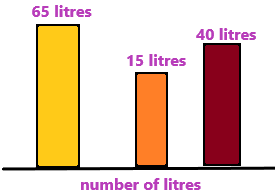
A tank contains 65 litres of oil Another 15 litres of oil are added. Later, 40 litres are poured out. What is the volume of oil in the tank in the end?
The volume of oil in the tank, in the end, is ___ litres.
Answer: 40 litres.
Explanation:
Math in Focus Grade 2 Cumulative Review Chapters 7 to 9 Answer Key q27
The number of litres of oil tank have=65
The number of litres added extra into the tank=15
The total number of litres of oil tank have after adding extra 15 litres=65+15=80
The number of litres poured out=40
The volume of the tank after pouring the 40 litres of oil=X
X=80-40
X=40 litres.

Question 28.
Sarah sells 27 liters of milk in the morning. She sells another 8 liters of milk in the afternoon. Ray sells 4-8 liters of milk.
a. Who sells more milk?

b. How much more?

a. ______ sells more milk.

b. sells ______ more litres of milk.
Explanation:
a. Sarah sells more milk.
Math in Focus Grade 2 Cumulative Review Chapters 7 to 9 Answer Key q28
The number of litres she sells in the morning=27
The number of litres she sells in the afternoon=8
The total number of litres Sarah sells=27+8=35.
The number of litres Ray sells=4-8
By comparing both of them Sarah is selling 35 litres of milk which is more than Ray.
b. sells 27 more litres of milk.
Explanation:
The total number of litres Sarah sells=35
The maximum number of litres Ray sells is totally=8.
We need to calculate the number of more litres more Sarah is selling than Ray.
Subtract the total number of litres sold by Sarah – sold by Rey
=35-8
=27.
therefore, Sarah sells 27 litres more than Rey.

Try Once:

Math in Focus Grade 5 Chapter 13 Answer Key Properties of Triangles and Four-sided Figures

This handy Math in Focus Grade 5 Workbook Answer Key Chapter 13 Properties of Triangles and Four-sided Figures provides detailed solutions for the textbook questions.

Math in Focus Grade 5 Chapter 13 Answer Key Properties of Triangles and Four-sided Figures

Put On Your Thinking Cap!

Challenging Practice

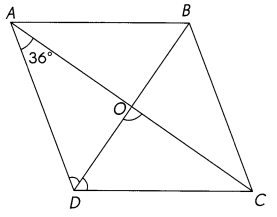
This figure is a rhombus and ∠ADO = ∠CDO. Find the measure of ∠DOC.
Math in Focus Grade 5 Chapter 13 Answer Key Properties of Triangles and Four-sided Figures 1
Answer:
∠DOC = 90°
Explanation:
The diagonals of a rhombus bisect each other at right angles (90°)
∠DOC = 90°

Put on Your Thinking cap!

Problem Solving

Question 1.
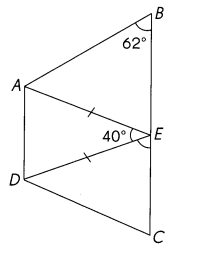
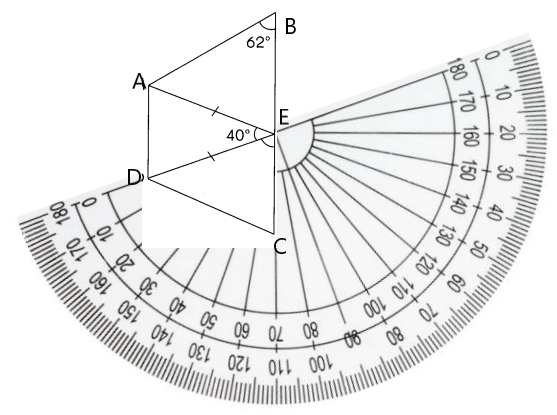
ABCD is a trapezoid in which \(\overline{A D}\) || \(\overline{B C}\). Find the measure of ∠CED.
Math in Focus Grade 5 Chapter 13 Answer Key Properties of Triangles and Four-sided Figures 2
Answer:

Explanation:
With the help of protractor we find the Measure of ∠CED.
∠CED. = 70°

Question 2.
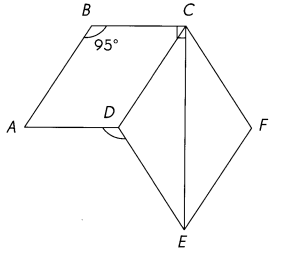
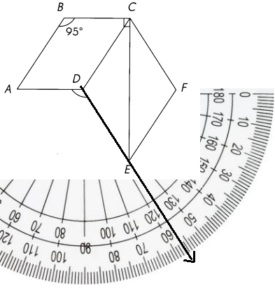
ABCD is a parallelogram and CDEF is a rhombus. Find the measure of ∠ADE.
Math in Focus Grade 5 Chapter 13 Answer Key Properties of Triangles and Four-sided Figures 3
Answer:


Explanation:
By using the protractor we can find the Angle of ADE
∠ADE. = 137°

Math Journal

Question 1.
A teacher asked her students to sketch and label the angles of a triangle. These are the angle measures that three students chose to draw.

Wayne: 120°, 80°, 10° Ashley: 70°, 28°, 72° Frank: 51 °, 37°, 92°
Will each student be able to draw his or her triangle? Explain your answer.
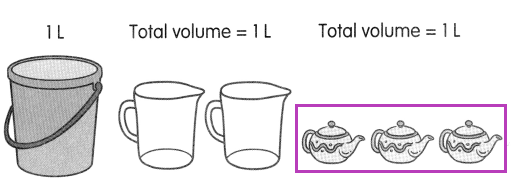
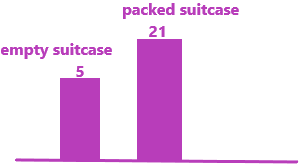
Wayne: _______
Ashley: ________
Frank: ______
Answer:
Wayne: 120°, 80°, 10° = 210°
Ashley: 70°, 28°, 72° = 170°
Frank: 51 °, 37°, 92° =  180°
Explanation:
The sum of all the angles of an triangle is equal to 180 degrees
Only Frank can draw the triangle.

Question 2.
What are two ways to identify an isosceles triangle?
Answer:
Isosceles. An isosceles triangle can be drawn in many different ways. It can be drawn to have two equal sides and two equal angles or with two acute angles and one obtuse angle.

Question 3.
Jordan is measuring the angles of a triangle. He finds out that m∠A = m∠B = 60°. Without measuring ∠C, he says that triangle ABC is an equilateral triangle. Is he correct? Explain why.
Math in Focus Grade 5 Chapter 13 Practice 1 Answer Key Right, Isosceles, and Equilateral Triangles 26
Explanation:
Yes.
The sum of all the angles of an equilateral triangle is equal to 180 degrees. As all the angles are equal to 60 degrees, the sum is equal to 60°+ 60°+ 60° =180 degrees
m∠C = 60°