Math in Focus Grade 6 Chapter 14 Lesson 14.4 Answer Key Real-World Problems: Mean, Median, and Mode

This handy Math in Focus Grade 6 Workbook Answer Key Chapter 14 Lesson 14.4 Real-World Problems: Mean, Median, and Mode detailed solutions for the textbook questions.

Math in Focus Grade 6 Course 1 B Chapter 14 Lesson 14.4 Answer Key Real-World Problems: Mean, Median, and Mode

Math in Focus Grade 6 Chapter 14 Lesson 14.4 Guided Practice Answer Key

Solve.

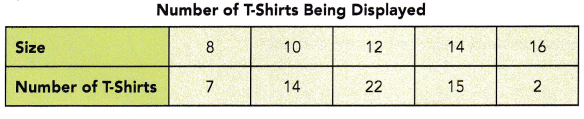
The table shows the sizes of T-shirts and the number of T-shirts displayed in a shop.
Math in Focus Grade 6 Chapter 14 Lesson 14.4 Answer Key Real-World Problems Mean, Median, and Mode 1
Question 1.
How many T-shirts are displayed in the shop?
Answer:
60 T-shirts are displayed in the shop.

Explanation:
The above table shows the sizes of T-shirts and the number of T-shirts displayed in a shop.
Sum of the T-shirts 7 + 14 + 22 + 15 + 2 = 60
60 T-shirts are displayed in the shop.

Question 2.
What is the mean size of the T-shirts being displayed?
Answer:
11.7
Rounded to the nearest ten as 12.

Explanation:
The above table shows the sizes of T-shirts and the number of T-shirts displayed in a shop.
Mean = \(\frac{\text {The sum of the values in a data set}}{\text {The number of values in a data set}}\)
Mean = \(\frac{ 8×7+ 10×14 + 12×22 + 14×15 + 16×2}{60}\)
Mean = \(\frac{56 + 140 + 264 + 210 + 32}{60}\)
Mean = \(\frac{702}{60}\)
Mean = 11.7

Question 3.
What is the modal size of the T-shirts being displayed?
Answer:
12
Explanation:
The above table shows the sizes of T-shirts and the number of T-shirts displayed in a shop.
As more number of T shirts displayed were 12 number size.

Question 4.
What is the median size of the T-shirts being displayed?
Answer:
12

Explanation:
The above table shows the sizes of T-shirts and the number of T-shirts displayed in a shop.
We know that the median is the middle point in a dataset.
To find the median: Arrange the data points from smallest to largest.
If the number of data points is odd, the median is the middle data point in the list.
So, the median of the above set is {8, 10, 12, 14, 16} is 12.

Question 5.
Which measure of central tendency best describes the data set? Justify your answer.
Answer:
Mean

Explanation:
Mean is generally considered the measure of central tendency and the most frequently used one. The mean is the most frequently used measure of central tendency because it uses all values in the data set to give you an average.

Solve.

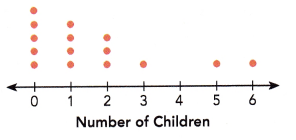
The dot plot shows the results of a survey on the number of children below 13 years old in each household. Each dot represents one household.
Math in Focus Grade 6 Chapter 14 Lesson 14.4 Answer Key Real-World Problems Mean, Median, and Mode 2
Question 6.
Find the mean, mode, and median of the data set.
Answer:
mean = 1.6
mode = 0
median = 1

Explanation:
The above dot plot shows the results of a survey on the number of children below 13 years old in each household. Each dot represents one household.
Mean:
The mean = \(\frac{Sum of a set of items}{Number of items}\)
mean = \(\frac{0 + 4 + 6 + 3 + 5 + 6 }{15}\)
mean = \(\frac{24}{15}\)
mean = 1.6

Mode:
Mode is the value which occurs the maximum number of times in a given data set.
It is the third measure of the central tendency.
0, 0, 0, 0, 0, 1, 1, 1, 1, 2, 2, 2, 3, 5, 6
the above data has 15 observations,
So,  0 appears most frequently, is the mode of a given data.

Median:
median : Middle value is the median of a given data set.
0, 0, 0, 0, 0, 1, 1, 1, 1, 2, 2, 2, 3, 5, 6
the above data has 15 observations,
So, 1 in the middle of the order sequence is the median.

Question 7.
Which measure of central tendency best describes the data set? Justify your answer.
Answer:
Mean or Median measure of central tendency best describes the data set.

Explanation:
Mode is the value which occurs the maximum number of times in a given data set.
Mode is zero ‘0’, but it tells 5 children out of 15 households.
So, the mode does not describe the set of the data.
Mean is 1.6 and median is 1.
These two may be used for better answer to describe the set of data.

Question 8.
Relate the measures of center to the shape of the data distribution.
Answer:
The shape of the data distribution is right skewed.
The mean gives more weight to the values on the right than the median does.
So, the mean is to the right of the median.

Explanation:
The two main numerical measures for the center of a distribution are the mean and the median. The mean is the average value, while the median is the middle value.

Solve.

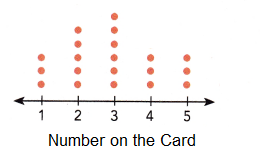
The dot plot shows the number of feedback forms received by a mall over a ten-week period. Each dot represents one feedback form.
Math in Focus Grade 6 Chapter 14 Lesson 14.4 Answer Key Real-World Problems Mean, Median, and Mode_8
Question 9.
Find the mean, mode, and median of the data set.
Answer:
mean = 5.4
mode = 5
median = 5

Explanation:
The above dot plot shows the number of feedback forms received by a mall over a ten-week period. Each dot represents one feedback form.
Mean:
The mean = \(\frac{Sum of a set of items}{Number of items}\)
mean = \(\frac{1×1 +1×2 + 2×3 + 3×4 + 4×5 + 3×6 + 2×7 + 2×8 + 1×9 + 1×10 }{20}\)
mean = \(\frac{108}{20}\)
mean = 5.4
Mode
The above observations are
1, 2, 3, 3, 4, 4, 4, 5, 5, 5, 5, 6, 6, 6,7, 7, 8, 8, 9, 10
As 5 has more number of dots in the above given dot plot : mode is 5
Median:
The above observations are
1, 2, 3, 3, 4, 4, 4, 5, 5, 5, 5, 6, 6, 6,7, 7, 8, 8, 9, 10
total 20 observation
median : Middle value is the median of a given data set.
1, 2, 3, 3, 4, 4, 4, 5, 5, 5, 5, 6, 6, 6,7, 7, 8, 8, 9, 10
the above data has 20 observations,
So, 5, 5 in the middle of the order sequence is the median.
the average of (5 + 5)/2 = 10/2 = 5

Question 10.
Relate the measures of center to the shape of the data distribution.
Answer:
The data are well spread out, and the shape of the data is symmetrical. Because the mode and median are the same 5 and 5 and the mean is slightly higher 5.4. The data set is likely to be more spread out for data greater then 5.

Explanation:
The two main numerical measures for the center of a distribution are the mean and the median. The mean is the average value, while the median is the middle value.

Hands-On Activity

FINDING POSSIBLE VALUES OF MEAN, MEDIAN, AND MODE

Work in pairs.

The lengths of 10 wallets have the same mean, median, and mode of 12 centimeters.

Explore and find a set of possible values for these lengths.

Show your work.
(Hint: You may use a dot plot to help you.)

Answer:
Mean = 12
Mode = 12
Median = 12

Explanation:
Given, The lengths of 10 wallets have the same mean, median, and mode of 12 centimeters.
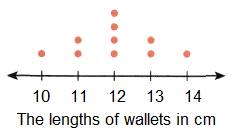
Math in Focus Grade 6 Chapter 14 Lesson 14.4 Answer Key Real-World Problems Mean, Median, and Mode_11
Mean:
The mean = \(\frac{Sum of a set of items}{Number of items}\)
mean = \(\frac{1×10 +2×11 + 4×12 + 2×13 + 1×14}{10}\)
mean = \(\frac{10 +22 + 48 + 26 + 14}{10}\)
mean = \(\frac{120}{10}\)
mean = 12
Mode:
The above observations are,
10, 11, 11, 12, 12, 12, 12, 13, 13, 14
As 12 has more number of dots in the above given dot plot : mode is 12
Median:
The above observations are,
10, 11, 11, 12, 12, 12, 12, 13, 13, 14
From the total 10 observations,
median : Middle value is the median of a given data set.
10, 11, 11, 12, 12, 12, 12, 13, 13, 14
the above data has 10 observations,
So, 12, 12 in the middle of the order sequence is the median.
the average of (12 + 12)/2 = 24/2 = 12

Math in Focus Course 1B Practice 14.4 Answer Key

Find the mean, median, and mode.

Question 1.
Eight students took a mathematics quiz. Their scores were 85, 92, 73, 85, 68, 82, 93, and 76. Find the mean, median, and mode.
Answer:
Mean = 81.75
Mode = 85
Median = 83.5

Explanation:
Eight student’s mathematics quiz scores were 85, 92, 73, 85, 68, 82, 93, and 76.
were arranged in ascending order as below.
68, 73, 76, 82, 85, 85, 92, 93
Mean:
The mean = \(\frac{Sum of a set of items}{Number of items}\)
mean = \(\frac{68 + 73 + 76 + 82 + 85 + 85 + 92 + 93}{8}\)
mean = \(\frac{654}{8}\)
mean = 81.75
Mode:
The above observations are
68, 73, 76, 82, 85, 85, 92, 93
As 85 has more number of observation : mode is 85
Median:
The above observations are
68, 73, 76, 82, 85, 85, 92, 93
total 8 observation
median : Middle value is the median of a given data set.
68, 73, 76, 82, 85, 85, 92, 93
the above data has 10 observations,
So, 82, 85 in the middle of the order sequence is the median.
the average of (82 + 85)/2 = 167/2 = 83.5

Use the data in the table to answer questions 2 and 3.

The table shows the results of a survey carried out on 80 families.
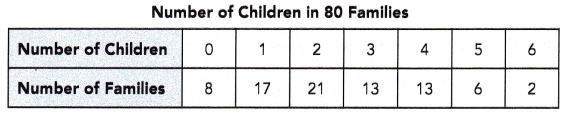
Math in Focus Grade 6 Chapter 14 Lesson 14.4 Answer Key Real-World Problems Mean, Median, and Mode 4
Question 2.
Find the mean, median, and mode.
Answer:
Mean = 2.4
Mode = 2
Median =2

Explanation:
The above table shows the results of a survey carried out on 80 families.
Mean:
The mean = \(\frac{Sum of a set of items}{Number of items}\)
mean = \(\frac{0x8 +1×17 + 2×21 + 3×13 + 4×13 +5×6 + 6×2}{21}\)
mean = \(\frac{0 +17 + 42 + 39 + 52 + 30 + 12}{80}\)
mean = \(\frac{192}{80}\)
mean = 2.4
Mode:
The above observations are
0x8,1×17, 2×21, 3×13, 4×13, 5×6, 6×2
As 2 has more number observation the above given table, 21 families have 2 childrens : mode is 2
Median:
As 2 has more number observation the above given table, 21 families have 2 children : median is 2
the above data has 192 observations,
So, 2, 2 in the middle of the order sequence is the median.
the average of (2 + 2)/2 = 4/2 = 2

Question 3.
Which measure of central tendency best describes the data set? Justify your answer.
Answer:
The median and mode.

Explanation:
The mean number of children is 2.4 it is not a realistic number for describing the data set.
The median and mode are both 2, which is a realistic number for describing the data.

Solve. Show your work.

The data set shows the weights of ten gerbils in ounces.
5.49, 4.48, 4.57, 4.59, 4.61, 4.57, 4.98, 4.43, 4.45, 4.58
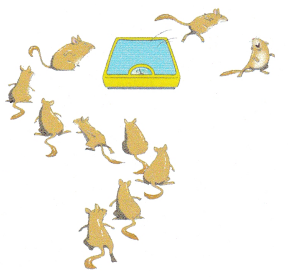
Math in Focus Grade 6 Chapter 14 Lesson 14.4 Answer Key Real-World Problems Mean, Median, and Mode 5
Question 4.
Find the mean, median, and mode.
Answer:
Mean = 4.675
Mode = 4.57
Median = 4.575

Explanation:
Given set of data, 5.49, 4.48, 4.57, 4.59, 4.61, 4.57, 4.98, 4.43, 4.45, 4.58
arrange the given data in the ascending order,
4.43, 4.45, 4.48, 4.57, 4.57, 4.58, 4.59, 4.61, 4.98, 5.49
Mean:
The mean = \(\frac{Sum of a set of items}{Number of items}\)
mean = \(\frac{4.43+ 4.45+ 4.48+ 4.57+ 4.57+ 4.58+ 4.59+ 4.61+ 4.98+ 5.49}{10}\)
mean = \(\frac{46.75}{8}\)
mean = 4.675
Mode:
The above observations are
4.43, 4.45, 4.48, 4.57, 4.57, 4.58, 4.59, 4.61, 4.98, 5.49
As 4.57 has more number of observation : mode is 4.57
Median:
median : Middle value is the median of a given data set.
4.43, 4.45, 4.48, 4.57, 4.57, 4.58, 4.59, 4.61, 4.98, 5.49
the above data has 10 observations,
So, 4.57, 4.58 in the middle of the order sequence is the median.
the average of (4.57 + 4.58)/2 = 9.15/2 = 4.575

Question 5.
Which one of the weights would you delete from the list if you want the mean to be closer to the median?
Answer:
5.49 ounce

Explanation:
5.49 oz is the separate value or higher value of the gerbil in the data set,
the weights of ten gerbils in ounces.

Use the data In the dot plot to answer questions 6 to 9.

The dot plot shows the number of hours nine students spent surfing the Internet one day. Each dot represents 1 student.
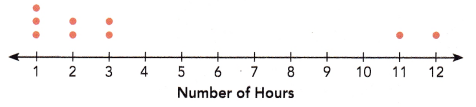
Math in Focus Grade 6 Chapter 14 Lesson 14.4 Answer Key Real-World Problems Mean, Median, and Mode 6
Question 6.
Find the mean, median, and mode.
Answer:
Mean = 4
Mode = 1
Median = 2

Explanation:
Mean:
The mean = \(\frac{Sum of a set of items}{Number of items}\)
mean = \(\frac{1×3 +2×2 + 3×2 + 11×1 + 12×1}{9}\)
mean = \(\frac{3 + 4 + 6 + 11 + 12}{9}\)
mean = \(\frac{36}{9}\)
mean = 4
Mode:
The above observations are,
1, 1, 1, 2, 2, 3, 3, 11, 12
As 1 has more number of dots in the above given dot plot : mode is 1
Median:
The above observations are,
1, 1, 1, 2, 2, 3, 3, 11, 12
There are total 9 observations,
median : Middle value is the median of a given data set.
1, 1, 1, 2, 2, 3, 3, 11, 12
The above data has 9 observations,
So, 2 in the middle of the order sequence is the median.

Question 7.
Give a reason why the mean is much greater than the median.
Answer:
11 and 12 are the two outliers in the above given data set.

Explanation:
The mean is affected by outliers that do not influence the mean.
Therefore, when the distribution of data is skewed in the middle,
the mean is often less than the median.
When the distribution is skewed to the right,
the mean is often greater than the median.

Question 8.
Which measure of central tendency best describes the data set?
Answer:
The median is 2 it is realistic number for describing the data set.

Explanation:
Mean is generally considered the measure of central tendency and the most frequently used one.
The median 2, which is a realistic number measure of central tendency best describes the data set.

Question 9.
Relate the measures of center to the shape of the data distribution.
Answer:
The share of the distribution is right-skewed.
So, the measure of center is likely to be 2 hours, which is in the lower range.

Explanation:
The two main numerical measures for the center of a distribution are the mean and the median. The mean is the average value, while the median is the middle value.

Use the data in the dot plot to answer the questions 6 to 9.

The dot plot shows the results of a survey on the number of brothers or sisters each student in a class has. Each dot represents 1 student.
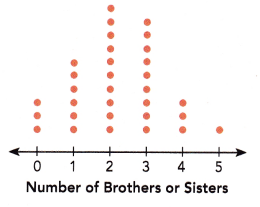
Math in Focus Grade 6 Chapter 14 Lesson 14.4 Answer Key Real-World Problems Mean, Median, and Mode 7
Question 10.
Briefly describe the data distribution and relate the measure of center to the shape of the dot plot shown.
Answer:
median = 2

Explanation:
Total 32 students are there,
is unimodal and symmetrical normal distribution.
Mode of the data set is 2.
Mean:
The mean = \(\frac{Sum of a set of items}{Number of items}\)
mean = \(\frac{0x3 +1×6 + 2×10 + 3×9 + 4×3 + 1×5}{32}\)
mean = \(\frac{0 + 6 + 20 + 27 + 12 + 5}{32}\)
mean = \(\frac{70}{32}\)
mean = 2.1875
median : Middle value is the median of a given data set.
0, 0, 0, 1, 1, 1, 1, 1, 1, 2, 2, 2, 2, 2, 2, 2, 2, 2, 2, 3, 3, 3, 3, 3, 3, 3, 3, 3, 4, 4, 4, 5
The above data has 32 observations,
(2+2)/2 = 4/2 = 2
So, 2 in the middle of the order sequence is the median.

Make a dot plot to show the data. Use your dot plot to answer questions 11 and 12.

A box contains cards each with a number 1, 2, 3, 4, or 5 on it. In an experiment, 20 students took turns drawing a card from the box. The number written on the card was recorded before it was put back into the box.

Alice, who was the last person to draw a card, was supposed to complete the dot plot below. However, she lost the record of the experiment’s results. All she could recall was the following information.
(i) There were twice as many cards with the number ‘3’ drawn as there were cards with the number ‘4’ drawn.
(ii) There were an equal number of cards with the numbers ‘1’ and ‘5’ drawn.
(iii) 5 cards with the number ‘2’ were drawn.
(iv) 8 students drew cards that show an even number.

Question 11.
Copy and complete the dot plot.
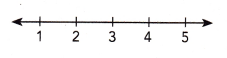
Math in Focus Grade 6 Chapter 14 Lesson 14.4 Answer Key Real-World Problems Mean, Median, and Mode 8
Answer:
Math in Focus Grade 6 Chapter 14 Lesson 14.4 Answer Key Real-World Problems Mean, Median, and Mode_8
Explanation:
Given that,
A box contains cards each with a number 1, 2, 3, 4, or 5 on it.
20 students took turns drawing a card from the box.
The number written on the card was recorded before it was put back into the box.
Alice, who was the last person to draw a card, was supposed to complete the dot plot below. However, she lost the record of the experiment’s results.
All she could recall was the following information.
(i) There were twice as many cards with the number ‘3’ drawn as there were cards with the number ‘4’ drawn.
So, there are 6 cards with number 3.
(ii) There were an equal number of cards with the numbers ‘1’ and ‘5’ drawn.
(iii) 5 cards with the number ‘2’ were drawn.
(iv) 8 students drew cards that show an even number.
So, the even number cards are 2 and 4.

Question 12.
Briefly describe the data distribution and relate the measure of center to the shape of the dot plot shown.
Answer:
Mode of the above data is 3.
Mean is 1.1825.

Explanation:
Mean:
The mean = \(\frac{Sum of a set of items}{Number of items}\)
mean = \(\frac{1×3 +2×5 + 3×6 + 4×3 + 5×3}{20}\)
mean = \(\frac{3 + 10 + 18 + 12 + 15}{20}\)
mean = \(\frac{58}{32}\)
mean = 1.1825
median : Middle value is the median of a given data set.
1,1,1,2,2,2,2,2,3,3,3,3,3,3,4,4,4,5,5,5
The above data has 20 observations,
(3+3)/2 = 6/2 = 3
So, 3 in the middle of the order sequence is the median.

Use the data in the table to answer questions 13 to 17.

The table shows the number of students absent from school over a 30-day period.
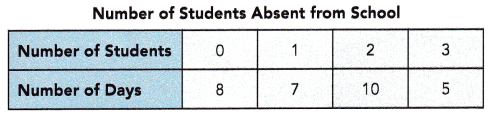
Math in Focus Grade 6 Chapter 14 Lesson 14.4 Answer Key Real-World Problems Mean, Median, and Mode 9
Question 13.
What is the mode of this distribution?
Answer:
mode = 2

Explanation:
Mode is the value which occurs the maximum number of times in a given data set.
It is the third measure of the central tendency.
So, 2 is most frequent appearance,
it means 10days out of 30 days 2 students are absent.

Question 14.
Find the mean and median number of students absent from school over the 30 days.
Answer:
Mean = 1.4
Median = 2

Explanation:
Mean:
The mean = \(\frac{Sum of a set of items}{Number of items}\)
mean = \(\frac{0x8 + 1×7 + 2×10 + 3×5}{30}\)
mean = \(\frac{0 + 7 + 20 + 15}{30}\)
mean = \(\frac{42}{30}\)
mean = 1.4
median : Middle value is the median of a given data set.
0, 0, 0, 0, 0, 0, 0, 0, 7, 2. 2. 2. 2. 2. 2. 2. 2. 2. 2, 10, 5, 5, 5
The above data has 30 observations,
(2+2)/2 = 4/2 = 2
So, 2 in the middle of the order sequence is the median.

Question 15.
It is found that the mean number of students absent from school over a subsequent 20-day period is 1. Find the mean number of students absent from school over the entire 50-day period.
Answer:
1.24

Explanation:
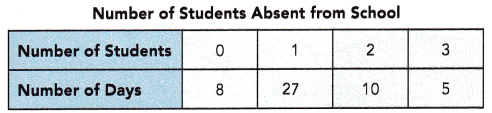
Math in Focus Grade 6 Chapter 14 Lesson 14.4 Answer Key Real-World Problems Mean, Median, and Mode_9
The mean = \(\frac{Sum of a set of items}{Number of items}\)
mean = \(\frac{0x8 + 1×27 + 2×10 + 3×5}{30}\)
mean = \(\frac{0 + 27 + 20 + 15}{30}\)
mean = \(\frac{62}{50}\)
mean = 1.24

Question 16.
If on one day of the 30-day period, 4 students were absent from school instead of 3, what should the mean of the distribution over the first 30-day period be? Round your answer to the nearest hundredth.
Answer:
1.57

Explanation:
Math in Focus Grade 6 Chapter 14 Lesson 14.4 Answer Key Real-World Problems Mean, Median, and Mode_16
The mean = \(\frac{Sum of a set of items}{Number of items}\)
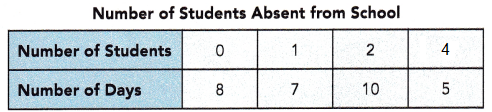
mean = \(\frac{0x8 + 1×7 + 2×10 + 4×5}{30}\)
mean = \(\frac{0 + 7 + 20 + 20}{30}\)
mean = \(\frac{47}{30}\)
mean = 1.566666
Round the answer to the nearest hundredth.
1.57

Question 17.
If on one day of the 30-day period, 2 students were absent from school instead of 1, would the median of the distribution over the 30-day period be affected? If so, what is the new median?
Answer:
Yes,
So, median is 2

Explanation:
Math in Focus Grade 6 Chapter 14 Lesson 14.4 Answer Key Real-World Problems Mean, Median, and Mode_17
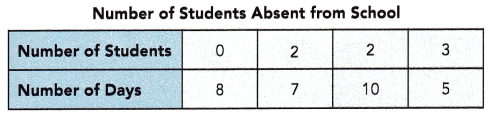
median : Middle value is the median of a given data set.
0, 0, 0, 0, 0, 0, 0, 0, 2, 2, 2, 2, 2, 2, 2, 2. 2. 2. 2. 2. 2. 2. 2. 2. 2, 10, 5, 5, 5
The above data has 30 observations,
So, 2 in the middle of the order sequence is the median.

Brain @ Work

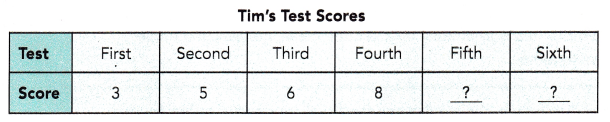
In a series of six class quizzes, Tim’s first four quiz scores are 3, 5, 6, and 8. The mean score of the six quizzes is 6. If the greater of the missing quiz scores is doubled, the mean score becomes 7\(\frac{1}{3}\). What are the two missing quiz scores?
Math in Focus Grade 6 Chapter 14 Lesson 14.4 Answer Key Real-World Problems Mean, Median, and Mode 10
Answer:
5th test score = 8
6th test score = 6

Explanation:
In a series of six class quizzes, Tim’s first four quiz scores are 3, 5, 6, and 8.
The mean score of the six quizzes is 6.
Let fifth test scores = x
sixth test scores = y
mean = (3 + 5 + 6 + 8 + x + y) ÷ 6= (22 + x + y) ÷ 6
(22 + x + y)÷ 6 = 6
22 + x + y = 36
x + y = 36 – 22
x + y = 14
y = 14 – x
if the high test test scores are doubled,
(3 + 5 + 6 + 8 + 2x + y) ÷ 6= (22 + 2x + y) ÷ 6
(22 + 2x + y)÷ 6 = 7\(\frac{1}{3}\)
22 + 2x + y = 7\(\frac{1}{3}\) x 6
2x + y = 44 – 22
2x + 14 – x = 22
x = 22 – 14
x = 8
So, y = 14 – x
y = 14 – 8
y = 6
Hence, 5th test score = 8
Hence, 6th test score = 6
Math in Focus Grade 6 Chapter 14 Lesson 14.3 Answer Key Mode

This handy Math in Focus Grade 6 Workbook Answer Key Chapter 14 Lesson 14.3 Mode detailed solutions for the textbook questions.

Math in Focus Grade 6 Course 1 B Chapter 14 Lesson 14.3 Answer Key Mode

Math in Focus Grade 6 Chapter 14 Lesson 14.3 Guided Practice Answer Key

Use the data set to complete the table. Then complete the sentence.

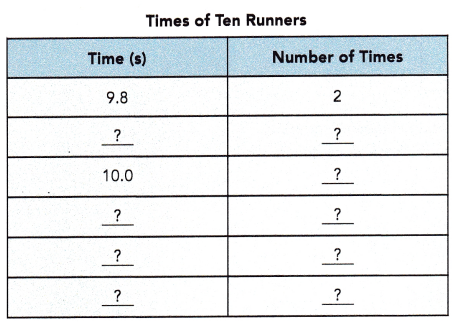
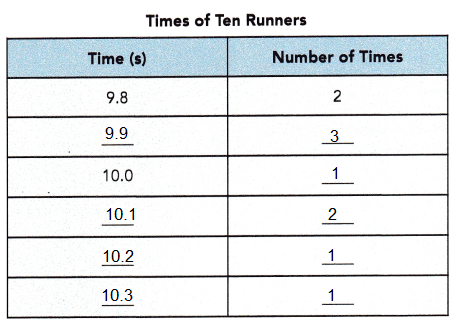
Justin recorded the times for the ten runners on a track team when they ran the 100-meter dash. The data set shows the times that he recorded.

9.8 s, 9.9 s, 10.0 s, 9.9 s, 10.2 s, 10.1 s, 9.8 s, 10.3 s, 9.9 s, 10.1 s
Math in Focus Grade 6 Chapter 14 Lesson 14.3 Answer Key Mode 1
Answer:
Math in Focus Grade 6 Chapter 14 Lesson 14.3 Answer Key Mode_1
Explanation:
Given that,
Justin recorded the times for the ten runners on a track team when they ran the 100-meter dash. The data set shows the times that he recorded as..
9.8 s, 9.9 s, 10.0 s, 9.9 s, 10.2 s, 10.1 s, 9.8 s, 10.3 s, 9.9 s, 10.1 s
Number of times of ten runners are recorded in the table as shown above.

Question 1.
The mode of this data set is Math in Focus Grade 6 Chapter 14 Lesson 14.3 Answer Key Mode 2 seconds.
Answer:
9.9 seconds.

Explanation:
Mode is the value which occurs the maximum number of times in a given data set.
So, it is the third measure of the central tendency.
9.9s occurs the maximum number of times in a given data set.

Complete. Use data in the dot plot.

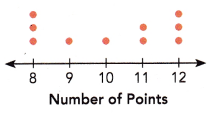
Elsie likes to bowl. The dot plot shows her scores for each of the ten frames that she bowled in one game. Each dot represents her scores for one frame.
Math in Focus Grade 6 Chapter 14 Lesson 14.3 Answer Key Mode 3
Question 2.
Elsie scored 11 points in each of Math in Focus Grade 6 Chapter 14 Lesson 14.3 Answer Key Mode 2 frames.
Answer:
2 frames.

Explanation:
A Dot Plot is a graphical display of data using dots.
As each dot represents her scores for one frame, there are 2 dots at 11 points.
So, Elsie scored 11 points in each of 2 frames.

Question 3.
The modes of this set of data are Math in Focus Grade 6 Chapter 14 Lesson 14.3 Answer Key Mode 2 and Math in Focus Grade 6 Chapter 14 Lesson 14.3 Answer Key Mode 2.
Math in Focus Grade 6 Chapter 14 Lesson 14.3 Answer Key Mode 4
Answer:
8, 12 are the modes.

Explanation:
The above dot plot shows her scores for each of the ten frames that she bowled in one game. Each dot represents her scores for one frame.
Mode is the value which occurs the maximum number of times in a given data set.
It is the third measure of the central tendency.
Three are 3 frames at 8 and three frames at the 12 point.
So, 3 is occurring more number of times.

Find the mode of each set of data.

Question 4.
There are 9 teachers, 88 boys, and 79 girls at a school camp.
Answer:
mode = boys.

Explanation:
Given that,
There are 9 teachers, 88 boys, and 79 girls at a school camp.
Mode is the value which occurs the maximum number of times in a given data set.
It is the third measure of the central tendency.
As boys are more number, which can see frequently more number of times.
So, in the above set of data boys are mode.

Question 5.
In a mall, there are 2 laundry shops, 14 garment shops, 3 photographic shops, 5 shoe shops, and 9 food stores.
Answer:
mode is garment shop.

Explanation:
Given that,
In a mall, there are 2 laundry shops, 14 garment shops, 3 photographic shops, 5 shoe shops, and 9 food stores.
Mode is the value which occurs the maximum number of times in a given data set.
It is the third measure of the central tendency.
As garment shops are more number, which can see frequently more number of times.
So, garment shop is mode.

Question 6.
The data set shows the masses of the school bags of some students.
5.5 kg, 6.6 kg, 4.8 kg, 4.3 kg, 5.5 kg, 4.3 kg, 5.5 kg, 6.6 kg, 4.5 kg, 5.5 kg
Answer:
mode is 5.5kg

Explanation:
Given that,
5.5 kg, 6.6 kg, 4.8 kg, 4.3 kg, 5.5 kg, 4.3 kg, 5.5 kg, 6.6 kg, 4.5 kg, 5.5 kg is to be written in the ascending order.
Mode is the value which occurs the maximum number of times in a given data set.
It is the third measure of the central tendency.
4.3, 4.3, 4.5, 4.8, 5.5, 5.5, 5.5, 5.5, 6.6, 6.6
So, 5.5 is more times observation is the mode of the given set of data.

Hands-On Activity

FINDING MEAN, MEDIAN, AND MODE

Materials:

  • net of a rectangular prism, with pairs of opposite faces numbered 10, 11, or 12
  • blank table
  • tape
  • scissors
  • centimeter ruler

Work in pairs.
Step 1: Cut out, fold, and tape the net of the rectangular prism provided by your teacher.
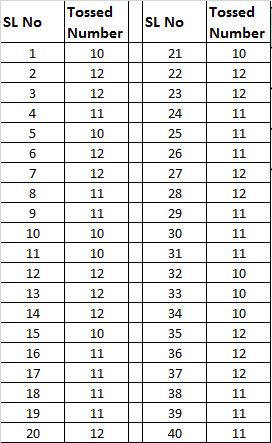
Step 2: Take turns to toss the rectangular prism 40 times and record the number tossed each time.
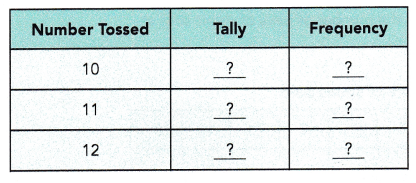
Step 3: Copy and complete your results in a table like the one below.
Math in Focus Grade 6 Chapter 14 Lesson 14.3 Answer Key Mode 5
Step 4: From the set of data collected, find the
a) mean
b) median
c) mode.

Step 5:
a) Measure the area of each face to the nearest tenth of a square centimeter. Find the ratio of the total area of the faces numbered 10 to the total area of the faces numbered 11 to the total area of the faces numbered 12.
b) Find the ratio of the number of times the number 10 is tossed to the number of times the number 11 is tossed to the number of times the number 12 is tossed.
c) Compare the two ratios. Why do you think you get this result?

Step 6: Compare your findings with the other pairs.
Answer:
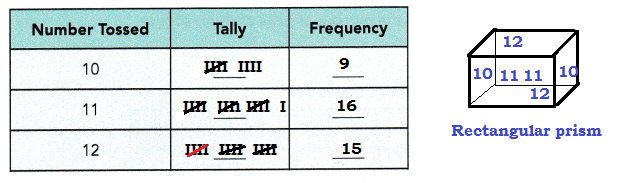
Math in Focus Grade 6 Chapter 14 Lesson 14.3 Answer Key Mode 5_2
the ratio of the number of times the number 10 is tossed to the number of times the number 11 is tossed to the number of times the number 12 is tossed
10:11:12
9 : 16 : 15

Math in Focus Course 1B Practice 14.3 Answer Key

Find the mode or modes of each data set.

Question 1.
5, 6, 4, 5, 8, 9, 9, 3, 4, 5
Answer:
Mode : 5

Explanation:
Mode is the value which occurs the maximum number of times in a given data set.
It is the third measure of the central tendency.
Given 5, 6, 4, 5, 8, 9, 9, 3, 4, 5
The given data set is to be written in the ascending order.
3, 4, 4, 5, 5, 5, 6, 8, 9, 9
So, number 5 appears most frequently in the given set of data.

Question 2.
13, 31, 12, 45, 6, 19, 21, 12, 31
Answer:
12 and 31

Explanation:
Mode is the value which occurs the maximum number of times in a given data set.
It is the third measure of the central tendency.
Given 13, 31, 12, 45, 6, 19, 21, 12, 31
The given data set is to be written in the ascending order.
6, 12, 12, 13, 19, 21, 31, 31, 45
So,12 and 31 appears most frequently in the given set of data.

Question 3.
8.5, 6.5, 7.8, 6.5, 6.4, 2.3, 4.5, 5.4, 7.8, 5.5, 7.8
Answer:
7.8

Explanation:
Mode is the value which occurs the maximum number of times in a given data set.
It is the third measure of the central tendency.
Given 8.5, 6.5, 7.8, 6.5, 6.4, 2.3, 4.5, 5.4, 7.8, 5.5, 7.8
The given data set is to be written in the ascending order.
2.3, 4.5, 5.4, 5.5, 6.4, 6.5, 6.5, 7.8, 7.8, 7.8, 8.5
So, 7.8 appears most frequently in the given set of data.

Find the mode.

Question 4.
The scores of a basketball team in a series of games are 76, 85, 65, 58, 68, 72, 91, and 68. Find the mode.
Answer:
mode is 65

Explanation:
Mode is the value which occurs the maximum number of times in a given data set.
It is the third measure of the central tendency.
Given 76, 85, 65, 58, 68, 72, 91, and 68
arranging in the ascending order
58, 65, 68, 68, 72, 76, 85, 91
So, 68 appears most frequently in the given set of data.

Question 5.
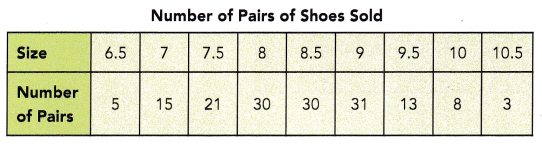
The table shows sizes of shoes and the number of pairs of shoes sold at a shop last month.
Math in Focus Grade 6 Chapter 14 Lesson 14.3 Answer Key Mode 6
Find the mode.
Answer:
30

Explanation:
Mode is the value which occurs the maximum number of times in a given data set.
It is the third measure of the central tendency.
The above number of pairs of shoes sold are arranged in the ascending order as shown below.
3, 5, 8, 13, 15, 21, 30, 30, 31
In the above 9 observations of 30 is occurred more number of times.
So, mode =  30

Question 6.
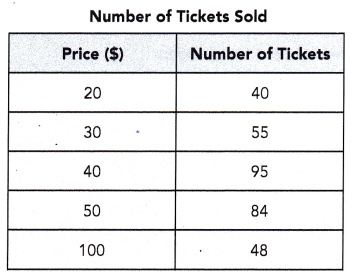
Tickets for a concert are priced at $20, $30, $40, $50, or $100. The table shows the number of tickets sold at each price.
Math in Focus Grade 6 Chapter 14 Lesson 14.3 Answer Key Mode 7
Find the mode.
Answer:
mode = 40

Explanation:
Mode is the value which occurs the maximum number of times in a given data set.
It is the third measure of the central tendency.
So, $40 is 95 tickets were sold, $40 appears most frequently.

Make a dot plot to show the data. Use your dot plot to answer each question.

The data set shows the number of goals scored by a soccer team in 17 matches. 3, 2, 1, 0, 2, 4, 1, 0, 2, 3, 4, 2, 3, 2, 1, 2, 5
Question 7.
What is the mean of the data set? Round your answer to the nearest number of goals.
Answer:
mean = 2
2 goals.

Explanation:
Given, 3, 2, 1, 0, 2, 4, 1, 0, 2, 3, 4, 2, 3, 2, 1, 2, 5
find the sum of the above data,
3+2+1+0+2+4+1+0+2+3+4+2+3+2+1+2+5 = 37
The mean = \(\frac{Sum of a set of items}{Number of items}\)
mean = \(\frac{3+2+1+0+2+4+1+0+2+3+4+2+3+2+1+2+5}{17}\)
mean = \(\frac{37}{17}\)
mean = 2.17
Round the answer to the nearest number of 2 goals.

Question 8.
What is the median of the data set?
Answer:
median =2

Explanation:
median: Middle value is the median of a given data set.
3, 2, 1, 0, 2, 4, 1, 0, 2, 3, 4, 2, 3, 2, 1, 2, 5
The above data is arranged in ascending order as shown below,
0, 0, 1, 1, 1, 2, 2, 2, 2, 2, 2, 3, 3, 3, 4, 4, 5
So, 2 in the middle of the order sequence is the median.

Question 9.
What is the mode of the data set?
Answer:
mode = 2

Explanation:
Mode is the value which occurs the maximum number of times in a given data set.
It is the third measure of the central tendency.
3, 2, 1, 0, 2, 4, 1, 0, 2, 3, 4, 2, 3, 2, 1, 2, 5
The above data is arranged in ascending order as shown below,
0, 0, 1, 1, 1, 2, 2, 2, 2, 2, 2, 3, 3, 3, 4, 4, 5
So, 2 appears most frequently in the given set of data.

Solve. Show your work.

Question 10.
A class of 15 students had a spelling test consisting of 10 words. The number of spelling mistakes made by each student in the class is listed in the data set.
1, 2, 1, 0, 3, 1, 2, 3, 1, 2, 0, 4, 2, 3, x
a) If there are two modes, what are the possible values for x?
Answer:
x = 0 and 4

Explanation:
Given, 1, 2, 1, 0, 3, 1, 2, 3, 1, 2, 0, 4, 2, 3, x
arrange the data in the ascending order,
0, 0, 1, 1, 1, 1, 2, 2, 2, 2, 3, 3, 3, 4, x
there are two modes,
As 1 and 2 appears most frequently in the given set of data.
So, the possible values of x is 0 and 4.

b) If there is exactly one mode, write a possible value for x, and the mode.
Answer:
1 or 2

Explanation:
Given set of data,
1, 2, 1, 0, 3, 1, 2, 3, 1, 2, 0, 4, 2, 3, x
arrange the data in the ascending order,
0, 0, 1, 1, 1, 1, 2, 2, 2, 2, 3, 3, 3, 4, 1
if the possible values for x = 1
As 1 appears most frequently in the given set of data,
mode is 1
if the possible values for x = 2
As 2 appears most frequently in the given set of data,
mode is 2.

Question 11.
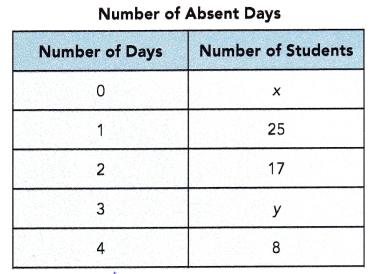
The table shows the number of days of absences for 80 students in a school.
Math in Focus Grade 6 Chapter 14 Lesson 14.3 Answer Key Mode 8
a) Find the value of x + y.
Answer:
30

Explanation:
As we know total number of students is 80 in the school.
x + 25 + 17 + y + 8 = 80
x + y = 80 – 50
x + y = 30

b) If the mode for this set of data is 3, write the possible values for the pair of numbers (x, y).
Answer:
(x, y)

Explanation:
x + 25 + 17 + y + 8 = 80
x + y = 80 – 50 = 30
we know total students are 80.
3 is mode, means y value should maximum value and x value should me minimum.
The sum of x + y = 30
(x, y) = (0, 30), (1, 29), (2, 28), (3, 27), (4, 26)
So, the possible values of the pair of numbers (x, y).

c) If the mode is equal to the median, write two possible values of x.
Answer:
25 and 27

Explanation:
median : Middle value is the median of a given data set.
x, 25, 17, y, 8
arrange the data in the ascending order,
8, 17, 25, x y
So, the possible numbers between are 16 to 24.
So, mode should be 25 and 17 if any one same numbers repeats.

Math in Focus Grade 6 Chapter 14 Lesson 14.2 Answer Key Median

This handy Math in Focus Grade 6 Workbook Answer Key Chapter 14 Lesson 14.2 Median detailed solutions for the textbook questions.

Math in Focus Grade 6 Course 1 B Chapter 14 Lesson 14.2 Answer Key Median

Math in Focus Grade 6 Chapter 14 Lesson 14.2 Guided Practice Answer Key

Find the median of each data set.

Question 1.
The data set shows the weights of a group of students.
109 lb, 86 lb, 117 lb, 97 lb, 98 lb
Ordered from least to greatest:
Math in Focus Grade 6 Chapter 14 Lesson 14.2 Answer Key Median 1 lb, Math in Focus Grade 6 Chapter 14 Lesson 14.2 Answer Key Median 1 Ib, Math in Focus Grade 6 Chapter 14 Lesson 14.2 Answer Key Median 1 lb, Math in Focus Grade 6 Chapter 14 Lesson 14.2 Answer Key Median 1 lb, Math in Focus Grade 6 Chapter 14 Lesson 14.2 Answer Key Median 1 lb
The median weight is ____ pounds.
Answer:
98 lb

Explanation:
It is given that the data set shows the weights of a group of students.
109 lb, 86 lb, 117 lb, 97 lb, 98 lb
Now, arrange the given weights of the group of students from the least to the greatest.
So, the order of the weights from the least to the greatest is:
86 lb, 97 lb, 98 lb, 109 lb, 117 lb
Now, from the given data set,
The number of given weights is: 5
We know that, when a data set has an odd number of values,
you can identify the middle value or median by inspection.
So, the median of the given data set is: 98 lb
Hence, the median weight is 98 lb.

Question 2.
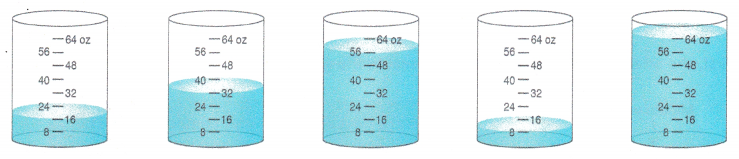
The data set shows the volumes of water (in fluid ounces) in some containers.
Math in Focus Grade 6 Chapter 14 Lesson 14.2 Answer Key Median 2
The median volume of water is _____fluid ounces.
Answer:
32 fluid ounces.

Explanation:
It is given that the data set shows the volumes of water (in fluid ounces) in some containers.
Math in Focus Grade 6 Chapter 14 Lesson 14.2 Answer Key Median 2
Now from the above containers we can observe that,
The volumes of water in the given containers are:
16 fluid ounces, 32 fluid ounces, 56 fluid ounces, 8 fluid ounces, 64 fluid ounces.
The volumes of water in the given containers from the least to the greatest are:
8 fluid ounces, 16 fluid ounces, 32 fluid ounces, 56 fluid ounces, 64 fluid ounces.
So, the number of volumes of water in the given containers is: 5
We know that when a data set has an odd number of values,
you can identify the middle value or median by inspection
So, the median volume of water is: 32 fluid ounces.

Question 3.
The data set shows the ages of a group of people.
23 years, 36 years, 28 years, 43 years, 34 years, 29 years
The two middle values are ______ years and ______ years.
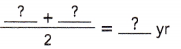
Mean of the two middle values = Math in Focus Grade 6 Chapter 14 Lesson 14.2 Answer Key Median 3
The median age is ______ years.
Answer:
31.5 years.

Explanation:
It is given that the data set shows the ages of a group of people.
23 years, 36 years, 28 years, 43 years, 34 years, 29 years.
Now arrange the ages of a group of people from the least to the greatest are:
23 years, 28 years, 29 years, 34 years, 36 years, 43 years.
We know that when a data set has an even number of values, identify the two middle values.
The median is the mean of these two middle values.
Now, the number of values present in a data set is: 6
So, the mean of the two middle values = \(\frac{29 + 34}{2}\)
= \(\frac{63}{2}\)
= 31.5 years
Hence, the median age is 31.5 years.
Question 4.

The data set shows the lengths of the tables that one company produces.
85 cm, 92 cm, 108 cm, 210 cm, 264 cm, 200 cm, 135 cm, 78 cm
The median length is Math in Focus Grade 6 Chapter 14 Lesson 14.2 Answer Key Median 1 centimeters.
Answer:
121.5 years.

Explanation:
It is given that the data set shows the lengths of the tables that one company produces.
85 cm, 92 cm, 108 cm, 210 cm, 264 cm, 200 cm, 135 cm, 78 cm
Now arrange the lengths of the tables from the least to the greatest are:
78 cm, 85 cm, 92 cm, 108 cm, 135 cm, 200 cm, 210 cm, 264 cm
We know that when a data set has an even number of values, identify the two middle values.
The median is the mean of these two middle values.
So, the number of values present in a data set is: 8
The mean of the two middle values = \(\frac{108 + 135}{2}\)
= \(\frac{243}{2}\)
= 121.5 years
Hence, the median length is 121.5 years.

Question 5.
The data set shows the distances that a group of students ran during an exercise.
\(\frac{1}{2}\) mi, \(\frac{7}{8}\) mi, \(\frac{3}{4}\) mi, \(\frac{5}{8}\) mi
The median distance was ___ miles.
Answer:
\(\frac{11}{16}\) miles

Explanation:
It is given that the data set shows the distances that a group of students ran during an exercise.
\(\frac{1}{2}\) mi, \(\frac{7}{8}\) mi, \(\frac{3}{4}\) mi, \(\frac{5}{8}\) mi
Now arrange the distance that a group of students ran during an exercise from the least to the greatest is:
\(\frac{1}{2}\) mi, \(\frac{5}{8}\) mi, \(\frac{3}{4}\) mi, \(\frac{7}{8}\) mi
We know that when a data set has an even number of values, identify the two middle values.
The median is the mean of these two middle values
So, the number of values present in a data set is: 4
The mean of the two middle values = (\(\frac{5}{8}\) + \(\frac{3}{4}\)) × \(\frac{1}{2}\)
= \(\frac{11}{8}\) × \(\frac{1}{2}\)
= \(\frac{11}{16}\) mi
Hence, the median distance is \(\frac{11}{16}\) miles.

Complete. Use the data in the dot plot.

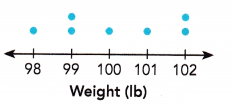
The dot plot shows the weights of a group of immature white-tailed deer fawns. Each dot represents 1 fawn.
Math in Focus Grade 6 Chapter 14 Lesson 14.2 Answer Key Median 4
Question 6.
The median weight of the fawns is _____ pounds.
Answer:
100 pounds.

Explanation:
It is given that the dot plot shows the weights of a group of immature white-tailed deer fawns and each dot represents 1 fawn.
The given dot plot is:
Math in Focus Grade 6 Chapter 14 Lesson 14.2 Answer Key Median 4
We observe that, the total number of fawns is: 7
Now arrange the order of the fawns from the least to the greatest is:
1 fawn, 1 fawn, 1 fawn, 2 fawns, 2 fawns
We know that when a data set has an odd number of values,
you can identify the middle value or median by inspection.
So, the median weight of the fawns = The middle value of the weights of a group of immature white-tailed deer fawn.
= 100 × (The number of fawns corresponding to the weight of 100 lb)
= 100 × 1
= 100 lb
Hence, the median weight of the fawns is 100 pounds.

Question 7.
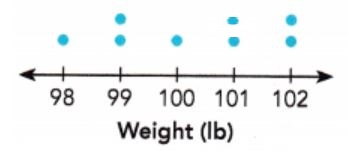
A new fawn joins the group. It weighs 101 pounds.
a) Add a dot to a copy of the dot plot above to show this information.
Answer:
Math in Focus Grade 6 Course 1 B Chapter 14 Lesson 14.2 Answer Key Median_7a
Explanation:
It is given that the dot plot shows the weights of a group of immature white-tailed deer fawns and each dot represents 1 fawn.
The given dot plot is:
Math in Focus Grade 6 Chapter 14 Lesson 14.2 Answer Key Median 4
A new fawn joins the group.
It weighs 101 pounds.
Hence, The dot plot that represents the given information is shown above.

b) Does this change the median of the data set? What is the median of the data set now?
Answer:
100.5 pounds.

Explanation:
From part (a), we can observe that
The new dot plot is:
Math in Focus Grade 6 Course 1 B Chapter 14 Lesson 14.2 Answer Key Median_7b
Since the dots (The number of fawns) are changed, the median of the data set will also be changed.
Since the number of fawns is even, the median will be the middle value of the 4th and 5th values.
So, the median of the new data set = \(\frac{101 + 100}{2}\)
= \(\frac{201}{2}\)
= 100.5 pounds
Hence, the median of the data set now will be 100.5 pounds.

Complete. Use the data in the dot plot.

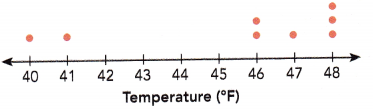
The lowest temperatures in a town are recorded over a few days. The dot plot on the right shows these temperature readings. Each dot represents 1 temperature reading.
Math in Focus Grade 6 Chapter 14 Lesson 14.2 Answer Key Median 5

Question 8.
The mean temperature is Math in Focus Grade 6 Chapter 14 Lesson 14.2 Answer Key Median 1 °F.
Answer:
45.5 °F

Explanation:
It is given that the lowest temperatures in a town are recorded over a few days.
The dot plot on the right shows these temperature readings.
Each dot represents 1 temperature reading.
The given data plot is:
Math in Focus Grade 6 Chapter 14 Lesson 14.2 Answer Key Median 5
We know that,
Mean = \(\frac{\text {The sum of the values in a data set}}{\text {The number of values in a data set}}\)
From the given data plot we observe that,
The number of values in the given data set is: 8
So, Mean temperature = \(\frac{(40 × 1) + (41 × 1) + (46 × 2) + (47 × 1) + (48 × 3)}{8}\)
= \(\frac{40 + 41 + 92 + 47 + 144}{8}\)
= \(\frac{364}{8}\)
= 45.5°F
Hence, the mean temperature is 45.5 °F.

Question 9.
The median temperature is Math in Focus Grade 6 Chapter 14 Lesson 14.2 Answer Key Median 1 °F.
Answer:
44 °F

Explanation:
It is given that the lowest temperatures in a town are recorded over a few days.
The dot plot on the right shows these temperature readings.
Each dot represents 1 temperature reading.
The given data plot is:
Math in Focus Grade 6 Chapter 14 Lesson 14.2 Answer Key Median 5
From the above dot plot we observe that,
The total number of temperature readings is 8.
So, Median = The middle value of the temperature readings.
Hence, The median temperature is 44 °F.

Question 10.
Math in Focus Grade 6 Chapter 14 Lesson 14.2 Answer Key Median 1 of the temperature readings recorded are higher than the mean temperature.
Answer:
46 °F, 47 °F, and 48 °F

Explanation:
It is given that the lowest temperatures in a town are recorded over a few days.
The dot plot on the right shows these temperature readings.
Each dot represents 1 temperature reading.
The given dot plot is:
Math in Focus Grade 6 Chapter 14 Lesson 14.2 Answer Key Median 5
From Question 8, we observe that,
The mean temperature is 45.5 ° F.
Hence, the temperature recordings that are higher than the mean temperature are 46 °F, 47 °F, and 48 °F.

Question 11.
Which of the two measures of central tendency, the mean or the median, better describes the data set? Justify your answer.
Answer:
The median describes the given data set better.

Explanation:
From Question 8 and Question 9,
We can observe that,
The mean is 45.5 °F. However, more than 1 temperature reading is less than 45.5 °F.
So, the mean does not describe the data set well.
The median is 44 °F.
It describes the data set better because most of the data values cluster around 44 °F.
Hence, the median describes the given data set better.

Hands-On Activity

COLLECTING AND TABULATING DATA TO FIND MEDIAN

Materials

  • blank table
Work in pairs.

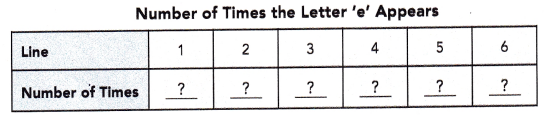
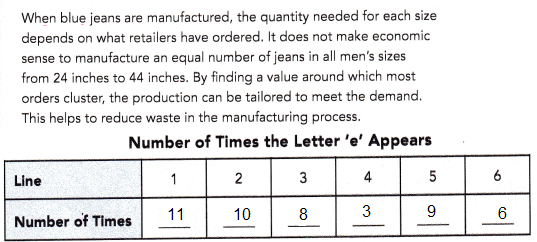
Step 1: Refer to the first paragraph of the chapter opener. Count the number of times the letter ‘e’ appears in each line. Record your answers in a copy of the table below.
Math in Focus Grade 6 Chapter 14 Lesson 14.2 Answer Key Median 6
Answer:
Math in Focus Grade 6 Chapter 14 Lesson 14.2 Answer Key Median_6

Step 2: Find the mean and median number of times the letter ‘e’ appears in each line.
Answer:
mean =7.833
median = 8.5

Explanation:
The mean = \(\frac{Sum of a set of items}{Number of items}\)
mean = \(\frac{11 + 10 + 8 + 3 + 9 + 6}{6}\)
mean = 7.833
median : Middle value is the median of a given data set.
The given data set {3, 6, 8, 9, 10, 11} contains even number and 8 and 9 are in the middle.
the average of the 8 and 9 is the median of the given data set.
median = \(\frac{8 + 9}{2}\)
median = 8.5

Math in Focus Course 1B Practice 14.2 Answer Key

Find the median of each data set.

Question 1.
9, 8, 7, 11, 7, 16, 3
Answer:
median = 8

Explanation:
median : Middle value is the median of a given data set.
The given data set {9, 8, 7, 11, 7, 16, 3}contains odd numbers.
So, arrange them in ascending order {3, 7, 7, 8, 9, 11, 16} to find the median.
Number 8 in the middle of the order sequence is the median.

Question 2.
31, 43, 12, 25, 54, 18
Answer:
median = 18.5

Explanation:
median : Middle value is the median of a given data set.
The given data set {12, 18, 25, 31, 43, 54} contains even number and are arranged in the ascending order.
12 and 25 are in the middle.
the average of the 12 and 25 is the median of the given data set.
median = \(\frac{12 + 25}{2}\)
median = \(\frac{37}{2}\)
median = 18.5

Question 3.
3.2, 1.5, 2.6, 3.5, 6.9, 5.8, 2.4
Answer:
median = 3.2

Explanation:
median : Middle value is the median of a given data set.
The given data set {3.2, 1.5, 2.6, 3.5, 6.9, 5.8, 2.4} contains odd numbers.
Arrange them in ascending order{1.5, 2.4, 2.6, 3.2, 3.5, 5.8, 6.9} to find the median.
So, 3.2 in the middle of the order sequence is the median.

Question 4.
32.6, 72.6, 28.7, 45.4, 83.6, 69.9
Answer:
median = 57.65

Explanation:
median : Middle value is the median of a given data set.
The given data set {32.6, 72.6, 28.7, 45.4, 83.6, 69.9} contains even numbers.
Arrange the numbers in the ascending order{28.7, 32.6, 45.4, 69.9, 72.6, 83.6} to fid the median.
So, the numbers 45.4 and 69.9 are in the middle.
Take the average of the 45.4 and 69.9 is the median of the given data set.
median = \(\frac{45.4 + 69.9}{2}\)
median = \(\frac{115.3}{2}\)
median = 57.65

Solve. Show your work.

Question 5.
The number of points scored by seven students in a language test are 68, 46, 74, 58, 63, 91, and 85. Find the median score.
Answer:
median = 68

Explanation:
median : Middle value is the median of a given data set.
The given data set {68, 46, 74, 58, 63, 91, 85} contains odd numbers.
Arrange the given data in ascending order {46, 58, 63, 68, 74, 85, 91} to find the median.
So, number 68 in the middle of the order sequence is the median.

Question 6.
The data set shows the number of goals scored by a soccer team in eight matches.
0, 2, 3, 1, 4, 2, 5, 2
Find the median number of goals scored.
Answer:
median = 57.65

Explanation:
median : Middle value is the median of a given data set.
The given data set {0, 2, 3, 1, 4, 2, 5, 2} contains even numbers.
Arrange the given data in ascending order {0, 1, 2, 2, 2, 3, 5} to find the median.
So, the numbers 2 and 2 are in the middle.
Take the average of the 2 and 2 is the median of the given data set.
median = \(\frac{2 + 2}{2}\)
median = \(\frac{4}{2}\)
median = 2

Question 7.
The costs of four cell phones are $345, $400, $110, and $640. Find the median cost.
Answer:
median = 372.5

Explanation:
median : Middle value is the median of a given data set.
The given data set {$345, $400, $110, and $640} contains even numbers.
Arrange the given data set in ascending order {$110, $345, $400, $640} to find the median.
So, the numbers $345 and $400 are in the middle.
Take the average of the 345 and 400 is the median of the given data set.
median = \(\frac{345 + 400}{2}\)
median = \(\frac{745}{2}\)
median = 372.5

Question 8.
The volumes of water, in liters, in eight containers are 3.1, 2.8, 3.2, 4.2, 3.9, 5.6, 3.7, and 4.5. Find the median volume.
Answer:
median = 3.8

Explanation:
median : Middle value is the median of a given data set.
The given data set {3.1, 2.8, 3.2, 4.2, 3.9, 5.6, 3.7, 4.5} contains even numbers.
Arrange the given data set in ascending order {2.8, 3.1, 3.2, 3.7, 3.9, 4.2, 4.5, 5.6}
So, the numbers 3.7 and 3.9 are in the middle.
Take the average of the 3.7 and 3.9 is the median of the given data set.
median = \(\frac{3.7 + 3.9}{2}\)
median = \(\frac{7.6}{2}\)
median = 3.8

Use the data in the dot plots to answer questions 9 and 10.

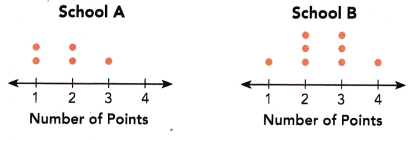
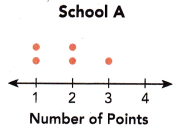
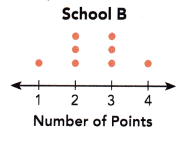
The dot plot shows the number of points scored by the members of a Quiz Bowl team in a competition between School A and School B. Each dot represents one student’s points.
Math in Focus Grade 6 Chapter 14 Lesson 14.2 Answer Key Median 7
Question 9.
How many team members did each school have?
Answer:
School A have 5 members.
School B have 8 members.

Explanation:
The above dot plot shows the number of points scored by the members of a Quiz Bowl team in a competition between School A and School B.
Each dot represents one student’s points.
So, count the dots on the plot of School A and School B.
School A have 5 members.
School B have 8 members.

Question 10.
What was the median number of points scored by the students from
a) School A?
Answer:
median = 2

Explanation:
Math in Focus Grade 6 Chapter 14 Lesson 14.2 Answer Key Median 7_A
median : Middle value is the median of a given data set.
The given data set {1, 1, 2, 2, 3} contains odd numbers and are arranged in the ascending order and 2 is in the middle of the order sequence.
median = 2

b) School B?
Answer:
median = 3.8

Explanation:
Math in Focus Grade 6 Chapter 14 Lesson 14.2 Answer Key Median 7_B
median : Middle value is the median of a given data set.
The given data set {1, 2, 2, 2, 3, 3, 3, 4} contains even number and are arranged in the ascending order.
2 and 3 are in the middle.
the average of the 2 and 3 is the median of the given data set.
median = \(\frac{2 + 3}{2}\)
median = \(\frac{5}{2}\)
median = 2.5

Use the data In the dot plot to answer questions 11 to 13.

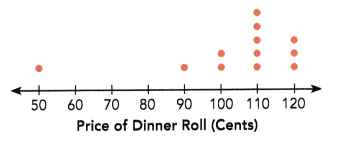
Janice bought some dinner rolls from a bakery. The dot plot shows the prices of the dinner rolls in cents. Each dot represents 1 dinner roll.
Math in Focus Grade 6 Chapter 14 Lesson 14.2 Answer Key Median 8
Question 11.
What is the mean price of the dinner rolls Janice bought? Round your answer to the nearest cent.
Answer:
104 cents.

Explanation:
The mean = \(\frac{Sum of a set of items}{Number of items}\)
mean = \(\frac{50 + 90 + 100 + 100 + 110 + 110 + 110 +110 + 110 + 120 + 120 + 120}{12}\)
mean = 104.2
Round the answer to the nearest cent. = 104

Question 12.
What is the median price of the dinner rolls she bought?
Answer:
$110

Explanation:
median : Middle value is the median of a given data set.
The given data set {50, 90,100, 100, 110, 110, 110, 110, 110, 120, 120, 120} contains even number and are arranged in the ascending order.
110 and 110 are in the middle.
the average of the 110 and 110 is the median of the given data set.
median = \(\frac{110 + 110}{2}\)
median = \(\frac{220}{2}\)
median = 110

Question 13.
Which of the two measures of central tendency, the mean or the median, better describes the data set? Justify your answer.
Answer:
Median

Explanation:
median : Middle value is the median of a given data set.
The given data set {50, 90,100, 100, 110, 110, 110, 110, 110, 120, 120, 120} contains even number and are arranged in the ascending order.
In this situation, we would like to have a better measure of central tendency.

Solve.

Question 14.
The median of a set of numbers is x. There are at least three numbers in the set. Write an algebraic expression, in terms of x, to represent the median of the new set of numbers obtained by

a) adding 3 to every number in the set.
Answer:
x+2, x+3, x+4

Explanation:
Given that,
The median of a set of numbers is x.
There are at least three numbers in the set.
x-1, x, x+1
x-1+3, x+3, x+1+3
x+2, x+3, x+4

b) doubling every number in the set.
Answer:
2x-2, 2x, 2x+2

Explanation:
Given that,
The median of a set of numbers is x.
There are at least three numbers in the set.
x-1, x, x+1
By doubling every number in the set we get,
2x-2, 2x, 2x+2

c) dividing every number in the set by 5 and then subtracting 2 from the resulting numbers.
Answer:
((x-1)/5) – 2, (x/5) – 2, ((x+1)/5) – 2

Explanation:
Given that,
The median of a set of numbers is x.
There are at least three numbers in the set.
x-1, x, x+1
By dividing every number in the set by 5 and then subtracting 2 from the resulting numbers.
((x-1)/5) – 2, (x/5) – 2, ((x+1)/5) – 2

d) adding 2 to the greatest number in the set.
Answer:
x-1, x, x+3

Explanation:
Given that,
The median of a set of numbers is x.
There are at least three numbers in the set.
x-1, x, x+1
By adding 2 to the greatest number in the set.
x-1, x, x+1+2
So, x-1, x, x+3

e) subtracting 3 from the least number in the set.
Answer:
x-4, x, x+1

Explanation:
Given that,
The median of a set of numbers is x.
There are at least three numbers in the set.
x-1, x, x+1
subtracting 3 from the least number in the set.
x-1, x, x+1
x-1-3, x, x+1
x-4, x, x+1

Question 15.
The median of a set of three unknown numbers is 5. If the number 3 is added to the least number in the set, give an example of the original set in which
a) the median of the new set of numbers will not be equal to 5.
Answer:
Answer vary.
4, 5, 6 is the sample.

Explanation:
x-1, x, x+1
The median of a set of three unknown numbers is 5.
If the number 3 is added to the least number in the set.
x = 5
x-1, x, x+1
4, 5 , 6
If the number 3 is added to the least number in the set.
Give an example of the original set in which,
4+3, 5 , 6
5, 6 , 7

b) the median of the new set of numbers will still be equal to 5.
Answer:
No

Explanation:
We know that the median is the middle point in a dataset.
To find the median: Arrange the data points from smallest to largest.
If the number of data points is odd, the median is the middle data point in the list.
So, the median of the above set is {5, 6 , 7} is 6.

Question 16.
The median of a set of three unknown numbers is 5. If the number 2 is subtracted from the greatest number in the set, give an example of the original set in which
a) the median of the new set of numbers will not be equal to 5.
Answer:
No

Explanation:
a) the median of the new set of numbers will not be equal to 5.
x-1, x, x+1
The median of a set of three unknown numbers is 5
4, 5, 6
If the number 2 is subtracted from the greatest number in the set,
So, the greatest number is 6.
4, 5, 6-2
4, 4, 5
We know that the median is the middle point in a dataset.
To find the median: Arrange the data points from smallest to largest.
If the number of data points is odd, the median is the middle data point in the list.
Hence, median is 4.

b) the median of the new set of numbers will still be equal to 5.
Answer:
No

Explanation:
After rearranging the numbers in ascending order,
median is 4 as shown above.

Math in Focus Grade 6 Chapter 14 Lesson 14.1 Answer Key Mean

This handy Math in Focus Grade 6 Workbook Answer Key Chapter 14 Lesson 14.1 Mean detailed solutions for the textbook questions.

Math in Focus Grade 6 Course 1 B Chapter 14 Lesson 14.1 Answer Key Mean

Math in Focus Grade 6 Chapter 14 Lesson 14.1 Guided Practice Answer Key

Complete.

Four boys have heights of 154 centimeters, 157 centimeters, 160 centimeters, and 165 centimeters.

Question 1.
What is the total height of the four boys?
Total height
= Math in Focus Grade 6 Chapter 14 Lesson 14.1 Answer Key Mean 1 + Math in Focus Grade 6 Chapter 14 Lesson 14.1 Answer Key Mean 1 + Math in Focus Grade 6 Chapter 14 Lesson 14.1 Answer Key Mean 1 + Math in Focus Grade 6 Chapter 14 Lesson 14.1 Answer Key Mean 1
= Math in Focus Grade 6 Chapter 14 Lesson 14.1 Answer Key Mean 1 cm
The total height of the four boys is ______ centimeters.
Answer:
636 centimeters.

Explanation:
It is given that four boys have heights of 154 centimeters, 157 centimeters, 160 centimeters, and 165 centimeters.
We know that, Total height of four boys = The sum of the heights of each boy.
So, The total height of the four boys = 154 cm + 157 cm + 160 cm + 165 cm = 636 cm
Hence, We can conclude that,
The total height of the four boys is 636 centimeters.

Question 2.
What is the mean height of the four boys?
Mean height
= \(\frac{\text { total height }}{\text { number of boys }}\)
= Math in Focus Grade 6 Chapter 14 Lesson 14.1 Answer Key Mean 1 ÷ Math in Focus Grade 6 Chapter 14 Lesson 14.1 Answer Key Mean 1
= Math in Focus Grade 6 Chapter 14 Lesson 14.1 Answer Key Mean 1 cm
The mean height of the four boys is ______ centimeters.
Answer:
159 centimeters.

Explanation:
From Question 1, We can observe that,
The total height of the four boys is 636 centimeters
Now, We know that,
The mean height of the four boys = \(\frac{\text {The total height of four boys}}{\text {The number of boys}}\)
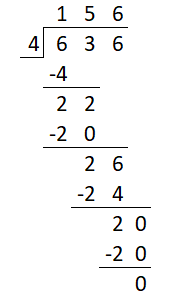
So, The mean height of the four boys = \(\frac{636}{4}\)
= 636 ÷ 4
Now, by using the Long Division,
Math in Focus Grade 6 Course 1 B Chapter 14 Lesson 14.1 Answer Key Mean_1
Hence, from the above,
We can conclude that the mean height of the four boys is: 159 centimeters.

Complete. Use the data in the table.

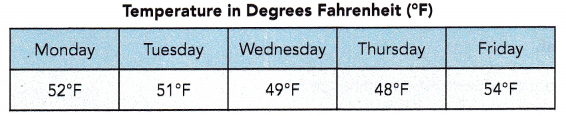
The table shows the temperature at noon from Monday to Friday in one city.
Math in Focus Grade 6 Chapter 14 Lesson 14.1 Answer Key Mean 2

Question 3.
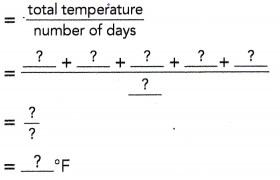
What was the mean temperature at noon from Monday to Friday?
Mean temperature
Math in Focus Grade 6 Chapter 14 Lesson 14.1 Answer Key Mean 3
The mean temperature at noon from Monday to Friday was Math in Focus Grade 6 Chapter 14 Lesson 14.1 Answer Key Mean 1 °F.
Answer:
50.8°F

Explanation:
The given table is:
Math in Focus Grade 6 Chapter 14 Lesson 14.1 Answer Key Mean 2
We know that,
Mean = \(\frac{\text {The sum of the values}}{\text {The number of values}}\)
So, The mean temperature at noon from Monday to Friday = \(\frac{52°F + 51°F + 49°F + 48°F + 54°F}{5}\)
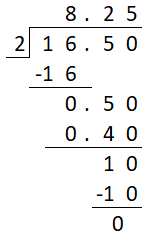
= \(\frac{254°F}{5}\)
Now, by using the Long Division,
Math in Focus Grade 6 Course 1 B Chapter 14 Lesson 14.1 Answer Key Mean_2
Hence, from the above,
We can conclude that the mean temperature at noon from Monday to Friday was 50.8°F

Complete. Use the data in the dot plot.

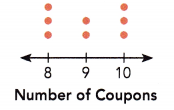
A group of volunteers was selling coupons to raise money for a food pantry. The dot plot on the right shows the number of coupons sold by each volunteer. Each dot represents 1 volunteer.
Math in Focus Grade 6 Chapter 14 Lesson 14.1 Answer Key Mean 4
Question 4.
Math in Focus Grade 6 Chapter 14 Lesson 14.1 Answer Key Mean 1 volunteers sold 8 coupons each. Math in Focus Grade 6 Chapter 14 Lesson 14.1 Answer Key Mean 1 × Math in Focus Grade 6 Chapter 14 Lesson 14.1 Answer Key Mean 1 = Math in Focus Grade 6 Chapter 14 Lesson 14.1 Answer Key Mean 1 coupons sold
Answer:
24 coupons sold.

Explanation:
It is given that, A group of volunteers was selling coupons to raise money for a food pantry.
The dot plot shows the number of coupons sold by each volunteer. Each dot represents 1 volunteer.
Now, The given figure is:
Math in Focus Grade 6 Chapter 14 Lesson 14.1 Answer Key Mean 4
From the given figure we can observe that,
The number of coupons sold by 3 Volunteers = 3 × (The number of coupons sold by each volunteer)
= 3 × 8
= 24 coupons
Hence, from the above We can conclude that,
3 volunteers sold 8 coupons each.
8 × 3 = 24 coupons sold.

Question 5.
Math in Focus Grade 6 Chapter 14 Lesson 14.1 Answer Key Mean 1 volunteers sold 9 coupons each. Math in Focus Grade 6 Chapter 14 Lesson 14.1 Answer Key Mean 1 × Math in Focus Grade 6 Chapter 14 Lesson 14.1 Answer Key Mean 1 = Math in Focus Grade 6 Chapter 14 Lesson 14.1 Answer Key Mean 1 coupons sold
Answer:
18 coupons sold.

Explanation:
It is given that, A group of volunteers was selling coupons to raise money for a food pantry.
The dot plot shows the number of coupons sold by each volunteer. Each dot represents 1 volunteer.
Now, The given figure is:
Math in Focus Grade 6 Chapter 14 Lesson 14.1 Answer Key Mean 4
From the given figure we can observe that,
The number of coupons sold by 2 Volunteers = 2 × (The number of coupons sold by each volunteer)
= 2 × 9
= 18 coupons
Hence, from the above we can conclude that,
2 volunteers sold 9 coupons each.
2 × 9 = 18 coupons sold.

Question 6.
Math in Focus Grade 6 Chapter 14 Lesson 14.1 Answer Key Mean 1 volunteers sold 10 coupons each. Math in Focus Grade 6 Chapter 14 Lesson 14.1 Answer Key Mean 1 × Math in Focus Grade 6 Chapter 14 Lesson 14.1 Answer Key Mean 1 = Math in Focus Grade 6 Chapter 14 Lesson 14.1 Answer Key Mean 1 coupons sold
Answer:
30 coupons sold.

Explanation:
It is given that, A group of volunteers was selling coupons to raise money for a food pantry.
The dot plot shows the number of coupons sold by each volunteer.
Each dot represents 1 volunteer.
Now, The given figure is:
Math in Focus Grade 6 Chapter 14 Lesson 14.1 Answer Key Mean 4
From the given figure we can observe that,
The number of coupons sold by 3 Volunteers = 10 × (The number of coupons sold by each volunteer)
= 10 × 3
= 30 coupons
Hence, from the above we can conclude that,
3 volunteers sold 10 coupons each.
10 × 3 = 30 coupons sold.

Question 7.
Math in Focus Grade 6 Chapter 14 Lesson 14.1 Answer Key Mean 1 coupons were sold altogether.
Answer:
72 coupons.

Explanation:
From Questions 4, 5, and 6,
We can observe that, the total number of coupons sold 24 + 18 + 30 = 72 coupons
Hence, from the above we can conclude that,
72 coupons were sold altogether.

Question 8.
There were _____ volunteers altogether.
Answer:
8 volunteers.

Explanation:
The given figure is:
Math in Focus Grade 6 Chapter 14 Lesson 14.1 Answer Key Mean 4
From the given figure we can observe that,
Each dot represents 1 volunteer
So, The total number of volunteers = 3 + 2 + 3 = 8 volunteers
Hence, from the above we can conclude that,
There were 8 volunteers altogether.

Question 9.
The mean number of coupons sold by the group of volunteers was _____.
Answer:
9 coupons.

Explanation:
The given figure is:
Math in Focus Grade 6 Chapter 14 Lesson 14.1 Answer Key Mean 4
The mean number of coupons sold by the group of volunteers = \(\frac{\text {The total number of coupons sold altogether}}{\text {The total number of volunteers}}\)
= \(\frac{72}{8}\)
= 9
Hence, from the above we can conclude that,
The mean number of coupons sold by the group of volunteers was 9 coupons.

Solve.

Question 10.
Jay’s mean score for four quizzes is 8. His scores for the first three quizzes are 7.5, 8, and 9. What is Jay’s score for the last quiz?
Total score for the four quizzes = mean score × number of quizzes
= Math in Focus Grade 6 Chapter 14 Lesson 14.1 Answer Key Mean 1 × Math in Focus Grade 6 Chapter 14 Lesson 14.1 Answer Key Mean 1
= Math in Focus Grade 6 Chapter 14 Lesson 14.1 Answer Key Mean 1
Total score for the first three quizzes = Math in Focus Grade 6 Chapter 14 Lesson 14.1 Answer Key Mean 1 + Math in Focus Grade 6 Chapter 14 Lesson 14.1 Answer Key Mean 1 + Math in Focus Grade 6 Chapter 14 Lesson 14.1 Answer Key Mean 1
= Math in Focus Grade 6 Chapter 14 Lesson 14.1 Answer Key Mean 1
Math in Focus Grade 6 Chapter 14 Lesson 14.1 Answer Key Mean 1Math in Focus Grade 6 Chapter 14 Lesson 14.1 Answer Key Mean 1 = Math in Focus Grade 6 Chapter 14 Lesson 14.1 Answer Key Mean 1
Jay’s score for the last quiz is ______.
Answer:
Jay’s score for the last quiz is 7.5.

Explanation:
It is given that, Jay’s mean score for four quizzes is 8.
His scores for the first three quizzes are 7.5, 8, and 9.
Now we know that,
The total score for the four quizzes = (The mean of the four quizzes) × (The total number of quizzes)
So, The total score for the four quizzes 8 × 4 = 32
The total score for the first three quizzes 7.5 + 8 + 9 = 24.5
So, Jay’s score for the last quiz,
(The total score for the four quizzes) – (The total score for the first three quizzes)
= 32 – 24.5
= 7.5
Hence, from the above we can conclude that,
Jay’s score for the final quiz is 7.5

Question 11.
Sarah’s mean number of points scored for four video games is 7,500. How many points must she score in the fifth video game so that her mean score becomes 7,700?
Answer:
8,500 points.

Explanation:
It is given that, Sarah’s mean number of points scored for four video games is 7,500 and her mean score is 7,700.
We know that,
The total number of points scored by Sarah = (The mean score of Sarah) × (The total number of video games played by Sarah)
The total number of points scored by Sarah = 7,700 × 5
= 38,500 points.
The total number of points scored by Sarah in her four video games = (The mean score of Sarah) ×4
The total number of points scored by Sarah in her four video games = 7,500 × 4
= 30,000 points.
The number of points scored by Sarah in the fifth video game = (The total number of points scored by Sarah) – (The number of points scored by Sarah in her four video games)
= 38,500 – 30,000
= 8,500 points
Hence, from the above we can conclude that,
The number of points scored by Sarah in her fifth video game is 8,500 points.

Hands-On Activity

Finding Mean and Using Mean to Solve Problems

Materials

  • centimeter ruler
  • blank table

Work in groups of five.

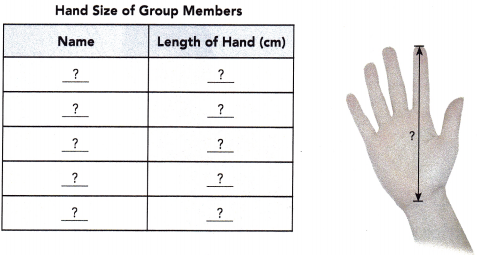
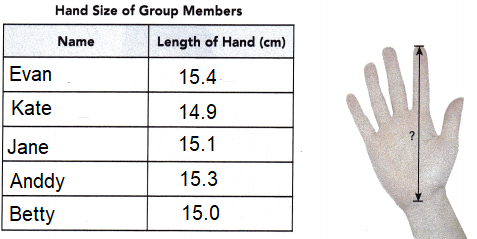
Step 1: Use a centimeter ruler to measure the length of each group member’s hand to the nearest tenth of a centimeter. Record your answers in a copy of the table below.
Math in Focus Grade 6 Chapter 14 Lesson 14.1 Answer Key Mean 5
Step 2: Use your data to answer the following questions.
What is the longest hand length? Math in Focus Grade 6 Chapter 14 Lesson 14.1 Answer Key Mean 1
What is the shortest hand length? Math in Focus Grade 6 Chapter 14 Lesson 14.1 Answer Key Mean 1
The mean hand length of the group is _____ centimeters.

Step 3: Math Journal Suppose a new student joins your group and the mean of the hand length of your group increases by 0.3 centimeters. Find the hand length of the new student to the nearest centimeter. Explain how you found your answer.
Answer:
Math in Focus Grade 6 Chapter 14 Lesson 14.1 Answer Key Mean 5_1
the longest hand length is 15.4 cm
the shortest hand length is 14.9 cm
The mean hand length of the group is 15.14 centimeters.
The hand length of the new student to the nearest centimeter is 17cm.
Explanation:
First by using the ruler find the hand of the students in the class randomly in centimeters.
Then find the longest and shortest hand length from the observations recorded as shown above.
Mean = \(\frac{\text {The sum of the values}}{\text {The number of values}}\)
= \(\frac{(15.4 + 14.9 + 15.1 + 15.3 + 15.0)}{5}\)
= \(\frac{75.7}{5}\)
= 15.14 cm.
If a new student joins the group and the mean of hand length of the group increases by 0.3 cm. Then, the hand length of the new student,
Mean = 15.14 + 0.3 = 15.44 cm
15.44 = \(\frac{(15.4 + 14.9 + 15.1 + 15.3 + 15.0 + x)}{6}\)
= \(\frac{75.7x}{6}\)
x = 15.44 x 6 – 75.7
x = 92.64 – 75.7
x = 16.94
So, the hand length of the new student to the nearest centimeter is 17 cm.

Math in Focus Course 1B Practice 14.1 Answer Key

Find the mean of each data set.

Question 1.
8, 7, 5, 9, 6, 13
Answer:
8

Explanation:
The given data set is:
8, 7, 5, 9, 6, 13
We know that,
Mean = \(\frac{\text {The sum of the total data set}}{\text {The number of digits present in the data set}}\)
The mean of the given data set = \(\frac{8 + 7 + 5 + 9 + 6 + 13}{6}\)
= \(\frac{48}{6}\)
= 8
Hence, from the above we can conclude that,
The mean of the given data set is 8.

Question 2.
72 L, 91 L, 65 L, 81 L, 62 L, 83 L, 75 L, 88 L
Answer:
77.125 L

Explanation:
The given data set is:
72 L, 91 L, 65 L, 81 L, 62 L, 83 L, 75 L, 88 L
We know that,
Mean = \(\frac{\text {The sum of the total data set}}{\text {The number of digits present in the data set}}\)
The mean of the given data set = \(\frac{72 + 91 + 65 + 81 + 62 + 83 + 75 + 88}{8}\)
= \(\frac{617}{8}\)
= 77.125
Hence, from the above we can conclude that,
The mean of the given data set is 77.125 L

Question 3.
21.5 cm, 63.7 cm, 18.9 cm, 34.1 cm, 75.6 cm
Answer:
42.76 cm.

Explanation:
The given data set is:
21.5 cm, 63.7 cm, 18.9 cm, 34.1 cm, 75.6 cm
We know that,
Mean = \(\frac{\text {The sum of the total data set}}{\text {The number of digits present in the data set}}\)
The mean of the given data set = \(\frac{21.5 + 63.7 + 18.9 + 34.1 + 75.6}{5}\)
= \(\frac{213.8}{5}\)
= 42.76
Hence, from the above we can conclude that,
The mean of the given data set is 42.76 cm.

Solve. Show your work.

Question 4.
The number of goals scored by seven forwards in one soccer season was 8, 6, 4, 8, 3, 1, and 5. Find the mean number of goals scored by the seven forwards.
Answer:
5 goals.

Explanation:
It is given that,
The number of goals scored by seven forwards in one soccer season was 8, 6, 4, 8, 3, 1, and 5
We know that,
The mean number of goals scored by the seven forwards = \(\frac{\text {The total sum of the goals scored by seven forwards}}{\text {The number of goals}}\)
The mean number of goals scored by the seven forwards = \(\frac{8 + 6 + 4 + 8 + 3 + 1 + 5}{7}\)
= \(\frac{35}{7}\)
= 5
Hence, from the above we can conclude that,
The mean number of goals scored by the seven forwards is 5 goals.

Question 5.
The lengths of the five ropes are 3.2 meters, 5.2 meters, 2.9 meters, 6.6 meters, and 4.5 meters. Find the mean length of these five ropes.
Answer:
4.48 meters.

Explanation:
It is given that,
The lengths of the five ropes are 3.2 meters, 5.2 meters, 2.9 meters, 6.6 meters, and 4.5 meters
We know that,
The mean length of the five ropes = \(\frac{\text {The total length of the five ropes}}{\text {The number of ropes}}\)
The mean length of the five ropes = \(\frac{3.2 + 5.2 + 2.9 + 6.6 + 4.5}{5}\)
= \(\frac{22.4}{5}\)
= 4.48
Hence, from the above we can conclude that,
The mean length of the five ropes is 4.48 meters.

Question 6.
The masses of six chairs are 34.5 kilograms, 42.6 kilograms, 39.8 kilograms, 40.1 kilograms, 53.4 kilograms, and 33.8 kilograms. Find their mean mass.
Answer:
40.7 kilograms.

Explanation:
It is given that,
The masses of six chairs are 34.5 kilograms, 42.6 kilograms, 39.8 kilograms, 40.1 kilograms, 53.4 kilograms, and 33.8 kilograms.
We know that,
The mean mass of the six chairs = \(\frac{\text {The total mass of the six chairs}}{\text {The number of chairs}}\)
The mean mass of the six chairs = \(\frac{34.5 + 42.6 + 39.8 + 40.1 + 53.4 + 33.8}{6}\)
= \(\frac{244.2}{6}\)
= 40.7 kilograms
Hence, from the above we can conclude that,
The mean mass of the six chairs is 40.7 kilograms.

Use the data in the table to answer the question.

The table shows a sprinter’s times for the 100-meter dash at the first five meets of one season.
Math in Focus Grade 6 Chapter 14 Lesson 14.1 Answer Key Mean 6
Question 7.
What was the sprinter’s meantime for the 100-meter dash at these meets?
Answer:
10.116 s

Explanation:
It is given that,
The table shows a sprinter’s times for the 100-meter dash at the first five meets of one season.
The given table is:
Math in Focus Grade 6 Chapter 14 Lesson 14.1 Answer Key Mean 6
From the above table we can observe that,
The sprinter’s meantime for the 100-meter dash at these meets = \(\frac{\text {The total time taken to complete the 100-meter dash}}{\text {The number of meets}}\)
The sprinter’s meantime for the 100-meter dash at these meets = \(\frac{10.09 + 10.14 + 10.29 + 10.07 + 9.99}{5}\)
= \(\frac{50.58}{5}\)
= 10.116 s
Hence, from the above we can conclude that,
The sprinter’s meantime for the 100-meter dash at these meets is 10.116 s.

Use the data in the dot plot to answer questions 8 and 9

Eight ice hockey teams competed in the quarter-finals of a national championship. The dot plot on the right shows the number of goals scored by each team. Each dot represents 1 team.
Math in Focus Grade 6 Chapter 14 Lesson 14.1 Answer Key Mean 7

Question 8.
What was the total number of goals scored by the eight teams?
Answer:
26 goals.

Explanation:
It is given that,
Eight ice hockey teams competed in the quarter-finals of a national championship.
The dot plot shows the number of goals scored by each team.
Each dot represents 1 team.
The given figure is:
Math in Focus Grade 6 Chapter 14 Lesson 14.1 Answer Key Mean 7
From the given figure we can observe that,
The total number of goals scored by the eight teams = (The total number of teams) × (The total number of goals made by each team)
= (2 × 2) + (3 × 3) + (4 × 2) + (5 × 1)
= 4 + 9 + 8 + 5
= 26 goals
Hence, from the above we can conclude that,
The total number of goals scored by the eight teams is 26 goals.

Question 9.
What was the mean number of goals scored by each team?
Answer:
3 goals.

Explanation:
From Question 8,
We can observe that the total number of goals scored by the eight teams is 26 goals.
We know that the mean number of goals scored by each team,
\(\frac{\text {The total number of goals scored by the eight teams}}{\text {The total number of teams}}\)
The mean number of goals scored by each team = \(\frac{26}{8}\)
= 3.25
≅ 3 goals
Hence, from the above we can conclude that,
The mean number of goals scored by each team is about 3 goals.

Solve. Show your work.

Question 10.
The mean of the five numbers 3, 7, 9, 12, and x is 8. Find the value of x.
Answer:
x = 9

Explanation:
It is given that the mean of the five numbers 3, 7, 9, 12, and x is 8
We know that,
Mean = \(\frac{\text {The sum of the numbers}}{\text {The count of the numbers}}\)
The mean of the five numbers = \(\frac{3 + 7 + 9 + 12 + x}{5}\)
8 = \(\frac{31 + x}{5}\)
31 + x = 8 × 5
x = 40 – 31
x = 9
Hence, the value of x is 9.

Question 11.
The mean of a set of five numbers is 4.8. Given that the sixth number is x and the mean of these six numbers is 5.5, find the value of x.
Answer:
x = 9

Explanation:
It is given that the mean of a set of five numbers is 4.8.
Mean = \(\frac{\text {The sum of the numbers}}{\text {The count of the numbers}}\)
The total sum of the set of five numbers = 4.8 × 5
= 24
The total sum of the set of six numbers 5.5 × 6 = 33
The value of the sixth number (x) = (The total sum of the set of six numbers) – (The total sum of the set of five numbers)
= 33 – 24
= 9
Hence, the value of x is 9.

Question 12.
In a race, the meantime for three runners was 12.4 seconds and the meantime for another six runners was 11.5 seconds. Calculate the meantime for all the nine runners.
Answer:
23.9 seconds.

Explanation:
It is given that, in a race, the meantime for three runners was 12.4 seconds and the meantime for another six runners was 11.5 seconds.
The meantime for all the nine runners = (The meantime for three runners) + (The meantime for six runners)
The meantime for all the nine runners = 12.4 + 11.5
= 23.9 seconds
Hence, the meantime for all the nine runners is 23.9 seconds.

Question 13.
The mean weight of nine apples is 7.5 ounces. Three of the apples have a mean weight of 8 ounces. Find the mean weight of the other six apples.
Math in Focus Grade 6 Chapter 14 Lesson 14.1 Answer Key Mean 8
Answer:
7.25 ounces.

Explanation:
It is given that the mean weight of nine apples is 7.5 ounces.
Three of the apples have a mean weight of 8 ounces
We know that,
The total mean weight of nine apples = (The total mean weight of three apples) + (The total mean weight of six apples)
So, The total weight of six apples = (The total weight of nine apples) – (The total weight of three apples)
= (7.5 × 9) – (8 × 3)
= 67.5 – 24
= 43.5 ounces
The total mean weight of six apples = \(\frac{\text {The total weight of six apples}}{\text {The number of apples}}\)
= \(\frac{43.5}{6}\)
= 7.25 ounces
Hence, the mean weight of the other six apples is 7.25 ounces.

Question 14.
The mean of six numbers is 45. Four of the numbers are 40, 38, 46, and 51. If the remaining two numbers are in the ratio 2 : 3, find the two numbers.
Answer:
38 and 57 are the numbers.

Explanation:
It is given that the mean of six numbers is 45.
Four of the numbers are 40, 38, 46, and 51 and the remaining two numbers are in the ratio 2 : 3
Now, Let
x—–> the missing smaller number
y—-> the missing larger number
We know that,
Mean = \(\frac{\text {The sum of the numbers in the data set}}{\text {The number of values present in the data set}}\)
45 = \(\frac{40 + 35 + 46 + 51 + x + y}{6}\)
40 + 35 + 46 + 51 + x + y = 270
175 + x + y = 270
x + y = 95  —–> Equation A
It is also given that, \(\frac{x}{y}\) = \(\frac{2}{3}\)
x = \(\frac{2}{3}\)y  —–> equation B
Now, substitute equation B in equation A and solve for y.
So, \(\frac{2}{3}\)y + y = 95
y (1 + \(\frac{2}{3}\) ) = 95
\(\frac{5}{3}\)y = 95
y = 95 × \(\frac{3}{5}\)
y = 19 × 3
y = 57
Now, substitute the value of y in Equation B.
So, x = \(\frac{2}{3}\) × 57
x = 2 × 19
x = 38
Hence, the two numbers are 38 and 57.

Question 15.
A data set consists of three numbers, a, b, and c. Write an algebraic expression, in terms of a, b, and c, to represent the mean of the new set of numbers obtained by
a) adding 5 to every number in the set.
Answer:
\(\frac{a + b + c}{3}\) + 5

Explanation:
It is given that a data set consists of three numbers, a, b, and c
We know that,
Mean = \(\frac{\text {The sum of the numbers in the data set}}{\text {The number of values present in the data set}}\)
According to the given condition,
We have to add 5 to each value
So, The sum of the numbers = (a + 5) + (b + 5) + (c + 5)
= (a + b + c) + 15
So, The mean of the new set of numbers = \(\frac{(a + b + c) + 15}{3}\)
= \(\frac{a + b + c}{3}\) + 5
Hence, the mean of the new set of numbers is \(\frac{a + b + c}{3}\) + 5

b) doubling every number in the set.
Answer:
\(\frac{2}{3}\) (a + b + c)

Explanation:
Given that a data set consists of three numbers, a, b, and c.
We know that,
Mean = \(\frac{\text {The sum of the numbers in the data set}}{\text {The number of values present in the data set}}\)
According to the given condition,
We have to double each value i.e., we have to multiply each value with 2
So, The sum of the numbers = (a + a) + (b + b) + (c + c)
= 2a + 2b + 2c
= 2(a + b + c)
So, The mean of the new set of numbers = \(\frac{2(a + b + c)}{3}\)
= \(\frac{2}{3}\) (a + b + c)
Hence, the mean of the new set of numbers is \(\frac{2}{3}\) (a + b + c)

c) halving every number in the set.
Answer:
\(\frac{1}{6}\) (a + b + c)

Explanation:
Given that, A data set consists of three numbers, a, b, and c.
We know that,
Mean = \(\frac{\text {The sum of the numbers in the data set}}{\text {The number of values present in the data set}}\)
According to the given condition,
We have to half each value i.e., we have to multiply each value with 0.5 or \(\frac{1}{2}\)
So, The sum of the numbers = (a × 0.5) + (b × 0.5) + (c × 0.5)
= 0.5a + 0.5b + 0.5c
= 0.5(a + b + c)
So, The mean of the new set of numbers = \(\frac{0.5(a + b + c)}{3}\)
= \(\frac{0.5}{3}\) (a + b + c)
= \(\frac{1}{6}\) (a + b + c)
Hence, the mean of the new set of numbers is \(\frac{1}{6}\) (a + b + c)

Question 16.
The table shows the mean scores of three classes in a history test.
Math in Focus Grade 6 Chapter 14 Lesson 14.1 Answer Key Mean 9
The mean score of all the students in classes A and B combined is 6.8
The mean score of all the students in classes B and C combined is 7.
If the number of students in classes A, B, and C are denoted by a, b, and c respectively, find the ratio a: b: c.

Answer:
a : b : c = 4 : 6 : 3

Explanation:
Let number of students in A = a
Let number of students in B = b
Let number of students in C = c

Total score of A ÷ a = 8
Total score of A = 8 x a = 8a

Total score of B ÷ b = 6
Total score of B = 6 x b = 6b

Total score of C ÷ c = 9
Total score of C = 9 x c = 9c

Total score of (A + B) ÷ (a + b) = 6.8
Total score of (A + B) = 6.8 x (a + b) = 6.8a + 6.8b
Total score of A + Total score of B = 6.8a + 6.8b
8a + 6b = 6.8a + 6.8b
1.2a = 0.8b
3a = 2b
a : b = 2 : 3

Total score of (B + C) ÷ (b + c) = 7
Total score of (B + C) = 7 x (b + c) = 7b + 7c
Total score of B + Total score of C = 7b + 7c
6b + 9c = 7b + 7c
b = 2c
b : c = 2 : 1

now we have
[a : b = 2 : 3] x 2
[b : c = 2 : 1] x 3

a : b = 4 : 6
b : c = 6 : 3

a : b : c = 4 : 6 : 3

Question 17.
Math Journal Find five different numbers whose mean is 12. Explain your strategy.
Answer:
Answers may vary.
The five different numbers whose mean is 12 are 10, 11, 12, 13 and14.

Explanation:
The mean is the average of the numbers.
Add up all the numbers, then divide by how many numbers there are.
10 + 11 + 12 + 13 + 14 = 65
So, divide the sum by the count or number of terms.
65 ÷ 5 = 12

Math in Focus Kindergarten Chapter 3 Answer Key Order by Size, Length, or Weight

Go through the Math in Focus Grade K Workbook Answer Key Chapter 3 Order by Size, Length, or Weight to finish your assignments.

Math in Focus Kindergarten Chapter 3 Answer Key Order by Size, Length, or Weight

Lesson 1 Ordering Things by Size

Look and talk

Math in Focus Kindergarten Chapter 3 Answer Key 1
Answer:
Math in Focus Kindergarten Chapter 3 Answer Key Order by Size, Length, or Weight-1

Explanation:
Ordering the things according to Bath Robes and Pillow sizes
1. Papa Bear’s,
2. Mama Bear’s and finally
3. Baby Bear’s.

Math in Focus Kindergarten Chapter 3 Answer Key 2
Answer:
Math in Focus Kindergarten Chapter 3 Answer Key Order by Size, Length, or Weight-2

Explanation:
Ordering the things according to Combs, Brushes and Slippers sizes
1. Papa Bear’s,
2. Mama Bear’s and finally
3. Baby Bear’s.

Which is the biggest? Color. Which is the smallest? Circle.

Question 1.
Math in Focus Kindergarten Chapter 3 Answer Key 3
Answer:
Math in Focus Kindergarten Chapter 3 Answer Key Order by Size, Length, or Weight-3
Explanation:
Colored the biggest one and circled the smallest sock.

Question 2.
Math in Focus Kindergarten Chapter 3 Answer Key 4
Answer:
Math in Focus Kindergarten Chapter 3 Answer Key Order by Size, Length, or Weight-4
Explanation:
Colored the biggest one and circled the smallest hat.

Question 3
Math in Focus Kindergarten Chapter 3 Answer Key 5
Answer:
Math in Focus Kindergarten Chapter 3 Answer Key Order by Size, Length, or Weight-5

Explanation:
Colored the biggest one and circled the smallest shirt.

Lesson 2 Comparing Sizes

Draw.

Question 1.
Math in Focus Kindergarten Chapter 3 Answer Key 6
Answer:
Math in Focus Kindergarten Chapter 3 Answer Key Order by Size, Length, or Weight-6
Explanation:
Drawn bigger ball than the given ball.

Question 2.
Math in Focus Kindergarten Chapter 3 Answer Key 7
Answer:
Math in Focus Kindergarten Chapter 3 Answer Key Order by Size, Length, or Weight-7
Explanation:
Drawn the smaller flower than the given flower.
Question 3.
Math in Focus Kindergarten Chapter 3 Answer Key 8
Answer:
Math in Focus Kindergarten Chapter 3 Answer Key Order by Size, Length, or Weight-8
Explanation:
Drawn the taller boy than the given boy.

Question 4.
Math in Focus Kindergarten Chapter 3 Answer Key 9
Answer:
Math in Focus Kindergarten Chapter 3 Answer Key Order by Size, Length, or Weight-10
Explanation:
Drawn the trouser which is shorter than the given trouser.

Lesson 3 Ordering Things by Length

Color the longest snake yellow. Color the shortest snake red.

Math in Focus Kindergarten Chapter 3 Answer Key 10
Answer:
Math in Focus Kindergarten Chapter 3 Answer Key Order by Size, Length, or Weight-11

Explanation:
Colored the longest snake yellow and Colored the shortest snake red above.

Lesson 4 Ordering Things by Weight

Which is the heaviest? Circle.

Question 1.
Math in Focus Kindergarten Chapter 3 Answer Key 11
Answer:
Math in Focus Kindergarten Chapter 3 Answer Key Order by Size, Length, or Weight-12
Explanation:
Circled the heaviest one.

Question 2.
Math in Focus Kindergarten Chapter 3 Answer Key 12
Answer:
Math in Focus Kindergarten Chapter 3 Answer Key Order by Size, Length, or Weight-13

Explanation:
Circled the heaviest one.

Question 3.
Math in Focus Kindergarten Chapter 3 Answer Key 13
Answer:
Math in Focus Kindergarten Chapter 3 Answer Key Order by Size, Length, or Weight-14
Explanation:
Circled the heaviest one.

Math in Focus Kindergarten Chapter 7 Answer Key Solid and Flat Shapes

Go through the Math in Focus Grade K Workbook Answer Key Chapter 7 Solid and Flat Shapes to finish your assignments.

Math in Focus Kindergarten Chapter 7 Answer Key Solid and Flat Shapes

Lesson 1 Solid Shapes

Which shape is it? Color.

Question 1.
Math in Focus Kindergarten Chapter 7 Answer Key 1
Answer:
Math in Focus Kindergarten Chapter 7 Answer Key Solid and Flat Shapes-1
Explanation:
Cone Shape,
Colored Icecream, Cap, Announcement Speaker.

Question 2.
Math in Focus Kindergarten Chapter 7 Answer Key 2
Answer:
Math in Focus Kindergarten Chapter 7 Answer Key Solid and Flat Shapes-2
Explanation:
Circle shape – Balls, Bubbles,
Cone shape – Caps, Lamp.

Lesson 2 Flat Shapes in Solid Shapes

Match

Math in Focus Kindergarten Chapter 7 Answer Key 3
Answer:
Math in Focus Kindergarten Chapter 7 Answer Key Solid and Flat Shapes-3
Explanation:
Matched with the given solid shapes,
Cube- Square,
Rectangle – Game Puzzel.

Math in Focus Kindergarten Chapter 7 Answer Key 4
Answer:
Math in Focus Kindergarten Chapter 7 Answer Key Solid and Flat Shapes-4
Explanation:
Matched with the given solid shape
Round-Circle- Balloons, Ball,
Triangle –  Prism.
Math in Focus Kindergarten Chapter 7 Answer Key Solid and Flat Shapes-5

Pair

Math in Focus Kindergarten Chapter 7 Answer Key 5
Answer:
Math in Focus Kindergarten Chapter 7 Answer Key Solid and Flat Shapes-5
Explanation:
Circle – Sun,
Rectangle – Tissue Box,
Triangle – Prism,
Sqaure – Clock.

Lesson 3 Flat Shapes

Draw

Question 1.
Math in Focus Kindergarten Chapter 7 Answer Key 6
Answer:
Math in Focus Kindergarten Chapter 7 Answer Key Solid and Flat Shapes-6
Explanation:
Drawn Big Circle and Small Circle in the given space.

Question 2.
Math in Focus Kindergarten Chapter 7 Answer Key 7
Answer:
Math in Focus Kindergarten Chapter 7 Answer Key Solid and Flat Shapes-7
Explanation:
Drawn Small Sqaure and Big Square in the given place.

Question 3.
Math in Focus Kindergarten Chapter 7 Answer Key 8
Answer:
Math in Focus Kindergarten Chapter 7 Answer Key Solid and Flat Shapes-8
Explanation:
Drawn Big Triangle and Small Triangle in the given space.

Question 4.
Math in Focus Kindergarten Chapter 7 Answer Key 9
Answer:
Math in Focus Kindergarten Chapter 7 Answer Key Solid and Flat Shapes-9
Explanation:
Drawn Small Rectangle and Big Rectangle in the given space.

Question 5.
Math in Focus Kindergarten Chapter 7 Answer Key 10
Answer:
Math in Focus Kindergarten Chapter 7 Answer Key Solid and Flat Shapes-10
Explanation:
Drawn Big Hexagon and Small Hexagon in the given space.

Lesson 4 Flat Shape Pictures

Color the squares red. Color the rectangles green. Color the circle yellow.
Color the triangle blue. Color the hexagon brown.

Math in Focus Kindergarten Chapter 7 Answer Key 11
Answer:
Math in Focus Kindergarten Chapter 7 Answer Key Solid and Flat Shapes-11
Explanation:
Colored the squares with red. Colored the rectangles with green.
Colored the circles with yellow.
Colored the triangles with blue. Colored the hexagons with brown.

Lesson 5 Shape Patterns

Complete the pattern.

Math in Focus Kindergarten Chapter 7 Answer Key 12

Question 1.
Math in Focus Kindergarten Chapter 7 Answer Key 13
Answer:
Math in Focus Kindergarten Chapter 7 Answer Key Solid and Flat Shapes-12
Explanation:
Completed the given pattern in the given box.

Question 2.
Math in Focus Kindergarten Chapter 7 Answer Key 14
Answer:
Math in Focus Kindergarten Chapter 7 Answer Key Solid and Flat Shapes-13
Explanation:
Completed the given pattern in the given box.

Question 3.
Math in Focus Kindergarten Chapter 7 Answer Key 15
Answer:
Math in Focus Kindergarten Chapter 7 Answer Key Solid and Flat Shapes-14
Explanation:
Completed the given pattern in the given box.

Math in Focus Grade 6 Chapter 10 Lesson 10.3 Answer Key Area of Other Polygons

Practice the problems of Math in Focus Grade 6 Workbook Answer Key Chapter 10 Lesson 10.3 Area of Other Polygons to score better marks in the exam.

Math in Focus Grade 6 Course 1 B Chapter 10 Lesson 10.3 Answer Key Area of Other Polygons

Math in Focus Grade 6 Chapter 10 Lesson 10.3 Guided Practice Answer Key

Give the minimum number of identical triangles you could divide each regular polygon into so that you could find the area of the polygon.

Question 1.
Math in Focus Grade 6 Chapter 8 Lesson 10.3 Answer Key Area of Other Polygons 1
Answer:
Math-in-Focus-Grade-6-Chapter-8-Lesson-10.3-Answer-Key-Area-of-Other-Polygons-1
Draw lines from the center of the pentagon, leading to each vertex corner. 5 such lines can be drawn. Thus, 5 identical triangles can be drawn for the given figure.
Area of polygon = n×Area of triangle
Where ‘n’ is the number of sides.
Area of triangle = \(\frac{1}{2}\)×b×h
Area of polygon = n×\(\frac{1}{2}\)×b×h
Here n equals 5
Area of polygon = 5×\(\frac{1}{2}\)×b×h

Question 2.
Math in Focus Grade 6 Chapter 8 Lesson 10.3 Answer Key Area of Other Polygons 2
Answer:
Math-in-Focus-Grade-6-Chapter-8-Lesson-10.3-Answer-Key-Area-of-Other-Polygons-2
Draw lines from the center of the pentagon, leading to each vertex corner. 6 such lines can be drawn. Thus, 6 identical triangles can be drawn for the given figure.
Area of polygon = n×Area of triangle
Where ‘n’ is the number of sides.
Area of triangle = \(\frac{1}{2}\)×b×h
Area of polygon = n×\(\frac{1}{2}\)×b×h
Here n equals 6
Area of polygon = 6×\(\frac{1}{2}\)×b×h

Count the number of sides in each figure.
Math in Focus Grade 6 Chapter 8 Lesson 10.3 Answer Key Area of Other Polygons 3

Complete.

Question 3.
Blake drew a regular pentagon with side lengths of 6 inches. He divided the pentagon into 5 identical triangles, and measured the height of one of the triangles to be 4.1 inches. Find the area of the pentagon.
Area of triangle = \(\frac{1}{2}\)bh
= Math in Focus Grade 6 Chapter 8 Lesson 10.3 Answer Key Area of Other Polygons 4Math in Focus Grade 6 Chapter 8 Lesson 10.3 Answer Key Area of Other Polygons 4Math in Focus Grade 6 Chapter 8 Lesson 10.3 Answer Key Area of Other Polygons 4
= Math in Focus Grade 6 Chapter 8 Lesson 10.3 Answer Key Area of Other Polygons 4 im.2
Area of pentagon = Math in Focus Grade 6 Chapter 8 Lesson 10.3 Answer Key Area of Other Polygons 4 • area of triangle
= Math in Focus Grade 6 Chapter 8 Lesson 10.3 Answer Key Area of Other Polygons 4Math in Focus Grade 6 Chapter 8 Lesson 10.3 Answer Key Area of Other Polygons 4
= Math in Focus Grade 6 Chapter 8 Lesson 10.3 Answer Key Area of Other Polygons 4 in.2
The area of the pentagon is Math in Focus Grade 6 Chapter 8 Lesson 10.3 Answer Key Area of Other Polygons 4 square inches.
Answer:
Given that a regular pentagon is divided into 5 identical triangles with side lengths of 6 inches. The height of one of the triangles to be 4.1 inches.
Therefore, the base will measure 6 in and the height will measure 4.1 in.
Area of triangle = \(\frac{1}{2}\)×b×h
= \(\frac{1}{2}\)×6×4.1
= 24.6 ÷ 2
= 12.3  sq.in
There are 5 such identical triangles.
Area of pentagon = 5×area of triangle
= 5×12.3
= 61.5 sq.in
The area of the pentagon is 61.5 sq.in

Question 4.
Melanie drew a regular hexagon with side lengths of 28 centimeters. She divided the hexagon into 6 identical triangles and measured the height of one of the triangles to be 24.2 centimeters. Find the area of the hexagon.
Math in Focus Grade 6 Chapter 8 Lesson 10.3 Answer Key Area of Other Polygons 5
Area of triangle = \(\frac{1}{2}\)bh
= Math in Focus Grade 6 Chapter 8 Lesson 10.3 Answer Key Area of Other Polygons 4Math in Focus Grade 6 Chapter 8 Lesson 10.3 Answer Key Area of Other Polygons 4Math in Focus Grade 6 Chapter 8 Lesson 10.3 Answer Key Area of Other Polygons 4
= Math in Focus Grade 6 Chapter 8 Lesson 10.3 Answer Key Area of Other Polygons 4 cm2
Area of hexagon = Math in Focus Grade 6 Chapter 8 Lesson 10.3 Answer Key Area of Other Polygons 4 • area of triangle
= Math in Focus Grade 6 Chapter 8 Lesson 10.3 Answer Key Area of Other Polygons 4Math in Focus Grade 6 Chapter 8 Lesson 10.3 Answer Key Area of Other Polygons 4
= Math in Focus Grade 6 Chapter 8 Lesson 10.3 Answer Key Area of Other Polygons 4 cm2
The area of the hexagon is Math in Focus Grade 6 Chapter 8 Lesson 10.3 Answer Key Area of Other Polygons 4 square centimeters.
Answer:
Given that a regular hexagon is divided into 6 identical triangles with side lengths of 28 cm. The height of one of the triangles to be 24.2cm.
Area of triangle = \(\frac{1}{2}\)×b×h
= \(\frac{1}{2}\)×28×24.2
= \(\frac{1}{2}\)×677.6
= 338.8 sq.cm
There are 6 such identical triangles.
Area of hexagon = 6×area of triangle
= 6 × 338.8
= 2032.8 sq.cm
The area of the hexagon is 2032.8 sq.cm

Math in Focus Course 1B Practice 10.3 Answer Key

Give the minimum number of identical triangles you could divide each regular polygon into so that you could find the area of the polygon.

Question 1.
Math in Focus Grade 6 Chapter 8 Lesson 10.3 Answer Key Area of Other Polygons 6
Answer:
Math-in-Focus-Grade-6-Chapter-8-Lesson-10.3-Answer-Key-Area-of-Other-Polygons-6
Explanation:
Draw lines from the center of the pentagon, leading to each vertex corner. 8 such lines can be drawn. Thus, 8 identical triangles can be drawn for the given figure.
Area of polygon = n×Area of triangle
Where ‘n’ is the number of sides.
Area of triangle = \(\frac{1}{2}\)×b×h
Area of polygon = n×\(\frac{1}{2}\)×b×h
Here n equals 8
Area of polygon = 8×\(\frac{1}{2}\)×b×h

Question 2.
Math in Focus Grade 6 Chapter 8 Lesson 10.3 Answer Key Area of Other Polygons 7
Answer:
Math-in-Focus-Grade-6-Chapter-8-Lesson-10.3-Answer-Key-Area-of-Other-Polygons-7
Explanation:
Draw lines from the center of the pentagon, leading to each vertex corner. 12 such lines can be drawn. Thus, 12 identical triangles can be drawn for the given figure.
Area of polygon = n×Area of triangle
Where ‘n’ is the number of sides.
Area of triangle = \(\frac{1}{2}\)×b×h
Area of polygon = n×\(\frac{1}{2}\)×b×h
Here n equals 12
Area of polygon = 12×\(\frac{1}{2}\)×b×h

Solve.

Question 3.
Derrick drew a regular pentagon with side lengths of 8 centimeters. He divided the pentagon into 5 identical triangles, and measured the height of one of the triangles to be 5.5 centimeters. Find the area of the pentagon.
Answer:
Given that a regular pentagon is divided into 5 identical triangles with side lengths of 8 cm. The height of one of the triangles is 5.5 cm.
Therefore, the base will be of length 8cm and the height will be 5.5cm.
Area of triangle = \(\frac{1}{2}\)×b×h
= \(\frac{1}{2}\)×8×5.5
= 44÷ 2
= 22 sq.cm
There are 5 such identical triangles.
Area of pentagon = 5×area of triangle
= 5×22
= 110 sq.cm
The area of the pentagon is 110 sq.cm

Question 4.
Lydia drew a regular hexagon. She divided it into 6 identical triangles, and measured the height of one of the triangles to be 4 inches. The area of the hexagon is 55.2 square inches. Find the length of each side of the hexagon.
Math in Focus Grade 6 Chapter 8 Lesson 10.3 Answer Key Area of Other Polygons 8
Answer:
Given that a regular hexagon is divided into 6 identical triangles. The height of one of the triangles is 4 in and the area of hexagon is  55.2 sq.in
Let us assume the side length as ‘b’.
Area of triangle = \(\frac{1}{2}\)×b×h
= \(\frac{1}{2}\)×b×4
= 2×b
There are 6 such identical triangles.
Area of hexagon = 6×area of triangle
55.2 = 6×2×b
55.2 = 12×b
55.2÷12 = 12×b÷12
4.6 = b
Thus, the length of each side of the hexagon will be 4.6 in

Question 5.
A floor tile is in the shape of a regular hexagon. Greg uses 187.5 floor tiles for a room. The area of the room is 450 square feet. Find the length of each side of the hexagon.
Math in Focus Grade 6 Chapter 8 Lesson 10.3 Answer Key Area of Other Polygons 9
Answer:
Given that 187.5 floor tiles of a regular hexagon shape are used for a room. The area of the room is 450 sq.ft and height of one of triangles is 0.8 ft.
Number of hexagons used = 187.5
Total area = 450 sq.ft
Height of a triangle = 0.8 ft
Area of room = n×Area of trinagle
Area of room = n×\(\frac{1}{2}\)×b×h, here n = 187.5
450 = 187.5×b×0.8
450 = 150×b
450÷150 = 150×b÷150
3 = b
Thus, the length of each side of the hexagon will be 3 ft.

Use the given information to find the area of each regular polygon.

Question 6.
The shaded area is 9.7 square inches.
Math in Focus Grade 6 Chapter 8 Lesson 10.3 Answer Key Area of Other Polygons 10
Answer:
Given that the area of shaded region is 9.7 sq.in
Given figure has 8 identical triangles. One of the triangle is divided into two equal triangles and one part of them is shaded.
Therefore, the area of one trinangle will be 9.7+9.7 = 19.4 sq.in
There are 8 such triangles in the given polygon.
Area of polygon = 8×area of triangle
= 8×19.4
= 155.2 sq.in

Question 7.
The shaded area is 12.8 square centimeters.
Math in Focus Grade 6 Chapter 8 Lesson 10.3 Answer Key Area of Other Polygons 11
Answer:
Given figure has 6 identical triangles. By observing the polygon, the shaded region is half of the two triangles.
Area of two triangles will be 12.8+12.8 = 25.6 sq.cm
Since we have area of 2 traingles and there are such 6 triangles.
Area of polygon will be 3×Area of two triangles
= 3 × 25.6
= 76.8 sq.cm

Question 8.
Suppose you have three identical equilateral triangles. Use a sketch to show how you can make each of the following from two or more of the triangles. Identify the quadrilateral.
a) a quadrilateral whose area is two times as great as an equilateral triangle.
Answer:
Math in Focus Grade 6 Course 1 B Chapter 10 Lesson 10.3 Answer Key Area of Other Polygons img_1
Explanation:
Two identical equilateral triangles are taken to form a quadrilateral whose area is two times as great as an equilateral triangle.
As shown in the figure, the formed quadrilateral from two equilateral traingles is a parallelogram.

b) a quadrilateral whose area is three times as great as an equilateral triangle.
Answer:
Math in Focus Grade 6 Course 1 B Chapter 10 Lesson 10.3 Answer Key Area of Other Polygons img_2
Explanation:
Three identical equilateral triangles are taken to form a quadrilateral whose area is three times as great as an equilateral triangle.
As shown in the figure, the formed quadrilateral from three equilateral traingles is a trapezium.

Each figure is made from a regular polygon surrounded by identical triangles. Find the area of each figure.

Question 9.
Math in Focus Grade 6 Chapter 8 Lesson 10.3 Answer Key Area of Other Polygons 12
Answer:
The regular polygon in the figure has 5 identical traingles and a pentagon.
The outer triangle measures 9.2 cm high and the base length measures 6 cm.
Area of outer triangles = \(\frac{1}{2}\)×b×h
= \(\frac{1}{2}\)×6×9.2
= 55.2÷2
= 27.6 sq.cm
There are 5 triangles, therefore the area of triangles will be 5×area of triangles
= 5×27.6
= 138 sq.cm

Area of pentagon:
A regular pentagon is formed from 5 identical triangles. These traingles are 4.1cm high and base length is 6cm.
Area of inner triangles = \(\frac{1}{2}\)×b×h
= \(\frac{1}{2}\)×6×4.1
= \(\frac{1}{2}\)×24.6
= 24.6÷2
= 12.3 sq.cm
Area of pentagon = 5×area of inner triangles
= 5×12.3
= 61.5 sq.cm
Area of polygon = Area of 5 outer triangle + Area of 5 inner triangles
= 138 + 61.5
= 199.5 sq.cm

Question 10.
Math in Focus Grade 6 Chapter 8 Lesson 10.3 Answer Key Area of Other Polygons 13
Answer:
The regular polygon in the figure has 6 identical traingles and a hexagon.
The outer triangle measures 6.9 cm high and the base length measures 8 cm.
Area of outer triangles = \(\frac{1}{2}\)×b×h
= \(\frac{1}{2}\)×8×6.9
= 55.2÷2
= 27.6 sq.cm
There are 6 such identical traingles.
Area of 6 outer triangles = 6×Area of outer triangles
= 6×27.6
= 165.6 sq.cm
Since the measurements for inner and outer traingle are same, the areas will also be same.
Area of hexagon:
A regular hexagon is formed from 6 identical triangles. These traingles are 6.9cm high and base length is 8cm.
Area of inner triangles = \(\frac{1}{2}\)×b×h
= \(\frac{1}{2}\)×8×6.9
= 55.2÷2
= 27.6 sq.cm
Area of 6 inner traingles = 6×Area of outer triangles
= 6×27.6
= 165.6 sq.cm
Area of polygon = Area of 6 outer triangle + Area of 6 inner triangles
= 165.6+165.6
= 331.2 sq.cm

Math in Focus Grade 6 Chapter 8 Lesson 8.3 Answer Key Solving Simple Inequalities

Practice the problems of Math in Focus Grade 6 Workbook Answer Key Chapter 8 Lesson 8.3 Solving Simple Inequalities to score better marks in the exam.

Math in Focus Grade 6 Course 1 B Chapter 8 Lesson 8.3 Answer Key Solving Simple Inequalities

Math in Focus Grade 6 Chapter 8 Lesson 8.3 Guided Practice Answer Key

Use substitution to determine the solutions of each inequality. Then represent the solution set of each inequality on a number line.

Question 1.
h > 8
Answer:
h = 8.1,Math in Focus Grade 6 Chapter 8 Lesson 8.3 Answer Key Solving Simple Inequalities-1

Explanation:
Let us take h = 8.1 and substituting h as 8.1 we get 8.1 > 8 which is true so we can substitute h as 8.1, shown h > 8 inequality on a number line as h is greater than 8 so it starts at 8.1 and red line moves towards the right side on the number line as shown above.

Question 2.
y < 1o
Answer:
y = 9.9,
Math in Focus Grade 6 Chapter 8 Lesson 8.3 Answer Key Solving Simple Inequalities-2

Explanation:
Let us take y as 9.9 substituting y as 9.9 we get 9.9 < 10 which is true so we can substitute y as 9.9, shown y < 10 inequality on a number line as y is less than 10 so it starts at 9.9 and red line moves towards the left side on the number line as shown above.

Question 3.
p > 23
Answer:
p = 23.1,
Math in Focus Grade 6 Chapter 8 Lesson 8.3 Answer Key Solving Simple Inequalities-3

Explanation:
Let us take p as 23.1 substituting p as 23.1 we get 23.1 > 23 which is true so we can substitute p as 23.1, shown p > 23 inequality on a number line as p is greater than 23 so it starts at 23.1 and red line moves towards the right side on the number line as shown above.

Question 4.
e < 14
Answer:
e = 13.9,
Math in Focus Grade 6 Chapter 8 Lesson 8.3 Answer Key Solving Simple Inequalities-4

Explanation:
Let us take e as 13.9 substituting e as 13.9 we get 13.9 < 14 which is true so we can substitute e as 13.9 shown e < 14 inequality on a number line as e is less than 14 so it starts at 13.9 and red line moves towards the left side on the number line as shown above.

Question 5.
m > 30
Answer:
m = 30.1,
Math in Focus Grade 6 Chapter 8 Lesson 8.3 Answer Key Solving Simple Inequalities-5

Explanation:
Let us take m as 30.1 substituting m as 30.1 we get 30.1 > 30 which is true so we can substitute m as 30.1 shown m > 30 inequality on a number line as m is greater than 30 so it starts at 30.1 and red line moves towards the right side on the number line as shown above.

Question 6.
n < 5
Answer:
n = 4.9,
Math in Focus Grade 6 Chapter 8 Lesson 8.3 Answer Key Solving Simple Inequalities-6

Explanation:
Let us take n as 4.9 substituting n as 4.9 we get 4.9 < 5 which is true so we can substitute n as 4.9 shown n < 5 inequality on a number line as n is less than 5 so it starts at 4.9 and red line moves towards the left side on the number line as shown above.

Hands-On Activity

Writing Inequalities

Step 1.
The figure shows a balance scale.
Math in Focus Grade 6 Chapter 8 Lesson 8.3 Answer Key Solving Simple Inequalities 1
Write the equation that this figure represents.

Step 2.
counters are added to the right side. Draw what the balance scale looks like now. Then write an inequality to represent the relationship between x and the counters on the right side of the balance scale.

Step 3.
3 counters are then removed from the right side. Draw what the balance scale looks like after removing the 3 counters. Then write an inequality to represent the relationship between x and the counters on the right side of the balance scale.

Step 4.
Now, if y > x, write an inequality to represent the solutions of y > x. Explain how x and y are related using a balance scale.
Answer:
x = 5,

Explanation:
The equation that this figure represents is as  both are equal so x = 5,

Use substitution to find three solutions of each inequality. Then represent the solutions of each inequality on a number line.

Question 7.
q ≥ 3
Answer:
q = 3, q = 4, q = 5,
Math in Focus Grade 6 Chapter 8 Lesson 8.3 Answer Key Solving Simple Inequalities-7

Explanation:
Let us take q as 3,4,5 substituting q as 3,4,5  if q = 3 then q is equal to 3 only, q = 4 means 4 is greater than 3 and q = 5 means 5 is greater than 3 we get in all 3 substitues q ≥ 3 which is true so we can substitute q as 3,4,5, shown q ≥ 3 inequality on a number line as q is greater than and equal to 3
1. It starts at 3 and red line moves towards the right side on the number line,
2. It starts at 4 and red line moves towards the right side on the number line,
3. It starts at 5 and red line moves towards the right side on the number line as shown above.

Question 8.
d ≤ 12
Answer:
d = 12, d = 11, d = 10,
Math in Focus Grade 6 Chapter 8 Lesson 8.3 Answer Key Solving Simple Inequalities-8

Explanation:
Let us take d as 12,11,10 substituting d as 12,13,14  if d = 12 then d is equal to 12 only, d = 13 means 13 is less than 12 and q = 11 means 11 is less than 12 we get in all 3 substitues d ≤ 12 which is true so we can substitute d as 12,11,10 shown d ≤ 12 inequality on a number line as d is less than and equal to 12
1. It starts at 12 and red line moves towards the left side on the number line,
2. It starts at 11 and red line moves towards the leftt side on the number line,
3. It starts at 10 and red line moves towards the left side on the number line as shown above.

Question 9.
k ≤ 25
Answer:
k = 25, k = 24, k = 23,
Math in Focus Grade 6 Chapter 8 Lesson 8.3 Answer Key Solving Simple Inequalities-9

Explanation:
Let us take k as 25,24,23 substituting k as 25,24,23 if k = 25 then k is equal to 25 only, d = 24 means 24 is less than 25 and d = 23 means 23 is less than 25 we get in all 3 substitues k ≤ 25 which is true so we can substitute d as 25,24,23 shown k ≤ 25 inequality on a number line as d is less than and equal to 25
1. It starts at 25 and red line moves towards the left side on the number line,
2. It starts at 24 and red line moves towards the leftt side on the number line,
3. It starts at 23 and red line moves towards the left side on the number line as shown above.

Question 10.
m ≥ -28
Answer:
m = -28, m = -27, m = -26,
Math in Focus Grade 6 Chapter 8 Lesson 8.3 Answer Key Solving Simple Inequalities-10

Explanation:
Let us take m as -28,-27,-26 substituting m as -28,-27,-26  if m = -28 then m is equal to -28 only, m = -27 means -27 is greater than -27 and m = -26 means -26 is greater than -28 we get in all 3 substitues m ≥ -28 which is true so we can substitute m as -28,-27,-26 shown m ≥ -28 inequality on a number line as m is greater than and equal to -28
1. It starts at -28 and red line moves towards the right side on the number line,
2. It starts at -27 and red line moves towards the right side on the number line,
3. It starts at -26 and red line moves towards the right side on the number line as shown above.

Match each inequality to its graph.

a) x < 10

b) x ≤ 10

c) x > 10

d) x ≥ 10

Question 11.
Math in Focus Grade 6 Chapter 8 Lesson 8.3 Answer Key Solving Simple Inequalities 2
Answer:
b) x ≤ 10,

Explanation:
As the point on the graph starts at 10 and moves left side so it is less than and equal to 10 so it is x ≤ 10 matches with b.

Question 12.
Math in Focus Grade 6 Chapter 8 Lesson 8.3 Answer Key Solving Simple Inequalities 3
Answer:
c) x > 10,

Explanation:
As the point on the graphs moves from 10 towards right side it is greater than 10 so it is x > 10 matches with c.

Question 13.
Math in Focus Grade 6 Chapter 8 Lesson 8.3 Answer Key Solving Simple Inequalities 4
Answer:
d) x ≥ 10,

Explanation:
As the point on the graph starts at 10 and moves right side it is greater than and equal 10 so it is d) x ≥ 10 matches with d.

Question 14.
Math in Focus Grade 6 Chapter 8 Lesson 8.3 Answer Key Solving Simple Inequalities 5
Answer:
a) x < 10,

Explanation:
As the point on the graphs moves from 10 towards left side it is lesser than 10 so it is x < 10 matches with a.

Math in Focus Course 1B Practice 8.3 Answer Key

Rewrite each statement using > <, ≥, or ≤.

Question 1.
k is less than 12.
Answer:
k < 12,

Explanation:
Given k is less than 12 so it is k < 12.

Question 2.
d is greater than 10.
Answer:
d > 10,

Explanation:
Given d is greater than 10 so it is d > 10.

Question 3.
w is greater than or equal to 17.
Answer:
w ≥ 17,

Explanation:
Given w is greater than or equal to 17 so it is w ≥ 17.

Question 4.
p is less than or equal to 36.
Answer:
p ≤ 36,

Explanation:
Given p is less than or equal to 36 so it is p ≤ 36.

Question 5.
A sack of potatoes weighs at least 20 pounds. Write an inequality to represent the weight of the sack of potatoes. Answer:
x ≥ 20,

Explanation:
Given a sack of potatoes weighs at least 20 pounds. Atleast means ≥ let x be the weight of the sack of potatoes so an inequality to represent the weight of the sack of potatoes is x ≥ 20.

Question 6.
The maximum number of shirts Amanda can buy is 9. Write an inequality to represent the number of shirts that she can buy.
Math in Focus Grade 6 Chapter 8 Lesson 8.3 Answer Key Solving Simple Inequalities 6
Answer:
x ≤ 9,

Explanation:
Given the maximum number of shirts Amanda can buy is 9. An inequality to represent the number of shirts that  she can buy is as maximum only is 9 let it be x so x ≤ 9.

Represent the solutions of each inequality on a number line.

Question 7.
x > 5
Answer:
Math in Focus Grade 6 Chapter 8 Lesson 8.3 Answer Key Solving Simple Inequalities-11

Explanation:
Given to show x > 5 inequality on a number line as x is greater than 5 so it starts at 5 and red line moves towards the right side on the number line as shown above.

Question 8.
r ≥ 8
Answer:
Math in Focus Grade 6 Chapter 8 Lesson 8.3 Answer Key Solving Simple Inequalities-12

Explanation:
Given to show r ≥ 8 inequality on a number line as r is greater than or equal to 8 so it starts at 8 and red line moves towards the right side on the number line as shown above.

Question 9.
m < 22
Answer:
Math in Focus Grade 6 Chapter 8 Lesson 8.3 Answer Key Solving Simple Inequalities-13

Explanation:
Given to show m < 22 inequality on a number line as m is less than 22 so it starts at 22 and red line moves towards the left side on the number line as shown above.

Question 10.
q ≤ 13
Answer:
Math in Focus Grade 6 Chapter 8 Lesson 8.3 Answer Key Solving Simple Inequalities-14

Explanation:
Given to show q ≤ 13 inequality on a number line as q is less than or equal to 13 so it starts at 13 and red line moves towards the left side on the number line as shown above.

Write an inequality for each graph on a number line.

Question 11.
Math in Focus Grade 6 Chapter 8 Lesson 8.3 Answer Key Solving Simple Inequalities 7
Answer:
x < 9,

Explanation:
Let the point be x on the graph which moves from 9 towards left side means it is lesser than 9 so the inequality is x < 9.

Question 12.
Math in Focus Grade 6 Chapter 8 Lesson 8.3 Answer Key Solving Simple Inequalities 8
Answer:
x > 14,

Explanation:
Let the point be x on the graphs x moves from 14 towards right side means it is greater than 14 so the inequality is x > 14.

Question 13.
Math in Focus Grade 6 Chapter 8 Lesson 8.3 Answer Key Solving Simple Inequalities 9
Answer:
x ≤ 11,

Explanation:
Let the point be x on the graph x starts at 11 and moves left side means it is less than and equal to 11 so the inequality is  x ≤ 11.

Question 14.
Math in Focus Grade 6 Chapter 8 Lesson 8.3 Answer Key Solving Simple Inequalities 10
Answer:
x ≥ 7,

Explanation:
Let the point be x on the graph x starts at 7 and moves right side it is greater than and equal 7 means the inequality is x ≥ 7.

Represent the solutions of each inequality on a number line. Then give three possible integer solutions of each inequality.

Question 15.
p < 9\(\frac{1}{2}\)

Answer:

Math in Focus Grade 6 Chapter 8 Lesson 8.3 Answer Key Solving Simple Inequalities-15

Explanation:
Given p < 9\(\frac{1}{2}\) means p < \(\frac{19}{2}\), p < 9.5, now substituting p as 9.4,9.3,9.2 substituting p as 9.4,9.3,9.2 if p = 9.4 then 9.4 is less than 9.5, d = 9.3 means 9.3 is less than 9.5 and d = 9.2 means 9.2 is less than 9.5 we get in all 3 substitues p < 9.5 which is true so we can substitute p as 9.4,9.3,9.2 shown p < 9.5 inequality on a number line as p is less than 9.5,
1. It starts at 9.4 and red line moves towards the left side on the number line,
2. It starts at 9.3 and red line moves towards the leftt side on the number line,
3. It starts at 9.2 and red line moves towards the left side on the number line as shown above.

Question 16.
y > \(\frac{37}{5}\)
Answer:
Math in Focus Grade 6 Chapter 8 Lesson 8.3 Answer Key Solving Simple Inequalities-16

Explanation:
Given y > \(\frac{37}{5}\) means y >7.4, Let us take y as 7.5, 7.6, 7.7 substituting y as 7.5, 7.6, 7.7  if y = 7.5 then y is greater than 7.4, y = 7.6 means 7.6 is greater than 7.4 and y = 7.7 means 7.7 is greater than 7.4 we get in all 3 substitues y > 7.4 which is true so we can substitute y as 7.5,7.6,7.7, shown y > \(\frac{37}{5}\) inequality on a number line as y is greater than to 7.4,
1. It starts at 7.5 and red line moves towards the right side on the number line,
2. It starts at 7.6 and red line moves towards the right side on the number line,
3. It starts at 7.7 and red line moves towards the right side on the number line as shown above.

Question 17.
b ≤ \(\frac{23}{4}\)
Answer:
Math in Focus Grade 6 Chapter 8 Lesson 8.3 Answer Key Solving Simple Inequalities-17

Explanation:
Given b ≤ \(\frac{23}{4}\), b ≤ 5.75, Let us take b as 5.75, 5.6, 5.5 substituting b as 5.75, 5.6, 5.5 if b = 5.75 then b is equal to 5.75 only, b = 5.6 means 5.6 is less than 5.75 and d = 5.5 means 5.5 is less than 5.75 we get in all 3 substitues b ≤ 5.75 which is true so we can substitute b as 5.75,5.6,5.5 shown b ≤ 5.75 inequality on a number line as b is less than and equal to 5.75,
1. It starts at 5.75 and red line moves towards the left side on the number line,
2. It starts at 5.6 and red line moves towards the leftt side on the number line,
3. It starts at 5.5 and red line moves towards the left side on the number line as shown above.

Question 18.
s ≥ 6\(\frac{3}{7}\)
Answer:
Math in Focus Grade 6 Chapter 8 Lesson 8.3 Answer Key Solving Simple Inequalities-18

Explanation:
Given s ≥ 6\(\frac{3}{7}\) , s ≥ 6.42, Let us take s as 6.42, 6.5, 6.6 substituting s as 6.42,6.5,6.6  if s = 6.42 then s is equal to 6.42 only, s = 6.5 means 6.5 is greater than 6.42 and s = 6.6 means s is greater than 6.42 we get in all 3 substitues s ≥ 6.42 which is true so we can substitute s as 6.42,6.5,6.6 shown s ≥ 6.42 inequality on a number line as s is greater than and equal to 6.42,
1. It starts at 6.42 and red line moves towards the right side on the number line,
2. It starts at 6.5 and red line moves towards the right side on the number line,
3. It starts at 6.6 and red line moves towards the right side on the number line as shown above.

Question 19.
g > 1.5
Answer:
Math in Focus Grade 6 Chapter 8 Lesson 8.3 Answer Key Solving Simple Inequalities-19

Explanation:
Given g >1.5, Let us take g as 2.5, 3.5,4.5 substituting g as 2.5, 3.5, 4.5  if g = 2.5 then g is greater than 1.5, g = 3.5 means 3.5 is greater than 1.5 and g = 4.5 means 4.5 is greater than 1.5 we get in all 3 substitues g > 1.5 which is true so we can substitute y as 2.5,3.5,4.5, shown g > 1.5 inequality on a number line as g is greater than 1.5
1. It starts at 2.5 and red line moves towards the right side on the number line,
2. It starts at 3.5 and red line moves towards the right side on the number line,
3. It starts at 4.5 and red line moves towards the right side on the number line as shown above.

Question 20.
m ≥ 4.8
Answer:
Math in Focus Grade 6 Chapter 8 Lesson 8.3 Answer Key Solving Simple Inequalities-20

Explanation:
Given m ≥ 4.8, Let us take m as 4.8, 5.0, 6.0 substituting m as 4.8,5,6 if m = 4.8 then m is equal to 4.8 only, m = 5 means 5 is greater than 4.8 and m = 6 means m is greater than 4.8 we get in all 3 substitues m ≥ 4.8 which is true so we can substitute m as 4.8,5,6 shown m ≥ 4.8 inequality on a number line as m is greater than and equal to 4.8,
1. It starts at 4.8 and red line moves towards the right side on the number line,
2. It starts at 5 and red line moves towards the right side on the number line,
3. It starts at 6 and red line moves towards the right side on the number line as shown above.

Question 21.
z ≤ 9.1
Answer:
Math in Focus Grade 6 Chapter 8 Lesson 8.3 Answer Key Solving Simple Inequalities-21

Explanation:
Given z ≤ 9.1, Let us take z as 9.1, 9, 8 substituting z as 9.1,9,8 if z = 9.1 then z is equal to 9.1 only, z =9 means 9 is less than 9.1 and z = 8 means 8 is less than 9.1 we get in all 3 substitues z ≤ 9.1 which is true so we can substitute b as 9.1,9,8 shown z ≤ 9.1 inequality on a number line as b is less than and equal to ,
1. It starts at 5.75 and red line moves towards the left side on the number line,
2. It starts at 5.6 and red line moves towards the leftt side on the number line,
3. It starts at 5.5 and red line moves towards the left side on the number line as shown above.

Question 22.
r < 16.6
Answer:
Math in Focus Grade 6 Chapter 8 Lesson 8.3 Answer Key Solving Simple Inequalities-22

Explanation:
Given r < 16.6, now substituting r as 16, 15, 14 substituting r as 16, 15 , 14 if r = 16 then 16 is less than 16.6, r = 15 means 15 is less than 16.6 and r = 14 means 14 is less than 16.6 we get in all 3 substitues r < 16.6 which is true so we can substitute r as 16,15,14 shown r < 16.6 inequality on a number line as r is less than 16.6,
1. It starts at 16 and red line moves towards the left side on the number line,
2. It starts at 15 and red line moves towards the leftt side on the number line,
3. It starts at 14 and red line moves towards the left side on the number line as shown above.

Solve.

Question 23.
In the inequality x > 9, x represents the number of restaurants along a Street.

a) Is 9 a possible value of c? Explain.
Answer:
No,

Explanation:
Given the inequality x > 9, x represents the number of restaurants along a Street as x is above 9 so 9 is not possible value of c.

b) Is 9\(\frac{2}{5}\) a possible value of x? Explain.
Answer:
Yes,

Explanation:
Yes it is possible value of as given the inequality x > 9, x represents the number of restaurants along a Street as x is above 9 so 9.4 is not possible value of x.

c) Use a number line to represent the solution set of the inequality. Then state the least possible number of restaurants on the street.
Answer:
Math in Focus Grade 6 Chapter 8 Lesson 8.3 Answer Key Solving Simple Inequalities-23

The least possible number of restaurants on the street is more than 9,

Explanation:
Used a number line to represent the solution set of the inequality as shown above. Then stated the least possible number of restaurants on the street is above 9.

Question 24.
In the inequality q ≤ 24.3, q represents the possible weights, in pounds, of a package.

a) Is 24.4 a possible value of q? Explain.
Answer:
No,

Explanation:
Given the inequality q ≤ 24.3, q represents the possible weights in pounds of a package. As 24.4 is not a possible value of q as q = 24.4 is not less than 24.3.

b) Is 20\(\frac{7}{10}\) a possible value of q. Explain.
Answer:
Yes,

Explanation:
Given the inequality q ≤ 24.3, q represents the possible weights in pounds of a package. As 20\(\frac{7}{10}\) = \(\frac{207}{10}\) =  20.7 is a possible value of q as q = 20.7 is less than 24.3.

c) Use a number line to represent the solution set of the inequality. Then state the greatest possible weight of the package.
Answer:
Math in Focus Grade 6 Chapter 8 Lesson 8.3 Answer Key Solving Simple Inequalities-24
Explanation:
Used a number line to represent the solution set of the inequality. The greatest possible weight of the package is 24.3.

Each inequality has the variable on the right side of the Inequality symbol. Graph each solution set on a number line.

Question 25.
11 ≤ d
Answer:
Math in Focus Grade 6 Chapter 8 Lesson 8.3 Answer Key Solving Simple Inequalities-25

Explanation:
Given inequality 11 ≤ d, Shown d is lessthan or equal to 11 on the number line above, d starts at point 11 and moves towards left side as shown above.

Question 26.
7\(\frac{3}{4}\) > q
Answer:
Math in Focus Grade 6 Chapter 8 Lesson 8.3 Answer Key Solving Simple Inequalities-26

Explanation:
Given inequality 7\(\frac{3}{4}\) > q, Shown q is greater than 7\(\frac{3}{4}\) = 7.75 on the number line above q starts above 7.75 and moves towards right side of 7.75.

Question 27.
2.5 < h
Answer:
Math in Focus Grade 6 Chapter 8 Lesson 8.3 Answer Key Solving Simple Inequalities-27

Explanation:
Given inequality 2.5 < h, Shown h is lessthan to 2.5 on the number line above h starts at 2.4 and moves towards left side as shown above.

Question 28.
-6 ≥ w
Answer:
Math in Focus Grade 6 Chapter 8 Lesson 8.3 Answer Key Solving Simple Inequalities-28

Explanation:
Given inequality -6 ≥ w, Shown w is greaterthan or equal to -6 on the number line above w starts at point -6 and moves right side.

Question 29.
5.7 < m
Answer:
Math in Focus Grade 6 Chapter 8 Lesson 8.3 Answer Key Solving Simple Inequalities-29
Explanation:
Given inequality 5.7 < m, Shown m is less than 5.7 on the number line above m starts below 5.7 and moves towards left side as shown above.

Question 30.
8.1 ≥ n
Answer:
Math in Focus Grade 6 Chapter 8 Lesson 8.3 Answer Key Solving Simple Inequalities-30

Explanation:
Given inequality 8.1 ≥ n, Shown n is greater than or equal to 8.1 on the number line above n starts at point 8.1 and moves right side.

Math in Focus Grade 6 Chapter 8 Lesson 8.4 Answer Key Real-World Problems: Equations and Inequalities

Practice the problems of Math in Focus Grade 6 Workbook Answer Key Chapter 8 Lesson 8.4 Real-World Problems: Equations and Inequalities to score better marks in the exam.

Math in Focus Grade 6 Course 1 B Chapter 8 Lesson 8.4 Answer Key Real-World Problems: Equations and Inequalities

Math in Focus Grade 6 Chapter 8 Lesson 8.4 Guided Practice Answer Key

Complete.

Question 1.
On Monday, Wendy had some leaves in a collection she was making for biology class. After she collected 23 more leaves on Tuesday, she had 41 leaves. Find the number of leaves Wendy had on Monday.
Let r represent the number of leaves Wendy had on Monday.
r + 23 = Math in Focus Grade 6 Chapter 8 Lesson 8.4 Answer Key Solving Simple Inequalities 1
r + 23 – Math in Focus Grade 6 Chapter 8 Lesson 8.4 Answer Key Solving Simple Inequalities 1 = Math in Focus Grade 6 Chapter 8 Lesson 8.4 Answer Key Solving Simple Inequalities 1Math in Focus Grade 6 Chapter 8 Lesson 8.4 Answer Key Solving Simple Inequalities 1
r = Math in Focus Grade 6 Chapter 8 Lesson 8.4 Answer Key Solving Simple Inequalities 1
Wendy had Math in Focus Grade 6 Chapter 8 Lesson 8.4 Answer Key Solving Simple Inequalities 1 leaves on Monday.
Answer:
Wendy had 18 leaves on Monday,

Explanation:
Given on Monday, Wendy had some leaves in a collection she was making for biology class. After she collected 23 more leaves on Tuesday, she had 41 leaves. The number of leaves Wendy had on Monday. Let r represent the number of leaves Wendy had on Monday so r + 23 = 41, r = 41 – 23 = 18 leaves.

Write an algebraic equation for each problem. Then solve.

Question 2.
Carlos thinks of a number. When he adds 17 to it, the result is 45. What is the number that Carlos thought of?
Answer:
The number is 28,

Explanation:
Given Carlos thinks of a number. When he adds 17 to it, the result is 45. Let the number that Carlos thought of is x so x + 17 = 45, therefore x = 45 – 17 = 28.

Question 3.
Sylvia bought some blouses and T-shirts. She paid a total of $63. The T-shirts cost $29. How much did the blouses cost?
Answer:
Blouses cost $34,

Explanation:
Given Sylvia bought some blouses and T-shirts. She paid a total of $63. The T-shirts cost $29. Let the blouses be b so it is $29 + b = $63, So b = $63 – $29 = $34.

Question 4.
Felicia used 153 yellow beads and some green beads for her art project. She used 9 times as many yellow beads as green beads. How many green beads did she use for the project?
Answer:
Green beads did she use for the project are 1,377 beads,

Explanation:
Given Felicia used 153 yellow beads and some green beads for her art project. She used 9 times as many yellow beads as green beads. Let g be green beads did she use for the project so we have green beads as 9 X 153 = 1,377 beads.

Question 5.
Ivan had saved some quarters. He spent 50 quarters, which was \(\frac{2}{5}\) of the quarters he started out with. How many quarters did he start out with?
Answer:
Quarters did Ivan start out with is 125,

Explanation:
Given Ivan had saved some quarters. He spent 50 quarters, which was \(\frac{2}{5}\) of the quarters he started out with. Let x quarters did he starts so x X \(\frac{2}{5}\) = 50, x = 50 X \(\frac{5}{2}\) =
125.

Complete.

Question 6.
The figure shows a speed limit sign on a highway.
a) Let x represent the speed in miles per hour.
Math in Focus Grade 6 Chapter 8 Lesson 8.4 Answer Key Solving Simple Inequalities 2
Write an inequality to represent the situation.
The inequality is Math in Focus Grade 6 Chapter 8 Lesson 8.4 Answer Key Solving Simple Inequalities 3.
Answer:
The inequality is x ≤ 55,

Expanation:
Given fiqure shows a speed limit sign on highway, Let x represent the speed in miles per hour so an inequality to represent the situation is x ≤ 55.
b) Give the maximum legal driving speed on the highway. The maximum legal driving speed is Math in Focus Grade 6 Chapter 8 Lesson 8.4 Answer Key Solving Simple Inequalities 3 miles per hour.
Answer:
The maximum legal driving speed is 55 miles per hour,

Explanation:
Given fiqure shows a speed limit sign on highway, So the maximum legal driving speed is 55 miles per hour.

Solve.

Question 7.
More than 35 guests came to Katrina’s birthday party last Sunday.

a) Write an inequality to represent the number of guests who turned up for the birthday party.
Answer:
x>35,

Explanation:
Given more than 35 guests came to Katrina’s birthday party last Sunday, Let x represent the number of guests turned up for the birthday party, so the inequality to represent the number of guests who turned up for the birthday party are  x > 35.

b) What is the least possible number of guests who could have come to the party?
Answer:
35,

Explanation:
Given more than 35 guests came to Katrina’s birthday party last Sunday, So the least possible number of guests who could have come to the party are 35.

Question 8.
In Mr. Boyle’s class, the students are required to summarize a passage in less than 50 words.
a) Write an inequality to represent the number of words that the students can use to summarize the passage.
Answer:
x < 50,

Explanation:
Given in Boyle’s class, the students are required to summarize a passage in less than 50 words. So the inequality to represent the number of words that the students can use to summarize the passage , let it be x so x < 50.

b) What is the maximum number of words that a student can use?
Answer:
50,

Explanation:
Given in Boyle’s class, the students are required to summarize a passage in less than 50 words. So the maximum number of words that a student can use are 50.

Question 9.
A cargo elevator has a load limit of 240 tons.
a) Write an inequality to represent the load limit of the cargo elevator.
Answer:
x ≤ 240,

Explanation:
Given a cargo elevator has a load limit of 240 tons. Let load limit be x so an inequality to represent the load limit of the cargo elevator is x ≤ 240.

b) What is the greatest possible load the cargo elevator can carry?
Answer:
240 tons,

Explanation:
Given a cargo elevator has a load limit of 240 tons. So the greatest possible load the cargo elevator can carry is 240 tons.

Question 10.
To get a discount coupon at a bookstore, you need to spend at least $50 at the store.
a) Write an inequality to represent the amount of money that you must spend in order to get a discount coupon.
Answer:
x ≥ 50,

Explanation:
Given to get a discount coupon at a bookstore we need to spend at least $50 at the store. Let amount spend be x so an inequality to represent the amount of money that must be spent in order to get a discount coupon is x ≥ 50.

b) Andrea has spent $45 at the store, and her friend Alex has spent $55. Which person can get a discount coupon?
Answer:
Alex will get a discount coupon,

Explanation:
Given to get a discount coupon at a bookstore we need to spend at least $50 at the store as Andrea has spent $45 which is less than $50 will not get the discount and Alex has spent $55 which is more than $50 so Alex will get a discount coupon.

Math in Focus Course 1B Practice 8.4 Answer Key

Write and solve an algebraic equation for each problem. Show your work.

Question 1.
Damien thinks of a number. When he adds 32 to it, the sum is 97. What is the number that Damien thought of?
Answer:
65,

Explanation:
Given Damien thinks of a number. Let it be x when he adds 32 to it, the sum is 97. So the number that Damien thought of is x + 32 = 97, x = 97 -32 = 65.

Question 2.
A baker made some bagels in the morning. After selling 85 bagels, there were 64 left. How many bagels did the baker make in the morning?
Answer:

Math in Focus Grade 6 Chapter 8 Lesson 8.4 Answer Key Solving Simple Inequalities 4
149 bagels,

Explanation:
Given a baker made some bagels in the morning. Let it be x after selling 85 bagels there were 64 left. So many bagels did the baker make in the morning are x – 85 bagels= 64 bagels, therefore x = 64 bagels + 85 bagels = 149 bagels.

Question 3.
Claudia can text 3 times as fast as Fiona. Claudia can text 78 words per minute. How many words per minute can Fiona text?
Answer:
26 words per minute,

Explanation:
Given Claudia can text 3 times as fast as Fiona. Claudia can text 78 words per minute means Fiona = Claudia/3 so many words per minute can Fiona text are 78/3 = 26 words per minute.

Question 4.
Eric spent \(\frac{2}{5}\) of his allowance on a jacket. The jacket cost him $12. How much was his allowance?
Answer:
Allowance is $30,

Explanation:
Given Eric spent \(\frac{2}{5}\) of his allowance on a jacket. The jacket cost him $12. Let A be the allowance so much was his allowance is A = $12 X \(\frac{5}{2}\) = \(\frac{$12  X  5}{2}\) = $30.

Write and solve an algebraic inequality for each problem.

Question 5.
In a science competition, students have to score more than 40 points in order to move on to the next round.
a) Write an inequality to represent this situation. Use a number line to represent the inequality.
Answer:
Math in Focus Grade 6 Chapter 8 Lesson 8.4 Answer Key Real World Problems Equations and Inequalities-1


Explanation:
Given in a science competition students have to score more than 40 points in order to move on to the next round,
So an inequality to represent this situation is x > 40. Used a number line to represent the inequality as shown above.

b) What is the least number of points a student needs to score in order to move on to the next round? Only whole numbers of points are awarded to students.
Answer;
41,

Explanation:
As given in a science competition students have to score more than 40 points in order to move on to the next round,
So the least number of points a student needs to score in order to move on to the next round if only whole numbers of points are awarded to students is 41.

Question 6.
A stadium has a seating capacity of 65,000 spectators.
a) What is the maximum number of spectators the stadium can hold?
Answer:
65,000 spectators,

Explanation:
Given a stadium has a seating capacity of 65,000 spectators. So the maximum number of spectators the stadium can hold is 65,000 spectators.

b) Write an inequality to represent this situation. Then use a number line to represent the inequality.
Answer:
x ≤ 65,000,
Math in Focus Grade 6 Chapter 8 Lesson 8.4 Answer Key Real World Problems Equations and Inequalities-2


Explanation:
Given a stadium has a seating capacity of 65,000 spectators. Inequality to represent this situation is x ≤ 65,000. Then used a number line to represent the inequality as shown above.

Write and solve an algebraic equation or inequality for each problem.
Show your work.

Question 7.
A bicycle store sells \(\frac{4}{7}\) of the mountain bikes in the store. Then only 24 mountain bikes are left. How many mountain bikes were there originally?
Answer:
42 mountain bikes,

Explanation:
Given a bicycle store sells \(\frac{4}{7}\) of the mountain bikes in the store. Then only 24 mountain bikes are left. Let x be mountain bikes were there originally so x X \(\frac{4}{7}\) = 24 mountain bikes, x = 24 mountain bikes X \(\frac{7}{4}\) = \(\frac{24 X 7}{4}\) mountain bikes = 6 X 7 = 42 mountain bikes.

Question 8.
Mabel has a total of 54 decorative beads. Some are black and some are white. The ratio of the number of black beads to the number of white beads is 7 : 2. How many more black beads than white beads are there?
Answer:
More black beads than white beads are there 30 beads,

Explanation:
Given Mabel has a total of 54 decorative beads. Some are black and some are white. The ratio of the number of black beads to the number of white beads is 7 : 2. Let x be number of beads so 7x + 2x = 54 beads, 9x =54 beads, x = 54/9 beads = 6 beads black beads are 7 X 6 = 42 beads and white beads are 2 X 6 = 12 beads so more black beads than white beads are there 42 beads – 12 beads = 30 beads.

Question 9.
Gary has a collection of comic books. After selling 70% of his comic books, he has 42 comic books left. How many comic books did he start with?
Answer:
Gary start with 60 comic books,

Explanation:
Given Gary has a collection of comic books. After selling 70% of his comic books, he has 42 comic books left. So many comic books did he start with be x is x X 70% = 42 comic books,  x = 42 X 100/70 = 60 comic books.

Question 10.
There are 30 students in the gym. If there are at least 16 girls, write an inequality to represent the number of boys in the gym.
Answer:
x ≤ 14,

Explanation:
Given there are 30 students in the gym. If there are at least 16 girls, So an inequality to represent the number of boys in the gym let it be x as number of boys + number of girls = 30 so number of boys are 30 – 16 = 14 therefore it is less than or equal to 14 so x ≤ 14.

Question 11.
The marbles in a box are repackaged in equal numbers into 6 smaller bags. If each bag has more than 8 marbles, what is the least possible number of marbles that could have been in the box?
Answer:
48 marbles,

Explanation:
Given the marbles in a box are repackaged in equal numbers into 6 smaller bags. If each bag has more than 8 marbles, let x be the least possible number of marbles that could have been in the box so it is x = 6 X 8 = 48 marbles.

Question 12.
Mr. Edwards is now 3 times as old as his daughter. In 15 years’ time, the sum of their ages will be 86.
a) Find their ages now.
Answer:
Father 42 years, Daughter 14 years,

EXplanation:
Given Mr. Edwards is now 3 times as old as his daughter. In 15 years’ time, the sum of their ages will be 86. Let the age of the daughter be x so 3x + 15 + x + 15 = 86, 4x + 30 = 86, 4x = 86 – 30 = 56, So x = 56/4 = 14 years. So fathers age is 3 X 14 years = 42 years.

b) How old was Mr. Edwards when his daughter was born?
Answer:
Mr.Edwards was 28 years when his daughter was born,

Explanation:
If the ages of father is 42 years and daughter age is 14 years then Mr.Edwards age when his daughter was born is 42 years – 14 years = 28 years.

Question 13.
In a competition, each school is allowed to send a team with at least 5 members, but not more than 8 members. 12 schools participated in the competition.
a) Find the least possible number of participants in the competition.
Answer:
60 participants,

Explanation:
Given in a competition, each school is allowed to send a team with at least 5 members. 12 schools participated in the competition. Let x be the least possible number of participants in the competition so x = 12 X 5 = 60 participants.

b) Find the greatest possible number of participants in the competition.
Answer:
96 participants,

Explanation:
In a competition each school is allowed to send a team but not more than 8 members. 12 schools participated in the competition. Let y be the greatest possible number of participants in the competition so y = 12 X 8 = 96 participants.

Brain @ Work

A rectangular photograph is mounted on a rectangular card. There is a border of equal width around the photograph. The perimeter of the card is 40 centimeters longer than that of the photograph. Find the width of the border in centimeters.
Math in Focus Grade 6 Chapter 8 Lesson 8.4 Answer Key Solving Simple Inequalities 5
Answer:
Given a rectangular photograph is mounted on a rectangular card. There is a border of equal width around the photograph. The perimeter of the card is 40 centimeters longer than that of the photograph. As the perimeter is 2(length + width), let the perimeter of the photo is p and given the perimeter of the card as 40 + p, So the width of the border in centimeters.

Math in Focus Grade 6 Chapter 8 Review Test Answer Key

Practice the problems of Math in Focus Grade 6 Workbook Answer Key Chapter 8 Review Test to score better marks in the exam.

Math in Focus Grade 6 Course 1 B Chapter 8 Review Test Answer Key

Concepts and Skills

Solve each equation using the concept of balancing. Write all fraction answers in simplest form.

Question 1.
x + 8 = 27
Answer:
x = 19,

Explanation:
Given x + 8 = 27, So x = 27 – 8 = 19.

Question 2.
\(\frac{10}{11}\) = a + \(\frac{4}{11}\)
Answer:
a=\(\frac{6}{11}\),

Explanation:
Given \(\frac{10}{11}\) = a + \(\frac{4}{11}\), So a = \(\frac{10}{11}\) – \(\frac{4}{11}\)  both have denominators common so we subtract only numerators so we get a = \(\frac{10 – 4}{11}\) = \(\frac{6}{11}\).

Question 3.
f + 3.8 = 9.2
Answer:
f = 5.4,

Explanation:
Given f + 3.8 = 9.2, So f = 9.2 – 3.8 = 5.4.

Question 4.
42 = y – 14
Answer:
y = 56,

Explanation:
Given 42 = y – 14, y = 42 + 14 = 56.

Question 5.
k – \(\frac{7}{8}\) = 2\(\frac{11}{24}\)
Answer:
k = 3\(\frac{1}{3}\)[/latex]

Explanation:
Given k – \(\frac{7}{8}\) = 2\(\frac{11}{24}\), k = 2\(\frac{11}{24}\) + \(\frac{7}{8}\) = \(\frac{59}{24}\) + \(\frac{7}{8}\) as denominators are different first we make them same
so we multiply \(\frac{7}{8}\) numerator and denominator by 3 as \(\frac{7 X 3}{8 X 3}\) = \(\frac{21}{24}\) now both denominators are same we add numerators \(\frac{59 + 21}{24}\) = \(\frac{80}{24}\) both have common factors so \(\frac{8 X 10}{8 X 3}\) we get \(\frac{10}{3}\) as numerator is greater than denominator we can further write as mixed fraction as \(\frac{3 X 3 + 1}{3} = 3[latex]\frac{1}{3}\)[/latex].

Question 6.
n – 2.7 = 13.4
Answer:
n = 16.1,

Explanation:
Given n- 2.7 = 13.4, So n = 13.4 + 2.7 = 16.1.

Question 7.
6h = 84
Answer:
h = 14,

Explanation:
Given 6h = 84, So h = 84/6,
6)84(14
   60
24
24
0
So h = 14.

Question 8.
75.6 = 7.2r
Answer:
r = 10.5,

Explanation:
Given 75.6 = 7.2r, So r = 75.6/7.2,
7.2)75.6(10.5
      72
        3.6
3.6
0
So r = 10.5.

Question 9.
\(\frac{4}{5}\)p = 10
Answer:
p = 12.5,

Explanation:
Given \(\frac{4}{5}\)p = 10, p = 10/\(\frac{4}{5}\), p= \(\frac{10 X 5}{4}\) = \(\frac{50}{4}\) =
4)50(12.5
   40
    10
      8
      20
      20
       0
So p = 12.5.

Question 10.
9 ∙ \(\frac{3}{5}\) = \(\frac{8}{11}\)w
Answer:
w = 13\(\frac{8}{40}\),

Explanation:
Given 9 ∙ \(\frac{3}{5}\) = \(\frac{8}{11}\)w, w = \(\frac{9 X 5 + 3}{5}\) X \(\frac{11}{8}\) = \(\frac{48 X 11}{5 X 8}\) = \(\frac{528}{40}\) as numerator is greater than denominator so we write in mixed fraction \(\frac{40 X 13 + 8}{40}\) = 13\(\frac{8}{40}\).

Represent the solution set of each inequality on a number line.

Question 11.
b < 7
Answer:
Math in Focus Grade 6 Chapter 8 Review Test Answer Key-1


Explanation:
Given to show b < 7 inequality on a number line as b is less than 7 so it starts at 7 and red line moves towards the left side on the number line as shown above.

Question 12.
b > 13
Answer:
Math in Focus Grade 6 Chapter 8 Review Test Answer Key-2

Explanation:
Given to show b > 13 inequality on a number line as b is greater than 13 so it starts at 13 and red line moves towards the right side on the number line as shown above.

Question 13.
m ≥ 24
Answer:
Math in Focus Grade 6 Chapter 8 Review Test Answer Key-3


Explanation:
Given to show m ≥ 24 inequality on a number line as m is greater than or equal to 24 so it starts at 24 and red line moves towards the right side on the number line as shown above.

Question 14.
m ≤ 38
Answer:
Math in Focus Grade 6 Chapter 8 Review Test Answer Key-4

Explanation:
Given to show m ≤ 38 inequality on a number line as m is less than or equal to 38 so it starts at 38 and red line moves towards the left side on the number line as shown above.

Question 15.
g > \(\frac{2}{3}\)
Answer:
Math in Focus Grade 6 Chapter 8 Review Test Answer Key-5


Explanation:
Given to show g > \(\frac{2}{3}\) = 0.666 inequality on a number line as g is greater than 0.66 so it starts at 0.66 and red line moves towards the right side on the number line as shown above.

Question 16.
g ≤ 5\(\frac{3}{5}\)
Answer:Math in Focus Grade 6 Chapter 8 Review Test Answer Key-6


Explanation:
Given to show g ≤ 5\(\frac{3}{5}\) = \(\frac{5 X 5 + 3}{5}\) = \(\frac{28}{5}\) = 5.6 inequality on a number line as g is less than or equal to 5.6 so it starts at 5.6 and red line moves towards the left side on the number line as shown above.

Question 17.
z < 7.1
Answer:
Math in Focus Grade 6 Chapter 8 Review Test Answer Key-7

Explanation:
Given to show z < 7.1 inequality on a number line as z is less than 7.1 so it starts at 7.1 and red line moves towards the left side on the number line as shown above.

Question 18.
z ≥ 10.4
Answer:
Math in Focus Grade 6 Chapter 8 Review Test Answer Key-8


Explanation:
Given to show z ≥ 10.4 inequality on a number line as m is greater than or equal to 10.4 so it starts at 10.4 and red line moves towards the right side on the number line as shown above.

Write an inequality for each number line.

Question 19.
Math in Focus Grade 6 Chapter 8 Review Test Answer Key 1
Answer:
x ≥ 9,

Explanation:
As seen on the number line let us take the point as x it starts exactly at 9 and moves towards right side means it is greater so the inequality is x ≥ 9.

Question 20.
Math in Focus Grade 6 Chapter 8 Review Test Answer Key 2
Answer:
x < 16,

Explanation:
As seen on the number line let us take the point as x it starts from 16 and moves towards left side means lesser so the inequality is x <16.

Question 21.
Math in Focus Grade 6 Chapter 8 Review Test Answer Key 3
Answer:
x < \(\frac{7}{10}\),

Explanation:
As seen on the number line let us take the point as x it starts from \(\frac{7}{10}\) and moves towards left side means lesser so the inequality is x < \(\frac{7}{10}\).

Question 22.
Math in Focus Grade 6 Chapter 8 Review Test Answer Key 4
Answer:
x ≥ 12.5,

Explanation:
As seen on the number line let us take the point as x it starts exactly at 12.5 and moves towards right side means it is greater so the inequality is x ≥ 12.5.