Math in Focus Grade 6 Chapter 4 Lesson 4.3 Answer Key Real-World Problems: Ratios

Go through the Math in Focus Grade 6 Workbook Answer Key Chapter 4 Lesson 4.3 Real-World Problems: Ratios to finish your assignments.

Math in Focus Grade 6 Course 1 A Chapter 4 Lesson 4.3 Answer Key Real-World Problems: Ratios

Math in Focus Grade 6 Chapter 4 Lesson 4.3 Guided Practice Answer Key

Solve.

Question 1.
A box contains baseball and football cards. The number of baseball cards to the number of football cards is in the ratio 5:1.
a) If the total number of cards is 1,380, find the number of each type of cards.
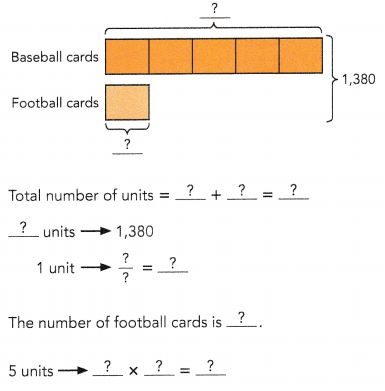
Math in Focus Grade 6 Chapter 4 Lesson 4.3 Answer Key Real-World Problems Ratios 1
The number of baseball cards is Math in Focus Grade 6 Chapter 4 Lesson 4.3 Answer Key Real-World Problems Ratios 2.
Answer:
1,150 baseball cards.
Explanation:
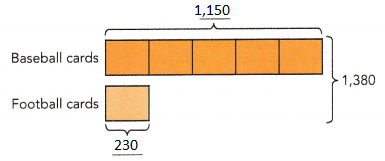
Total number of units is = 5 + 1 = 6
6 units => 1,380
1 unit = 1,380/6 = 230
number of foot ball cards = 230
5 units x 230 = 1,150
The number of baseball cards is 1,150.

b) Suppose the number of baseball cards is 950, find the number of football cards.
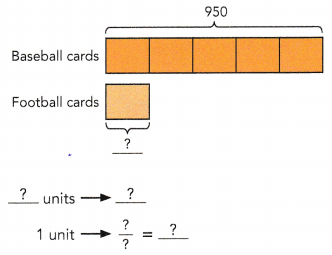
Math in Focus Grade 6 Chapter 4 Lesson 4.3 Answer Key Real-World Problems Ratios 3
The number of football cards is Math in Focus Grade 6 Chapter 4 Lesson 4.3 Answer Key Real-World Problems Ratios 2.
Answer:
190 football cards.
Explanation:
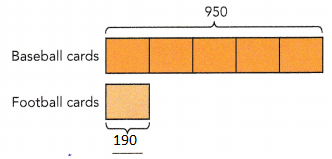
5 units => 950
1 unit = 950 / 5 = 190

Question 2.
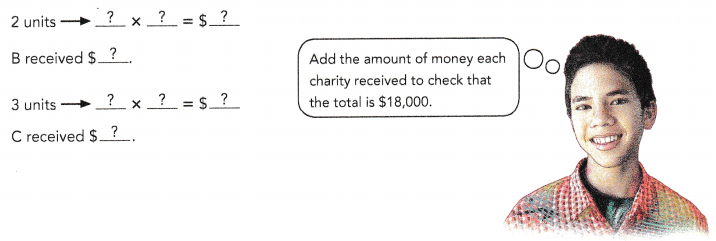
A school raised $18,000 at a charity event. The money raised was shared among three charities, A, B, and C, in the ratio 1: 2: 3. How much money did each charity receive?
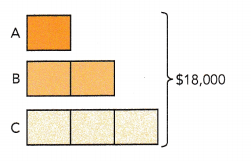
Math in Focus Grade 6 Chapter 4 Lesson 4.3 Answer Key Real-World Problems Ratios 4
Total number of units = Math in Focus Grade 6 Chapter 4 Lesson 4.3 Answer Key Real-World Problems Ratios 2 + Math in Focus Grade 6 Chapter 4 Lesson 4.3 Answer Key Real-World Problems Ratios 2 + Math in Focus Grade 6 Chapter 4 Lesson 4.3 Answer Key Real-World Problems Ratios 2
= Math in Focus Grade 6 Chapter 4 Lesson 4.3 Answer Key Real-World Problems Ratios 2
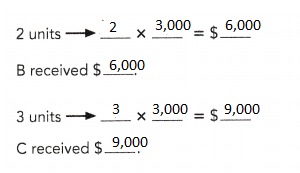
Math in Focus Grade 6 Chapter 4 Lesson 4.3 Answer Key Real-World Problems Ratios 2 units → $Math in Focus Grade 6 Chapter 4 Lesson 4.3 Answer Key Real-World Problems Ratios 2
1 unit → $\(\frac{?}{?}\) = $Math in Focus Grade 6 Chapter 4 Lesson 4.3 Answer Key Real-World Problems Ratios 2
A received $Math in Focus Grade 6 Chapter 4 Lesson 4.3 Answer Key Real-World Problems Ratios 2
Math in Focus Grade 6 Chapter 4 Lesson 4.3 Answer Key Real-World Problems Ratios 5
Answer:
$9,000
Explanation:
Total number of units = 1 +2 + 3 = 6
6 units → $18,000
1 unit → $\(\frac{18,000}{6}\) = $ 3,000
A received $ 3,000
Question 3.
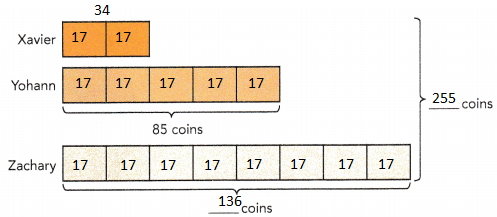
The number of coins collected by Xavier, Yohann, and Zachary is in the ratio 2:5:8. Yohann collected 85 coins.
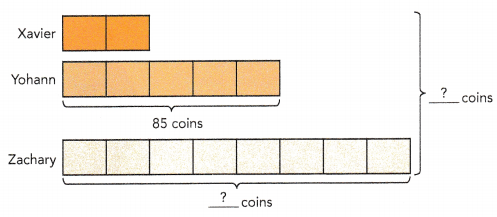
Math in Focus Grade 6 Chapter 4 Lesson 4.3 Answer Key Real-World Problems Ratios 6
a) Find the number of coins Zachary collected.
5 units → Math in Focus Grade 6 Chapter 4 Lesson 4.3 Answer Key Real-World Problems Ratios 2 coins
1 unit → $\(\frac{?}{?}\) = Math in Focus Grade 6 Chapter 4 Lesson 4.3 Answer Key Real-World Problems Ratios 2 coins
Math in Focus Grade 6 Chapter 4 Lesson 4.3 Answer Key Real-World Problems Ratios 2 units → Math in Focus Grade 6 Chapter 4 Lesson 4.3 Answer Key Real-World Problems Ratios 2 × Math in Focus Grade 6 Chapter 4 Lesson 4.3 Answer Key Real-World Problems Ratios 2 = Math in Focus Grade 6 Chapter 4 Lesson 4.3 Answer Key Real-World Problems Ratios 2 coins
Zachary collected Math in Focus Grade 6 Chapter 4 Lesson 4.3 Answer Key Real-World Problems Ratios 2 coins.
Answer:
136 coins
Explanation:

the number of coins Zachary collected.
5 units → 136 coins
1 unit → $\(\frac{136}{8}\) = 17 coins
8 units → 17 × 8 = 136 coins
Zachary collected 136 coins.

b) Find the number of coins collected by the three boys altogether.
Total number of units = Math in Focus Grade 6 Chapter 4 Lesson 4.3 Answer Key Real-World Problems Ratios 2 + Math in Focus Grade 6 Chapter 4 Lesson 4.3 Answer Key Real-World Problems Ratios 2 + Math in Focus Grade 6 Chapter 4 Lesson 4.3 Answer Key Real-World Problems Ratios 2
= Math in Focus Grade 6 Chapter 4 Lesson 4.3 Answer Key Real-World Problems Ratios 2
Math in Focus Grade 6 Chapter 4 Lesson 4.3 Answer Key Real-World Problems Ratios 2 units → Math in Focus Grade 6 Chapter 4 Lesson 4.3 Answer Key Real-World Problems Ratios 2 × Math in Focus Grade 6 Chapter 4 Lesson 4.3 Answer Key Real-World Problems Ratios 2 = Math in Focus Grade 6 Chapter 4 Lesson 4.3 Answer Key Real-World Problems Ratios 2 coins
The three boys collected Math in Focus Grade 6 Chapter 4 Lesson 4.3 Answer Key Real-World Problems Ratios 2 coins altogether.
Answer:
255 coins
Explanation:
the number of coins collected by the three boys altogether.
Total number of units = 2 + 5 + 8
= 15
15 units → 17 ×  = 15 coins
The three boys collected 255 coins altogether.

Question 4.
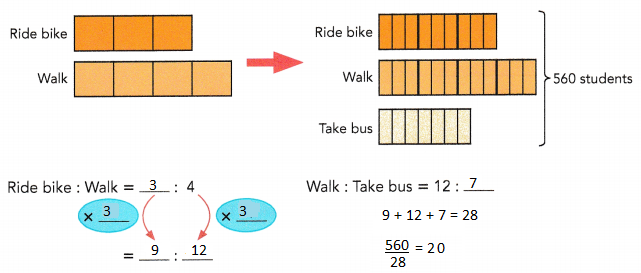
At Stacey’s middle school, students either ride bikes to school, walk, or take a bus. The ratio of the number of students who ride bikes to the number who walk is 3 : 4. The ratio of the number of students who walk to the number who take a bus is 12 : 7. There are 560 students in all.
a) Find the number of students who ride bikes to school.
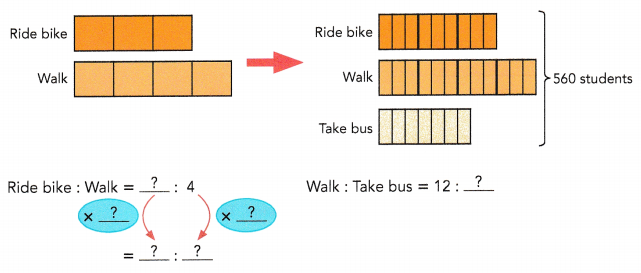
Math in Focus Grade 6 Chapter 4 Lesson 4.3 Answer Key Real-World Problems Ratios 7
So, Ride bike : Walk : Take bus = Math in Focus Grade 6 Chapter 4 Lesson 4.3 Answer Key Real-World Problems Ratios 2 : Math in Focus Grade 6 Chapter 4 Lesson 4.3 Answer Key Real-World Problems Ratios 2 : Math in Focus Grade 6 Chapter 4 Lesson 4.3 Answer Key Real-World Problems Ratios 2.
Total number of units = Math in Focus Grade 6 Chapter 4 Lesson 4.3 Answer Key Real-World Problems Ratios 2 + Math in Focus Grade 6 Chapter 4 Lesson 4.3 Answer Key Real-World Problems Ratios 2 + Math in Focus Grade 6 Chapter 4 Lesson 4.3 Answer Key Real-World Problems Ratios 2
= Math in Focus Grade 6 Chapter 4 Lesson 4.3 Answer Key Real-World Problems Ratios 2
Math in Focus Grade 6 Chapter 4 Lesson 4.3 Answer Key Real-World Problems Ratios 2 units → 560 students
1 unit → \(\frac{?}{?}\) = Math in Focus Grade 6 Chapter 4 Lesson 4.3 Answer Key Real-World Problems Ratios 2 students
9 units → Math in Focus Grade 6 Chapter 4 Lesson 4.3 Answer Key Real-World Problems Ratios 2 × Math in Focus Grade 6 Chapter 4 Lesson 4.3 Answer Key Real-World Problems Ratios 2 = Math in Focus Grade 6 Chapter 4 Lesson 4.3 Answer Key Real-World Problems Ratios 2 students
The number of students who ride bikes is Math in Focus Grade 6 Chapter 4 Lesson 4.3 Answer Key Real-World Problems Ratios 2.
Answer:
180 bike rides
Explanation:

Ride : Walk        Walk : bus
3:4 = 9:12              12  :  7
So, Ride bike : Walk : Take bus = 9 : 12 : 7.
Total number of units = 9 + 12 +  7 = 28
28 units → 560 students
1 unit → \(\frac{560}{28}\) = 20 students
9 units → 9 × 20 = 180 students
The number of students who ride bikes is 180.

b) Find the number of students who walk to school.
Math in Focus Grade 6 Chapter 4 Lesson 4.3 Answer Key Real-World Problems Ratios 2 units → Math in Focus Grade 6 Chapter 4 Lesson 4.3 Answer Key Real-World Problems Ratios 2 × Math in Focus Grade 6 Chapter 4 Lesson 4.3 Answer Key Real-World Problems Ratios 2 = Math in Focus Grade 6 Chapter 4 Lesson 4.3 Answer Key Real-World Problems Ratios 2 students
The number of students who walk is Math in Focus Grade 6 Chapter 4 Lesson 4.3 Answer Key Real-World Problems Ratios 2.
Answer: 240
Explanation:
12 units → 12 × 20 = 240 students
The number of students who walk is 240.

c) Find the number of students who take a bus to school.
Math in Focus Grade 6 Chapter 4 Lesson 4.3 Answer Key Real-World Problems Ratios 2 units → Math in Focus Grade 6 Chapter 4 Lesson 4.3 Answer Key Real-World Problems Ratios 2 × Math in Focus Grade 6 Chapter 4 Lesson 4.3 Answer Key Real-World Problems Ratios 2 = Math in Focus Grade 6 Chapter 4 Lesson 4.3 Answer Key Real-World Problems Ratios 2 students
The number of students who take a bus is Math in Focus Grade 6 Chapter 4 Lesson 4.3 Answer Key Real-World Problems Ratios 2.
Answer: 140
Explanation:
7 units → 7 × 20 = 140 students
The number of students who take a bus is 140.

Question 5.
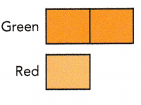
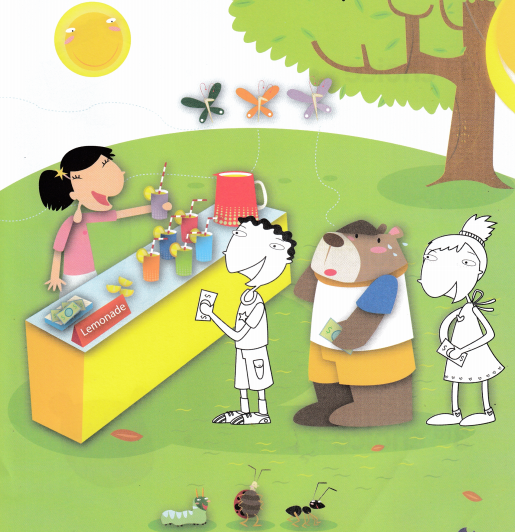
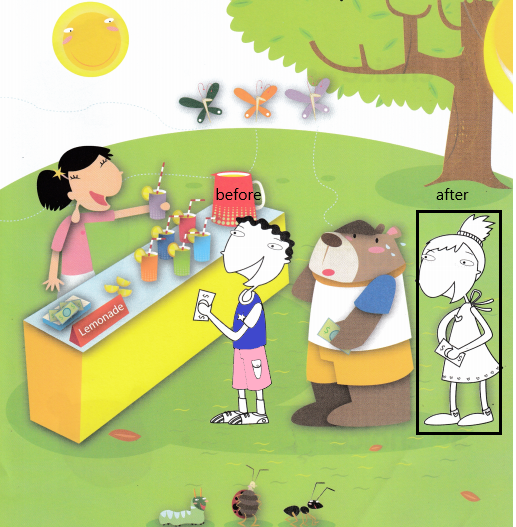
Claire keeps some green and red plates in a cabinet. The ratio of the number of green plates to the number of red plates is 2 : 1. She adds 18 more red plates in the cabinet and the ratio becomes 4 : 5.
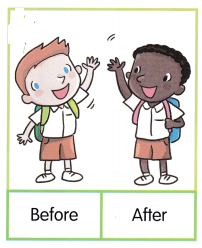
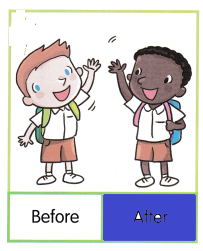
Before
The ratio of the number of green plates to the number of red plates is Math in Focus Grade 6 Chapter 4 Lesson 4.3 Answer Key Real-World Problems Ratios 2 : Math in Focus Grade 6 Chapter 4 Lesson 4.3 Answer Key Real-World Problems Ratios 2.
Math in Focus Grade 6 Chapter 4 Lesson 4.3 Answer Key Real-World Problems Ratios 8

After
The ratio of the number of green plates to the number of red plates becomes Math in Focus Grade 6 Chapter 4 Lesson 4.3 Answer Key Real-World Problems Ratios 2 : Math in Focus Grade 6 Chapter 4 Lesson 4.3 Answer Key Real-World Problems Ratios 2.
The length of the model for Math in Focus Grade 6 Chapter 4 Lesson 4.3 Answer Key Real-World Problems Ratios 2 plates does not change. The model for Math in Focus Grade 6 Chapter 4 Lesson 4.3 Answer Key Real-World Problems Ratios 2 plates is divided into Math in Focus Grade 6 Chapter 4 Lesson 4.3 Answer Key Real-World Problems Ratios 2 units.
The model for red plates is divided into units of the same size and additional units are added to make the total length Math in Focus Grade 6 Chapter 4 Lesson 4.3 Answer Key Real-World Problems Ratios 2 units.
The additional units represent the Math in Focus Grade 6 Chapter 4 Lesson 4.3 Answer Key Real-World Problems Ratios 2 red plates Claire adds in the cabinet.
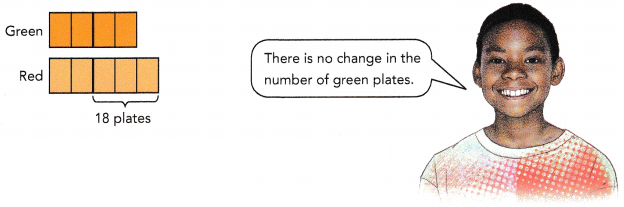
Math in Focus Grade 6 Chapter 4 Lesson 4.3 Answer Key Real-World Problems Ratios 9

Answer:
Before
The ratio of the number of green plates to the number of red plates is 2 : 1.

After
The ratio of the number of green plates to the number of red plates becomes 2 : 15.
The length of the model for green plates does not change. The model for green plates is divided into 2 units.
The model for red plates is divided into units of the same size and additional units are added to make the total length 5 units.
The additional units represent the 6 red plates Claire adds in the cabinet.

a) How many green plates are there in the cabinet?
3 units → Math in Focus Grade 6 Chapter 4 Lesson 4.3 Answer Key Real-World Problems Ratios 2plates
1 unit → \(\frac{?}{?}\) = Math in Focus Grade 6 Chapter 4 Lesson 4.3 Answer Key Real-World Problems Ratios 2 plates
Math in Focus Grade 6 Chapter 4 Lesson 4.3 Answer Key Real-World Problems Ratios 2 units → Math in Focus Grade 6 Chapter 4 Lesson 4.3 Answer Key Real-World Problems Ratios 2 × Math in Focus Grade 6 Chapter 4 Lesson 4.3 Answer Key Real-World Problems Ratios 2 = Math in Focus Grade 6 Chapter 4 Lesson 4.3 Answer Key Real-World Problems Ratios 2 plates
There are Math in Focus Grade 6 Chapter 4 Lesson 4.3 Answer Key Real-World Problems Ratios 2 green plates in the cabinet.
Answer:
8 green plates
Explanation:
3 units → 6 plates
1 unit → \(\frac{6}{3}\) = 2 plates
4 units → 4 × 2 =8plates
There are 8 green plates in the cabinet.

b) How many red plates are there in the cabinet in the end?
Math in Focus Grade 6 Chapter 4 Lesson 4.3 Answer Key Real-World Problems Ratios 2 units → Math in Focus Grade 6 Chapter 4 Lesson 4.3 Answer Key Real-World Problems Ratios 2 × Math in Focus Grade 6 Chapter 4 Lesson 4.3 Answer Key Real-World Problems Ratios 2 = Math in Focus Grade 6 Chapter 4 Lesson 4.3 Answer Key Real-World Problems Ratios 2 plates
There are Math in Focus Grade 6 Chapter 4 Lesson 4.3 Answer Key Real-World Problems Ratios 2 red plates in the cabinet in the end.
Answer:
30 Red plates
Explanation:
5units → 5 ×6 =30 plates
There are 30 red plates in the cabinet in the end.

Math in Focus Course 1A Practice 4.3 Answer Key

Solve. Show your work.

Question 1.
A rope is cut into three pieces P, Q, and R. The lengths of the pieces are in the ratio 3 : 5 : 7. If the rope is 33 feet 9 inches long, find the lengths of P, Q, and R.
Answer:
P = 81in , Q = 135in, R = 189in.
Explanation:
First convert 33 feet 9 inches into inches,
 There are 12 inches in 1 foot,
33 × 12 = 396.
= 396 + 9 = 405
3 : 5 : 7 = 405
3x + 5x + 7x = 405
15x = 405
x = 27
3x = 3 x 27 = 81
5x = 5 x 27 = 135
7x = 7 x 27 = 189
P = 81 , Q = 135 , R = 189.

Question 2.
Alice, Bernice, and Cheryl shared some stamps in the ratio 8 : 9 : 18. Alice received 184 stamps. Find the number of stamps that Bernice and Cheryl each received.
Answer:
Bernice 207 and Cheryl 230
Explanation:
Consider the ratios in parts
Alice 8 parts = 184
184 ÷ 8 = 23
So, 1 part = 23 stamps
Bernice has 9 parts,
9 x 23 = 207 stamps
Cheryl has 10 parts,
10 x 23 = 230 stamps.

Question 3.
Alan, Gil, and Deb’s point score in a video game was in the ratio 2 : 3 : 4. Deb scored 114,400 points.
a) How many points did Gil score?
Answer:
85,800 points
Explanation:
Let the points scored by Alan, Gil and Deb be
2x, 3x, and 4x
Deb scored 114,400
So, 4x = 114400
x = 28600
Gil scored 3x = 85800

b) How many points did they score in all?
Answer:
257,400 points
Explanation:
Let the points scored by Alan, Gil and Deb be
2x, 3x, and 4x
Deb scored 114,400
So, 4x = 114400
x = 28600
Alan scored 2x = 2 x 28600 = 57200
Gil scored 3x = 85800
Alan scored 57200 + Gil scored 85800 + Deb scored 114400 = 257,400

Question 4.
Lara has three cats: Socks, Princess, and Luna. The ratio of Socks weight to Princess’s weight is 4 : 5. The ratio of Princess’s weight to Luna’s weight is 6 : 7. What is the ratio of Socks weight to Luna’s weight?
Answer:
Ratio of Socks weight to Luna’s weight = 24 : 35
Explanation:
Let Socks weight = s
Princess weight = p
Luna’s weight = l
The ratio of Socks weight to princess weight is 4 : 5 s : p = 4 : 5
s / p = 4 / 5
The ratio of princesses weight to Luna’s weight is 6 : 7
p : l = 6 : 7
p / l = 6 / 7
the ratio of socks weight to Luna’s weight,
Multiply both given ratios (s / p) X (p / l) = (4 / 5) X (6 / 7)
s / l = 24 / 35
s : l = 24 : 35
Ratio of socks weight to Luna’s weight is 24 : 35

Question 5.
Danny poured 78 liters of water into containers X, Y, and Z. The ratio of the volume of water in Container X to the volume of water in Container Y is 5 : 2. The ratio of the volume of water in Container Y to the volume of water in Container Z is 8 : 11.
a) How much water was poured into Container X?
Answer:
40 liters
Explanation:
x + y + z = 78
The ratio of the volume of water in Container X to the volume of water in Container Y is 5 : 2.
x : y = 5 : 2
The ratio of the volume of water in Container Y to the volume of water in Container Z is 8 : 11.
y : z = 8 : 11
x : y = 20 : 8 , and y : z = 8 : 11
Now, both ratios we can rewrite as one,
x : y : z = 20 : 8 : 11
20 + 8 + 11 = 39 units
Three containers contain 78 liters and that is 39 units, let’s find how many litters in 1 unit.
78 / 39 = 2 litters per unit
x = 20 x 2 = 40

b) How much more water was poured into Container X than Container Z?
Answer:
18 liters
Explanation:
x + y + z = 78
The ratio of the volume of water in Container X to the volume of water in Container Y is 5 : 2.
x : y = 5 : 2
The ratio of the volume of water in Container Y to the volume of water in Container Z is 8 : 11.
y : z = 8 : 11
x : y = 20 : 8 , and y : z = 8 : 11
Now, both ratios we can rewrite as one,
x : y : z = 20 : 8 : 11
20 + 8 + 11 = 39 units
Three containers contain 78 liters and that is 39 units, let’s find how many litters in 1 unit.
78 / 39 = 2 litters per unit
x = 20 x 2 = 40
y = 8 x 2 = 16
z = 11 x 2 = 22
x – z = 40 – 22 = 18

Question 6.
The ratio of the number of mystery books to the number of science fiction books is 4 : 3. The ratio of the number of science fiction books to the number of biographies is 4 : 5. If there are 48 science fiction books, find the total number of books.
Answer:
172 books
Explanation:
The ratio of the number of mystery books to the number of science fiction books is 4 : 3.
Mystery  books = 48 / 3 = 16
16 x 4 = 64
Biography books = 48 / 4 = 12
12 x 5 = 60
The ratio of the number of science fiction books to the number of biographies is 4 : 5.
If there are 48 science fiction books
The total number of books = 60 + 64 + 48 = 172

Question 7.
In a music room, the ratio of the number of clarinets to the number of flutes was 3 : 4. After the school bought another 24 flutes, the ratio became 3 : 8. How many clarinets were there in the music room?
Answer:
18 clarinets
Explanation:
The ratio of the number of clarinets to the number of flutes was 3 : 4.
clarinets (c) : flutes (f) = 3 : 4
4c = 3f
After the school bought another 24 flutes, the ratio became 3 : 8.
\(\frac{c}{(f + 24)}\) = \(\frac{3}{8}\)
Number of clarinets in music room
8=3f + 72 (3f = 4c)
8c = 4c + 72
4c = 72
c = 18

Question 8.
In a school gym, the ratio of the number of boys to the number of girls was 4 : 3. After 160 boys left the gym, the ratio became 4 : 5. How many girls were there in the gym?
Answer:
300 girls
Explanation:
The ratio of the number of boys to the number of girls was 4 : 3.
b/g = 4/3
After 160 boys left the gym, the ratio became 4 : 5.
(b-160)/g = 4/5
g = 300

Question 9.
The ratio of the number of men to the number of women on a bus was 2 : 3. At a bus stop, 4 women got off and the ratio became 4 : 5.
a) How many men were on the bus?
Answer:
16 men

b) How many women were on the bus in the end?
Answer:
20 women
Explanation:
ratio of men to women is 2:3
2 and 3 have to be multiplied by some number, call it x, to determine the exact number of men and women
2x/3x is how to write the ratio
4 women got off the bus
2x is the number of men and 3x – 4 is the number of women
2x/(3x – 4) is the ratio now which equals 4/5
2x/(3x – 4) = 4/5
cross multiply
5(2x) = 4(3x – 4)
10x = 12x – 16
10x – 12x = – 16
-2x = -16
2x = 16
x = 16/2
x = 8
2 x 8 = 16 and 3 x 8 = 24,
so the original ratio was 16/24 which is 2/3
4 women got off the bus
16 men and 24 – 4 = 20 women

Question 10.
CD The number of chickens to the number of ducks on a farm was 6 : 5. After 63 ducks were sold, there were 3 times as many chickens as ducks left,
a) How many chickens were there on the farm?
Answer:
126 chickens
Explanation:
Let there be 6x chickens and 5x ducks
Ratio of chickens and ducks = 6 : 5.
When 63 ducks are sold, by given condition,
\(\frac{6x}{(5x – 63)}\) = \(\frac{3}{1}\)
6x = 15x – 189
9x = 189
x = \(\frac{189}{9}\)
x = 21
6x = 6 x 21 = 126
Therefore, 126 chickens were there in the farm.

b) How many chickens and ducks were there altogether on the farm in the end?
Answer:
168 ducks
Explanation:
Total number of chickens and ducks in the end are
(6x) + (5x63) = 11x 63
= 11 x 21 63
= 231 63 = 168

Question 11.
The ratio of the volume of fruit juice to the volume of smoothies served at a party was 4\(\frac{1}{2}\) : 2.4. There were 35 liters more fruit juice served than smoothies. Find the volume of smoothies served.
Answer:
40 liters
Explanation:
4\(\frac{1}{2}\) : 2.4
35 liters more fruit juice served than smoothies
4\(\frac{1}{2}\) = \(\frac{9}{2}\) = 4.5
4.5 : 2.4  ::  x + 35 : x
4.5 x :: 2.4 (x + 35)
4.5 x :: 2.4x + 84
4.5x – 2.4x :: 84
2.1 x = 84
x = 84/2.1
x = 40

Question 12.
A piece of ribbon is cut into two shorter pieces in the ratio 2.8 : 1.25. The difference in the length of the two shorter pieces is 80.6 centimeters. What is the length of the original piece of ribbon?
Answer:
210.6cm
Explanation:
The lengths of the two pieces are in the ratio 2.8 : 1.25,
the lengths are 2.8x and 1.25x, for some positive number, x.
2.8x – 1.25x = 80.6
1.55x = 80.6
x = 52
Length of larger piece = 2.8x = 2.8 X 52 = 145.6 cm
Length of smaller piece = 1.25x = 1.25 X 52) = 65 cm
length of the original piece of ribbon = 145.6 + 65 = 210.6cm

Question 13.
Math journal The ratio of the number of beads collected by Jane to the number of beads collected by Jill is 7 : 3. Jane gave some beads to Jill. Is it possible for both Jane and Jill to have the same number of beads after Jane gave some beads to Jill? Explain why you think so.
Answer:
YES
Explanation:
The ratio of the number of beads collected by Jane to the number of beads collected by Jill is 7 : 3
7x : 3x
Let ratio coefficient is = x  , So Jane have total beads  = 7 x and Jill have total beads  = 3 
Now we assume that Jane gave ‘ y ‘ beads to Jill to have same number of beads for both , So
7x – y = 3x + y
7x – 3 x = y + y
4x = 2y
y = 2x
yes, it possible for both Jane and Jill to have the same number of beads after Jane gave some beads to Jill.

Question 14.
Today the ratio of Elinor’s age to her mother’s age is 3 : 8. After 15 years, the ratio will become 6 : 11.
a) Find Elinor’s age today.
Answer:
15 years
Explanation:
Today the ratio of Elinor’s age to her mother’s age is 3 : 8
3x + 15 : 8x + 15 = 6 : 11
(3x + 15 ) x 11 = (8x + 15) x 6
33x + 165 = 48x + 90
48x -33x = 165 – 90
15x = 75
x = 75 / 15
x = 5

b) Find her mother’s age after 15 years.
Answer:
55 years
Explanation
3x + 15 : 8x + 15 = 6 : 11
her mother’s age after 15 years.
11x = 11 x 5
= 55 years

Question 15.
The ratio of Mike’s savings to Nick’s savings was 4 : 3. After Mike saved another $120 and Nick saved another $60, the ratio became 8 : 5. What was their combined savings before each of them saved the additional money?
Answer:
$210
Explanation:
The ratio of Mike’s savings to Nick’s savings was 4 : 3
4 : 3
4x : 3x
4x + 120 : 3x + 60 = 8 : 5
4x + 120 = 8x
4x = 120
x = 120/4
x = 30
4 x 30 + 3 x 30 = 120+90 = $210

Brain @ Work

Question 1.
ABCD is a rectangle. BD is a straight line that cuts the rectangle into equal halves. The ratio of the area of P to the area of Q is 2 : 5, and the ratio of the area R to the area of S is 4 : 3. The area of S is 9 square centimeters.
a) Find the ratio of the area of R to the area of the rectangle.
Answer:
12 square centimeter
Explanation:
The ratio of the area of P to the area of Q is 2 : 5,
the ratio of the area R to the area of S is 4 : 3. The area of S is 9 square centimeters.
P : Q :: 2 : 5
R : S :: 4 : 3
R : 9 :: 4 : 3
R = (9 x 4) / 3
R =  12 square centimeter

b) Find the area of the rectangle.
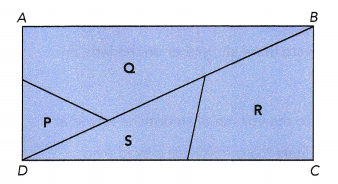
Math in Focus Grade 6 Chapter 4 Lesson 4.3 Answer Key Real-World Problems Ratios 10
Answer:
42 square centimeters
Explanation:
Area of  rectangle
S+R = P + Q
9 + 12 = P + Q
P + Q = 21
Area of  rectangle
S+R + P + Q
21 + 21 = 42 square centimeters

Question 2.
A farmer raises chickens and sheep on his farm. The ratio of the total number of legs of the chickens to the total number of legs of the sheep is 4 : 7. Find the minimum number of chickens and sheep on his farm. Copy and complete the table to solve the problem. (Hint: Make a list and solve the problem using guess and check.)
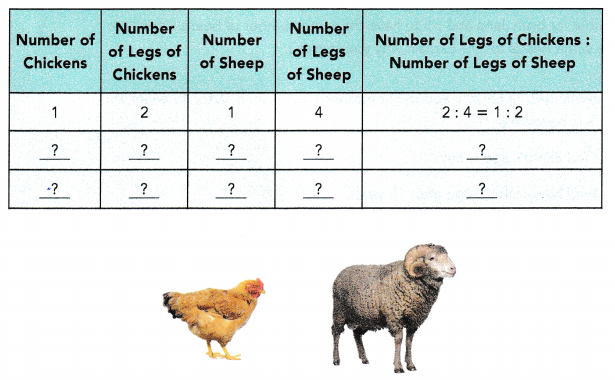
Math in Focus Grade 6 Chapter 4 Lesson 4.3 Answer Key Real-World Problems Ratios 11
Answer:
1 : 2
Explanation:
The ratio of the total number of legs of the chickens to the total number of legs of the sheep is 4 : 7
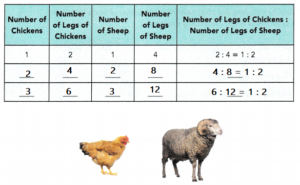
1 chicken has 2 legs
1 sheep has 4 legs
So, the ratio of chicken legs and sheep legs are 2 : 4 = 1 : 2

Math in Focus Grade 6 Cumulative Review Chapters 1-3 Answer Key

Go through the Math in Focus Grade 6 Workbook Answer Key Cumulative Review Chapters 1-3 to finish your assignments.

Math in Focus Grade 6 Course 1 A Cumulative Review Chapters 1-3 Answer Key

Concepts and Skills

Draw a horizontal number line to represent each set of numbers. (Lesson 1.1)

Question 1.
Mixed numbers from 3 to 7, with an interval of \(\frac{1}{3}\) between each pair of mixed numbers
Answer:

Explanation:
Mixed Fractions on Number Line Mixed fractions have two parts,
one whole number and one proper fraction.
To represent mixed fractions on a number line,
first, mark two points: the whole number part on the left and its successor on the right.

Question 2.
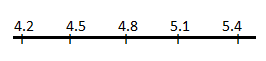
Decimals between 4.2 and 5.4, with an interval of 0.3 between each pair of decimals
Answer:

Explanation:
To represent a decimal on a number line,
divide each segment of the number line into ten equal parts.
Then mark the numbers with given intervals.

Express each number as a product of its prime factors. (Lesson 1.2)

Question 3.
84
Answer:
Factors of 84 are  1, 2, 3, 4, 6, 7, 12, 14, 21, 28, 42 and 84.
The prime factorization of 84 is 2 × 2 × 3 × 7 or 22 × 3 × 7.
Explanation:
Factors of 84 are the numbers that divide the original number evenly,
since 84 divided by 2 is equal to 42,
42 divided by 2 is equal to 21,
21 divided by 3 is equal to 7.
So, The prime factorization of 84 is 2 × 2 × 3 × 7 or 22 × 3 × 7.
where 2, 3 and 7 are the prime numbers.

Question 4.
240
Answer:
Factors of 240 are 1, 2, 3, 4, 5, 6, 8, 10, 12, 15, 16, 20, 24, 30, 40, 48, 60, 80, 120 and 240.
Prime Factorization of 240 is 2 × 2 × 2 × 2 × 3 × 5 or 24 × 3 × 5.
Explanation:
Factors of 240 are the numbers that divide the original number evenly,
since 240 divided by 2 is equal to 120,
120 divided by 2 is equal to 60,
60 divided by 2 is 30,
30 divided by 2 is 15,
15 divided by 3 is 5.
So, Prime Factorization of 240 is 2 × 2 × 2 × 2 × 3 × 5 or 24 × 3 × 5.

Find the greatest common factor of each pair of numbers. (Lesson 1.3)

Question 5.
16 and 60
Answer:
GCF = 4
Explanation:
Find the prime factorization of 16
16 = 2 × 2 × 2 × 2
Find the prime factorization of 60
60 = 2 × 2 × 3 × 5
To find the GCF, multiply all the prime factors common to both numbers.
Therefore, GCF = 2 × 2
GCF = 4

Question 6.
63 and 96
Answer:
GCF = 3
Explanation:
The factors of 63 are 1,3,7,9,21,63;
The factors of 96 are 1,2,3,4,6,8,12,16,24,32,48,96.
To find the GCF, take the common factor to both numbers.
3 is the greatest number that 63 and 96 divides into.
Therefore, GCF = 3

Find the least common multiple of each pair of numbers. (Lesson 1.3)

Question 7.
9 and 12
Answer:
LCM = 36
Explanation:
To find the least common multiple of 9 and 12,
we need to find the multiples of 9 and 12
multiples of 9 = 9, 18, 27, 36;
multiples of 12 = 12, 24, 36, 48
choose the smallest multiple that is exactly divisible by 9 and 12, i.e., 36.
So, the LCM of 9 and 12 is 36.

Question 8.
15 and 18
Answer:
LCM = 90
Explanation:
To find the least common multiple of 15 and 18,
we need to find the multiples of 15 and 18.
multiples of 15 = 15, 30, 45, 60, 75, 90;
multiples of 18 = 18, 36, 54, 72, 90.
choose the smallest multiple that is exactly divisible by 15 and 18, i.e., 90.
So, the LCM of 15 and 18 is 90.

Find the square root of each number. (Lesson 1.4)

Question 9.
256
Answer:
The square root of 256 is 16.
Explanation:
Determine the prime factors using prime factorization.
Prime factorization of 256 =  2 × 2 × 2 × 2 × 2 × 2 × 2 × 2
 Group the prime factors obtained for 256 in pairs.
Pick one factor from each pair and they can be written in the form:
256 = (2 × 2 × 2 × 2)2
 we get, √256 = √(162)
The square root of 256 is 16.

Question 10.
676
Answer:
The square root of 676 is 26.
Explanation:
676 is a perfect square hence,
we can express it as (2 × 2 × 13 × 13).
The numbers within square root which get repeated are 2 and 13.
Hence, the square root of 676 is 2 × 13 = 26 .

Find the cube root of each number. (Lesson 1.5)

Question 11.
1,728
Answer:
The cube root of 1,728 is 12
Explanation:
To find the cube root of 1728 through the prime factorization method,
1728 = 2 × 2 ×2 × 2 × 2 × 2 ×3 × 3 × 3
Pair the similar factors in a group of them and represent them as cubes.
1728 =  (2 × 2 × 2) × (2 × 2 × 2 ) × (3 × 3 ×3)
1728 = 23 × 23 × 33
1728 = 2 x 2 x 3 = 12
Hence, the cube root of 1,728 is 12.

Question 12.
5,832
Answer:
The cube root of 5,832 is 18.
Explanation:
To find the cube root of 1728 through the prime factorization method,
1728 = 2 × 2 × 2 × 3 × 3 × 3 ×3 × 3 × 3
Pair the similar factors in a group of them and represent them as cubes.
1728 =  (2 × 2 × 2) × (3 × 3 × 3 ) × (3 × 3 ×3)
1728 = 23 × 33 × 33
1728 = 2 x 3 x 3 = 18
Hence, the cube root of 5,832 is 18.

Find the value of each of the following. (Lesson 1.5)

Question 13.
53 – 112 + 73
Answer: 347
Explanation:
Write the cubes  and square roots of given numbers.
53 = 5 x 5 x 5 = 125
73 = 7 x 7 x 7 = 343
112 = 11 x 11 = 121
According to BOADMAS first add the numbers of positive integers and then subtract the negative integers.
5+ 73 = 468
53 – 112 + 73 = 468 – 121 = 347

Question 14.
43 ÷ 82 × 123
Answer: 1,728
Explanation:
Apply the order of mathematical operations,
BODMAS stands for B-Brackets, O-Orders, D-Division, M-Multiplication, A-Addition, S-Subtraction.
43 ÷ 82
4x4x4 = 64
8×8 = 64
So, 64 ÷ 64 = 1
123  = 12 x 12 12 = 1,728
43 ÷ 82 × 123 = 1,728
Solve. (Lesson 1.5).

Question 15.
Given that 562 = 3,136, find the square of 112.
Answer:
112 x 112 = 12,544
Explanation:
Square root is the number that we multiply by itself to get the original number.
56 x 56 = 3,136
112 x 112 = 12,544

Question 16.
Given that 133 = 2,197, find the cube root of 17,576.
Answer:
The cube root of 17,576 is 26.
Explanation:
To find the cube root of 17,576 through the prime factorization method,
17,576 = 2 × 2 × 2 × 13 x 13 x 13
Pair the similar factors in a group of them and represent them as cubes.
17,576 =  (2 × 2 × 2) × (13 × 13 × 13 )
17,576 = 23 × 133 
17,576 = 2 x 13 = 26
Hence, the cube root of 17,576 is 26.

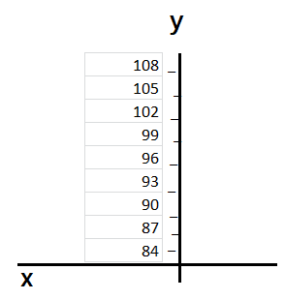
Draw a vertical number line to represent each set of numbers. (Lessons 1.3, 2.1)

Question 17.
Multiples of 3 between 81 and 110
Answer:
84, 87, 90, 93, 96, 99, 102, 105, 108.
Explanation:

3 x 28 = 84
3 x 29 = 87
3 x 30 = 90
3 x 31 = 93
3 x 32 = 96
3 x 33 = 99
3 x 34 = 102
3 x 35 = 105
3 x 36 = 108

Question 18.
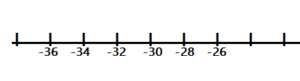
Even numbers greater than -37 but less than -25
Answer:
-36, -34,  -32. -30, -28, -26
Explanation:
Even numbers after -37 and -25 given number are
-36
-36+2 = -34
-34 + 2 = -32
-32 + 2 = 30
-30 + 2 = 28
-28 + 2 = -26

Write a positive or negative number to represent each situation. (Lesson 2.1)

Question 19.
Getting a pay raise of $320 per year
Answer:
Getting a pay raise of $320 per year, means increase to the previous pay.
Explanation:
positive number
Pay raise of $320 per year
it means adding to the previous number

Question 20.
214°F below zero
Answer:
-214°F
Explanation:
Measurement of temperature
0 degrees Fahrenheit is equal to -17.77778 degrees Celsius:
0°F = -17.77778 °C

The temperature T in degrees Celsius (°C) is equal to 214 degrees Fahrenheit (°F) minus 32, times 5/9. To convert 214 Fahrenheit to Celsius we can use the formula below:

Question 21.
Riding an elevator down 15 floors
Answer:
negative number
Explanation:
It means Elevator is moving down.
Elevator down from 15, to 14 , 13 …….. to zero (it means ground floor)

Copy and complete each inequality using > or <. (Lesson 2.1)

Question 22.
121 Math in Focus Grade 6 Cumulative Review Chapters 1-3 Answer Key 1 -388
Answer:
121 > -388
Explanation:
Important symbol or signs used to identify the numbers to understand the bigger number,
smaller number and the number that is equal.
When one number is bigger than the other number; we use greater than sign >.
When one number is smaller than the other number; we use less than sign <.

Question 23.
-795 Math in Focus Grade 6 Cumulative Review Chapters 1-3 Answer Key 1 347
Answer:
-795 < 347
Explanation:
Important symbol or signs used to identify the numbers to understand the bigger number,
smaller number and the number that is equal.
When one number is bigger than the other number; we use greater than sign >.
When one number is smaller than the other number; we use less than sign <.

Question 24.
-78 Math in Focus Grade 6 Cumulative Review Chapters 1-3 Answer Key 1 -132
Answer:
-78 > -132
Explanation:
Important symbol or signs used to identify the numbers to understand the bigger number, smaller number and the number that is equal.
When one number is bigger than the other number; we use greater than sign >.
When one number is smaller than the other number; we use less than sign <.

Question 25.
-234 Math in Focus Grade 6 Cumulative Review Chapters 1-3 Answer Key 1 -243
Answer:
-234 > -243
Explanation:
Important symbol or signs used to identify the numbers to understand the bigger number, smaller number and the number that is equal.
When one number is bigger than the other number; we use greater than sign >.
When one number is smaller than the other number; we use less than sign <.

Write an inequality for each of the following statements using > or <. (Lesson 2.1)

Question 26.
185°F is colder than 209°F.
Answer:
Yes,
Explanation:
According to the Fahrenheit scale 185°F is less then 209°F, according to the number system 185 is less then the 209, hence the 185°F is colder then 209°F

Question 27.
Town A, which is 84 kilometers from Town B, is farther from Town B than Town C, which is 76 kilometers from Town B.
Answer:

Copy and complete each inequality using > or <. (Lesson 2.2)

Question 28.
|-356| Math in Focus Grade 6 Cumulative Review Chapters 1-3 Answer Key 1 |368|
Answer:
356 < 368
Explanation:
Important symbol or signs used to identify the numbers to understand the bigger number, smaller number and the number that is equal.
When one number is bigger than the other number; we use greater than sign >.
When one number is smaller than the other number; we use less than sign <.

Question 29.
|232| Math in Focus Grade 6 Cumulative Review Chapters 1-3 Answer Key 1 |-324|
Answer:
232 < 324
Explanation:
Important symbol or signs used to identify the numbers to understand the bigger number, smaller number and the number that is equal.
When one number is bigger than the other number; we use greater than sign >.
When one number is smaller than the other number; we use less than sign <.

Question 30.
|264| Math in Focus Grade 6 Cumulative Review Chapters 1-3 Answer Key 1 |246|
Answer:
264 > 246
Explanation:
Important symbol or signs used to identify the numbers to understand the bigger number, smaller number and the number that is equal.
When one number is bigger than the other number; we use greater than sign >.
When one number is smaller than the other number; we use less than sign <.

Question 31.
|-311| Math in Focus Grade 6 Cumulative Review Chapters 1-3 Answer Key 1 |-389|
Answer:
311 < 389
Explanation:
Important symbol or signs used to identify the numbers to understand the bigger number, smaller number and the number that is equal.
When one number is bigger than the other number; we use greater than sign >.
When one number is smaller than the other number; we use less than sign <.

Divide. (Lesson 3.1)

Question 32.
28 ÷ \(\frac{1}{5}\)
Answer: 140
Explanation:
Dividing fractions is equal to the multiplication of a fraction by the reciprocal of another fraction. A fraction has a numerator and a denominator.
When we divide one fraction by another, we almost multiply the fractions.

28 ÷ \(\frac{1}{5}\)

\(\frac{28}{1}\) x \(\frac{5}{1}\)

28 x 5 = 140

Question 33.
42 ÷ \(\frac{2}{3}\)
Answer: 63
Explanation:
Dividing fractions is equal to the multiplication of a fraction by the reciprocal of another fraction. A fraction has a numerator and a denominator.
When we divide one fraction by another, we almost multiply the fractions.

42 ÷ \(\frac{2}{3}\)

\(\frac{42}{2}\) x \(\frac{3}{1}\)

\(\frac{126}{2}\) = 63

Question 34.
\(\frac{3}{8}\) ÷ 12
Answer: 32
Explanation:
Dividing fractions is equal to the multiplication of a fraction by the reciprocal of another fraction. A fraction has a numerator and a denominator.
When we divide one fraction by another, we almost multiply the fractions.

\(\frac{3}{8}\) ÷ 12

\(\frac{8×12}{3}\)

\(\frac{96}{3}\) = 32

Question 35.
\(\frac{5}{14}\) ÷ \(\frac{10}{21}\)
Answer: 0.75
Explanation:
Dividing fractions is equal to the multiplication of a fraction by the reciprocal of another fraction. A fraction has a numerator and a denominator.
When we divide one fraction by another, we almost multiply the fractions.

\(\frac{5}{14}\) ÷ \(\frac{10}{21}\)

\(\frac{5×21}{10×14}\)

\(\frac{105}{140}\) = 0.75

Multiply. (Lesson 3.2)

Question 36.
0.3 × 3.8
Answer: 1.14
Explanation:
Multiplication of decimals is done by ignoring the decimal point and multiply the numbers,
and then the number of decimal places in the product is equal to the total number of decimal places in the given numbers.

Question 37.
6.3 × 4.7
Answer: 29.61
Explanation:
Multiplication of decimals is done by ignoring the decimal point and multiply the numbers,
and then the number of decimal places in the product is equal to the total number of decimal places in the given numbers.
Question 38.
0.28 × 474
Answer: 132.72
Explanation:
Multiplication of decimals is done by ignoring the decimal point and multiply the numbers,
and then the number of decimal places in the product is equal to the total number of decimal places in the given numbers.

Question 39.
8.23 × 9.107
Answer: 74.95061
Explanation:
Multiplication of decimals is done by ignoring the decimal point and multiply the numbers,
and then the number of decimal places in the product is equal to the total number of decimal places in the given numbers.

Divide. (Lesson 3.3)

Question 40.
72 ÷ 0.3
Answer: 240
Explanation:
When we divide decimals,
we change the divisor to a whole number by moving the decimal point all the way to the right.
Then, we move the decimal point of the dividend up to the same number of places to the right,
and divide the resultant numbers in the normal way as we do regular division.

Question 41.
8.1 ÷ 0.3
Answer: 27
Explanation:
When we divide decimals,
we change the divisor to a whole number by moving the decimal point all the way to the right.
Then, we move the decimal point of the dividend up to the same number of places to the right,
and divide the resultant numbers in the normal way as we do regular division.

Question 42.
2.88 ÷ 1.2
Answer: 240
Explanation:
When we divide decimals,
we change the divisor to a whole number by moving the decimal point all the way to the right.
Then, we move the decimal point of the dividend up to the same number of places to the right,
and divide the resultant numbers in the normal way as we do regular division.

Question 43.
128 ÷ 0.02
Answer: 6,400
Explanation:
When we divide decimals,
we change the divisor to a whole number by moving the decimal point all the way to the right.
Then, we move the decimal point of the dividend up to the same number of places to the right,
and divide the resultant numbers in the normal way as we do regular division.

Problem Solving

Solve. Show your work.

Question 44.
Alison paid $21.75 for a number of packs of rice crackers. Three packs of rice crackers cost $1.45. How many packs of rice crackers did Alison buy? If she were to buy 60 packs of the same rice crackers, would $30 be enough to pay for them? (Chapter 3)
Answer:
60 packs
Explanation:
Find the x, the unit price 3x = 1.45
\(\frac{3x}{3}\)

= \(\frac{1.45}{3x}\)

x = 0.483 cost per pack.
the number of packs bought 21.75 = 0.483 x 0.483x = 21.75
0.483x / 0.483 = 21.75 / 0.483 x = 45 packs bought
total cost of 60 packs x = 0.483(60) x = 28.98 is the total cost.
$30 is more than enough to pay for 60 packs.

Question 45.
Find two consecutive numbers whose cubes differ by 169. (Chapter 1)
Answer:
8 and 7 are 2 consecutive numbers.
Explanation:
cube of 8 = 8 x 8 x 8 = 512
cube of 7 = 7 x 7 x 7 = 343
Difference of 8 cube and 7 cube
512 – 343 = 169

Question 46.
Two light houses flash their lights every 30 seconds and 40 seconds respectively. Given that they last flashed together at 10:40 A.M., when will they next flash together? (Chapter 1)
Answer:
10:42 AM
Explanation:
for every 120 seconds the lights will flash together
30 x 4 = 120 sec
40 x 3 = 120 sec
10:40 AM flash
10:42 AM

Question 47.
\(\frac{7}{8}\) of a rectangle is colored red. Damien cuts this red part into a number of pieces so that each piece is \(\frac{1}{24}\) of the whole rectangle. Find the number of red pieces Damien has. (Chapter 3)
Answer:
21 red pieces
Explanation:
\(\frac{7}{8}\) of a rectangle is colored red.
Damien cuts this red part into a number of pieces so that each piece is \(\frac{1}{24}\) The number of red pieces Damien has
\(\frac{7}{8}\) ÷ \(\frac{1}{24}\)

\(\frac{7×24}{8}\) = \(\frac{168}{8}\) = 21

Question 48.
Jon spent \(\frac{1}{3}\) of his allowance on baseball cards, \(\frac{1}{4}\) on baseball souvenirs, and \(\frac{3}{8}\) on a baseball ticket. If he had $5 left, how much allowance did he have to start with? (Chapter 3)
Answer:
$120
Explanation:
Let x is total allowance Jan started
Allowance spent on baseball = \(\frac{1}{3}\)

Allowance spent on baseball souvenirs = \(\frac{3}{4}\)

Allowance spent on baseball ticket = \(\frac{3}{8}\)
Remaining allowances = Total allowance – baseball – souvenirs – ticket
= x -(\(\frac{1}{3}\)) x  – (\(\frac{3}{4}\))x – (\(\frac{3}{8}\)) x

= x – \(\frac{x}{3}\) – \(\frac{x}{4}\) – \(\frac{3x}{8}\)

L.C.M of the denominators = 24
Multiply each term with 24
24x – 8x – 6x – 9x ÷ 24
Jane left with $5
\(\frac{x}{24}\) = 5
Multiply 24 on both sides
\(\frac{x}{24}\) x 24 = 5 x 24
= 120

Question 49.
A baker baked some loaves of bread. 240 loaves were sold by the end of the day. The baker was then left with \(\frac{9}{25}\) of the number of loaves that were baked. How many loaves of bread did the baker bake on that day? (Chapter 3)
Answer:
375 loaves
Explanation:
x- 240 = \(\frac{x9}{25}\)

x –  \(\frac{x9}{25}\) = 240
25 x -9x = 240 x 25
16x = 6000
x = 6000/25
x = 375

Question 50.
Front and back row tickets to a performance are available. There are 18 front rows with 39 seats in each row, and 27 back rows with 4 seats in each row. If \(\frac{5}{6}\) of all the front row seats and \(\frac{7}{9}\) of the back row seats are sold, how much is the total ticket sales? (Chapter 3)
Answer:
669 seats
Explanation:
18 front rows with 39 seats in each row =
=18 x 39 = 702
702 x \(\frac{5}{6}\) = 585 seats

27 back rows with 4 seats in each row
27 x 4 = 108
108x\(\frac{7}{9}\)
=84
the total ticket sales
= 585 + 84
= 669 seats

Question 51.
A charitable organization packed 195 bags of rice, 325 blankets, and 455 bottles of water equally into boxes. (Chapter 1)
a) Find the greatest possible number of boxes that the items can be packed into.
Answer:
5 boxes
Explanation:
195/5 = 35
325/5 =65
445/5= 91
packed 195 bags of rice, 325 blankets, and 455 bottles of water equally into 5 boxes.

b) Find the number of bags of rice, blankets, and bottles of water in each box.
Answer:
35 rice bags, 65 blankets and 91 water bottles.
Explanation:
195/5 = 35 rice
325/5 =65 blankets
445/5= 91 water bottles

Math in Focus Grade 6 Chapter 3 Lesson 3.3 Answer Key Dividing Decimals

Go through the Math in Focus Grade 6 Workbook Answer Key Chapter 3 Lesson 3.3 Dividing Decimals to finish your assignments.

Math in Focus Grade 6 Course 1 A Chapter 3 Lesson 3.3 Answer Key Dividing Decimals

Math in Focus Grade 6 Chapter 3 Lesson 3.3 Guided Practice Answer Key

Complete.

Question 1.
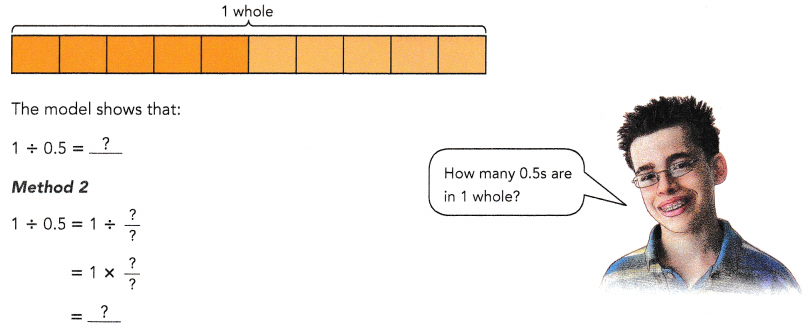
Find 1 ÷ 0.5
Method 1
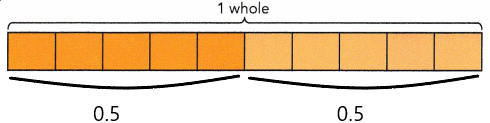
Math in Focus Grade 6 Chapter 3 Lesson 3.3 Answer Key Dividing Decimals 1
Answer:
There are two 0.5s in 1 whole.

Explanation:
There are two 0.5s are in 1 whole.
Math in Focus Grade 6 Chapter 3 Lesson 3.3 Answer Key Dividing Decimals 1-1
Method 2
1 ÷ 0.5 = 1 ÷ \(\frac{5}{10}\)
= 1 × \(\frac{10}{5}\)
= 2.

Question 2.
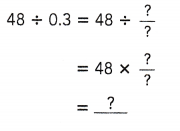
Find 48 ÷ 0.3
Math in Focus Grade 6 Chapter 3 Lesson 3.3 Answer Key Dividing Decimals 2
Answer:
48 ÷ 0.3 = 160.

Explanation:
48 ÷ 0.3 = 48 ÷ \(\frac{3}{10}\)
= 48 × \(\frac{10}{3}\)
= 16 × 10
= 160.

Complete.

Question 3.
Complete the model to show the division expression 98 ÷ 0.14.
Math in Focus Grade 6 Chapter 3 Lesson 3.3 Answer Key Dividing Decimals 3
Answer:
98 ÷ 0.14 = 700.

Explanation:
Math-in-Focus-Grade-6-Chapter-3-Lesson-3.3-Answer-Key-Dividing-Decimals-3-1
Method 2
98 ÷ 0.14 = 98 ÷ \(\frac{14}{100}\)
= 98 × \(\frac{100}{14}\)
= 7 × 100
= 700.

Divide.

Question 4.
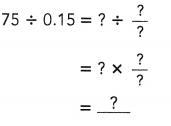
Math in Focus Grade 6 Chapter 3 Lesson 3.3 Answer Key Dividing Decimals 4
Answer:
75 ÷ 0.15 = 500.

Explanation:
75 ÷ 0.15 = 75 ÷ \(\frac{15}{100}\)
= 75 × \(\frac{100}{15}\)
= 5 × 100
= 500.

Question 5.
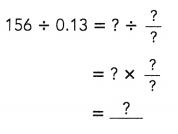
Math in Focus Grade 6 Chapter 3 Lesson 3.3 Answer Key Dividing Decimals 5
Answer:
156 ÷ 0.13 = 1200.

Explanation:
Given the division expression is 156 ÷ 0.13,
156 ÷ 0.13 = 156 ÷ \(\frac{13}{100}\)
= 156 × \(\frac{100}{13}\)
= 12 × 100
= 1200.

Complete.

Question 6.
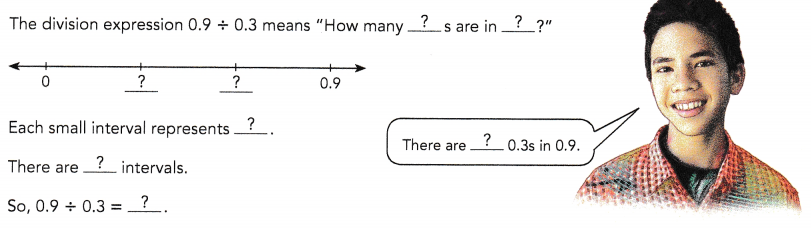
Find 0.9 ÷ 0.3.
Math in Focus Grade 6 Chapter 3 Lesson 3.3 Answer Key Dividing Decimals 7
Answer:
There are three 0.3s in 0.9.

Explanation:
Given the division expression is 0.9 ÷ 0.3,
0.9 ÷ 0.3 = \(\frac{9}{10}\) ÷ \(\frac{3}{10}\)
= \(\frac{9}{10}\) × \(\frac{10}{3}\)
= 3.
So each small interval represents 0.3 and there are 3 intervals.

Complete.

Question 7.
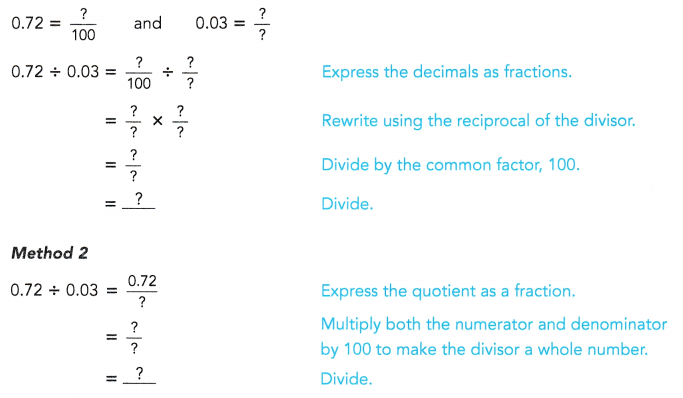
Find 0.72 ÷ 0.03.
Method 1
Math in Focus Grade 6 Chapter 3 Lesson 3.3 Answer Key Dividing Decimals 8
Answer:
0.72 ÷ 0.03 = 24.

Explanation:
Given the division expression is 0.72 ÷ 0.03,
Method 1
0.72 = \(\frac{72}{100}\)  and 0.03 = \(\frac{3}{100}\)
= \(\frac{72}{100}\) ÷ \(\frac{3}{100}\)
= \(\frac{72}{100}\) × \(\frac{100}{3}\)
= 24.

Method 2
0.72 ÷ 0.03 = \(\frac{0.72}{0.03}\)
= \(\frac{0.72}{0.03}\) × \(\frac{100}{100}\)
= \(\frac{72}{3}\)
= 24.

Complete.

Question 8.
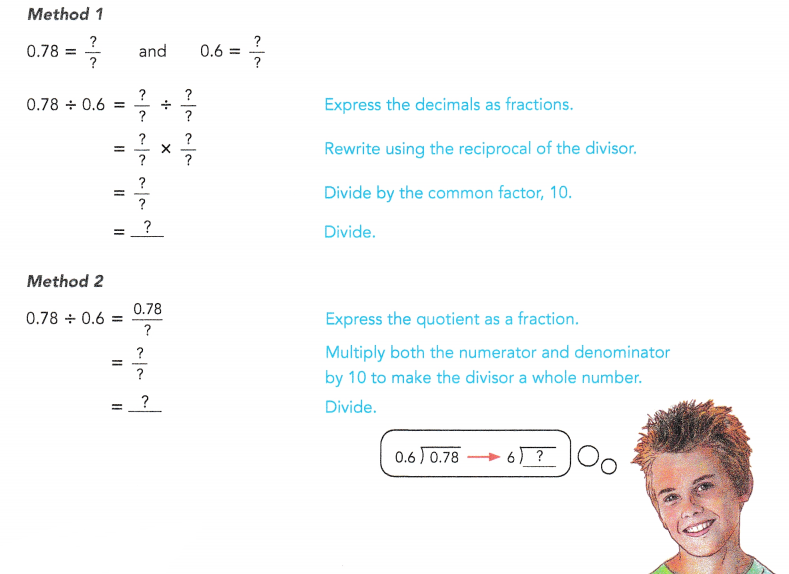
Find 0.78 ÷ 0.6.
Math in Focus Grade 6 Chapter 3 Lesson 3.3 Answer Key Dividing Decimals 9
Answer:
0.78 ÷ 0.6 = 1.3.

Explanation:
Given the division expression is 0.78 ÷ 0.6,
Method 1
0.78 = \(\frac{78}{100}\)  and 0.6 = \(\frac{6}{10}\)
= \(\frac{78}{100}\) ÷ \(\frac{6}{10}\)
= \(\frac{78}{100}\) × \(\frac{10}{6}\)
= \(\frac{13}{10}\)
= 1.3.

Method 2
0.78 ÷ 0.6 = \(\frac{0.78}{0.6}\)
= \(\frac{0.78}{0.6}\) × \(\frac{10}{10}\)
= \(\frac{7.8}{6}\)
= 1.3.

Question 9.
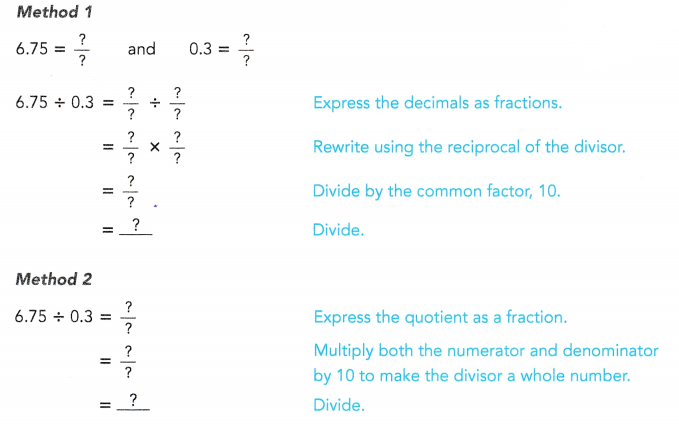
Find 6.75 ÷ 0.3.
Math in Focus Grade 6 Chapter 3 Lesson 3.3 Answer Key Dividing Decimals 10
Answer:

Explanation:
Given the division expression is 6.75 ÷ 0.3,
Method 1
6.75 = \(\frac{675}{100}\)  and 0.3 = \(\frac{3}{10}\)
= \(\frac{675}{100}\) ÷ \(\frac{3}{10}\)
= \(\frac{675}{100}\) × \(\frac{10}{3}\)
= \(\frac{225}{10}\)
= 22.5.

Method 2
6.75 ÷ 0.3 = \(\frac{6.75}{0.3}\)
= \(\frac{6.75}{0.3}\) × \(\frac{10}{10}\)
= \(\frac{67.5}{3}\)
= 22.5

Math in Focus Course 1A Practice 3.3 Answer Key

Write a division expression that represents each model.

Question 1.
Math in Focus Grade 6 Chapter 3 Lesson 3.3 Answer Key Dividing Decimals 11
Answer:
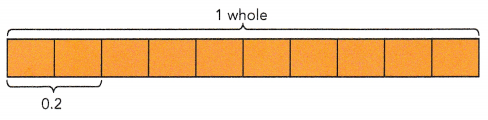
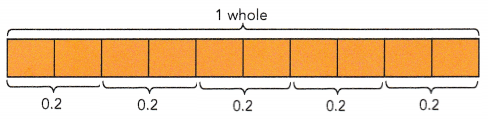
1 ÷ 0.2 = 5.

Explanation:
In 1 whole there are five 0.2s, so the division expression will be 1 ÷ 0.2 which is 5.
Math-in-Focus-Grade-6-Chapter-3-Lesson-3.3-Answer-Key-Dividing-Decimals-11-1

Question 2.
Math in Focus Grade 6 Chapter 3 Lesson 3.3 Answer Key Dividing Decimals 12
Answer:
3 ÷ 0.2 = 15.

Explanation:
In 3 wholes there are 15 0.2s, so the division expression will be 3 ÷ 0.2 which is 15.
Math-in-Focus-Grade-6-Chapter-3-Lesson-3.3-Answer-Key-Dividing-Decimals-12-1

Divide.

Question 3.
2 ÷ 0.4
Answer:
2 ÷ 0.4 = 5.

Explanation:
Given the division expression is 2 ÷ 0.4,
2 ÷ 0.4 = 2 ÷ \(\frac{4}{10}\)
= 2 × \(\frac{10}{4}\)
= 5.

Question 4.
4 ÷ 0.5
Answer:
4 ÷ 0.5 = 8.

Explanation:
Given the division expression is 4 ÷ 0.5,
4 ÷ 0.5 = 4 ÷ \(\frac{5}{10}\)
= 4 × \(\frac{10}{5}\)
= 8.

Question 5.
5 ÷ 0.2
Answer:
5 ÷ 0.2 = 25.

Explanation:
Given the division expression is 5 ÷ 0.2,
5 ÷ 0.2 = 5 ÷ \(\frac{2}{10}\)
= 5 × \(\frac{10}{2}\)
= 5 × 5
= 25.

Question 6.
8 ÷ 0.8
Answer:
8 ÷ 0.8 = 10.

Explanation:
Given the division expression is 8 ÷ 0.8,
8 ÷ 0.8 = 8 ÷ \(\frac{8}{10}\)
= 8 × \(\frac{10}{8}\)
= 10.

Question 7.
9 ÷ 0.3
Answer:
9 ÷ 0.3 = 30.

Explanation:
Given the division expression is 9 ÷ 0.3,
9 ÷ 0.3 = 9 ÷ \(\frac{3}{10}\)
= 9 × \(\frac{10}{3}\)
= 3 × 10
= 30.

Question 8.
7 ÷ 0.4
Answer:
7 ÷ 0.4 = 17.5.

Explanation:
Given the division expression is 7 ÷ 0.4,
7 ÷ 0.4 = 7 ÷ \(\frac{4}{10}\)
= 7 × \(\frac{10}{4}\)
= 7 × \(\frac{5}{2}\)
= \(\frac{35}{2}\)
= 17.5.

Question 9.
12 ÷ 0.3
Answer:
12 ÷ 0.3 = 40.

Explanation:
Given the division expression is 12 ÷ 0.3,
12 ÷ 0.3 = 12 ÷ \(\frac{3}{10}\)
= 12 × \(\frac{10}{3}\)
= 4 × 10
= 40.

Question 10.
42 ÷ 0.7
Answer:
42 ÷ 0.7 = 60.

Explanation:
Given the division expression is 42 ÷ 0.7,
42 ÷ 0.7 = 42 ÷ \(\frac{7}{10}\)
= 42 × \(\frac{10}{7}\)
= 6 × 10
= 60.

Question 11.
55 ÷ 0.5
Answer:
55 ÷ 0.5 = 110.

Explanation:
Given the division expression is 55 ÷ 0.5,
55 ÷ 0.5 = 55 ÷ \(\frac{5}{10}\)
= 55 × \(\frac{10}{5}\)
= 11 × 10
= 110.

Question 12.
69 ÷ 0.2
Answer:
69 ÷ 0.2 = 345

Explanation:
Given the division expression is 69 ÷ 0.2,
69 ÷ 0.2 = 69 ÷ \(\frac{2}{10}\)
= 69 × \(\frac{10}{2}\)
= 69 × 5
= 345.

Question 13.
86 ÷ 0.5
Answer:
86 ÷ 0.5 = 172

Explanation:
Given the division expression is 86 ÷ 0.5,
86 ÷ 0.5 = 86 ÷ \(\frac{5}{10}\)
= 86 × \(\frac{10}{5}\)
= 86 × 2
= 172.

Question 14.
93 ÷ 0.4
Answer:

Explanation:
Given the division expression is 93 ÷ 0.4,
93 ÷ 0.4 = 93 ÷ \(\frac{4}{10}\)
= 93 × \(\frac{10}{4}\)
= 93 × \(\frac{5}{2}\)
= \(\frac{465}{2}\)
= 232.5.

Question 15.
1 ÷ 0.02
Answer:
1 ÷ 0.02 = 50.

Explanation:
Given the division expression is 1 ÷ 0.02,
1 ÷ 0.02 = 1 ÷ \(\frac{2}{100}\)
= 1 × \(\frac{100}{2}\)
= 50.

Question 16.
3 ÷ 0.06
Answer:
3 ÷ 0.06 = 50.

Explanation:
Given the division expression is 3 ÷ 0.06,
3 ÷ 0.06 = 3 ÷ \(\frac{6}{100}\)
= 3 × \(\frac{100}{6}\)
= \(\frac{100}{2}\)
= 50.

Question 17.
6 ÷ 0.15
Answer:
6 ÷ 0.15 = 40.

Explanation:
Given the division expression is 6 ÷ 0.15,
6 ÷ 0.15 = 6 ÷ \(\frac{15}{100}\)
= 6 × \(\frac{100}{15}\)
= 2 × \(\frac{100}{5}\)
= 2 × 20
= 40.

Question 18.
7 ÷ 0.35
Answer:
7 ÷ 0.35 = 20.

Explanation:
Given the division expression is 7 ÷ 0.35,
7 ÷ 0.35 = 7 ÷ \(\frac{35}{100}\)
= 7 × \(\frac{100}{35}\)
= 20.

Question 19.
8 ÷ 0.32
Answer:
8 ÷ 0.32 = 25.

Explanation:
Given the division expression is 8 ÷ 0.32,
8 ÷ 0.32 = 8 ÷ \(\frac{32}{100}\)
= 8 × \(\frac{100}{32}\)
= 25.

Question 20.
9 ÷ 0.72
Answer:
9 ÷ 0.72 = 12.5.

Explanation:
Given the division expression is 9 ÷ 0.72,
9 ÷ 0.72 = 9 ÷ \(\frac{72}{100}\)
= 9 × \(\frac{100}{72}\)
= 12.5.

Draw a model to show each division expression.

Question 21.
2 ÷ 0.5
Answer:
2 ÷ 0.5 = 4.

Explanation:
Given the division expression is 2 ÷ 0.5,
2 ÷ 0.5 = 2 ÷ \(\frac{5}{10}\)
= 2 × \(\frac{10}{5}\)
= 4.

Question 22
5 ÷ o.2
Answer:
5 ÷ o.2 = 10.

Explanation:
Given the division expression is 5 ÷ o.2,
5 ÷ o.2 = 5 ÷ \(\frac{2}{10}\)
= 5 × \(\frac{10}{5}\)
= 10.

Divide.

Question 23.
36 ÷ 0.36
Answer:
36 ÷ 0.36 = 100.

Explanation:
Given the division expression is 36 ÷ 0.36,
36 ÷ 0.36 = 36 ÷ \(\frac{36}{100}\)
= 36 × \(\frac{100}{36}\)
= 100.

Question 24.
49 ÷ 0.14
Answer:
49 ÷ 0.14 = 350.

Explanation:
Given the division expression is 49 ÷ 0.14,
49 ÷ 0.14 = 49 ÷ \(\frac{14}{100}\)
= 49 × \(\frac{100}{14}\)
= 49 × 50
= 350.

Question 25.
56 ÷ 0.28
Answer:
56 ÷ 0.28 = 200.

Explanation:
Given the division expression is 56 ÷ 0.28,
56 ÷ 0.28 = 56 ÷ \(\frac{28}{100}\)
= 56 × \(\frac{100}{28}\)
= 2 × 100
= 200.

Question 26.
72 ÷ 0.20
Answer:
72 ÷ 0.20 = 360.

Explanation:
Given the division expression is 72 ÷ 0.20,
72 ÷ 0.20 = 72 ÷ \(\frac{20}{100}\)
= 72 × \(\frac{100}{20}\)
= 72 × 5
= 360.

Question 27.
81 ÷ 0.54
Answer:
81 ÷ 0.54 = 150.

Explanation:
Given the division expression is 81 ÷ 0.54,
81 ÷ 0.54 = 81 ÷ \(\frac{54}{100}\)
= 81 × \(\frac{100}{54}\)
= 3 × \(\frac{100}{2}\)
= 3 × 50
= 150.

Question 28.
256 ÷ 0.64
Answer:
256 ÷ 0.64 = 400.

Explanation:
Given the division expression is 256 ÷ 0.64,
256 ÷ 0.64 = 256 ÷ \(\frac{64}{100}\)
= 256 × \(\frac{100}{64}\)
= 4 × 100
= 400.

Question 29.
749 ÷ 0.7
Answer:
749 ÷ 0.7 = 1,070.

Explanation:
Given the division expression is 749 ÷ 0.7,
749 ÷ 0.7 = 749 ÷ \(\frac{7}{10}\)
= 749 × \(\frac{10}{7}\)
= 107 × 10
= 1,070.

Question 30.
972 ÷ 0.8
Answer:
972 ÷ 0.8 = 1,215.

Explanation:
Given the division expression is 972 ÷ 0.8,
972 ÷ 0.8 = 972 ÷ \(\frac{8}{10}\)
= 972 × \(\frac{10}{8}\)
= 972 × \(\frac{5}{4}\)
= 243 × 5
= 1,215.

Question 31.
96 ÷ 0.16
Answer:
96 ÷ 0.16 = 1600.

Explanation:
Given the division expression is 96 ÷ 0.16,
96 ÷ 0.16 = 96 ÷ \(\frac{16}{100}\)
= 96 × \(\frac{100}{16}\)
= 16 × 100
= 1600.

Question 32.
545 ÷ 0.25
Answer:
545 ÷ 0.25 = 218.

Explanation:
Given the division expression is 545 ÷ 0.25,
545 ÷ 0.25 = 545 ÷ \(\frac{25}{10}\)
= 545 × \(\frac{10}{25}\)
= 545 × \(\frac{2}{5}\)
= 109 × 2
= 218.

Question 33.
0.6 ÷ 0.3
Answer:
0.6 ÷ 0.3 = 2.

Explanation:
Given the division expression is 0.6 ÷ 0.3,
0.6 ÷ 0.3 = \(\frac{6}{10}\) ÷ \(\frac{3}{10}\)
= \(\frac{6}{10}\) × \(\frac{10}{3}\)
= 2.

Question 34.
0.64 ÷ 0.04
Answer:
0.64 ÷ 0.04 = 64.

Explanation:
Given the division expression is 4 ÷ 0.5,
0.64 ÷ 0.04 = \(\frac{64}{100}\) ÷ \(\frac{4}{100}\)
= \(\frac{64}{100}\) × \(\frac{100}{4}\)
= 16.

Question 35.
0.78 ÷ 0.06
Answer:
0.78 ÷ 0.06 = 13.

Explanation:
Given the division expression is 0.78 ÷ 0.06,
0.78 ÷ 0.06 = \(\frac{78}{100}\) ÷ \(\frac{6}{100}\)
=\(\frac{78}{100}\) × \(\frac{100}{6}\)
= 13.

Question 36.
0.85 ÷ 0.5
Answer:
0.85 ÷ 0.5 = 17.

Explanation:
Given the division expression is 0.85 ÷ 0.5,
0.85 ÷ 0.5 = \(\frac{85}{100}\) ÷ \(\frac{5}{10}\)
= \(\frac{85}{10}\)× \(\frac{10}{5}\)
= 17.

Question 37.
0.025 ÷ 0.5
Answer:
0.025 ÷ 0.5 = 0.05.

Explanation:
Given the division expression is 0.025 ÷ 0.5,
0.025 ÷ 0.5 = \(\frac{25}{1000}\) ÷ \(\frac{5}{10}\)
= \(\frac{25}{1000}\) × \(\frac{10}{5}\)
= \(\frac{5}{100}\)
= 0.05.

Question 38.
0.816 ÷ 0.34
Answer:
0.816 ÷ 0.34 = 2.4.

Explanation:
Given the division expression is 0.816 ÷ 0.34,
0.816 ÷ 0.34 = \(\frac{816}{1000}\) ÷ \(\frac{34}{100}\)
= \(\frac{816}{1000}\) × \(\frac{100}{34}\)
= \(\frac{24}{10}\)
= 2.4.

Question 39.
4.5 ÷ 0.2
Answer:
4.5 ÷ 0.2 = 22.5.

Explanation:
Given the division expression is 4.5 ÷ 0.2,
4.5 ÷ 0.2 = \(\frac{45}{10}\) ÷ \(\frac{2}{10}\)
= \(\frac{45}{10}\) × \(\frac{10}{2}\)
= \(\frac{45}{2}\)
= 22.5.

Question 40.
8.82 ÷ 0.6
Answer:
8.82 ÷ 0.6 = 14.7.

Explanation:
Given the division expression is 8.82 ÷ 0.6,
8.82 ÷ 0.6 = \(\frac{882}{100}\) ÷ \(\frac{6}{10}\)
= \(\frac{882}{100}\) × \(\frac{10}{6}\)
= \(\frac{147}{10}\)
= 14.7.

Math in Focus Grade 6 Chapter 2 Lesson 2.1 Answer Key Negative Numbers

Go through the Math in Focus Grade 6 Workbook Answer Key Chapter 2 Lesson 2.1 Negative Numbers to finish your assignments.

Math in Focus Grade 6 Course 1 A Chapter 2 Lesson 2.1 Answer Key Negative Numbers

Math in Focus Grade 6 Chapter 2 Lesson 2.1 Guided Practice Answer Key

Write a positive or negative number to represent each situation.

Question 1.
36°F below zero
Answer:
-36°F
Explanation:
The given situation is 36°F below zero. The word ‘below zero’ represents negative sign. The given situation is represented with negative number -36°F.

Question 2.
A debit of $10,540
Answer:
-$10,540
Explanation:
The given situation is a debit of $10,540. The word debit is represented with negative sign and credit is represented with positive sign. The given situation is represented with negative number -$10,540.

Question 3.
29,035 feet below sea level
Answer:
-29,035 feet
Explanation:
The given situation is 29,035 feet below sea level. The word ‘below sea level’ is represented with negative sign. So, the given situation is represented with negative number -29,035 feet.

Question 4.
A gain of 45 yards
Answer:
45 yards
Explanation:
The given situation is a gain of 45 yards. The word ‘gain’ is represented with positive sign. The word ‘loss’ is represented with negative sign. So, the given situation is represented with positive number 45 yards.

Answer the questions.

The table shows the elevations of four locations compared to sea level.
Math in Focus Grade 6 Chapter 2 Lesson 2.1 Answer Key Negative Numbers 1

Question 5.
New Orleans is 8 feet Math in Focus Grade 6 Chapter 2 Lesson 2.1 Answer Key Negative Numbers 2 sea level.
Answer:
New Orleans is 8 feet below sea level.

Question 6.
Mount Davidson is Math in Focus Grade 6 Chapter 2 Lesson 2.1 Answer Key Negative Numbers 2 feet above sea level.
Answer:
Mount Davidson is 928 feet above sea level.

Question 7.
The deepest location among the four locations is Math in Focus Grade 6 Chapter 2 Lesson 2.1 Answer Key Negative Numbers 2.
Answer:
The deepest location among the four locations is Death Valley.

Question 8.
The highest location among the four locations is Math in Focus Grade 6 Chapter 2 Lesson 2.1 Answer Key Negative Numbers 2
Answer:
The highest location among the four locations is Pilot Mountain.

Question 9.
The location nearest to sea level is Math in Focus Grade 6 Chapter 2 Lesson 2.1 Answer Key Negative Numbers 2.
Answer:
The location nearest to sea level is New Orleans.

Copy and complete each inequality using > or <.

Question 10.
Math in Focus Grade 6 Chapter 2 Lesson 2.1 Answer Key Negative Numbers 3
Answer:
Math-in-Focus-Grade-6-Chapter-2-Lesson-2.1-Answer-Key-Negative-Numbers-3
-13 < -12 < -11 < -10 < -9 < -8 < -7 < -6 < -5 < -4
Explanation:
The missing numbers on the horizontal number line are -13, -11, -9, -6. On a horizontal number line, the numbers become greater as you move to the right, and less as you move to the left as we can observe in the above image.

Draw a horizontal number line to represent each set of numbers.

Question 11.
-8, -5, -4, -2, 2, 5, 7
Answer:
Math-in-Focus-Grade-6-Chapter-2-Lesson-2.1-Answer-Key-Negative-Numbers-3(1)
The given numbers -8, -5, -4, -2, 2, 5, 7 are represented in the above horizontal number line. On a horizontal number line, the numbers become greater as you move to the right, and less as you move to the left.

Question 12.
-16, -19, -20, -22, -25
Answer:
Math-in-Focus-Grade-6-Chapter-2-Lesson-2.1-Answer-Key-Negative-Numbers-3(2)
The given numbers -16, -19, -20, -22, -25 are represented in the above horizontal number line. On a horizontal number line, the numbers become greater as you move to the right, and less as you move to the left.

Write the opposite of each number.

Question 13.
-14
Answer:
The opposite number of -14 is 14.

Question 14.
-9
Answer:
The opposite number of -9 is 9.

Question 15.
-17
Answer:
The opposite number of -17 is 17.

Question 16.
27
Answer:
The opposite number of 27 is -27.

Question 17.
-23
Answer:
The opposite number of -23 is 23.

Question 18.
46
Answer:
The opposite number of 46 is -46.

Copy and complete each Inequality using > or <.

Question 19.
-15 Math in Focus Grade 6 Chapter 2 Lesson 2.1 Answer Key Negative Numbers 4 -6
Answer:
-15 Math-in-Focus-Grade-6-Chapter-2-Lesson-2.1-Answer-Key-Negative-Numbers-4 -6
Explanation:
The given numbers are -15 and -6. Here we have to compare both the numbers. By comparing the above given numbers the number -15 is less than -6.

Question 20.
-20 Math in Focus Grade 6 Chapter 2 Lesson 2.1 Answer Key Negative Numbers 4 -23
Answer:
-20 Math-in-Focus-Grade-6-Chapter-2-Lesson-2.1-Answer-Key-Negative-Numbers-4 (1) -23
The given numbers are -20 and -23. Here we have to compare both the numbers. By comparing the above given numbers the number -20 is greater than -23.

Question 21.
-30 Math in Focus Grade 6 Chapter 2 Lesson 2.1 Answer Key Negative Numbers 4 -3
Answer:
-30 Math-in-Focus-Grade-6-Chapter-2-Lesson-2.1-Answer-Key-Negative-Numbers-4 (2) -3
The given numbers are -30 and -3. Here we have to compare both the numbers. By comparing the above given numbers the number -30 is less than -3.

Question 22.
-19 Math in Focus Grade 6 Chapter 2 Lesson 2.1 Answer Key Negative Numbers 4 0
Answer:
-19 Math-in-Focus-Grade-6-Chapter-2-Lesson-2.1-Answer-Key-Negative-Numbers-4 (3)  0
The given numbers are -19 and 0. Here we have to compare both the numbers. By comparing the above given numbers the number -19 is less than 0.

Question 23.
12 Math in Focus Grade 6 Chapter 2 Lesson 2.1 Answer Key Negative Numbers 4 -31
Answer:
12 Math-in-Focus-Grade-6-Chapter-2-Lesson-2.1-Answer-Key-Negative-Numbers-4 (4) -31
The given numbers are 12 and -31. Here we have to compare both the numbers. By comparing the above given numbers the number 12 is greater than -31.

Question 24.
-75 Math in Focus Grade 6 Chapter 2 Lesson 2.1 Answer Key Negative Numbers 4 46
Answer:
-75 Math-in-Focus-Grade-6-Chapter-2-Lesson-2.1-Answer-Key-Negative-Numbers-4 (5) 46
The given numbers are -75 and 46. Here we have to compare both the numbers. By comparing the above given numbers the number -75 is less than 46.

Hands-On Activity

Materials:

  • number cards

Work in pairs. Your teacher will give you and your partner a set of number cards with these numbers on them:
Math in Focus Grade 6 Chapter 2 Lesson 2.1 Answer Key Negative Numbers 5

Step 1.
Draw a number line and divide it into ten equal intervals. Label the endpoints -100 and 0. Shuffle the cards and place them face down on a flat surface.
Step 2.
Choose one card and turn it over. Mark the number shown on the card on the drawn number line.
Step 3.
Have your partner choose another card and mark the number shown on the number line.
Step 4.
Work together to write a statement of inequality for the two numbers you represented on the number line.
Step 5.
Repeat Step 2 through Step 4 using the other number cards.

Interpret and explain statements of order for positive and negative numbers in real-world situations.

a) The table shows the lowest recorded temperature in Alaska for each month from July through December.
Math in Focus Grade 6 Chapter 2 Lesson 2.1 Answer Key Negative Numbers 6
September’s lowest recorded temperature of -13°F is lower than August’s lowest recorded temperature of 8°F.
To compare these two temperatures using an inequality, you can write -13°F < 8°F.
Answer:

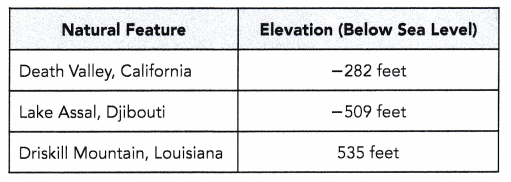
b) The table shows the elevations of some natural features.
Math in Focus Grade 6 Chapter 2 Lesson 2.1 Answer Key Negative Numbers 7
The elevation of Death Valley, which is -282 feet, ¡s greater than the elevation of Lake Assai, which is -509 feet.
To compare the two elevations using an inequality, you can write -282 ft > -509 ft.
The elevation of Lake Assai, which is -509 feet, is less than the elevation of Driskill Mountain, which has an elevation of 535 feet.
To compare the two elevations using an inequality, you can write -509 ft < 535 ft.

You can also write the inequalities above as -509ft < -282 ft and 535 ft > -509 ft.
Math in Focus Grade 6 Chapter 2 Lesson 2.1 Answer Key Negative Numbers 8

Write an inequality for each statement using > or <.

Question 25.
0°C is warmer, than -5°C.
Answer:
0°C > -5°C
Explanation:
The given statement is 0°C is warmer, than -5°C. Here we have to compare both the temperatures. After comparing the temperatures 0°C is greater than -5°C.

Question 26.
The elevation of the Valdes Peninsula, which is -131 feet, is less than the elevation of the Caspian Sea, which is -92 feet.
Answer:
-131 feet < -92 feet
Explanation:
The elevation of the Valdes Peninsula is -131 feet.
The elevation of the Caspian Sea is -92 feet.
After comparing both the elevations -131 feet is less than -92 feet.

Write a statement to describe each inequality.

Question 27.
-61 °F < -47°F
Answer:
The lowest recorded temperature yesterday was -61°F, which is colder than today’s lowest recorded temperature of -47°F.

Question 28. –
520 feet > -893 feet
Answer:
A dog is standing on a cliff, 520 feet above sea level which is greater than a dolphin which is swimming 893 feet below sea level.

Math in Focus Course 1A Practice 2.1 Answer Key

Write a positive or negative number to represent each situation.

Question 1.
438°C above zero
Answer:
438°C
Explanation:
The given situation is 438°C above zero. The word ‘below zero’ represents negative number and ‘above zero’ represents positive number. So the situation is represented with positive number 438°C, which is above zero.

Question 2.
164°F below zero
Answer:
-164°F
Explanation:
The given situation is 164°F below zero. The word ‘below zero’ represents negative number and ‘above zero’ represents positive number. So the situation is represented with negative number -164°F, which is below zero.

Question 3.
8,327 feet below sea level
Answer:
-8,327 feet
Explanation:
The given situation is 8,327 feet below sea level. The word ‘below sea level’ represents negative number and ‘above sea level’ represents positive number. So the situation is represented with negative number -8,327 feet, which is below sea level.

Question 4.
12,316 feet above sea level
Answer:
12,316 feet
Explanation:
The given situation is 12,316 feet above sea level. The word ‘below sea level’ represents negative number and ‘above sea level’ represents positive number. So the situation is represented with positive number 12,316 feet, which is above sea level.

Question 5.
A loss of 20 yards
Answer:
-20 yards
Explanation:
The given situation is a loss of 20 yards. In general loss is represented with negative number and gain is represented with positive number. So the given situation is represented with negative number -20 yards.

Question 6.
A credit of $3,401
Answer:
$3,401
Explanation:
The given situation is a credit of $3,401. In general debit is represented with ‘negative sign’ and credit is represented with ‘positive sign’. So, the given situation is represented with positive number $3,401.

Copy and complete each number line by filling in the missing numbers.

Question 7.
Math in Focus Grade 6 Chapter 2 Lesson 2.1 Answer Key Negative Numbers 9
Answer:
Math-in-Focus-Grade-6-Chapter-2-Lesson-2.1-Answer-Key-Negative-Numbers-9
Explanation:
The missing numbers are -11, -9, -7, -3. The above number line is filled with the missing numbers as we can observe in the above image.

Question 8.
Math in Focus Grade 6 Chapter 2 Lesson 2.1 Answer Key Negative Numbers 10
Answer:
Math-in-Focus-Grade-6-Chapter-2-Lesson-2.1-Answer-Key-Negative-Numbers-10
Explanation:
The missing numbers are -35, -33, -32, -29. The above number line is filled with the missing numbers as we can observe in the above image.

Write the opposite of each number.

Question 9.
8
Answer:
The opposite number of 8 is -8.

Question 10.
-5
Answer:
The opposite number of -5 is 5.

Question 11.
21
Answer:
The opposite number of 21 is -21.

Question 12.
-29
Answer:
The opposite number of -29 is 29.

Question 13.
24
Answer:
The opposite number of 24 is -24.

Question 14.
-106
Answer:
The opposite number of -106 is 106.

Draw a horizontal number line to represent each set of numbers.

Question 15.
Even negative numbers from -24 to -1o
Answer:
Even negative numbers from -24 to -1o are -24, -22, -20 ,-18, -16, -14, -12, -10.
Math-in-Focus-Grade-6-Chapter-2-Lesson-2.1-Answer-Key-Negative-Numbers-10
Explanation:
The even negative numbers are  -24, -22, -20 ,-18, -16, -14, -12, -10 are represented in the above horizontal number line. On a horizontal number line, the numbers become greater as you move to the right, and less as you move to the left.

Question 16.
The opposites of the whole numbers from 35 to 45
Answer:
The opposites of the whole numbers from 35 to 45 are -35, -36, -37, -38, -39, -40, -41, -42, -43, -44, -45.
Math-in-Focus-Grade-6-Chapter-2-Lesson-2.1-Answer-Key-Negative-Numbers-10(1)
Explanation:
The opposites of the whole numbers from 35 to 45 are -35, -36, -37, -38, -39, -40, -41, -42, -43, -44, -45 are represented in the above horizontal number line. On a horizontal number line, the numbers become greater as you move to the right, and less as you move to the left.

Draw a vertical number line to represent each set of numbers.

Question 17.
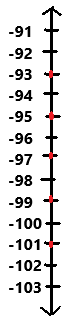
Odd numbers between -91 and -103
Answer:
Odd numbers between -91 and -103 are -93, -95, -97, -99, -101.
Math-in-Focus-Grade-6-Chapter-2-Lesson-2.1-Answer-Key-Negative-Numbers-10(2)
Explanation:
The odd numbers between -91 and -103 are -93, -95, -97, -99, -101 are represented in the above vertical number line. On a vertical number line, the numbers become greater as you move up, and lesser as you move down.

Question 18.
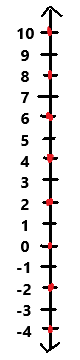
Even numbers greater than -6 but less than 12
Answer:
Even numbers greater than -6 but less than 12 are -4, -2, 0, 2 , 4, 6, 8, 10.
Math-in-Focus-Grade-6-Chapter-2-Lesson-2.1-Answer-Key-Negative-Numbers-10(3)
Explanation:
Even numbers greater than -6 but less than 12 are -4, -2, 0, 2 , 4, 6, 8, 10 are represented in the above vertical number line. On a vertical number line, the numbers become greater as you move up, and lesser as you move down.

Use the number line to compare each pair of numbers using > or <.

Math in Focus Grade 6 Chapter 2 Lesson 2.1 Answer Key Negative Numbers 11

Question 19.
-9 Math in Focus Grade 6 Chapter 2 Lesson 2.1 Answer Key Negative Numbers 12 -2
Answer:
-9 Math-in-Focus-Grade-6-Chapter-2-Lesson-2.1-Answer-Key-Negative-Numbers-12 (6) -2
Explanation:
In the above horizontal number line, the numbers become greater as you move to the right, and less as you move to the left.
Here -9 is to the left of -2.
So, -9 < -2.

Question 20.
-10 Math in Focus Grade 6 Chapter 2 Lesson 2.1 Answer Key Negative Numbers 12 -4
Answer:
-10 Math-in-Focus-Grade-6-Chapter-2-Lesson-2.1-Answer-Key-Negative-Numbers-12 (7) -4
Explanation:
In the above horizontal number line, the numbers become greater as you move to the right, and less as you move to the left.
Here -10 is to the left of -4.
So, -10 < -4.

Question 21.
-5 Math in Focus Grade 6 Chapter 2 Lesson 2.1 Answer Key Negative Numbers 12 4
Answer:
-5 Math-in-Focus-Grade-6-Chapter-2-Lesson-2.1-Answer-Key-Negative-Numbers-12 (8) 4
Explanation:
In the above horizontal number line, the numbers become greater as you move to the right, and less as you move to the left.
Here -5 is to the left of 4.
So, -5 < 4.

Question 22.
2 Math in Focus Grade 6 Chapter 2 Lesson 2.1 Answer Key Negative Numbers 12 -6
Answer:
2 Math-in-Focus-Grade-6-Chapter-2-Lesson-2.1-Answer-Key-Negative-Numbers-12 (9) -6
Explanation:
In the above horizontal number line, the numbers become greater as you move to the right, and less as you move to the left.
Here 2 is to the right of -6.
So, 2 > -6.

Question 23.
-5 Math in Focus Grade 6 Chapter 2 Lesson 2.1 Answer Key Negative Numbers 12 -12
Answer:
-5 Math-in-Focus-Grade-6-Chapter-2-Lesson-2.1-Answer-Key-Negative-Numbers-12 (10) -12
Explanation:
In the above horizontal number line, the numbers become greater as you move to the right, and less as you move to the left.
Here -5 is to the right of -12.
So, -5 > -12.

Question 24.
-10 Math in Focus Grade 6 Chapter 2 Lesson 2.1 Answer Key Negative Numbers 12 3
Answer:
-10 Math-in-Focus-Grade-6-Chapter-2-Lesson-2.1-Answer-Key-Negative-Numbers-12 (11) 3
Explanation:
In the above horizontal number line, the numbers become greater as you move to the right, and less as you move to the left.
Here -10 is to the left of 3.
So, -10 < 3.

Copy and complete each inequality using > or <.

Question 25.
-27 Math in Focus Grade 6 Chapter 2 Lesson 2.1 Answer Key Negative Numbers 12 -3
Answer:
-27 Math-in-Focus-Grade-6-Chapter-2-Lesson-2.1-Answer-Key-Negative-Numbers-12 -3
Explanation:
The given numbers are -27 and -3. Here we have to compare both the numbers. By comparing the above given numbers the number -27 is less than -3.

Question 26.
-45 Math in Focus Grade 6 Chapter 2 Lesson 2.1 Answer Key Negative Numbers 12 15
Answer:
-45 Math-in-Focus-Grade-6-Chapter-2-Lesson-2.1-Answer-Key-Negative-Numbers-12 (1) 15
Explanation:
The given numbers are -45 and 15. Here we have to compare both the numbers. By comparing the above given numbers the number -45 is less than 15.

Question 27.
25 Math in Focus Grade 6 Chapter 2 Lesson 2.1 Answer Key Negative Numbers 12 -25
Answer:
25 Math-in-Focus-Grade-6-Chapter-2-Lesson-2.1-Answer-Key-Negative-Numbers-12 (2) -25
Explanation:
The given numbers are 25 and -25. Here we have to compare both the numbers. By comparing the above given numbers the number 25 is greater than -25.

Question 28.
19 Math in Focus Grade 6 Chapter 2 Lesson 2.1 Answer Key Negative Numbers 12 -15
Answer:
19 Math-in-Focus-Grade-6-Chapter-2-Lesson-2.1-Answer-Key-Negative-Numbers-12 (3) -15
Explanation:
The given numbers are 19 and -15. Here we have to compare both the numbers. By comparing the above given numbers the number 19 is greater than -15.

Question 29.
14 Math in Focus Grade 6 Chapter 2 Lesson 2.1 Answer Key Negative Numbers 12 -16
Answer:
14 Math-in-Focus-Grade-6-Chapter-2-Lesson-2.1-Answer-Key-Negative-Numbers-12 (4) -16
Explanation:
The given numbers are 14 and -16. Here we have to compare both the numbers. By comparing the above given numbers the number 14 is greater than -16.

Question 30.
-81 Math in Focus Grade 6 Chapter 2 Lesson 2.1 Answer Key Negative Numbers 12 -80
Answer:
-81 Math-in-Focus-Grade-6-Chapter-2-Lesson-2.1-Answer-Key-Negative-Numbers-12 (5) -80
Explanation:
The given numbers are -81 and -80. Here we have to compare both the numbers. By comparing the above given numbers the number -81 is less than -80.

Order the numbers in each set from least to greatest.

Question 31.
3, 7, -2, -9, 0, -5
Answer:
The above given numbers from least to greatest are -9, -5, -2, 0, 3, 7.

Question 32.
-10, 8, 34, -13, 10, -17
Answer:
The above given numbers from least to greatest are -17, -13, -10, 8, 10, 34.

Order the numbers in each set from greatest to least.

Question 33.
-14, 43, -20, -57, 19, 31
Answer:
The above given numbers from greatest to least are 43, 31, 19, -14, -20, -57.

Question 34.
98, -101, -76, 125, -92, 113
Answer:
The above given numbers from greatest to least are 125, 113, 98, -76, -92, -101.

Answer the questions.

Question 35.
Name two numbers that are each 2 units away from -7. Give the opposites of these two numbers.
Answer:

Question 36.
Math Journal Is the opposite of a number always negative? Explain
Answer:
No. The opposite of a negative integer is a positive number. For example, the opposite of -1 is 1.
Explanation:
The opposite of any positive integer is negative. The opposite of any negative integer is positive. Zero is its own opposite.

Question 37.
Write an inequality using > or < for the following statement: -22°C is colder than -4°C.
Answer:
-22°C < -4°C
Explanation:
The given statement is -22°C is colder than -4°C. Here we have to compare both the temperatures. After comparing the temperatures -22°C is less than -4°C.

Question 38.
Your friend says that the statement 0 < -15 is correct. Explain why the statement is incorrect.
Answer:
The statement 0 < -15 is incorrect.
-15 is the negative integer.
0 is the positive integer.
Explanation:
Consider a horizontal number line, In that line the numbers become greater as you move to the right, and less as you move to the left.
Here -15 is to the left of 0.
So, -15 < 0.

Question 39.
The elevation of the deepest part of the Pacific Ocean is -36,200 feet. The elevation of the deepest part of the Indian Ocean is -24,442 feet.
Write an inequality to compare the elevations. In which of the two oceans is the deepest part farther from sea level?
Math in Focus Grade 6 Chapter 2 Lesson 2.1 Answer Key Negative Numbers 13
Answer:
The elevation of the deepest part of the Pacific Ocean is -36,200 feet.
The elevation of the deepest part of the Indian Ocean is -24,442 feet.
 -36,200 ft < -24,442 ft
Pacific ocean is the deepest part farther from seal level.

Question 40.
The temperature at which a substance boils is called its boiling point. The boiling points of two elements are shown in the table.
Math in Focus Grade 6 Chapter 2 Lesson 2.1 Answer Key Negative Numbers 14
Write an inequality to compare the two boiling points. Which element has the greater boiling point?
Answer:
The boiling point of the oxygen is -183°C.
The boiling point of the Nitrogen is -196 °C.
-183°C > -196 °C
The oxygen has the greatest boiling point with -183°C.

Write a statement to describe each inequality.

Question 41.
-45 feet > -80 feet
Answer:
The given inequality is -45 feet > -80 feet. The statement for the given inequality is the elevation of the deepest part of the North Atlantic ocean is -45 feet which is greater than the elevation of the deepest part of the South Atlantic Ocean is -80 feet.

Question 42.
-436°F < -271 °F
Answer:
The given inequality is -436°F < -271 °F. The statement for the given inequality is –436°F is colder than -271 °F.

Math in Focus Grade 6 Chapter 1 Lesson 1.4 Answer Key Squares and Square Roots

Go through the Math in Focus Grade 6 Workbook Answer Key Chapter 1 Lesson 1.4 Squares and Square Roots to finish your assignments.

Math in Focus Grade 6 Course 1 A Chapter 1 Lesson 1.4 Answer Key Squares and Square Roots

Math in Focus Grade 6 Chapter 1 Lesson 1.4 Guided Practice Answer Key

Find the square of each number.

Question 1.
2
Answer:
2 x 2 = 4

Explanation:
The square of 2 is 4.

Question 2.
6
Answer:
6 x 6 = 36

Explanation:
The square of 6 is 36.

Question 3.
9
Answer:
9 x 9 = 81

Explanation:
The square of 9 is 81.

Question 4.
11
Answer:
11 x 11 = 121

Explanation:
The square of 11 is 121.

Find a square root of a perfect square.

a) A square has an area of 9 square inches. Find the length of each side of the square.
Math in Focus Grade 6 Chapter 1 Lesson 1.4 Answer Key Squares and Square Roots 1
You know that
Area of square = length × length.
To find the length of a side of the square, you need to find the number whose square is 9.
Recalling the multiplication facts of 3, you know that 3 × 3 = 9.
So, the length of each side of the square is 3 inches.
3 is called a square root of 9. This can be written as \(\sqrt{9}\) = 3.
You read this as “the square root of 9 equals 3”.
Math in Focus Grade 6 Chapter 1 Lesson 1.4 Answer Key Squares and Square Roots 2

b) Find the square root of 100.

I can relate this to finding the length of the side of a square, given that it has an area of 1oo units2.
Math in Focus Grade 6 Chapter 1 Lesson 1.4 Answer Key Squares and Square Roots 3
Math in Focus Grade 6 Chapter 1 Lesson 1.4 Answer Key Squares and Square Roots 4

Method 1
Recalling the multiplication facts of 10, you know that
10 × 10 = 100
So, \(\sqrt{100}\) = 10.

Method 2
By prime factorization,
Math in Focus Grade 6 Chapter 1 Lesson 1.4 Answer Key Squares and Square Roots 5

Find the square root of each number.

Question 5.
25
Answer:
5

Explanation:
Recalling the multiplication facts of 25, you know that
25 = 5 x 5
= 5²
So, \(\sqrt{25}\) = 5

Question 6.
64
Answer:
8

Explanation:
Recalling the multiplication facts of 64, you know that
64 = 8 x 8
= 8²
So, \(\sqrt{64}\) = 8

Question 7.
144
Answer:
12

Explanation:
Recalling the multiplication facts of 144, you know that
144 = 12 x 12
= 12²
So, \(\sqrt{144}\) = 12

Question 8.
196
Answer:
13

Explanation:
Recalling the multiplication facts of 169, you know that
169 = 13 x 13
= 13²
So, \(\sqrt{169}\) = 13

Math in Focus Course 1A Practice 1.4 Answer Key

Find the square of each number.

Question 1.
3
Answer:
3 x 3 = 9

Explanation:
The square of 3 is 9.

Question 2.
7
Answer:
7 x 7 = 49

Explanation:
The square of 7 is 49.

Question 3.
12
Answer:
144

Explanation:
The square of 12 is 144.

Question 4.
10
Answer:
100

Explanation:
The square of 10 is 100.

Find the square root of each number.

Question 5.
36
Answer:
6

Explanation:
Recalling the multiplication facts of 36, you know that
36 = 6 x 6
= 6²
So, \(\sqrt{36}\) = 6

Question 6.
81
Answer:
9

Explanation:
Recalling the multiplication facts of 81, you know that
81 = 9 x 9
= 9²
So, \(\sqrt{81}\) = 9

Question 7.
121
Answer:
11

Explanation:
Recalling the multiplication facts of 121, you know that
121 = 11 x 11
= 11²
So, \(\sqrt{121}\) = 11

Question 8.
49
Answer:
7

Explanation:
Recalling the multiplication facts of 49, you know that
49 = 7 x 7
= 7²
So, \(\sqrt{49}\) = 7

Solve.

Question 9.
List the perfect squares that are between 25 and 100.
Answer:

Find the value of each of the following.

Question 10.
352
Answer:

35 x 35 = 1225

Explanation:
The square of 35 is 1225.

Question 11.
562
Answer:

56 x 56 = 3136

Explanation:
The square of 56 is 3136.

Question 12.
642
Answer:

64 x 64 = 4096

Explanation:
The square of 64 is 4096.

Question 13.
\(\sqrt{289}\)
Answer:
17

Explanation:
Recalling the multiplication facts of 289, you know that
289 = 17 x 17
= 17²
So, \(\sqrt{289}\) = 17

Question 14.
\(\sqrt{400}\)
Answer:
20

Explanation:
Recalling the multiplication facts of 400, you know that
400 = 20 x 20
= 20²
So, \(\sqrt{400}\) = 20

Question 15.
\(\sqrt{484}\)
Answer:
22

Explanation:
Recalling the multiplication facts of 484, you know that
484 = 22 x 22
= 22²
So, \(\sqrt{484}\) = 22

Solve.

Question 16.
Given that 412 = 1,681, find the square of 410.
Answer:
168100

Explanation:
If 412 = 1,681 then 4102 = 168100.

Question 17.
Given that 512 = 2,601, find the square root of 260,100.
Answer:
510

Explanation:
If 512 = 2601 then the square root of 260100 will be 510.

Question 18.
Given that \(\sqrt{676}\) = 26, evaluate \(\sqrt{2,704}\).
Answer:
52

Explanation:
Recalling the multiplication facts of 400, you know that
2704 = 52 x 52
= 52²
So, \(\sqrt{2704}\) = 52

Question 19.
Given that \(\sqrt{1,521}\) = 39, evaluate 3902.
Answer:
152100

Explanation:
If \(\sqrt{1,521}\) = 39 then 390² = 152100.

Question 20.
Heather wants to make a giant square quilt with sides of length 28 feet. She uses square patches of fabric that have sides of length 4 feet. How many patches of fabric will Heather need to make the giant square quilt?
Math in Focus Grade 6 Chapter 1 Lesson 1.4 Answer Key Squares and Square Roots 6
Answer:
7 patches of fabric Heather will need to make the giant square quilt.

Explanation:
Heather wants to make a giant square quilt with sides of length 28 feet.
She uses square patches of fabric that have sides of length 4 feet.
4 x 7 = 28
So, 7 patches of fabric Heather will need to make the giant square quilt.

Question 21.
This week, customers at a carpet store pay $3 for a square foot of carpet. Next week the store will be having a sale. During the sale, each square foot of carpet will cost only $2. Neil wants to carpet two square rooms in his house. The floor in one room is 10 feet by 10 feet. The floor in the other room is 14 feet by 14 feet. How much money will Neil save if he waits to buy carpet during the sale?
Answer:
296

Explanation:
Neil wants to carpet two square rooms in his house.
The floor in one room is 10 feet by 10 feet.
10 x 10 = 100 square feet
The floor in the other room is 14 feet by 14 feet
14 x 14 = 196
Neil wants to carpet two square rooms in his house
100+196=296
During the sale, each square foot of carpet is reduced by 1 so, $296 Neil will save.

Math in Focus Grade 6 Chapter 1 Answer Key Positive Numbers and the Number Line

Go through the Math in Focus Grade 6 Workbook Answer Key Chapter 1 Positive Numbers and the Number Line to finish your assignments.

Math in Focus Grade 6 Course 1 A Chapter 1 Answer Key Positive Numbers and the Number Line

Math in Focus Grade 6 Chapter 1 Quick Check Answer Key

Find the factors of each number.

Question 1.
30
Answer:
30 = 1 x 30, 30 = 2 x 15,
30 = 3 x 10, 30 = 5 x 6

Explanation:
1, 2, 3, 5, 6, 10, 15 and 30 are the factors of number 30.
a number or algebraic expression that divides another number or expression evenly,
with no remainder.

Question 2.
63
Answer:
1 x 63 = 63, 3 x 21 = 63, 7 x 9 = 63.

Explanation:
1, 3, 7, 9, 21 and 63 are the factors of number 63.
a number or algebraic expression that divides another number or expression evenly,
with no remainder.

Question 3.
56
Answer:
1 x 56 = 56, 2 x 28 = 56
4 x 14 = 56, 7 x 8 = 56

Explanation:
1, 2, 4, 7, 8, 14, 28 and 56 are the factors of number 56.
a number or algebraic expression that divides another number or expression evenly,
with no remainder.

Question 4.
84
Answer:
1 x 84 = 84, 2 x 42 = 84, 3 x 28 = 84
4 x 21 = 84, 6 x 14 = 84, 7 x 12 = 84

Explanation:
1, 2, 3, 4, 6, 7, 12, 14, 21, 28, 42 and 84 are the factors of number 84.
a number or algebraic expression that divides another number or expression evenly,
with no remainder.

Find the first five multiples of each number.

Question 5.
4
Answer:
4, 8, 12, 16 and 20

Explanation:
4 x 1 = 4, 4 x 2 = 8, 4 x 3 = 12, 4 x 4  = 16, 4 x 5 = 20
4, 8, 12, 16 and 20 are the first five multiples of number 4.

Question 6.
6
Answer:
6, 12, 18, 24 and 30

Explanation:
6 x 1 = 6, 6x 2 = 12, 6 x 3 = 18, 6 x 4 = 24, 6 x 5 = 30
6, 12, 18, 24 and 30 are the first five multiples of number 6.

Question 7.
9
Answer:
9, 18, 27, 36 and 45

Explanation:
9 x 1 = 9, 9 x 2 = 18, 9 x 3 = 27, 9 x 4 = 36,9 x 5 = 45
9, 18, 27, 36 and 45 are the first five multiples of number 9.

Question 8.
13
Answer:
13, 26, 6, 52, 65

Explanation:
13 x 1 = 13, 13 x 2 = 26, 13 x 3 = 36, 13 x 4 = 52, 13 x 5 = 65
13, 26, 39, 52 and 65 are the first five multiples of number 13.

Complete.

Question 9.
Identify all the prime numbers in the following set of numbers.
2, 5, 13, 21, 23, 39, 47, 51, 53, 57
Answer:
2, 5, 13, 23, 47, 53.

Explanation:
2, 5, 13, 23, 47, 53 are the prime numbers in the given set.

Simplify.

Question 10.
(40 – 28) + 8 × 7
Answer:
68

Explanation:
(40-28) + 8 x 7
=12 + 56
=68
(40 – 28) + 8 × 7 = 68.

Question 11.
75 × (45 ÷ 5) – 70
Answer:
605

Explanation:
75 (45 ÷  5) – 70
=75 (9) – 70
=675 – 70
=605
75 × (45 ÷ 5) – 70 = 605.

Math in Focus Kindergarten Chapter 10 Answer Key Ordinal Numbers

Go through the Math in Focus Grade K Workbook Answer Key Chapter 10 Ordinal Numbers to finish your assignments.

Math in Focus Kindergarten Chapter 10 Answer Key Ordinal Numbers

Lesson 1 Sequencing Events

Pair.

Math in Focus Kindergarten Chapter 10 Answer Key 1
Answer:
Definition of ordinal numbers: Ordinal numbers are the numbers that indicate the exact position of something or someone at a place. If the number of objects/persons are specified in a list: the position of the objects/persons is defined by ordinal numbers.
According to the definition we need to map the correct sequence of the above-given diagram.
Math in Focus Kindergarten Chapter 10 Answer Key Ordinal Numbers q1
The first stage is laying eggs.
The second stage is the eggs slowly broke up.
The third stage is the little birds comes out from the broken eggs.

Color the frames

Math in Focus Kindergarten Chapter 10 Answer Key 2
Answer:
Definition of ordinal numbers: Ordinal numbers are the numbers that indicate the exact position of something or someone at a place. If the number of objects/persons are specified in a list: the position of the objects/persons is defined by ordinal numbers.
According to the definition we need to map the correct sequence of the above-given diagram.
Math in Focus Kindergarten Chapter 10 Answer Key Ordinal Numbers q2
Explanation:
In the first stage, we need to wear socks.
In the second stage, we need to wear shoes.
In the third stage, we need to tie up the shoe lays.

Color.

Question 1.
Math in Focus Kindergarten Chapter 10 Answer Key 3
Answer:
The apple is red in colour.
To eat apples, first of all, we need to wash the apple. This is the first stage.

Question 2.
Math in Focus Kindergarten Chapter 10 Answer Key 4
Answer:
The peel-off is the second stage of eating apples. Because wax is present above the apples. So definitely we need to peel off the first layer of the apple.

Question 3.
Math in Focus Kindergarten Chapter 10 Answer Key 5
Answer:
After peeling off eating is the third stage.
Now we can happily eat the apple because we removed the first layer which is not good for health.

Question 4.
Math in Focus Kindergarten Chapter 10 Answer Key 6
Answer:
After completion of eating the apple, we need to throw it out in the dustbin which is the last stage. Do not leave the remaining part here and there which is not good for society and human health also.

Lesson 2 Physical Position

Color the child that comes before Baby Bear. Circle the child that comes after Baby Bear.

Math in Focus Kindergarten Chapter 10 Answer Key 7
Answer:
– The baby bear is in the middle of the baby boy and baby girl.
– So here we need to colour the person who is present before the baby bear. That’s why I coloured baby boy because he is in front of the baby bear.
–  The baby girl is the back of the bear so she is standing after the baby bear so I circled her.
Math in Focus Kindergarten Chapter 10 Answer Key Ordinal Numbers q5

Lesson 3 Showing Your Preferences

Pair.

Math in Focus Kindergarten Chapter 10 Answer Key 8
Answer:
I preferred according to the alphabetical order. Here the above-given animals are lions, elephants, and bears.
As per alphabets, we get the first letter B, E, and L
according to that I mapped the choices:
Math in Focus Kindergarten Chapter 10 Answer Key Ordinal Numbers q6

Math in Focus Kindergarten Chapter 1 Answer Key Numbers to 5

Go through the Math in Focus Grade K Workbook Answer Key Chapter 1 Numbers to 5 to finish your assignments.

Math in Focus Kindergarten Chapter 1 Answer Key Numbers to 5

Lesson 1 All About 1 and 2

Math in Focus Kindergarten Chapter 1 Answer Key Numbers to 5 1
Two big potatoes met in a lane, Bowed most politely, bowed once again How do you do? How do you do? How do you do again?

Math in Focus Kindergarten Chapter 1 Answer Key Numbers to 5 2
Two tall green beans met in a lane, Bowed most politely, bowed once again How do you do? How do you do? How do you do again?

Two thin chillies met in a lane, Bowed most politely, bowed once again. How do you do? How do you do? How do you do again?

Math in Focus Kindergarten Chapter 1 Answer Key Numbers to 5 3
Two little peas met in a lane, Bowed most politely, bowed once again. How do you do? How do you do? How do you do again?
Math in Focus Kindergarten Chapter 1 Answer Key Numbers to 5 4

Match.

Math in Focus Kindergarten Chapter 1 Answer Key Numbers to 5 5
Answer:

Explanation:
Matched 2 cookies with 2 cookies
and 1 cookie with 1 cookie

Trace.

Math in Focus Kindergarten Chapter 1 Answer Key Numbers to 5 6
Answer:

Explanation:
Counted and traced the number

Count and write.


Question 1.
Math in Focus Kindergarten Chapter 1 Answer Key Numbers to 5 7
Answer:

Explanation:
Counted and traced the number

Question 2.
Math in Focus Kindergarten Chapter 1 Answer Key Numbers to 5 8
Answer:

Explanation:
Counted and traced the number

Question 3.
Math in Focus Kindergarten Chapter 1 Answer Key Numbers to 5 9
Answer:

Explanation:
Counted and traced the number

Question 4.
Math in Focus Kindergarten Chapter 1 Answer Key Numbers to 5 10
Answer:

Explanation:
Counted and traced the number

Question 5.
Math in Focus Kindergarten Chapter 1 Answer Key Numbers to 5 11
Answer:

Explanation:
Counted and traced the number

Question 6.
Math in Focus Kindergarten Chapter 1 Answer Key Numbers to 5 12
Answer:

Explanation:
Counted and traced the number

Lesson 2 Finding Matches

Color the same object.

Math in Focus Kindergarten Chapter 1 Answer Key Numbers to 5 13

Question 1.
Math in Focus Kindergarten Chapter 1 Answer Key Numbers to 5 14
Answer:

Explanation:
Colored the same object

Question 2.
Math in Focus Kindergarten Chapter 1 Answer Key Numbers to 5 15
Answer:

Explanation:
Colored the same object

Question 3.
Math in Focus Kindergarten Chapter 1 Answer Key Numbers to 5 16
Answer:

Explanation:
Colored the same object

Question 4.
Math in Focus Kindergarten Chapter 1 Answer Key Numbers to 5 17
Answer:

Explanation:
Colored the same object

Circle the groups of 2.

Math in Focus Kindergarten Chapter 1 Answer Key Numbers to 5 18
Explanation:

Circled the that have group of 2

Draw the same object.

Math in Focus Kindergarten Chapter 1 Answer Key Numbers to 5 19

Question 1.
Math in Focus Kindergarten Chapter 1 Answer Key Numbers to 5 20
Answer:

Explanation:
Drawn the same object

Question 2.
Math in Focus Kindergarten Chapter 1 Answer Key Numbers to 5 21
Answer:

Explanation:
Drawn the same object

Write the same number.

Question 1.
Math in Focus Kindergarten Chapter 1 Answer Key Numbers to 5 22
Answer:

Explanation:
Written the same number

Question 2.
Math in Focus Kindergarten Chapter 1 Answer Key Numbers to 5 23
Answer:

Explanation:
Written the same number

Draw an object that is not the same.

Math in Focus Kindergarten Chapter 1 Answer Key Numbers to 5 24

Question 1.
Math in Focus Kindergarten Chapter 1 Answer Key Numbers to 5 25
Answer:

Explanation:
Drawn the object that is not same

Question 2.
Math in Focus Kindergarten Chapter 1 Answer Key Numbers to 5 26
Answer:

Explanation:
Drawn the object that is not same

Write a number that is not the same.

Question 1.
Math in Focus Kindergarten Chapter 1 Answer Key Numbers to 5 27
Answer:

Explanation:
Written the number  that is not same

Question 2.
Math in Focus Kindergarten Chapter 1 Answer Key Numbers to 5 28
Answer:

Explanation:
Written the number  that is not same

Lesson 3 Not the Same but Different: All About 3

Match.

Math in Focus Kindergarten Chapter 1 Answer Key Numbers to 5 29
Answer:

Explanation:
Counted the number of balloons and matched with same number of balloons

Trace.

Math in Focus Kindergarten Chapter 1 Answer Key Numbers to 5 30
Answer:

Explanation:
Traced the given numbers

Look and Say.

Math in Focus Kindergarten Chapter 1 Answer Key Numbers to 5 31

Count and write.

Question 1.
Math in Focus Kindergarten Chapter 1 Answer Key Numbers to 5 32
Answer:

Explanation:
Counted and written the number

Question 2.
Math in Focus Kindergarten Chapter 1 Answer Key Numbers to 5 33
Answer:

Explanation:
Counted and written the number

Question 3.
Math in Focus Kindergarten Chapter 1 Answer Key Numbers to 5 34
Answer:

Explanation:
Counted and written the number

Question 4.
Math in Focus Kindergarten Chapter 1 Answer Key Numbers to 5 35
Answer:

Explanation:
Counted and written the number

Question 5.
Math in Focus Kindergarten Chapter 1 Answer Key Numbers to 5 36
Answer:

Explanation:
Counted and written the number

Question 6.
Math in Focus Kindergarten Chapter 1 Answer Key Numbers to 5 37
Answer:

Explanation:
Counted and written the number

Lesson 4 Why is this Different? All about 4

Look and Stay.

Math in Focus Kindergarten Chapter 1 Answer Key Numbers to 5 38

Match.

Math in Focus Kindergarten Chapter 1 Answer Key Numbers to 5 39
Answer:

Explanation:
Counted the number of spoons and matched with the same number of spoons

Trace.

Math in Focus Kindergarten Chapter 1 Answer Key Numbers to 5 40
Answer:

Explanation:
Traced the numbers 1 , 2 , 3 , 4

Count and write.

Question 1.
Math in Focus Kindergarten Chapter 1 Answer Key Numbers to 5 41
Answer:

Explanation:
Counted and written the number

Question 2.
Math in Focus Kindergarten Chapter 1 Answer Key Numbers to 5 42
Answer:

Explanation:
Counted and written the number

Question 3.
Math in Focus Kindergarten Chapter 1 Answer Key Numbers to 5 43
Answer:

Explanation:
Counted and written the number

Question 4.
Math in Focus Kindergarten Chapter 1 Answer Key Numbers to 5 44
Answer:

Explanation:
Counted and written the number

Question 5.
Math in Focus Kindergarten Chapter 1 Answer Key Numbers to 5 45
Answer:

Explanation:
Counted and written the number

Question 6.
Math in Focus Kindergarten Chapter 1 Answer Key Numbers to 5 46
Answer:

Explanation:
Counted and written the number

Look and win.

Math in Focus Kindergarten Chapter 1 Answer Key Numbers to 5 47

Lesson 5 All about 5

Look and Say

Math in Focus Kindergarten Chapter 1 Answer Key Numbers to 5 48

Draw a pretend animal.

Math in Focus Kindergarten Chapter 1 Answer Key Numbers to 5 49
Answer:

Match.

Math in Focus Kindergarten Chapter 1 Answer Key Numbers to 5 50
Answer:

Explanation:
Counted the number of trees and matched with the same number of trees

Question 1.
Math in Focus Kindergarten Chapter 1 Answer Key Numbers to 5 51
Answer:

Explanation:
Counted and written the number

Question 2.
Math in Focus Kindergarten Chapter 1 Answer Key Numbers to 5 52
Answer:

Explanation:
Counted and written the number

Question 3.
Math in Focus Kindergarten Chapter 1 Answer Key Numbers to 5 53
Answer:

Explanation:
Counted and written the number

Question 4.

Math in Focus Kindergarten Chapter 1 Answer Key Numbers to 5 54
Answer:

Explanation:
Counted and written the number

Question 5.
Math in Focus Kindergarten Chapter 1 Answer Key Numbers to 5 55
Answer:

Explanation:
Counted and written the number

Question 6.
Math in Focus Kindergarten Chapter 1 Answer Key Numbers to 5 56
Answer:

Explanation:
Counted and written the number

Lesson 6 Spotting Small Differences

Color 5 differences.

Math in Focus Kindergarten Chapter 1 Answer Key Numbers to 5 57
Explanation:

Colored the five differences

Circle the differences.

Math in Focus Kindergarten Chapter 1 Answer Key Numbers to 5 58

Circle the differences.

Math in Focus Kindergarten Chapter 1 Answer Key Numbers to 5 59
Explanation:

Circled the 5 differences in the picture

Math in Focus Kindergarten Chapter 5 Answer Key Size and Position

Go through the Math in Focus Grade K Workbook Answer Key Chapter 5 Size and Position to finish your assignments.

Math in Focus Kindergarten Chapter 5 Answer Key Size and Position

Lesson 1 Big and Small Things

Draw.

Math in Focus Kindergarten Chapter 5 Answer Key 1
Answer:

Explanation:
Drawn one more big balloon and a small balloon

Count and write.

Math in Focus Kindergarten Chapter 5 Answer Key 2
Answer:

Explanation:
There are 3 big boxes, 4 small boxes and 7 boxes in all

Lesson 2 Does It Fit?

Which will fit? Color.

Question 1.
Math in Focus Kindergarten Chapter 5 Answer Key 3
Answer:

Explanation:
The pillow will not fit in the box and brush the brush is colored

Question 2.
Math in Focus Kindergarten Chapter 5 Answer Key 4
Answer:

Explanation:
The ball will not fit in the cup so marbles are colored

Question 3.
Math in Focus Kindergarten Chapter 5 Answer Key 5
Answer:

Explanation:
the elephant will not fit in the net
so fish is colored

Lesson 3 Positions

Pair.

Math in Focus Kindergarten Chapter 5 Answer Key 6
Answer:

Explanation:
The pencil will be on book
the spoon will be in cup
The bell will be hanged on the wall
The ball is placed on the ground

Lesson 4 ‘Before’ and ‘After’

Color the box.

Question 1.
Math in Focus Kindergarten Chapter 5 Answer Key 7
Answer:

Explanation:
The food is before the boy

Question 2.
Math in Focus Kindergarten Chapter 5 Answer Key 8
Answer:

Explanation:
The book is after the pencil and eraser

Question 3.
Math in Focus Kindergarten Chapter 5 Answer Key 9
Answer:

Explanation:
The boys are waving bye after completing the school

Question 4.
Math in Focus Kindergarten Chapter 5 Answer Key 10
Answer:

Explanation:
The boy is brushing before going to school

What do you d0 before school? Color.
Math in Focus Kindergarten Chapter 5 Answer Key 11
Answer:

Explanation:
Before going to school we have to brush our teeth.

What do you d0 after school? Color.
Math in Focus Kindergarten Chapter 5 Answer Key 12
Answer:

Explanation:
After coming from school We take the snacks

Math in Focus Grade 1 Chapter 2 Practice 2 Answer Key Making Number Bonds

This handy Math in Focus Grade 1 Workbook Answer Key Chapter 2 Practice 2 Making Number Bonds detailed solutions for the textbook questions.

Math in Focus Grade 1 Chapter 2 Practice 2 Answer Key Making Number Bonds

Look at the pictures.

Complete the number bonds.

Example

Math in Focus Grade 1 Chapter 2 Practice 2 Answer Key Making Number Bonds 1

Question 1.
Math in Focus Grade 1 Chapter 2 Practice 2 Answer Key Making Number Bonds 2
Answer:

Explanation:
4 + 1 = 5
4 bees with basket and one bee is without basket
so, total there are 5 bees

Question 2.
Math in Focus Grade 1 Chapter 2 Practice 2 Answer Key Making Number Bonds 3
Answer:

Explanation:
Three monkeys are with crowns and three monkeys are with out crowns
so, 3 + 3 = 6
The sum of 3 and 3 is 6

Look at the pictures. Complete the number bonds.

Question 3.
Math in Focus Grade 1 Chapter 2 Practice 2 Answer Key Making Number Bonds 4
Answer:

Explanation:
2 + 1 = 3
There are 2 roses and a hibiscus
The sum of two and one is 3

Question 4.
Math in Focus Grade 1 Chapter 2 Practice 2 Answer Key Making Number Bonds 5
Answer:

Explanation:
There are 5 jokers
Three are smiling jokers and 2 are crying jokers
3 + 2 = 5
The sum of 3 and 2 is 5

Question 5.
Math in Focus Grade 1 Chapter 2 Practice 2 Answer Key Making Number Bonds 6
Answer:

Explanation:
Four mice are waiting in the restaurant  and three mice are preparing the food
3 + 4 = 7
the sum of 4 and 3 is 7

Question 6.
Math in Focus Grade 1 Chapter 2 Practice 2 Answer Key Making Number Bonds 7
Answer:

Explanation:
6 + 4 = 10
there 6 boys and 4 girls
The sum of 6 and 4 is 10