Math in Focus Grade 7 Chapter 1 Lesson 1.2 Answer Key Writing Rational Numbers as Decimals

Go through the Math in Focus Grade 7 Workbook Answer Key Chapter 1 Lesson 1.2 Writing Rational Numbers as Decimals to finish your assignments.

Math in Focus Grade 7 Course 2 A Chapter 1 Lesson 1.2 Answer Key Writing Rational Numbers as Decimals

Math in Focus Grade 7 Chapter 1 Lesson 1.2 Guided Practice Answer Key

Using long division, write each rational number as a terminating decimal.

Question 1.
\(\frac{7}{8}\)
Answer:
7/8
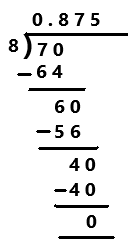
Math-in-Focus-Grade-7-Chapter-1-Lesson-1.2-Answer-Key-Writing-Rational-Numbers-as-Decimals-1(1)
Explanation:
A Decimal Number that contains a finite number of digits next to the decimal point is called a Terminating Decimal. Perform division operation on given rational number. By using long division divide 7 by 8 the quotient is 0.875 which is a terminating decimal.

Question 2.
\(\frac{19}{4}\)
Answer:
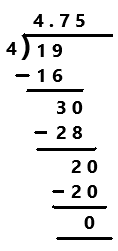
Math-in-Focus-Grade-7-Chapter-1-Lesson-1.2-Answer-Key-Writing-Rational-Numbers-as-Decimals-1(2)
Explanation:
Perform division operation on given rational number. By using long division divide 19 by 4 the quotient is 4.75 which is a terminating decimal.

Question 3.
\(\frac{52}{40}\)
Answer:
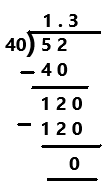
Math-in-Focus-Grade-7-Chapter-1-Lesson-1.2-Answer-Key-Writing-Rational-Numbers-as-Decimals-1(3)

Explanation:
Perform division operation on given rational number. By using long division divide 52 by 40 the quotient is 1.3 which is a terminating decimal.

Question 4.
10\(\frac{13}{25}\)
Answer:
10(13/25)
= (250 + 13)/25
= 263/25
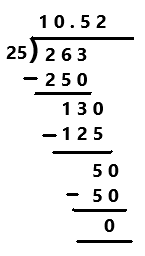
Math-in-Focus-Grade-7-Chapter-1-Lesson-1.2-Answer-Key-Writing-Rational-Numbers-as-Decimals-1(4)

Explanation:
Perform division operation on given rational number. The mixed fraction 10(13/25) in fraction form as 263/25. By using long division divide 263 by 25 the quotient is 10.52 which is a terminating decimal.

Using long division, write each rational number as a repeating decimal.

Question 5.
\(\frac{2}{9}\)
Answer:
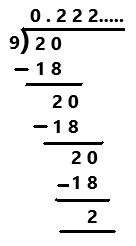
Math-in-Focus-Grade-7-Chapter-1-Lesson-1.2-Answer-Key-Writing-Rational-Numbers-as-Decimals-1(5)

A repeating decimal or recurring decimal is decimal representation of a number whose digits are periodic (repeating its values at regular intervals) and the infinitely repeated portion is not zero. Perform division operation on given rational number. By using long division divide 2 by 9 the quotient is 0.222… which is a repeating decimal.

Question 6.
\(\frac{11}{6}\)
Answer:
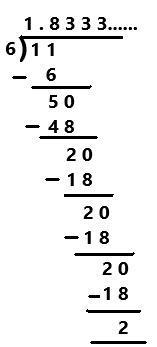
Math-in-Focus-Grade-7-Chapter-1-Lesson-1.2-Answer-Key-Writing-Rational-Numbers-as-Decimals-1(6)
Explanation:
A repeating decimal is decimal representation of a number whose digits are periodic and the infinitely repeated portion is not zero. Perform division operation on given rational number. By using long division divide 11 by 6 the quotient is 1.8333… which is a repeating decimal.

Using a calculator, write each rational number as a repeating decimal.

Question 7.
\(\frac{23}{24}\)
Answer:
23/24
= 0.958333…
Explanation:
Perform division operation on given rational number. By using calculator divide 23 by 24 the quotient is 0.958333… which is a repeating decimal.

Question 8.
\(\frac{78}{37}\)
Answer:
78/37
= 2.108108….
Explanation:
Perform division operation on given rational number. By using calculator divide 78 by 37 the quotient is 2.108108… which is a repeating decimal.

Using long division, write each rational number as a repeating decimal. Use bar notation to indicate the repeating digits.

Question 9.
\(\frac{5}{6}\)
Answer:
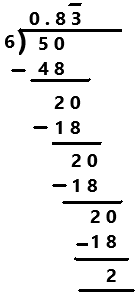
Math-in-Focus-Grade-7-Chapter-1-Lesson-1.2-Answer-Key-Writing-Rational-Numbers-as-Decimals-1(9)
Explanation:
Perform division operation on given rational number. By using long division divide 5 by 6 the quotient is 0.8333… which is a repeating decimal. The repeating digits are denoted by this ¯¯¯ symbol as we can observe in the above  image.

Question 10.
\(\frac{17}{12}\)
Answer:
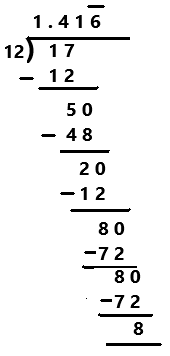
Math-in-Focus-Grade-7-Chapter-1-Lesson-1.2-Answer-Key-Writing-Rational-Numbers-as-Decimals-1(10)
Explanation:
Perform division operation on given rational number. By using long division divide 17 by 12 the quotient is 1.41666… which is a repeating decimal. The repeating digits are denoted by this ¯¯¯ symbol as we can observe in the above  image.

Technology Activity

Materials:

  • spreadsheet software

Classify rational numbers in decimal form

Work in pairs.

Step 1.
On a spreadsheet, label four columns with the following column heads.
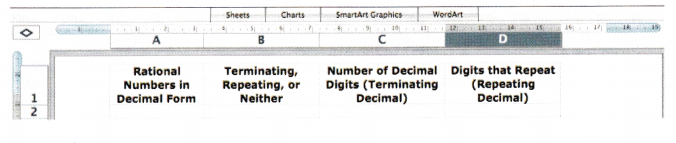
Math in Focus Grade 7 Chapter 1 Lesson 1.2 Answer Key Writing Rational Numbers as Decimals 1

Step 2.
Enter each rational number below in the first column, labeled “Rational Numbers in Decimal Form”. Make sure that the cells in this column are formatted to display decimals up to 8 decimal places.
\(\frac{5}{16}\), \(\frac{141}{25}\), –\(\frac{40}{111}\), –\(\frac{15}{16}\), \(\frac{14}{5}\), \(\frac{1}{8}\), –\(\frac{9}{44}\), \(\frac{2}{11}\), \(\frac{5}{4}\) and –\(\frac{40}{9}\).
For example, if you enter into the spreadsheet, the entry will show the decimal form of this fraction.

Step 3.
Determine whether the decimal ¡s terminating, repeating, or neither. Enter either “Terminating”, “Repeating”, or “Neither” in the second column.

Step 4.
If the decimal terminates, record the number of decimal digits in the third column. If the decimal repeats, record the repeating digits in the fourth column.
Example:
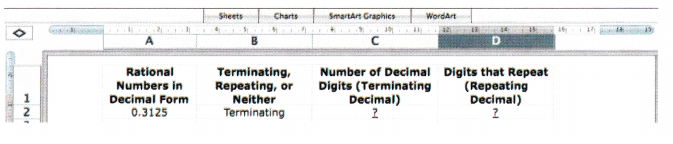
Math in Focus Grade 7 Chapter 1 Lesson 1.2 Answer Key Writing Rational Numbers as Decimals 2

Math Journal
Did you find any decimals that neither terminated nor repeated? What can you conclude about the decimal form of a rational number?

Compare the positive rational numbers using the symbols < or >. Use a number line to help you.

Question 11.
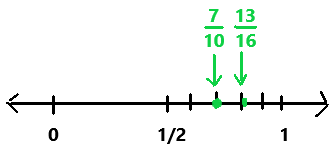
\(\frac{7}{10}\) ? \(\frac{13}{16}\)
Answer:
7/10 < 13/16
Math-in-Focus-Grade-7-Chapter-1-Lesson-1.2-Answer-Key-Writing-Rational-Numbers-as-Decimals-1(11)
Explanation:
In the above number line we can observe the given positive rational numbers. The positive rational number 7/10 is less than 13/16.

Question 12.
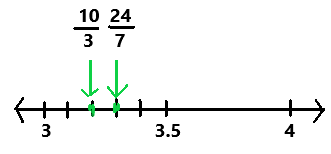
\(\frac{24}{7}\) ? \(\frac{10}{3}\)
Answer:
24/7 > 10/3
Math-in-Focus-Grade-7-Chapter-1-Lesson-1.2-Answer-Key-Writing-Rational-Numbers-as-Decimals-1(12)

Explanation:
In the above number line we can observe the given positive rational numbers 24/7 and 10/3. The positive rational number 24/7 is greater than 10/3.

Compare the negative rational numbers using the symbols < or >. Use a number line to help you.

Question 13.
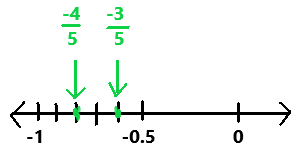
–\(\frac{3}{5}\) ? –\(\frac{4}{5}\)
Answer:
-3/5  > -4/5
Math-in-Focus-Grade-7-Chapter-1-Lesson-1.2-Answer-Key-Writing-Rational-Numbers-as-Decimals-1(13)
Explanation:
In the above number line we can observe the given negative rational numbers -3/5 and -4/5. The negative rational number -3/5 is greater than -4/5.

Question 14.
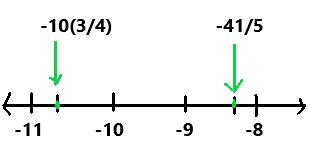
-10\(\frac{3}{4}\) ? –\(\frac{41}{5}\)
Answer:
-10(3/4)
= -(40 + 3)/4
= -43/4
-10(3/4) < – 41/5
Math-in-Focus-Grade-7-Chapter-1-Lesson-1.2-Answer-Key-Writing-Rational-Numbers-as-Decimals-1(14)
Explanation:
In the above number line we can observe the given negative rational numbers -10(3/4) and -41/5. The negative rational number -10(3/4) is less than -41/5.

Question 15.
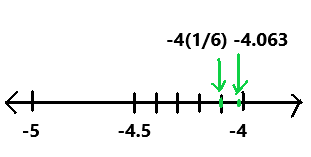
-4.063 ? -4\(\frac{1}{6}\)
Answer:
-4(1/6)
= – (24 + 1)/6
= -25/6
-4.063 > -4(1/6)
Math-in-Focus-Grade-7-Chapter-1-Lesson-1.2-Answer-Key-Writing-Rational-Numbers-as-Decimals-1(15)

In the above number line we can observe the given negative rational numbers -4.063 and -4(1/6). The negative rational number -4.063 is greater than -4(1/6).

Math in Focus Course 2A Practice 1.2 Answer Key

Using long division, write each rational number as a terminating decimal.

Question 1.
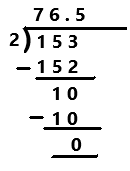
76\(\frac{1}{2}\)
Answer:
76(1/2)
= 153/2
Math-in-Focus-Grade-7-Chapter-1-Lesson-1.2-Answer-Key-Writing-Rational-Numbers-as-Decimals-1(16)

Explanation:
A Decimal Number that contains a finite number of digits next to the decimal point is called a Terminating Decimal. Perform division operation on given rational number. The mixed fraction 76(1/2) in fraction form is 153/2. By using long division divide 153 by 2 the quotient is 76.5 which is a terminating decimal.

Question 2.
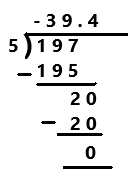
-39\(\frac{2}{5}\)
Answer:
-39(2/5)
= -(195 + 2)/5
= -197/5
Math-in-Focus-Grade-7-Chapter-1-Lesson-1.2-Answer-Key-Writing-Rational-Numbers-as-Decimals-1(17)
Explanation:
Perform division operation on given rational number. The mixed fraction -39(2/5) in fraction form is -197/5. By using long division divide -197 by 5 the quotient is -39.4 which is a terminating decimal.

Question 3.
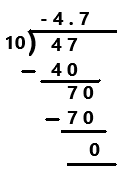
–\(\frac{47}{10}\)
Answer:
-47/10
Math-in-Focus-Grade-7-Chapter-1-Lesson-1.2-Answer-Key-Writing-Rational-Numbers-as-Decimals-1(18)
Explanation:
Perform division operation on given rational number. By using long division divide -47 by 10 the quotient is -4.7 which is a terminating decimal.

Question 4.
\(\frac{5}{16}\)
Answer:
5/16
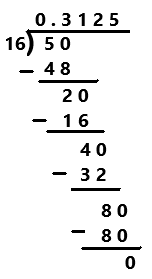
Math-in-Focus-Grade-7-Chapter-1-Lesson-1.2-Answer-Key-Writing-Rational-Numbers-as-Decimals-1(19)
Explanation:
Perform division operation on given rational number. By using long division divide 5 by 16 the quotient is 0.3125 which is a terminating decimal.

Question 5.
\(\frac{7}{20}\)
Answer:
7/20
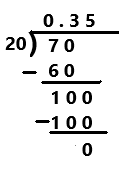
Math-in-Focus-Grade-7-Chapter-1-Lesson-1.2-Answer-Key-Writing-Rational-Numbers-as-Decimals-1(20)

Explanation:
Perform division operation on given rational number. By using long division divide 7 by 20 the quotient is 0.35 which is a terminating decimal.

Question 6.
\(\frac{7}{8}\)
Answer:
7/8
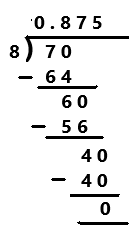
Math-in-Focus-Grade-7-Chapter-1-Lesson-1.2-Answer-Key-Writing-Rational-Numbers-as-Decimals-1(21)

Explanation:
Perform division operation on given rational number. By using long division divide 7 by 8 the quotient is 0.875 which is a terminating decimal.

Simplify each rational number. Then use long division to write each rational number as a terminating decimal.

Question 7.
\(\frac{99}{36}\)
Answer:
99/36
= 11/4
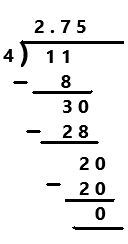
Math-in-Focus-Grade-7-Chapter-1-Lesson-1.2-Answer-Key-Writing-Rational-Numbers-as-Decimals-1(22)
Explanation:
The given ration number is 99/36. The simplified form of a given rational number is 11/4. Perform division operation on simplified rational number. By using long division divide 11 by 4 the quotient is 2.75 which is a terminating decimal.

Question 8.
\(\frac{12}{15}\)
Answer:
12/15
= 4/5
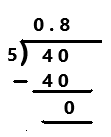
Math-in-Focus-Grade-7-Chapter-1-Lesson-1.2-Answer-Key-Writing-Rational-Numbers-as-Decimals-1(23)
Explanation:
The given ration number is 12/15. The simplified form of a given rational number is 4/5. Perform division operation on simplified rational number. By using long division divide 4 by 5 the quotient is 0.8 which is a terminating decimal.

Question 9.
\(\frac{9}{48}\)
Answer:
9/48
= 3/16
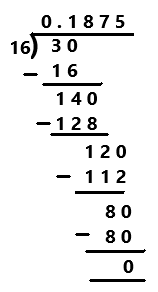
Math-in-Focus-Grade-7-Chapter-1-Lesson-1.2-Answer-Key-Writing-Rational-Numbers-as-Decimals-1(24)
Explanation:
The given ration number is 9/48. The simplified form of a given rational number is 3/16. Perform division operation on simplified rational number. By using long division divide 3 by 16 the quotient is 0.1875 which is a terminating decimal.

Question 10.
–\(\frac{132}{8}\)
Answer:
-132/8
= -33/2
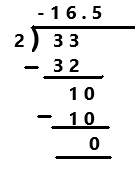
Math-in-Focus-Grade-7-Chapter-1-Lesson-1.2-Answer-Key-Writing-Rational-Numbers-as-Decimals-1(25)
Explanation:
The given ration number is -132/8. The simplified form of a given rational number is -33/2. Perform division operation on simplified rational number. By using long division divide -33 by 2 the quotient is -16.5 which is a terminating decimal.

Question 11.
–\(\frac{48}{50}\)
Answer:
-48/50
= -24/25
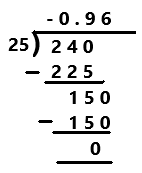
Math-in-Focus-Grade-7-Chapter-1-Lesson-1.2-Answer-Key-Writing-Rational-Numbers-as-Decimals-1(26)
Explanation:
The given ration number is -48/50. The simplified form of a given rational number is -24/25. Perform division operation on simplified rational number. By using long division divide -24 by 25 the quotient is -0.96 which is a terminating decimal.

Question 12.
–\(\frac{14}{128}\)
Answer:
-14/128
= -7/64
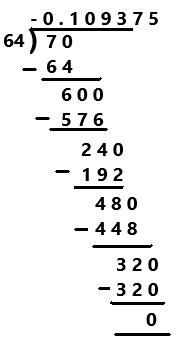
Math-in-Focus-Grade-7-Chapter-1-Lesson-1.2-Answer-Key-Writing-Rational-Numbers-as-Decimals-1(27)
Explanation:
The given ration number is -14/128. The simplified form of a given rational number is -7/64. Perform division operation on simplified rational number. By using long division divide -7 by 64 the quotient is -0.109375 which is a terminating decimal.

Using long division, write each rational number as a repeating decimal with 3 decimal places. Identify the pattern of repeating digits using bar notation.

Question 13.
\(\frac{5}{6}\)
Answer:
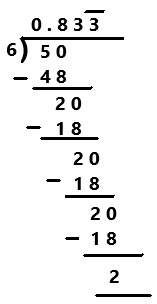
Math-in-Focus-Grade-7-Chapter-1-Lesson-1.2-Answer-Key-Writing-Rational-Numbers-as-Decimals-1(34)
Explanation:
Perform division operation on given rational number. By using long division divide 5 by 6 the quotient is 0.83333… which is a repeating decimal. The repeating decimal with 3 decimal places is denoted as 0.833 bar for the number 3 on last. The repeating digits are denoted by this ¯¯¯ symbol as we can observe in the above  image.

Question 14.
-8\(\frac{2}{3}\)
Answer:
-8(2/3)
= -(24+2)/3
= -26/3
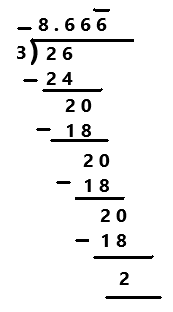
Math-in-Focus-Grade-7-Chapter-1-Lesson-1.2-Answer-Key-Writing-Rational-Numbers-as-Decimals-1(35)

Explanation:
The mixed fraction -8(2/3) in fraction form is -26/3. Perform division operation on fraction. By using long division divide -26 by 3 the quotient is -8.66666… which is a repeating decimal. The repeating decimal with 3 decimal places is denoted as -8.666 bar for the number 6 on last. The repeating digits are denoted by this ¯¯¯ symbol as we can observe in the above  image.

Write each rational number as a repeating decimal using bar notation. You may use a calculator.

Question 15.
\(\frac{8}{55}\)
Answer:
8/55
= 0.1454545…
= Math-in-Focus-Grade-7-Chapter-1-Lesson-1.2-Answer-Key-Writing-Rational-Numbers-as-Decimals-1(28)
Explanation:
Perform division operation on given rational number. By using calculator divide 8 by 55 the quotient is 0.1454545… which is a repeating decimal. The repeating decimal 45 is represented by bar notation as we can observe in the answer.

Question 16.
\(\frac{456}{123}\)
Answer:
456/123
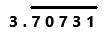
= 3.7073170731….
= Math-in-Focus-Grade-7-Chapter-1-Lesson-1.2-Answer-Key-Writing-Rational-Numbers-as-Decimals-1(29)
Explanation:
Perform division operation on given rational number. By using calculator divide 456 by 123 the quotient is 3.7073170731… which is a repeating decimal. The repeating decimal 70731 is represented by bar notation as we can observe in the answer.

Question 17.
–\(\frac{987}{110}\)
Answer:
-987/110
= -8.9727272….
= Math-in-Focus-Grade-7-Chapter-1-Lesson-1.2-Answer-Key-Writing-Rational-Numbers-as-Decimals-1(30)
Explanation:
Perform division operation on given rational number. By using calculator divide -987 by 110 the quotient is -8.9727272… which is a repeating decimal. The repeating decimal 72 is represented by bar notation as we can observe in the answer.

Question 18.
\(\frac{11}{14}\)
Answer:
11/14
= 0. 7857142857142….
= Math-in-Focus-Grade-7-Chapter-1-Lesson-1.2-Answer-Key-Writing-Rational-Numbers-as-Decimals-1(31)
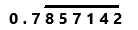
Explanation:
Perform division operation on given rational number. By using calculator divide 11 by 14 the quotient is 0.7857142857142… which is a repeating decimal. The repeating decimal 857142 is represented by bar notation as we can observe in the answer.

Question 19.
–\(\frac{10}{13}\)
Answer:
-10/ 13
= – 0. 769230769230….
= Math-in-Focus-Grade-7-Chapter-1-Lesson-1.2-Answer-Key-Writing-Rational-Numbers-as-Decimals-1(32)
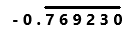
Explanation:
Perform division operation on given rational number. By using calculator divide -10 by 13 the quotient is -0.769230769230… which is a repeating decimal. The repeating decimal 769230 is represented by bar notation as we can observe in the answer.

Question 20.
\(\frac{4,005}{101}\)
Answer:
4,005/101
= 39.65346534….
= Math-in-Focus-Grade-7-Chapter-1-Lesson-1.2-Answer-Key-Writing-Rational-Numbers-as-Decimals-1(33)
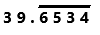
Explanation:
Perform division operation on given rational number. By using calculator divide 4,005 by 101 the quotient is 39.65346534… which is a repeating decimal. The repeating decimal 6534 is represented by bar notation as we can observe in the answer.

Refer to the list of rational numbers below for questions 21 to 23, You may use a calculator.

–\(\frac{23}{32}\), \(\frac{7}{15}\), –\(\frac{368}{501}\), –\(\frac{19}{26}\), \(\frac{37}{44}\)

Question 21.
Write each rational number as a decimal with at most 6 decimal places.
Answer:
Given rational numbers are -23/32, 7/15, -368/501, -19/26, 37/44.
The given rational numbers in a decimal form with at most 6 decimal places.
-0.71875, 0.466667, -0.734531, -0.730769, 0.840909

Question 22.
Using your answers in 21 list the numbers from least to greatest using the symbol <. Graph a number line between —1 and 1 with 0 in the middle. Then, place each rational number on the number line.
Answer:
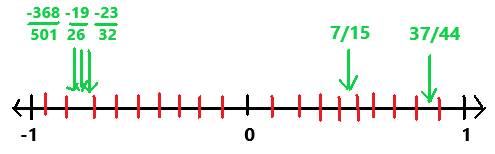
Math-in-Focus-Grade-7-Chapter-1-Lesson-1.2-Answer-Key-Writing-Rational-Numbers-as-Decimals-1(36)
Explanation:
From the answer 21 the numbers from least to greatest are -368/501, -19/26, -23/32, 7/15, 37/44. In the above image we can observe the above given rational numbers on the number line.

Question 23.
Math Journal Margo tries to compare –\(\frac{2}{3}\) and –\(\frac{5}{8}\) using absolute values. She finds their decimal equivalents to be –\(0 . \overline{6}\) and —0.625, and she knows |-\(0 . \overline{6}\)| |-0.625|. Explain why she must reverse the inequality in her final answer, –\(\frac{2}{3}\) < –\(\frac{5}{8}\)
Answer:
The greater the absolute value of a number the farther that number is from 0.
So, -2/3 is farther to the left of 0 than -5/8.
A number that is to the left of another number on the number line is less than that number. So, -2/3 < -5/8.

Math in Focus Grade 7 Chapter 1 Lesson 1.1 Answer Key Representing Rational Numbers on the Number Line

Go through the Math in Focus Grade 7 Workbook Answer Key Chapter 1 Lesson 1.1 Representing Rational Numbers on the Number Line to finish your assignments.

Math in Focus Grade 7 Course 2 A Chapter 1 Lesson 1.1 Answer Key Representing Rational Numbers on the Number Line

Math in Focus Grade 7 Chapter 1 Lesson 1.1 Guided Practice Answer Key

Solve.

Question 1.
Find the absolute values of 3\(\frac{2}{7}\) and –\(\frac{18}{5}\)
Answer:
3(2/7) = (21+2)/7 = 23/7
The simplified form of 3(2/7) is 23/7
The absolute value of |3(2/7)| is 3(2/7)
The absolute value of |-(18/5)| is 18/5

Question 2.
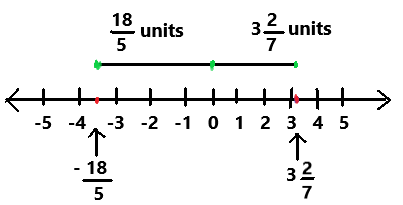
Graph the two numbers on a number line and indicate their distances from 0. Which number is farther from 0?
Answer:
Math-in-Focus-Grade-7-Chapter-1-Lesson-1.1-Answer-Key-Representing-Rational-Numbers-on-the-Number-Line-1(1)
The number -18/5 is farther from 0.
Explanation:
In the above image we can observe a number line. On the number line the two numbers 3(2/7) and -18/5 are indicated. The two numbers distance from 0 are graphed. The number -18/5 is farther from 0.

Write each number in \(\frac{m}{n}\) form where m and n are integers.

Question 3.
11\(\frac{1}{6}\)
Answer:
11(1/6)
= (66 + 1)/6
= 67/6
The number 11(1/6) in m/n form is 67/6.
Here m = 67 and n= 6

Question 4.
48
Answer:
48 = 48/1
The number 48 in m/n form is 48/1.
Here m = 48 and n = 1

Question 5.
-5\(\frac{4}{12}\)
Answer:
-5(4/12)
= – (60 + 4)/12
= -64/12
= -16/3
The number -5(4/12) in m/n form is -16/3.
Here m = -16 and n = 3

Question 6.
–\(\frac{25}{10}\)
Answer:
-25/10 = -5/2
The given number -25/10 is already in m/n form.

Write each decimal as \(\frac{m}{n}\) where m and n are integers with n ≠ 0.

Question 7.
11.5
Answer:
11.5 = 23/2
The given decimal number 11.5 is represented in m/n form. The m/n form of 11.5 is 23/2.

Question 8.
-7.8
Answer:
-7.8 = -78/10
The given decimal number -7.8 is represented in m/n form. The m/n form of -7.8 is -78/10.

Question 9.
0.36
Answer:
0.36 = 36/100
The given decimal number 0.36 is represented in m/n form. The m/n form of 0.36 is 36/100.

Question 10.
-0.125
Answer:
-0.125 = – 125/1000
The given decimal number -0.125 is represented in m/n form. The m/n form of -0.125 is 125/1000.

Copy and complete.

Question 11.
Locate the rational numbers -1.5 and \(\frac{15}{4}\) on the number line.
STEP 1
Find the integers that the rational number lies between.
\(\frac{15}{4}\) can be written as a mixed number, 3\(\frac{3}{4}\), and 3\(\frac{3}{4}\) lies between 3 and 4. The negative decimal -1.5 lies between —2 and —1.
STEP 2
Graph a number line and label the integers.
Math in Focus Grade 7 Chapter 1 Lesson 1.1 Answer Key Representing Rational Numbers on the Number Line 1
Answer:
Math-in-Focus-Grade-7-Chapter-1-Lesson-1.1-Answer-Key-Representing-Rational-Numbers-on-the-Number-Line-1
The integers are labeled on a number line.
STEP 3
Divide the distance between the integers into equal segments.
You divide the distance between —2 and —1 into Math in Focus Grade 7 Chapter 1 Lesson 1.1 Answer Key Representing Rational Numbers on the Number Line 2 segments and the distance between 3 and 4 into Math in Focus Grade 7 Chapter 1 Lesson 1.1 Answer Key Representing Rational Numbers on the Number Line 2 segments.

Math in Focus Grade 7 Chapter 1 Lesson 1.1 Answer Key Representing Rational Numbers on the Number Line 3
Answer:
Math-in-Focus-Grade-7-Chapter-1-Lesson-1.1-Answer-Key-Representing-Rational-Numbers-on-the-Number-Line-3
Divide the distance between —2 and —1 into segments and the distance between 3 and 4 into 3 segments.

STEP4
Use the segments to locate -1.5 and 3\(\frac{3}{4}\).
Math in Focus Grade 7 Chapter 1 Lesson 1.1 Answer Key Representing Rational Numbers on the Number Line 4
Answer:
Math-in-Focus-Grade-7-Chapter-1-Lesson-1.1-Answer-Key-Representing-Rational-Numbers-on-the-Number-Line-4
Located the rational numbers -1.5 and 15/4 on the number line.

Locate the following rational numbers on the number line.

Question 12.
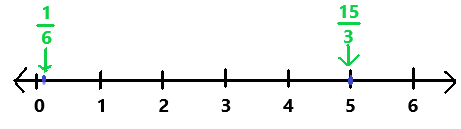
\(\frac{1}{6}\) and \(\frac{15}{3}\)
Answer:
1/6 and 15/3
Math-in-Focus-Grade-7-Chapter-1-Lesson-1.1-Answer-Key-Representing-Rational-Numbers-on-the-Number-Line-4(1)
Explanation:
First we have to find the integers that where the rational number lies between on the number line.
The fraction 1/6 lies between 0 and 1. The simplified form of 15/3 is 5. The fraction 15/3 lies on number 5.
Next we have to label the integers and locate the rational numbers on a number line.
In the above image we can observe the rational numbers 1/6 and 15/3 are located on the number line.

Question 13.
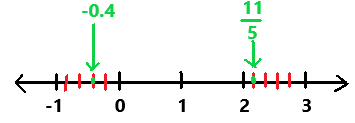
-0.4 and \(\frac{11}{5}\)
Answer:
-0.4 and 11/5
Math-in-Focus-Grade-7-Chapter-1-Lesson-1.1-Answer-Key-Representing-Rational-Numbers-on-the-Number-Line-4(2)
Explanation:
First we have to find the integers that where the rational number lies between on the number line.
The negative decimal -0.4 lies between —1 and 0.The fraction 11/5 lies between 2 and 3.
Next we have to label the integers and locate the rational numbers on a number line.
Divide the distance between —1 and 0 into 4 segments and the distance between 2 and 3 into 4 segments.
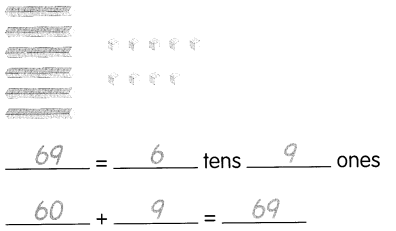
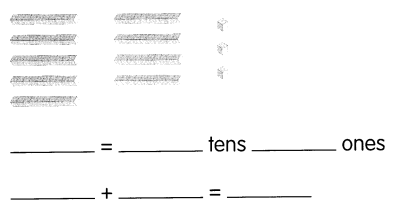
In the above image we can observe the rational numbers -0.4 and 11/5 are located on the number line.

Question 14.
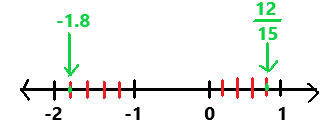
\(\frac{12}{15}\) and -1.8
Answer:
12/15 and -1.8
Math-in-Focus-Grade-7-Chapter-1-Lesson-1.1-Answer-Key-Representing-Rational-Numbers-on-the-Number-Line-4(3)
Explanation:
First we have to find the integers that where the rational number lies between on the number line.
The negative decimal -1.8 lies between —2 and -1.The fraction 12/15 lies between 0 and 1.
Next we have to label the integers and locate the rational numbers on a number line.
Divide the distance between —2 and -1 into 4 segments and the distance between 0 and 1 into 4 segments.
In the above image we can observe the rational numbers -1.8 and 12/15 are located on the number line.

Question 15.
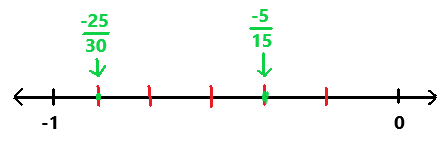
\(-\frac{5}{15}\) and \(-\frac{25}{30}\)
Answer:
-5/15 and 25/30
Math-in-Focus-Grade-7-Chapter-1-Lesson-1.1-Answer-Key-Representing-Rational-Numbers-on-the-Number-Line-4(4)
Explanation:
First we have to find the integers that where the rational number lies between on the number line.
The negative fractions -25/30 and -5/15 lies between —1 and 0.
Next we have to label the integers and locate the rational numbers on a number line.
In the above image we can observe the rational numbers -25/30 and -5/15 are located on the number line.

Math in Focus Course 2A Practice 1.1 Answer Key

Find the absolute value of each fraction. Use a number line to show how far the fraction is from 0. Write fractions in simplest form.

Question 1.
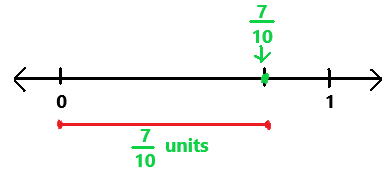
\(\frac{7}{10}\)
Answer:
7/10
Math-in-Focus-Grade-7-Chapter-1-Lesson-1.1-Answer-Key-Representing-Rational-Numbers-on-the-Number-Line-4(5)
The absolute value of above fraction is 7/10.
Explanation:
First we have to find where the fraction lies between on the number line.
The fraction 7/10 lies between 0 and 1.
Next we have to label the fraction on a number line.
In the above image we can observe the fraction is 7/10 units far from the 0 on the number line.

Question 2.
\(\frac{18}{8}\)
Answer:
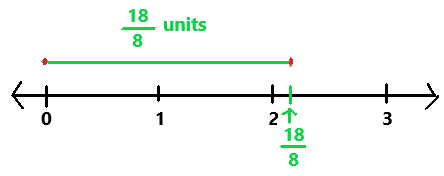
The absolute value of 18/8 is 18/8.
18/8 = 9/4
The simplest form of 18/8 is 9/4.
Math-in-Focus-Grade-7-Chapter-1-Lesson-1.1-Answer-Key-Representing-Rational-Numbers-on-the-Number-Line-4(6)
Explanation:
First we have to find where the fraction lies between on the number line.
The fraction 18/8 lies between 2 and 3.
Next we have to label the fraction on a number line.
In the above image we can observe the fraction is 18/8 units far from the 0 on the number line.

Question 3.
–\(\frac{5}{13}\)
Answer:
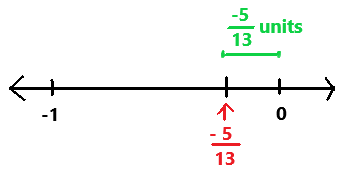
The absolute value of -5/13 is 5/13.
Math-in-Focus-Grade-7-Chapter-1-Lesson-1.1-Answer-Key-Representing-Rational-Numbers-on-the-Number-Line-4(7)
Explanation:
First we have to find where the fraction lies between on the number line.
The fraction -5/13 lies between -1 and 0.
Next we have to label the fraction on a number line.
In the above image we can observe the fraction is -5/13 units far from the 0 on the number line.

Question 4.
–\(\frac{48}{15}\)
Answer:
-48/15
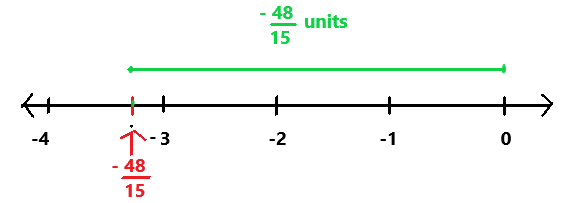
The absolute value of -48/15 is 48/15.
Math-in-Focus-Grade-7-Chapter-1-Lesson-1.1-Answer-Key-Representing-Rational-Numbers-on-the-Number-Line-4(8)

Explanation:
First we have to find where the fraction lies between on the number line.
The fraction -48/15 lies between -3 and 0.
Next we have to label the fraction on a number line.
In the above image we can observe the fraction is -48/15 units far from the 0 on the number line.

Write each integer or fraction as \(\frac{m}{n}\) in simplest form where m and n are integers.

Question 5.
67
Answer:
67
= 67/1
The number 67 in m/n form is 67/1.
Here m = 67 and n= 1

Question 6.
-345
Answer:
-345
= -345/1
The number -345 in m/n form is -345/1.
Here m = -345 and n= 1

Question 7.
\(\frac{25}{80}\)
Answer:
25/80
= 5/16
The simplest form of 25/80 is 5/16.
The fraction 25/80 in m/n form is 5/16.
Here m = 5 and n= 16

Question 8.
–\(\frac{264}{90}\)
Answer:
-264/90
= -44/15
The simplest form of -264/90 is -44/15.
The fraction -264/90 in m/n form is -44/15.
Here m = -44 and n= 15

Question 9.
–\(\frac{14}{70}\)
Answer:
-14/70
= -1/5
The simplest form of -14/70 is -1/5.
The fraction -14/70 in m/n form is -1/5.
Here m = -1 and n= 5

Question 10.
\(\frac{600}{480}\)
Answer:
600/480
= 50/40
= 5/4
The simplest form of 600/480 is 5/4.
The fraction 600/480 in m/n form is 5/4.
Here m =5 and n = 4

Write each mixed number or decimal \(\frac{m}{n}\) as in simplest form where m and n are integers.

Question 11.
7\(\frac{7}{9}\)
Answer:
7(7/9)
= (63 + 7)/9
= 70/9
The simplest form of the mixed number 7(7/9) is 70/9.
Here m = 70 and n = 9 both are integers.

Question 12.
-5\(\frac{1}{10}\)
Answer:
-5(1/10)
= -(50 + 1)/10
= -51/10
The simplest form of the mixed number -5(1/10) is -51/10.
Here m = -51 and n = 10 both are integers.

Question 13.
2\(\frac{5}{12}\)
Answer:
2(5/12)
= (24 + 5)/12
= 29/12
The simplest form of the mixed number 2(5/12) is 29/12.
Here m = 29 and n = 12 both are integers.

Question 14.
-10\(\frac{11}{36}\)
Answer:
-10(11/36)
=-(360 + 11)/36
= -371/36
The simplest form of the mixed number-10(11/36) is -371/36.
Here m =-371 and n = 36 both are integers.

Question 15.
0.4
Answer:
0.4
= 4/10
= 2/5
The simplest form of the decimal number 0.4 is 2/5.
Here m = 2 and n = 5 both are integers.

Question 16.
-0.625
Answer:
-0.625
= -625/1000
= -5/8
The simplest form of the decimal number -0.625 is -5/8.
Here m = -5 and n = 8 both are integers.

Question 17.
5.80
Answer:
5.80
= 29/5
The simplest form of the decimal number 5.80 is 29/5.
Here m = 29 and n = 5 both are integers.

Question 18.
9.001
Answer:
9.001
= 9001/1000
The simplest form of the decimal number 9.001 is 9001/1000.
Here m = 9001 and n =1000 both are integers.

Question 19.
-10.68
Answer:
-10.68
= -267/25
The simplest form of the decimal number -10.68 is -267/25.
Here m = -267 and n = 25 both are integers.

Copy and complete.

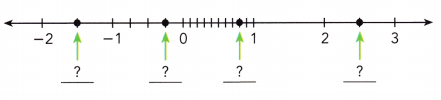
Question 20.
Locate the following rational numbers correctly on the number line.
–\(\frac{1}{4}\), -1.5, 0.8, \(\frac{5}{2}\)
Math in Focus Grade 7 Chapter 1 Lesson 1.1 Answer Key Representing Rational Numbers on the Number Line 5
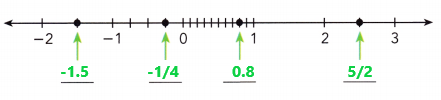
Answer:
Math-in-Focus-Grade-7-Chapter-1-Lesson-1.1-Answer-Key-Representing-Rational-Numbers-on-the-Number-Line-5
Explanation:
First we have to find where the given rational numbers lies between on the number line.
The negative decimal -1.5 lies between -2 and -1.
The negative fraction -1/4 lies between -1 and 0.
The decimal 0.8 lies between 0 and 1.
The fraction 5/2 lies between 2 and 3.
The above given rational numbers are located correctly on the number line.

Question 21.
Locate the following rational numbers correctly on the number line.
1\(\frac{7}{10}\), –\(\frac{13}{5}\), 2.25, -0.7
Math in Focus Grade 7 Chapter 1 Lesson 1.1 Answer Key Representing Rational Numbers on the Number Line 6
Answer:
Math-in-Focus-Grade-7-Chapter-1-Lesson-1.1-Answer-Key-Representing-Rational-Numbers-on-the-Number-Line-6
Explanation:
First we have to find where the given rational numbers lies between on the number line.
The negative fraction -13/5 lies between -3 and -2
The negative decimal -0.7 lies between -1 and 0.
The mixed fraction 1(7/10) in fraction as 17/10 lies between 1 and 2.
The decimal 2.25 lies between 2 and 3.
The above given rational numbers are located correctly on the number line.

Graph each rational number on a separate number line.

Question 22.
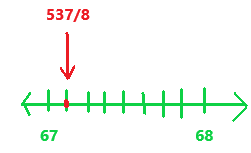
67\(\frac{1}{8}\)
Answer:
67(1/8)
= (536 + 1)/8
= 537/8
Math-in-Focus-Grade-7-Chapter-1-Lesson-1.1-Answer-Key-Representing-Rational-Numbers-on-the-Number-Line-6(1)
Explanation:
First we have to find where the given rational number lies between on the number line.
The mixed fraction 67(1/8) in fraction as 537/8 lies between 67 and 68.
The above given rational number is drawn correctly on the number line.

Question 23.
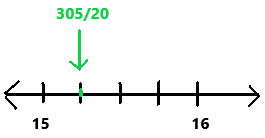
\(\frac{305}{20}\)
Answer:
305/20
Math-in-Focus-Grade-7-Chapter-1-Lesson-1.1-Answer-Key-Representing-Rational-Numbers-on-the-Number-Line-6(2)
Explanation:
First we have to find where the given rational number lies between on the number line.
The fraction 305/20 lies between 15 and 16.
The above given rational number is drawn correctly on the number line.

Question 24.
\(\frac{98}{28}\)
Answer:
98/28
Math-in-Focus-Grade-7-Chapter-1-Lesson-1.1-Answer-Key-Representing-Rational-Numbers-on-the-Number-Line-6(3)
Explanation:
First we have to find where the given rational number lies between on the number line.
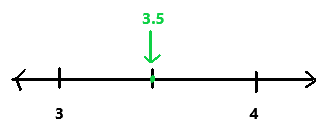
The fraction 98/28 lies between 3 and 4.
The above given rational number is drawn correctly on the number line.

Question 25.
–\(\frac{21}{12}\)
Answer:
-21/12
Math-in-Focus-Grade-7-Chapter-1-Lesson-1.1-Answer-Key-Representing-Rational-Numbers-on-the-Number-Line-6(4)
Explanation:
First we have to find where the given rational number lies between on the number line.
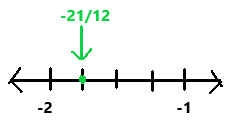
The fraction -21/12 lies between -2 and -1.
The above given rational number is correctly drawn on the number line.

Question 26.
-25.8
Answer:
Math-in-Focus-Grade-7-Chapter-1-Lesson-1.1-Answer-Key-Representing-Rational-Numbers-on-the-Number-Line-6(5)
Explanation:
First we have to find where the given rational number lies between on the number line.
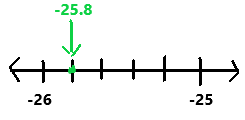
The decimal lies between -26 and -25.
The above given rational number is  drawn correctly on the number line.

Question 27.
-45.3
Answer:
Math-in-Focus-Grade-7-Chapter-1-Lesson-1.1-Answer-Key-Representing-Rational-Numbers-on-the-Number-Line-6(6)
Explanation:
First we have to find where the given rational number lies between on the number line.
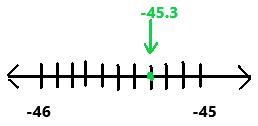
The decimal lies between -46 and -45.
The above given rational number is correctly drawn on the number line.

A video game gives you 10 minutes to find a treasure. The results of your first 8 games show the amount of time left unused when you have found the treasure. A negative time means you have gone beyond the 10 minutes allotted. Use these data for questions 28 to 35.

\(\frac{23}{8}\), 0, -7\(\frac{1}{5}\), 6, –\(\frac{17}{4}\), 8, 7.8, -9.1
Math in Focus Grade 7 Chapter 1 Lesson 1.1 Answer Key Representing Rational Numbers on the Number Line 7

Question 28.
Order the times left from most to least time using the symbol >.
Answer:
The time left from most to least are 8, 7.8, 6, 23/8, 0, -17/4, -7(1/5), -9.1.

Question 29.
Write the absolute value of each number.
Answer:
23/8, 0, -7(1/5), 6 , -17/4, 8, 7.8, -9.1
The absolute value of 23/8 is 23/8.
The absolute value of 0 is 0.
The absolute value of -7(1/5) is 7(1/5) or 36/5.
The absolute value of 6 is 6.
The absolute value of -17/4 is 17/4.
The absolute value of 8 is 8.
The absolute value of 7.8 is 7.8.
The absolute value of -9.1 is 9.1.

Question 30.
Which number has the greatest absolute value?
Answer:
The decimal number – 9.1 has the greatest absolute value.

Question 31.
Order the absolute values from least to greatest. Use the symbol <.
Answer:
The absolute values from least to greatest are 0 < 23/8 < 17/4 < 6 < 7(1/5) < 7.8 < 8 < 9.1.

Question 32.
Graph the original numbers on a number line.
Answer:
23/8, 0, -7(1/5), 6 , -17/4, 8, 7.8, -9.1
Math-in-Focus-Grade-7-Chapter-1-Lesson-1.1-Answer-Key-Representing-Rational-Numbers-on-the-Number-Line-7(1)
The original numbers on a number line is drawn on the graph.

Question 33.
Which negative number in the list is farthest from 0?
Answer:
The negative number –9.1 in the given list is farthest from 0.

Question 34.
Which positive number in the list is closest to 10?
Answer:
The positive number 8 in the given list is closest to 10.

Question 35.
Which time is closest to —5 minutes?
Answer:
The time -17/4 is closest to – 5 minutes.

Math in Focus Grade 7 Chapter 1 Answer Key The Real Number System

Go through the Math in Focus Grade 7 Workbook Answer Key Chapter 1 The Real Number System to finish your assignments.

Math in Focus Grade 7 Course 2 A Chapter 1 Answer Key The Real Number System

Math in Focus Grade 7 Chapter 1 Quick Check Answer Key

Order the numbers from least to greatest. Use the < symbol. Graph each number on a horizontal number line.

Question 1.
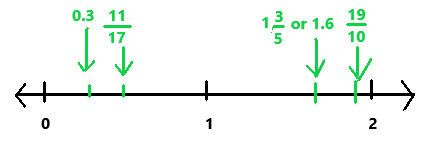
\(\frac{11}{17}\), 1\(\frac{3}{5}\), 0.3, 1.6, \(\frac{19}{10}\)
Answer:
\(\frac{11}{17}\), 1\(\frac{3}{5}\), 0.3, 1.6, \(\frac{19}{10}\)
The given numbers from least to greatest are 0.3 < \(\frac{11}{17}\) < 1\(\frac{3}{5}\)  or 1.6 < 19/10.
Math in Focus Grade 7 Chapter 1 Quick Check Answer Key-1
In the above image we can observe the given numbers on a horizontal number line.

Compare. Copy and complete each ? with <, > or =

Question 2.
3.87 ? 3.68
Answer:
3.87 > 3.68
Explanation:
Compare the above given two decimal numbers. The two decimal numbers are 3.87 and 3.68. The decimal number 3.87 is greater than 3.68.

Question 3.
0.982 ? 0.982
Answer:
0.982 = 0.982
Explanation:
Compare the above given two decimal numbers. The two decimal numbers are 0.982 and 0.982. The decimal number 0.982 is equal to 0.982.

Question 4.
5.23 ? 5.235
Answer:
5.23 < 5.235
Explanation:
Compare the above given two decimal numbers. The two decimal numbers are 5.23 and 5.235. The decimal number 5.23 is less than 5.235.

Round each number.

Question 5.
1,456 to the nearest hundred.
Answer:
Explanation:
1,456 is rounded to the nearest hundred as 1,500.
Explanation:
The number 1,456 is between 1,400 and 1,500. 1,450 is the midpoint between 1,400 and 1,500. The number 1,456 is greater than the midpoint. So, 1,456 is rounded to the nearest hundred as 1,500

Question 6.
849.58 to the nearest whole number.
Answer:
849.58 is rounded to the nearest whole number as 850.
Explanation:
Here, the tenths value is 5 which is greater than or equal to 5, increase the whole number ones place by 1, and remove all the digits after the decimal point.
The number 849.58 becomes 850 after rounding to the nearest whole number.

Question 7.
4,923 to the nearest ten.
Answer:
4923 is rounded to the nearest ten is 4920
When we are rounding to the nearest ten, we have to follow the below rules.
We have to round the number up. If the last digit in the number is 5, 6, 7, 8, or 9.
We have to round the number down. If the last digit in the number is 1, 2, 3, or 4.

Question 8.
23.84 to 1 decimal place.
Answer:
23.84 is rounded to 1 decimal place is 23.8.
Explanation:
If the last digit in 23.84 is less than 5, then remove the last digit.
If the last digit in 23.84 is 5 or more and the second to the last digit in 23.84 is less than 9, then remove the last digit and add 1 to the second to the last digit.
If the last digit in 23.84 is 5 or more and the second to the last digit in 23.84 is 9, then remove the last digit, make the second to last digit 0, and add 1 to the number to the left of the decimal place.
The last digit in 23.84 is less than 5, So we have to remove the last digit. 23.84 is rounded to 23.8.

Question 9.
306.128 to the nearest hundredth.
Answer:
306.128 is rounded to the nearest hundredth is 306.13.
Explanation:
If the digit after hundredth is greater than or equal to 5, then add 1 to hundredth. Else remove the digit.
The third digit of 306.128 right of decimal point is 8. Add 1 to the before decimal number then the number is 306.13.

Round 9,909.937 as indicated.

Question 10.
To 2 decimal places
Answer:
9,909.937 is rounded to 2 decimal place is 9,909.9.
Explanation:
If the last digit after decimal point is greater than or equal to 5, then add 1 to before decimal number. Else remove the digit.
9,909.937 the third digit of right of decimal point is 7. Add 1 to the before decimal number then the number is 9,909.94
The second digit after decimal point is 4 which is less than 5.
So remove the number 4, the result is 9,909.9.

Question 11.
To the nearest whole number
Answer:
9,909.937 is rounded to nearest whole number is 9,910.
Explanation:
Here, the hundredths value is 9 which is greater than 5. Increase the whole number ones place by 1, and remove all the digits after the decimal point.
9,909.937 after rounding to the nearest whole number becomes 9,910.

Question 12.
To the nearest whole number
Answer:
9,909.937 is rounded to nearest whole number is 9,910.
Explanation:
Here, the hundredths value is 9 which is greater than 5. Increase the whole number ones place by 1, and remove all the digits after the decimal point.
9,909.937 after rounding to the nearest whole number becomes 9,910.

Question 13.
To the nearest ten
Answer:
9,909.937 is rounded to nearest ten is 9,909.9.
Explanation:
If the digit after tenth is greater than or equal to 5, add 1 to tenth. Else remove the digit.
The third digit after decimal point is 7 which is greater than 5. Add 1 to the 3 which is second digit of the given number is 9,909.94.
The second digit after decimal point is 4 which is less than 5. So, remove the digits after 9.
The Result is equal to 9,909.9

Find the square of each number.

Question 14.
3
Answer:
32
3 x 3 = 9
Explanation:
The given number is 3. Here we have to find the square of the given number. The square of number 3 is 9.

Question 15.
12
Answer:
122
12 x 12 = 144
Explanation:
The given number is 12. Here we have to find the square of the given number. The square of number 12 is 144.

Find the cube of each number.

Question 16.
5
Answer:
53
5 x 5 x 5 = 125
Explanation:
The given number is 5. Here we have to find the cube of the given number. The cube of number 5 is 125.

Question 17.
6
Answer:
63
6 x 6 x 6 = 216
Explanation:
The given number is 6. Here we have to find the cube of the given number. The cube of number 6 is 216.

Find the square root and cube root of each number.

Question 18.
64
Answer:
\(\sqrt{64}\) = 8
3 √64 = 4
Explanation:
The square root of 64 is equal to 8.
The cube root of 64 is equal to 4.

Question 19.
729
Answer:
\(\sqrt{729}\) = 27
3 √729 = 9
Explanation:
The square root of 729 is equal to 27.
The cube root of 729 is equal to 9.

Order the numbers from greatest to least. Use the > symbol.

Question 20.
\(\sqrt{81}\), 82, 33
Answer:
\(\sqrt{81}\) = 9
82 = 64
33  = 27
The numbers from greatest to least are 82, 33 ,\(\sqrt{81}\).

Use the following set of numbers for questions 21 to 25.

34, -23, -54, 54, -60

Question 21.
Find the absolute value of each number.
Answer:
The absolute values of the given numbers are as below.
The absolute value of |34| is 34.
The absolute value of |-23| is 23.
The absolute value of |-54| is 54.
The absolute value of |54| is 54.
The absolute value of |-60| is 60.

Question 22.
Which number is closest to 0?
Answer:
The given set of numbers are 34, -23, -54, 54, -60
The number -23 is closest to 0.

Question 23.
Which number is farthest from 0?
Answer:
The given set of numbers are 34, -23, -54, 54, -60.
The number -60 is farthest from 0.

Question 24.
Name two numbers with the same absolute value.
Answer:
The given set of numbers are 34, -23, -54, 54, -60.
The absolute value of |-54| is 54.
The absolute value of |54| is 54.
The two numbers with the same absolute values are  -54 and 54.

Question 25.
Which number has the greatest absolute value?
Answer:
The given set of numbers are 34, -23, -54, 54, -60.
The absolute value of |-60| is 60.
The number -60 has the greatest absolute value  as we can observe in the answer 21.

Use the number line to find the absolute value of each of the following numbers.

Question 26.
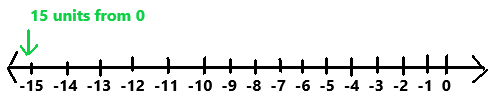
|-15|
Answer:
Math in Focus Grade 7 Chapter 1 Quick Check Answer Key-1(1)
The given number is |-15|.
The absolute value of the number |-15| is 15.
So the number |-15| is 15 units from 0.

Question 27.
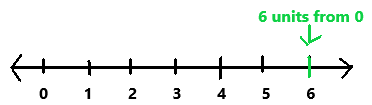
|6|
Answer:
Math in Focus Grade 7 Chapter 1 Quick Check Answer Key-1(2)
The given number is |6|.
The absolute value of the number |6| is 6.
So the number |6| is 6 units from 0.

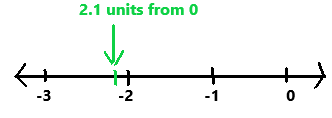
Question 28.
|-2.1|
Answer:
Math in Focus Grade 7 Chapter 1 Quick Check Answer Key-1(3)
The given number is |-2.1|.
The absolute value of the number |-2.1| is 2.1.
So the number |-2.1| is 2.1 units from 0.

Copy and complete each ? with >, =, or <.

Question 29.
|-7| ? |-72|
Answer:
|-7| < |-72|
Explanation:
The absolute value of |-7|  is 7.
The absolute value of |-72|  is 72.
So, |-7| is less than  |-72|.

Question 30.
|5| ? |-5|
Answer:
|5| = |-5|
Explanation:
The absolute value of |5| is 5.
The absolute value of |-5| is 5.
So, |5| is equal to |-5|.

Question 31.
|-26| ? |5|
Answer:
|-26| = |5|
Explanation:
The absolute value of |-26| is 26.
The absolute value of |5| is 5.
So, |-26| is greater than |5|.

Math in Focus Grade 1 Chapter 16 Practice 2 Answer Key Place Value

Go through the Math in Focus Grade 1 Workbook Answer Key Chapter 16 Practice 2 Place Value to finish your assignments.

Math in Focus Grade 1 Chapter 16 Practice 2 Answer Key Place Value

Look at the pictures. Then fill in the blanks.

Example
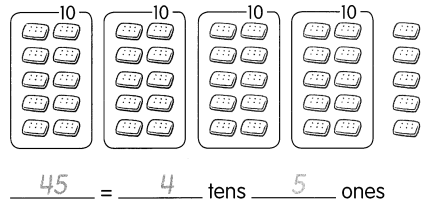
Math in Focus Grade 1 Chapter 16 Practice 2 Answer Key Place Value 1

Question 1.
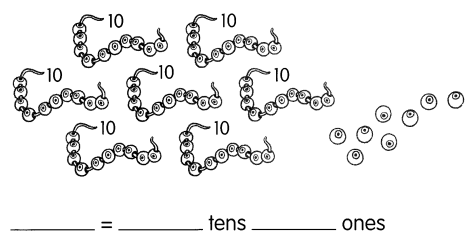
Math in Focus Grade 1 Chapter 16 Practice 2 Answer Key Place Value 2
Answer:
78 = 7 tens 8 ones.

Explanation:
In the above image, we can see that there are 7 tens and 8 ones which are 78.

Question 2.
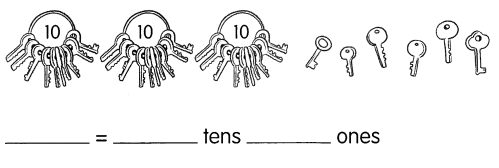
Math in Focus Grade 1 Chapter 16 Practice 2 Answer Key Place Value 3
Answer:
36 = 3 tens 6 ones.

Explanation:
In the above image, we can see that there are 3 tens and 6 ones which are 36.

Question 3.
Math in Focus Grade 1 Chapter 16 Practice 2 Answer Key Place Value 4
Answer:
92 = 9 tens 2 ones.

Explanation:
In the above image, we can see that there are 9 tens and 2 ones which are 92.

Question 4.
Math in Focus Grade 1 Chapter 16 Practice 2 Answer Key Place Value 5
Answer:
57 = 5 tens 7 ones.

Explanation:
In the above image, we can see that there are 5 tens and 7 ones which are 57.

Question 5.
Math in Focus Grade 1 Chapter 16 Practice 2 Answer Key Place Value 6
Answer:
84 = 8 tens 4 ones.

Explanation:
In the above image, we can see that there are 8 tens and 4 ones which are 84.

Count the base-ten blocks. Then fill in the blanks.

Example
Math in Focus Grade 1 Chapter 16 Practice 2 Answer Key Place Value 7

Question 6.
Math in Focus Grade 1 Chapter 16 Practice 2 Answer Key Place Value 8
Answer:
93 = 9 tens 3 ones.
90 + 3 = 93.

Explanation:
In the above image, we can see that there are 9 tens and 3 ones which are 93.
90+3 = 93.

Question 7.
Math in Focus Grade 1 Chapter 16 Practice 2 Answer Key Place Value 9
Answer:
87 = 8 tens 7 ones.
80+7 = 87.

Explanation:
In the above image, we can see that there are 8 tens and 7 ones which are 87.
80+7= 87.

Fill in the place-value charts.

Question 8.
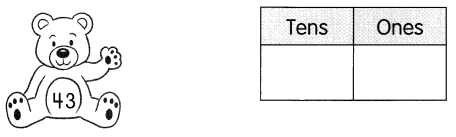
Math in Focus Grade 1 Chapter 16 Practice 2 Answer Key Place Value 10
Answer:
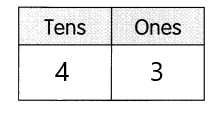
43 = 4 tens 3 ones.

Explanation:
Here, place value is a value represented by a digit in a number on the basis of its position in the number. So the place value of 43 is 4 in the tens place and 3 in ones place.
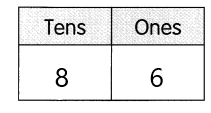
Math-in-Focus-Grade-1-Chapter-16-Practice-2-Answer-Key-Place-Value-10-1

Question 9.
Math in Focus Grade 1 Chapter 16 Practice 2 Answer Key Place Value 11
Answer:
86 = 8 tens and 6 ones.

Explanation:
Here, place value is a value represented by a digit in a number on the basis of its position in the number. So the place value of 86 is 8 in the tens place and 6 in ones place.
Math-in-Focus-Grade-1-Chapter-16-Practice-2-Answer-Key-Place-Value-10-2

Question 10.
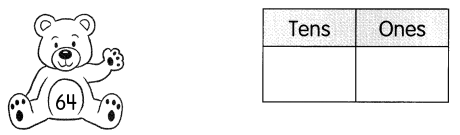
Math in Focus Grade 1 Chapter 16 Practice 2 Answer Key Place Value 12
Answer:
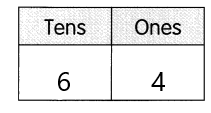
64 = 6 tens 4 ones.

Explanation:
Here, place value is a value represented by a digit in a number on the basis of its position in the number. So the place value of 64 is 6 in the tens place and 4 in ones place.
Math-in-Focus-Grade-1-Chapter-16-Practice-2-Answer-Key-Place-Value-10-3

Question 11.
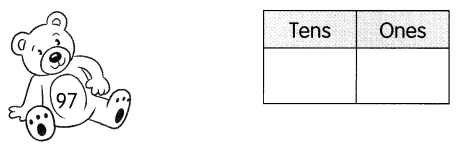
Math in Focus Grade 1 Chapter 16 Practice 2 Answer Key Place Value 13
Answer:
97 = 9 tens 7 ones.

Explanation:
Here, place value is a value represented by a digit in a number on the basis of its position in the number. So the place value of 97 is 9 in the tens place and 7 in ones place.
Math-in-Focus-Grade-1-Chapter-16-Practice-2-Answer-Key-Place-Value-10-4

Question 12.
Math in Focus Grade 1 Chapter 16 Practice 2 Answer Key Place Value 14
Answer:
75 = 7 tens 5 ones.

Explanation:
Here, place value is a value represented by a digit in a number on the basis of its position in the number. So the place value of 75 is 7 in the tens place and 5 in ones place.
Math-in-Focus-Grade-1-Chapter-16-Practice-2-Answer-Key-Place-Value-10-5

Math in Focus Grade 1 Chapter 16 Practice 1 Answer Key Counting to 100

Go through the Math in Focus Grade 1 Workbook Answer Key Chapter 16 Practice 1 Counting to 100 to finish your assignments.

Math in Focus Grade 1 Chapter 16 Practice 1 Answer Key Counting to 100

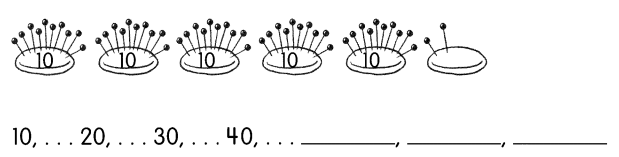
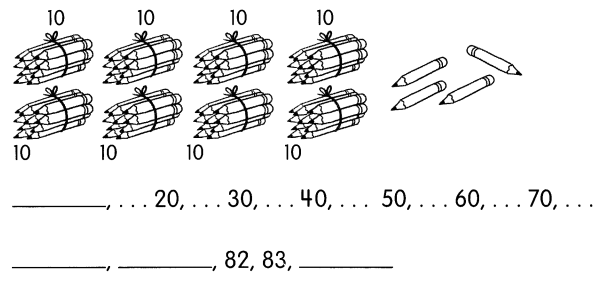
Count in tens and ones.

Fill in the blanks.

Example

Math in Focus Grade 1 Chapter 16 Practice 1 Answer Key Counting to 100 1

Question 1.
Math in Focus Grade 1 Chapter 16 Practice 1 Answer Key Counting to 100 2
Answer:
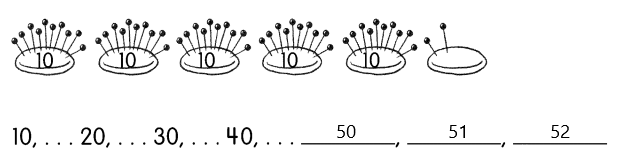
10,20,30,40,50,51,52.

Explanation:
In the above image, we can see that there are 5 tens and 2 ones which is 52.
Math-in-Focus-Grade-1-Chapter-16-Practice-1-Answer-Key-Counting-to-100-2-1

Question 2.
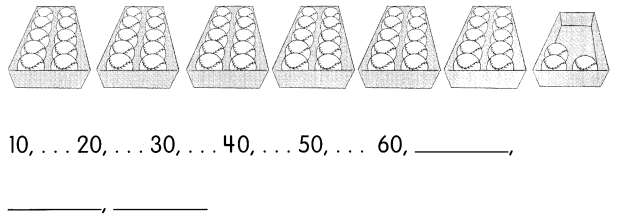
Math in Focus Grade 1 Chapter 16 Practice 1 Answer Key Counting to 100 3
Answer:
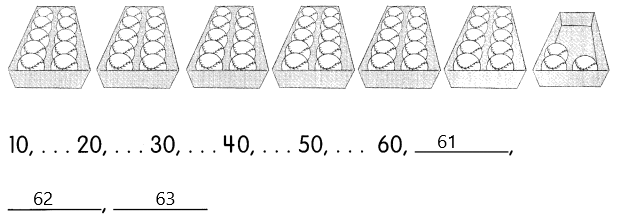
10,20,30,40,50,60,61,62,63.

Explanation:
In the above image, we can see that there are 6 tens and 3 ones which is 63.
Math-in-Focus-Grade-1-Chapter-16-Practice-1-Answer-Key-Counting-to-100-3-1

Question 3.
Math in Focus Grade 1 Chapter 16 Practice 1 Answer Key Counting to 100 4
Answer:
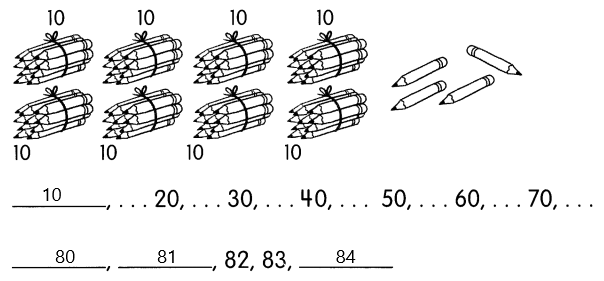
10,20,30,40,50,60,70,80,81,82,83,84.

Explanation:
In the above image, we can see that there are 8 tens and 4 ones which is 84.
Math-in-Focus-Grade-1-Chapter-16-Practice-1-Answer-Key-Counting-to-100-4-1

Write the number.

Question 4.
forty-nine _____
Answer:
forty-nine – 45.

Explanation:
Given that forty-nine, so in numbers, it will be 45.

Question 5.
sixty-eight _____
Answer:
sixty-eight – 68.

Explanation:
Given that sixty-eight, so in numbers, it will be 68.

Question 6.
ninety-five _____
Answer:
ninety-five – 95.

Explanation:
Given that ninety-five, so in numbers, it will be 95.

Question 7.
eighty-seven _____
Answer:
eighty-seven – 87.

Explanation:
Given that eighty-seven, so in numbers, it will be 87.

Question 8.
fifty-six _____
Answer:
fifty-six – 56.

Explanation:
Given that fifty-six, so in numbers, it will be 56.

Question 9.
seventy-three _____
Answer:
seventy-three – 73.

Explanation:
Given that seventy-three, so in numbers, it will be 73.

Question 10.
ninety-two _____
Answer:
ninety-two – 92.

Explanation:
Given that ninety-two, so in numbers, it will be 92.

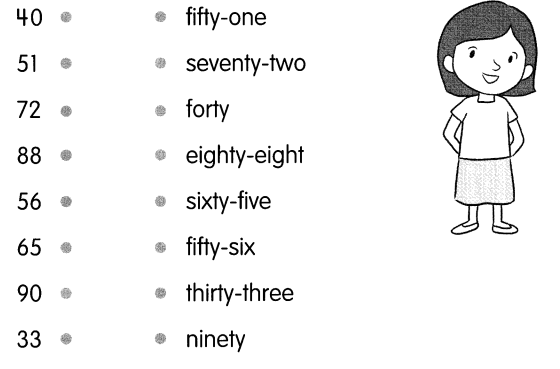
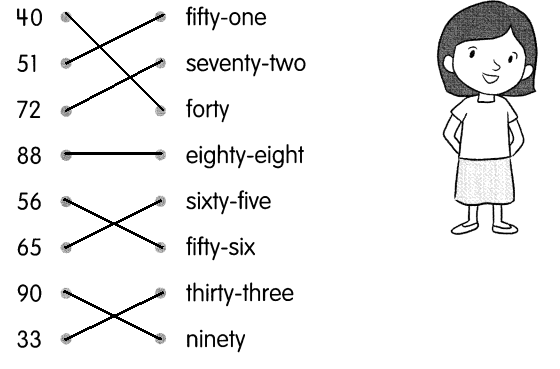
Match the number to the words.

Question 11.
Math in Focus Grade 1 Chapter 16 Practice 1 Answer Key Counting to 100 5

Answer:
Math-in-Focus-Grade-1-Chapter-16-Practice-1-Answer-Key-Counting-to-100-5-1

Find the missing numbers.

Question 12.
60 and 4 make _____
Answer:
60 and 4 make 64.

Explanation:
Given that 60 and 4 make 64.

Question 13.
5 and 70 make _____
Answer:
5 and 70 make 75.

Explanation:
Given that 5 and 70 make 75.

Question 14.
50 and ____ make 53.
Answer:
50 and 3 make 53.

Explanation:
Here, 53 makes 50 and 3.

Question 15.
____ and 4 make 84.
Answer:
80 and 4 make 84.

Explanation:
Here, 84 makes 80 and 4.

Question 16.
40 + 5 = ____
Answer:
40 + 5 = 45.

Explanation:
Given that 40+5 makes 45.

Question 17.
___ + 80 = 88
Answer:
8 + 80 = 88.

Explanation:
Here, 88 makes 8 + 80.

Circle a group of 10. Estimate how many there are. Then count.

Question 18.
Math in Focus Grade 1 Chapter 16 Practice 1 Answer Key Counting to 100 6
Answer:
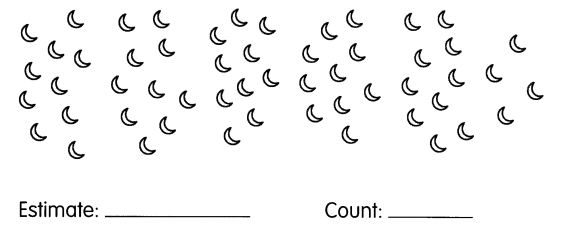
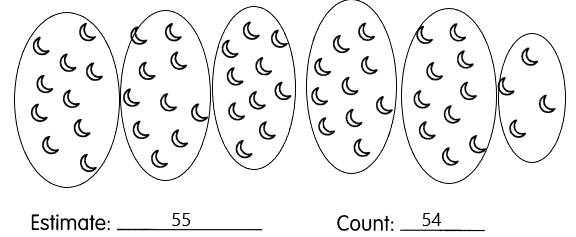
The actual count is 50 and the estimated is 55.

Explanation:
In the image, we can see 5 groups with 10 half-moons. So the estimation will be 55 and the count is 50.
Math-in-Focus-Grade-1-Chapter-16-Practice-1-Answer-Key-Counting-to-100-6-1

Question 19.
Math in Focus Grade 1 Chapter 16 Practice 1 Answer Key Counting to 100 7
Answer:
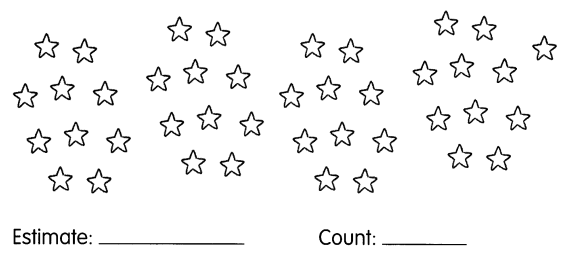
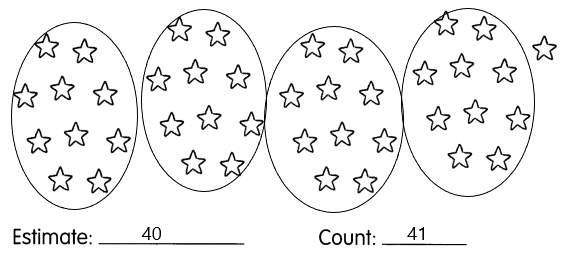
The actual count is 41 and the estimated is 41.

Explanation:
In the image, we can see 4 groups with 10 stars. So the estimation will be 40 and the count is 41.

Math-in-Focus-Grade-1-Chapter-16-Practice-1-Answer-Key-Counting-to-100-7-1

Math in Focus Grade 1 Chapter 19 Practice 3 Answer Key Counting Money

Go through the Math in Focus Grade 1 Workbook Answer Key Chapter 19 Practice 3 Counting Money to finish your assignments.

Math in Focus Grade 1 Chapter 19 Practice 3 Answer Key Counting Money

Count on to find the value.

Example
Math in Focus Grade 1 Chapter 19 Practice 3 Answer Key Counting Money 1

Question 1.
Math in Focus Grade 1 Chapter 19 Practice 3 Answer Key Counting Money 2
___________¢
Answer: 81¢
Explanation:
2 quarters + 3 dimes + 1 penny = 81¢
1 quarter = 25¢
1 dime = 10¢
1 penny = 1¢
25 + 25 + 10 + 10 + 10 + 1 = 81¢

Question 2.
Math in Focus Grade 1 Chapter 19 Practice 3 Answer Key Counting Money 3
___________¢
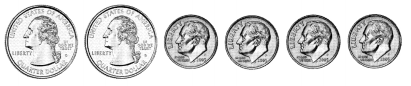
Answer: 90¢
Explanation:
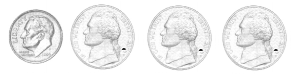
2 quarters + 4 dimes = 90¢
1 quarter = 25¢
1 dime = 10¢
25 + 25 + 10 + 10 +10 +10 = 90¢

Question 3.
Math in Focus Grade 1 Chapter 19 Practice 3 Answer Key Counting Money 4
___________¢
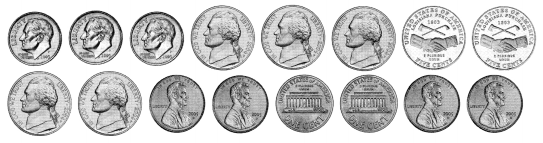
Answer: 70¢
Explanation;
3 dimes + 7 nickels + 5 pennies = 70¢
1 dime = 10¢
1 nickel = 5¢
1 penny = 1¢
10 + 10 + 10 + 5 + 5 + 5 +5 + 5 + 5 + 5 + 1 + 1 + 1 + 1 + 1 = 70¢

Question 4.
Math in Focus Grade 1 Chapter 19 Practice 3 Answer Key Counting Money 5
___________¢
Answer: 83¢
Explanation:
3 quarters + 3 pennies + 1 nickel = 83¢
1 quarter = 25¢
1 penny = 1¢
1 nickel = 5¢
25 + 25 + 25 + 1 + 1 + 1 + 5 = 83¢

Question 5.
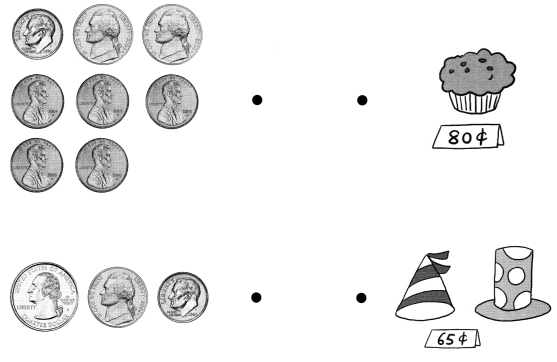
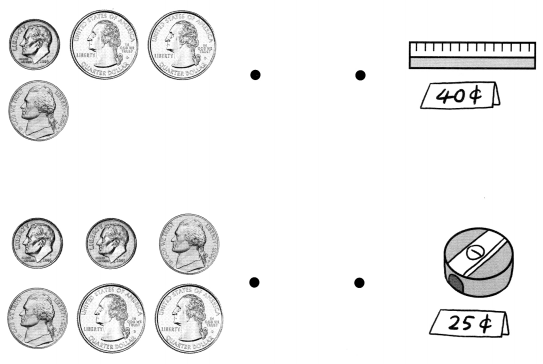
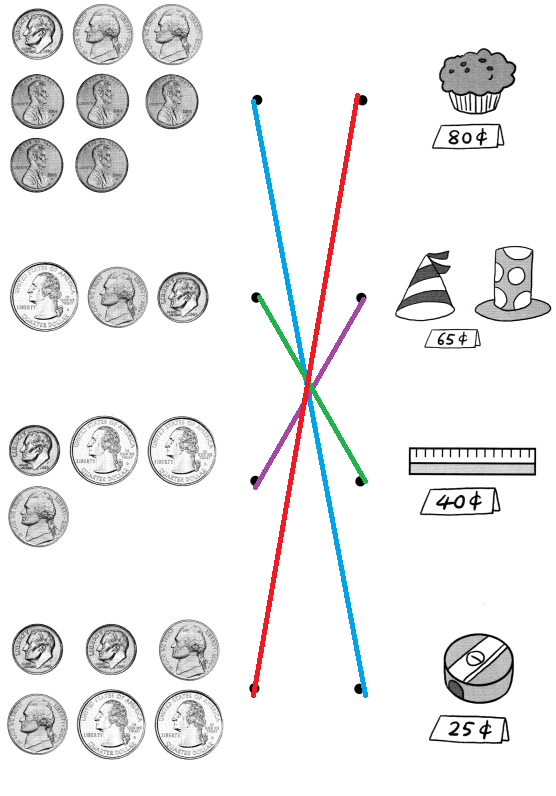
Match
Math in Focus Grade 1 Chapter 19 Practice 3 Answer Key Counting Money 6
Math in Focus Grade 1 Chapter 19 Practice 3 Answer Key Counting Money 7
Answer:

Explanation:
1 quarter = 25¢
1 penny = 1¢
1 nickel = 5¢
1 dime = 10¢
80¢ = 2 dimes + 2 nickels + 2 quarters
65¢ = 1 dime + 2 quarters + 1 nickel
40¢ = 1 quarter + 1 nickel + 1 dime
25¢ = 1 dime + 2 nickels  + 5 pennies

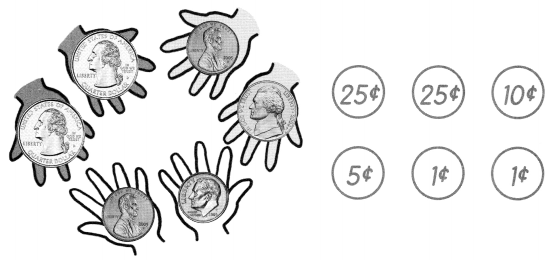
Sort the coins.

Example
Math in Focus Grade 1 Chapter 19 Practice 3 Answer Key Counting Money 8

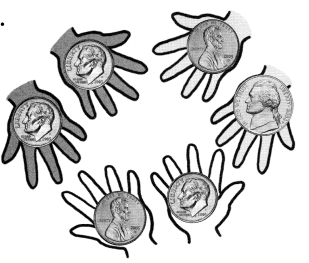
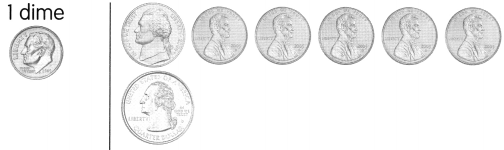
Question 6.
Math in Focus Grade 1 Chapter 19 Practice 3 Answer Key Counting Money 9
Answer:

Explanation:
The above given pictures of currency consists,
3 dimes, 1 nickel and 2 pennies.

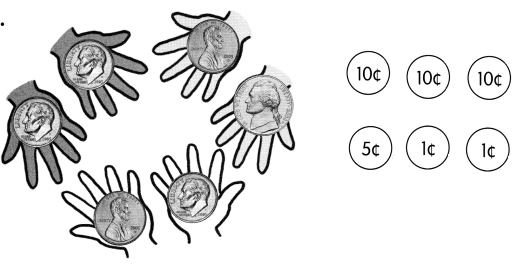
Question 7.
Math in Focus Grade 1 Chapter 19 Practice 3 Answer Key Counting Money 10
Answer:

Explanation:
The above given pictures of currency consists,
1 quarter, 1 dime, and 2 nickels.

Circle the coins you need to buy each thing.

Example
Math in Focus Grade 1 Chapter 19 Practice 3 Answer Key Counting Money 11

Question 8.
Math in Focus Grade 1 Chapter 19 Practice 3 Answer Key Counting Money 12
Answer:

Explanation:
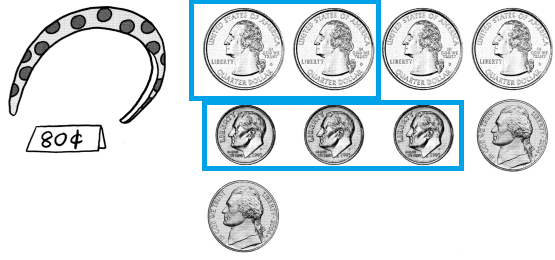
The above picture costs  80¢
2 quarters + 3 dimes = 80¢
1 quarter = 25¢
1 dime = 10¢

Question 9.
Math in Focus Grade 1 Chapter 19 Practice 3 Answer Key Counting Money 13
Answer:

Explanation:
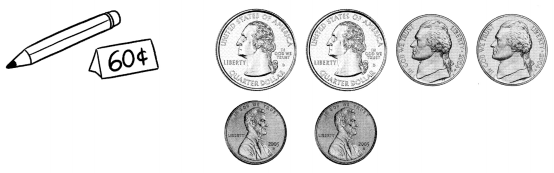
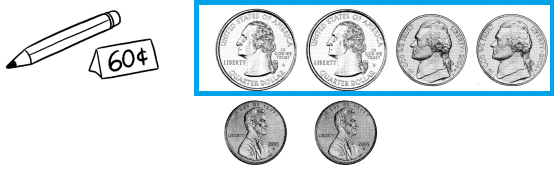
Cost of pencil is 60¢
2 quarters + 2 nickels = 60¢
1 quarter = 25¢
1 nickel = 5¢

Question 10.
Math in Focus Grade 1 Chapter 19 Practice 3 Answer Key Counting Money 14
Answer:

Explanation:
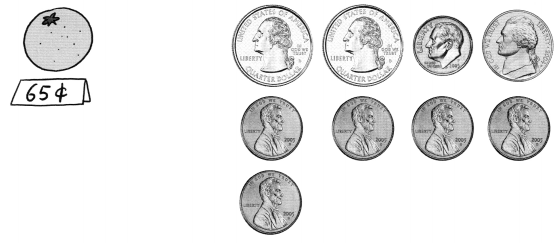
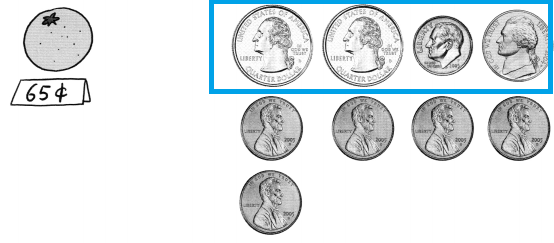
Cost of Tomato 65¢
2 quarters + 1 dime + 1 nickel = 65¢
1 quarter = 25¢
1 dime = 10¢
1 nickel = 5¢

Question 11.
Math in Focus Grade 1 Chapter 19 Practice 3 Answer Key Counting Money 15
Answer:

Explanation:
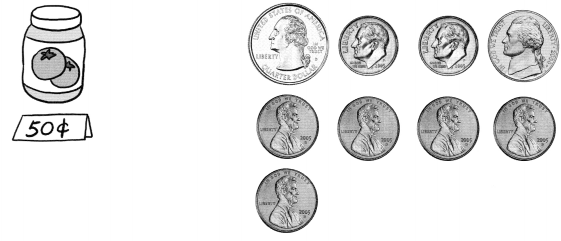
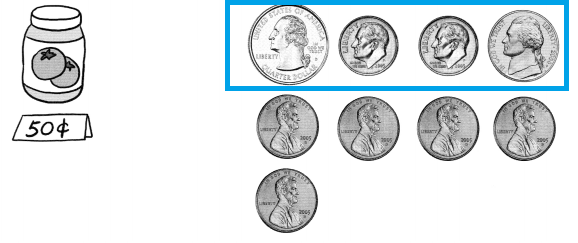
Cost of 1 bottle is 50¢
1 quarter + 2 dimes + 1 nickel = 50¢
1 quarter = 25¢
1 dime = 10¢
1 nickel = 5¢

Question 12.
Math in Focus Grade 1 Chapter 19 Practice 3 Answer Key Counting Money 16
Answer:

Explanation:
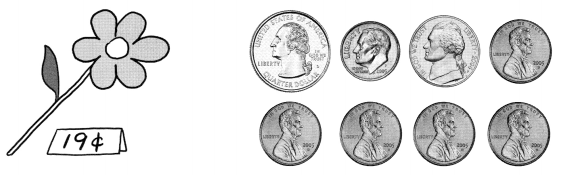
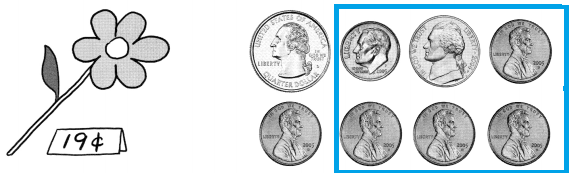
Cost of flower is 19¢
1 dime + 1 nickel + 4 pennies = 19¢
1 penny = 1¢
1 dime = 10¢
1 nickel = 5¢

Question 13.
Math in Focus Grade 1 Chapter 19 Practice 3 Answer Key Counting Money 17
Answer:

Explanation:
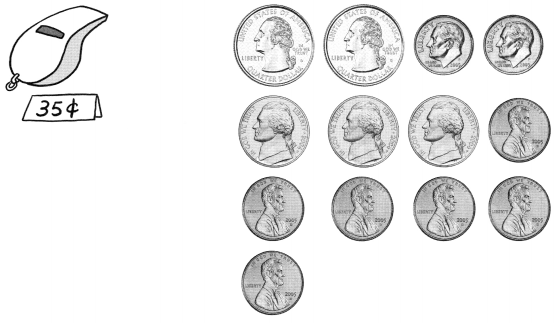
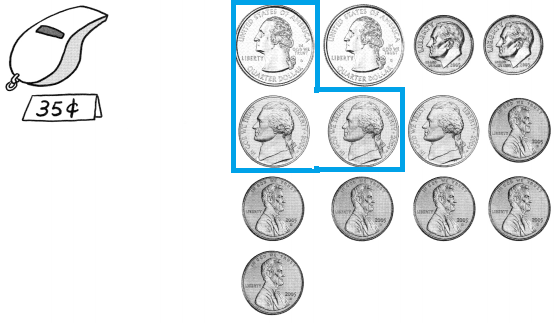
Cost of Whistle is 35¢
1 quarter + 2 nickels = 35¢
1 quarter = 25¢
1 nickel = 5¢

Question 14.
Math in Focus Grade 1 Chapter 19 Practice 3 Answer Key Counting Money 18
Answer:

Explanation:
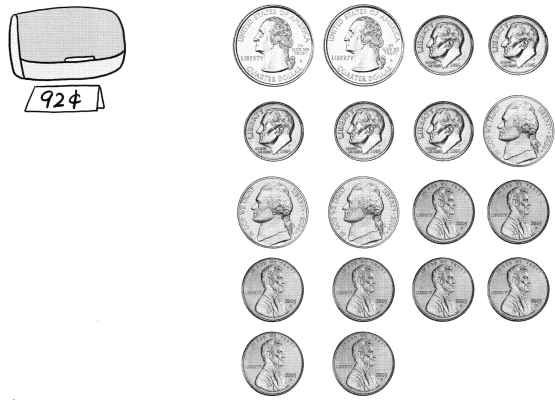
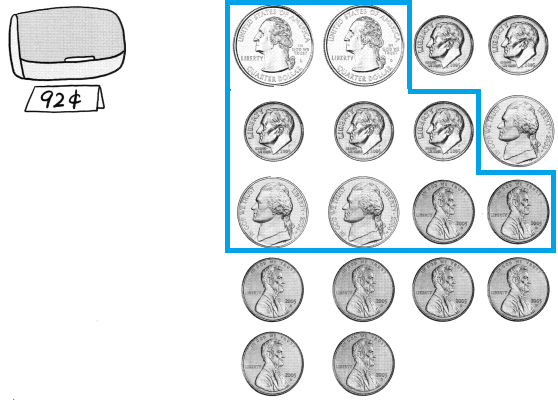
Cost of Bag is 92¢
2 quarter + 3 dimes + 2 nickels + 2 pennies = 92¢
1 quarter = 25¢
1 dime = 10¢
1 nickel = 5¢
1 penny = 1¢

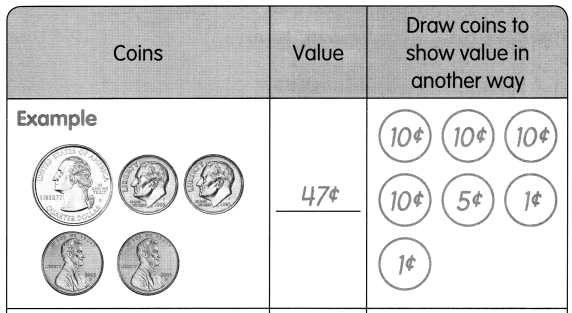
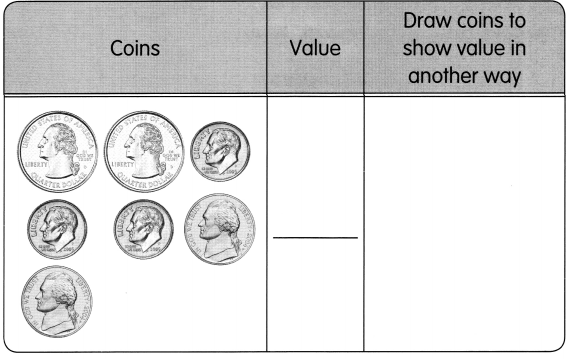
Complete the table.
Math in Focus Grade 1 Chapter 19 Practice 3 Answer Key Counting Money 19

Question 15.
Math in Focus Grade 1 Chapter 19 Practice 3 Answer Key Counting Money 20
Answer:

Explanation:
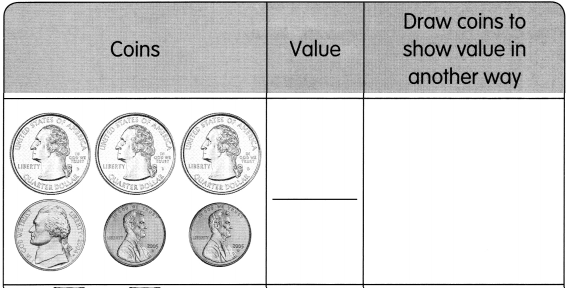
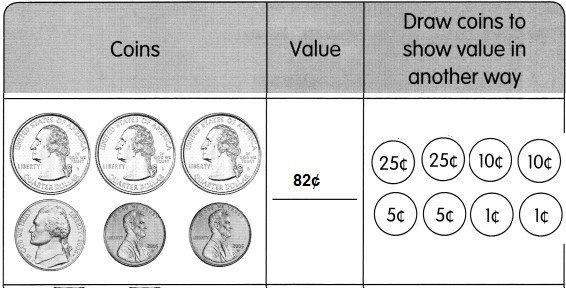
In the table there are 3 quarters, 1 nickel and 2 pennies of coins are present.
1 quarter = 25¢
1 nickel = 5¢
1 penny = 1¢
25¢ + 25¢ + 25¢ + 5¢ + 5¢ + 1¢ + 1¢ = 82¢
82¢ can also be shown in another way as
2 quarters + 2 dimes + 2 nickels + 2 pennies = 82¢

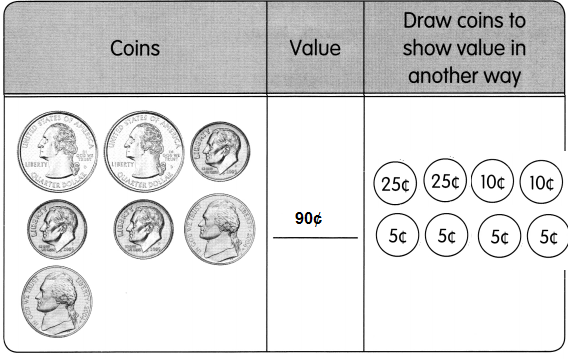
Question 16.
Math in Focus Grade 1 Chapter 19 Practice 3 Answer Key Counting Money 21
Answer:

Explanation:
In the table there are 2 quarters, 3 dimes and 2 nickels of coins are present.
1 quarter = 25¢
1 nickel = 5¢
1 dime = 10¢
25¢ + 25¢ + 10¢ + 10¢ + 10¢ + 5¢ + 5¢ = 90¢
90¢ can also be shown in another way as
2 quarters + 2 dimes + 4 nickels = 90¢

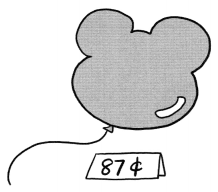
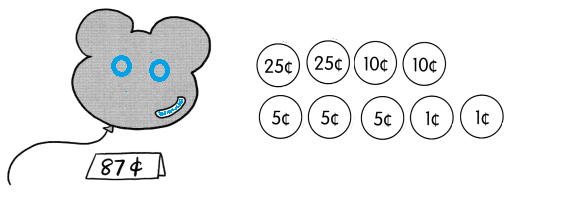
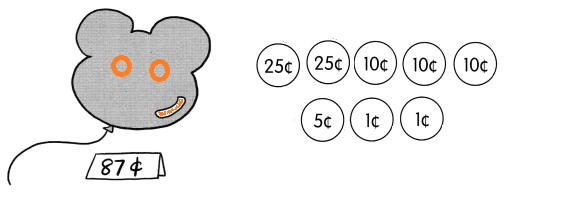
Use pennies 1¢, nickels 5¢, dimes 10¢, and quarters 25¢. Draw 2 ways to pay for the balloon.

Math in Focus Grade 1 Chapter 19 Practice 3 Answer Key Counting Money 22

Question 17.
Answer: 87¢
25 + 25 + 10 + 10 + 5 + 5 + 5 + 1 + 1 = 87¢

Explanation:
1 quarter = 25¢
1 dime = 10¢
1 nickel = 5¢
1 penny = 1¢
2 quarters + 2 dimes + 3 nickels + 2 pennies
25 + 25 + 10 + 10 + 5 + 5 + 5 + 1 + 1 = 87¢

Question 18.
Answer: 87¢
25 + 25 + 10 + 10 + 10 + 5 + 1 + 1 = 87¢

Explanation:
1 quarter = 25¢
1 dime = 10¢
1 nickel = 5¢
1 penny = 1¢
another way to pay balloons
2 quarters + 3 dimes + 1 nickel + 2 pennies = 87¢
25 + 25 + 10 + 10 + 10 + 5 + 1 + 1 = 87¢

Math in Focus Grade 1 Chapter 19 Practice 2 Answer Key Quarter

Go through the Math in Focus Grade 1 Workbook Answer Key Chapter 19 Practice 2 Quarter to finish your assignments.

Math in Focus Grade 1 Chapter 19 Practice 2 Answer Key Quarter

Fill in the blanks.

Question 1.
Math in Focus Grade 1 Chapter 19 Practice 2 Answer Key Quarter 1
This is a ____________.
Its value is ___________¢.
Answer:
This is a Quarter Dollar
Its value is 25 ¢.
Explanation:
The quarter, short for quarter dollar, is a United States coin worth 25 cents, one-quarter of a dollar.
1 Quarter = 25 cents.

Complete.

Question 2.
Math in Focus Grade 1 Chapter 19 Practice 2 Answer Key Quarter 2
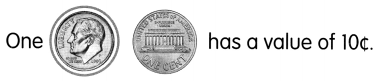
Answer: 10¢
Explanation:
1 dime = 10 cents or 10 pennies

Question 3.
Math in Focus Grade 1 Chapter 19 Practice 2 Answer Key Quarter 3
Answer:
5 nickels
Explanation:
one quarter =25 ¢
1 nickel = 5 cents
when we convert quarter into nickles
1 quarter = 5 nickels

Question 4.
Math in Focus Grade 1 Chapter 19 Practice 2 Answer Key Quarter 4
Answer:
5 pennies
Explanation:
1 nickel = 5 cents
when we convert into pennies
1 nickel = 5 pennies

Circle the coins to show the same value.

Question 5.
Math in Focus Grade 1 Chapter 19 Practice 2 Answer Key Quarter 5
Answer:
1 dime = 1 nickel + 5 pennies

Explanation:
1 dime = 10 cents
1 nickel = 5 cents
1 penny = 1 cent
So, 1 dime = 1 nickel + 5 pennies
= 5¢ +5¢
=10¢

Question 6.
Math in Focus Grade 1 Chapter 19 Practice 2 Answer Key Quarter 6
Answer:
1 nickel = 5 pennies

Explanation:
1 nickel = 5 cents
1 penny = 1 cent
convert nickel to pennies
1 nickel = 5 pennies

Question 7.
Math in Focus Grade 1 Chapter 19 Practice 2 Answer Key Quarter 7
Answer:
1 quarter


Explanation:
1 quarter = 25 cents
= 3 nickel + 10 pennies
=15¢  + 10¢
= 25¢

Question 8.
Math in Focus Grade 1 Chapter 19 Practice 2 Answer Key Quarter 8
Answer:
one dime = 2 nickels

Explanation:
1 dime = 10 cents
1 nickel = 5 cents
1 dime = 2 nickels
1 dime = 5¢ + 5¢

Question 9.
Math in Focus Grade 1 Chapter 19 Practice 2 Answer Key Quarter 9
Answer:

Explanation:
one quarter = 2 dimes and one nickel
= 10 ¢+ 10¢ + 5¢
=25¢

Use pennies 1¢, nickels 5¢, dimes and 10¢, quarters 25¢. Draw 5 ways to play.

Math in Focus Grade 1 Chapter 19 Practice 2 Answer Key Quarter 10

Question 10.
Answer: 25¢
25 = 10 + 10 + 5


Explanation:
2 dimes + 1 nickel = 1 quarter
1 dime = 10 cents
1 nickel = 5 cents
1 quarter = 25 cents

Question 11.
Answer: 25¢
25 = 10 + 5 + 5 + 5


Explanation:
1 dime + 3 nickels = 1 quarter
1 dime = 10 cents
1 nickel = 5 cents
1 quarter = 25 cents

Question 12.
Answer:
25 = 10 + 5 + 5 + 1 + 1 + 1 + 1 + 1


Explanation:
1 dime + 2 nickels + 5 pennies = 1 quarter
1 dime = 10 cents
1 nickel = 5 cents
1 quarter = 25 cents
1 penny = 1 cent

Question 13.
Answer:

Question 14.
Answer:
10 + 5  + 1 + 1 + 1 + 1 + 1 + 1 + 1 + 1 + 1 + 1

Explanation:
1 dime + 1 nickel + 10 pennies = 1 quarter
1 dime = 10 cents
1 nickel = 5 cents
1 quarter = 25 cents
1 penny = 1 cent

Math in Focus Grade 1 Chapter 19 Practice 2 Answer Key Quarter 11

Circle the coin.

Example
Math in Focus Grade 1 Chapter 19 Practice 2 Answer Key Quarter 12

Question 15.
Math in Focus Grade 1 Chapter 19 Practice 2 Answer Key Quarter 13
Answer:

Explanation:
1 quarter has a value of 25¢

Question 16.
Math in Focus Grade 1 Chapter 19 Practice 2 Answer Key Quarter 14
Answer:

Explanation:
1 dime = 10¢
1 nickel = 5¢
So, dime is greater than nickel

Question 17.
Math in Focus Grade 1 Chapter 19 Practice 2 Answer Key Quarter 15
Answer:

Explanation:
1 nickel = 5¢
1 penny = 1¢
So, penny is less than a nickel.

Question 18.
Math in Focus Grade 1 Chapter 19 Practice 2 Answer Key Quarter 16
Answer:

Explanation:
1 nickel = 5¢
2 nickels = 10¢
1 dime = 10¢
So, 2 nickels can be exchanged as 1 dime.

Fill in the blanks.

Question 19.
___________ nickels can be exchanged for 1 quarter.
Answer:
5 nickels
Explanation:
5 nickels nickels can be exchanged for 1 quarter.
5 x 5 = 25
1 quarter = 25 cents = 5 nickels

Question 20.
___________ pennies can be exchanged for 1 dime.
Answer:
10 pennies
Explanation:
10 pennies can be exchanged for 1 dime.
1 dime = 10 cents

Math in Focus Grade 2 Chapter 13 Answer Key Customary Measurement of Length

This handy Math in Focus Grade 2 Workbook Answer Key Chapter 13 Customary Measurement of Length detailed solutions for the textbook questions.

Math in Focus Grade 2 Chapter 13 Answer Key Customary Measurement of Length

Put On Your Thinking Cap!

Challenging Practice

Question 1.
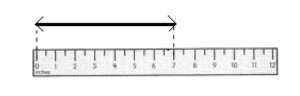
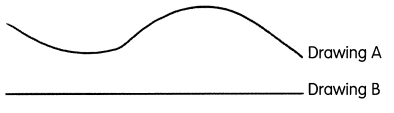
There are three drawings, A, B, and C. Drawing A is shown.
Math in Focus Grade 2 Chapter 13 Answer Key Customary Measurement of Length 1
Drawing B is 12 inches longer than Drawing A. Drawing C is 4- inches shorter than Drawing B. How long is Drawing C?
Answer:

Given,

Drawing B is 12 inches longer than Drawing A.

Drawing C is 4- inches shorter than Drawing B.

Length of Drawing C = 12 + 4 = 16

Therefore, Drawing C is 16 inches long.


Question 2.
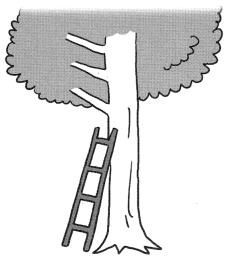
Tom and Lionel climb a tree. They have to climb a ladder first, then up to the branches. The ladder is 6 feet long. Tom climbs 4- feet from the ladder to a branch. Lionel climbs 2 feet from the ladder to another branch. What is the total distance that Tom and Lionel have climbed?
Math in Focus Grade 2 Chapter 13 Answer Key Customary Measurement of Length 2
Answer:

Given,

Tom and Lionel climb a tree.

They have to climb a ladder first, then up to the branches.

The ladder is 6 feet long.

Tom climbs 4- feet from the ladder to a branch.

Lionel climbs 2 feet from the ladder to another branch.

Distance climbed by Tom = 6 + 4 = 10 feet

Distance climbed by Lionel = 6 + 2 = 8 feet

Total distance = 10 + 8 = 18 feet

Therefore, the Total distance climbed by Tom and Lionel is 18 feet.


Put On Your Thinking Cap!

Problem Solving

Solve.

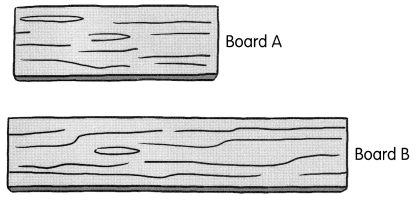
Math in Focus Grade 2 Chapter 13 Answer Key Customary Measurement of Length 3
Question 1.
There are 2 boards, A and B. The total length of both boards is 28 feet. Board B is at least 5 feet longer than Board A, but the difference is not more than 12 feet. What are the possible lengths of the two boards?
Answer:

Given,

There are 2 boards, A and B.

The total length of both boards is 28 feet.

Board B is at least 5 feet longer than Board A, but the difference is not more than 12 feet.

Let Length of Board  A be a

Length of Board B be b

From thee given data, these conditions can be drawn,

a + b = 28

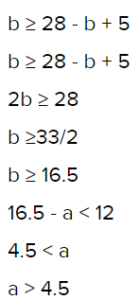
b  ≥ a + 5

b – a < 12

So,  substituting a = 28 – b in b  ≥ a + 5, it becomes,

Therefore,

The possible lengths of board a is 8 to 11.5 feet.

The possible lengths of board b is 16.5 to 20 feet.


Chapter Review/Test

Vocabulary

Fill in the blanks with words from the box.

foot/feet
inch/inches
tallest
shorter

Question 1.
Measure short lengths in ___________ and longer lengths in __________
Answer:

Measure short lengths in foot/feet and longer lengths in inch/inches.


Question 2.
Math in Focus Grade 2 Chapter 13 Answer Key Customary Measurement of Length 4
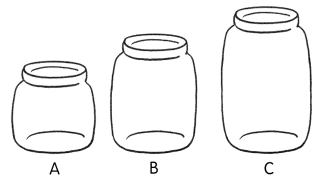
Cookie jar C is the __________
Answer:

Cookie jar C is the tallest.


Question 3.
Math in Focus Grade 2 Chapter 13 Answer Key Customary Measurement of Length 5
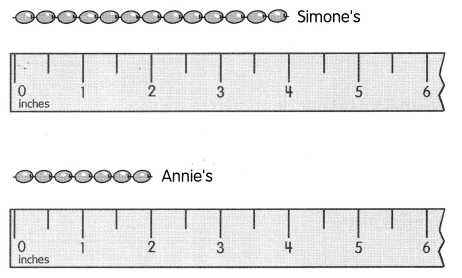
Annie’s string of beads is 2 inches __________ than Simone’s.
Answer:

Annie’s string of beads is 2 inches shorter than Simone’s.


Concepts and Skills

Check (✓) the correct answers.

Question 4.
What is the length of your math textbook?
Math in Focus Grade 2 Chapter 13 Answer Key Customary Measurement of Length 6
Answer:


Question 5.
What is the height of your desk?
Math in Focus Grade 2 Chapter 13 Answer Key Customary Measurement of Length 7
Answer:


Question 6.
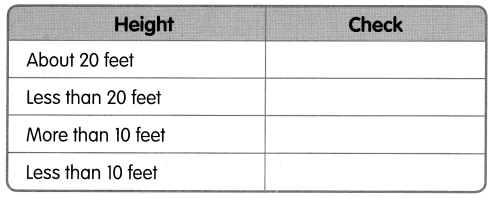
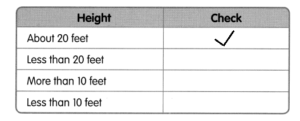
What is the height of your classroom?
Math in Focus Grade 2 Chapter 13 Answer Key Customary Measurement of Length 8

Answer:


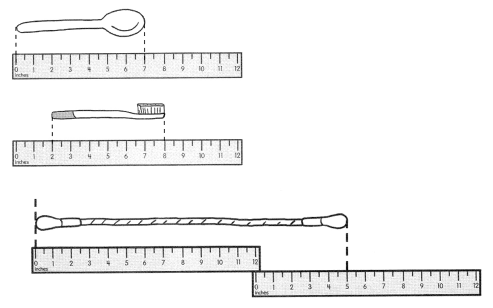
Look at the objects measured. Then fill in the blanks.

Math in Focus Grade 2 Chapter 13 Answer Key Customary Measurement of Length 9

Question 7.
spoon: __________ in.
Answer:

Spoon : 7 in

Question 8.
toothbrush: __________ in.
Answer:

toothbrush : 8 – 2 = 6 in

Question 9.
rope: __________ ft __________ in.
Answer:

rope : 1 ft 5 in

Question 10.
The rope is __________ foot longer than the spoon.
Answer:

The rope is 0.8 foot longer than the spoon.

Question 11.
The rope is longer than __________ foot.
Answer:

The rope is longer than 1 foot.


Question 12.
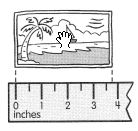
Math in Focus Grade 2 Chapter 13 Answer Key Customary Measurement of Length 10
The photo is about __________ inches long.
Answer:

The photo is about 4 inches long.

Question 13.
Use a ruler to draw a part of a line 7 inches long.
Answer:


Problem Solving

Solve. Show your work. Draw bar models to help you.

Question 14.
Ms. Cooper used 86 feet of yellow yarn and 123 feet of blue yarn to make a sweater.
a. What is the total length of yarn that Ms. Cooper used to make a sweater?
The total length of yarn is __________ feet.
Answer:

Given,

Ms. Cooper used 86 feet of yellow yarn and 123 feet of blue yarn to make a sweater.

Total length = 86 + 123 = 209 feet

Therefore, The total length of yarn is 209 feet.


b. How much more blue yarn than yellow yarn did Ms. Cooper use?
Ms. Cooper used ____________ feet more blue yarn than yellow yarn.
Answer:

Given,

Ms. Cooper used 86 feet of yellow yarn and 123 feet of blue yarn to make a sweater.

Difference = 123 – 86 = 37 feet

Therefore, Ms. Cooper used 37 feet more blue yarn than yellow yarn.


Question 15.
A bookshelf is 50 inches tall. It is 15 inches shorter than a step ladder. How tall is the ladder?
The step ladder is ____________ inches tall.
Answer:

Given,

A bookshelf is 50 inches tall.

It is 15 inches shorter than a step ladder.

Difference =  50 – 15 = 35 inches

Therefore, The step ladder is 35 inches tall.

Math in Focus Grade 2 Chapter 13 Practice 5 Answer Key Real-World Problems: Customary Length

This handy Math in Focus Grade 2 Workbook Answer Key Chapter 13 Practice 5 Real-World Problems: Customary Length detailed solutions for the textbook questions.

Math in Focus Grade 2 Chapter 13 Practice 5 Answer Key Real-World Problems: Customary Length

Solve.

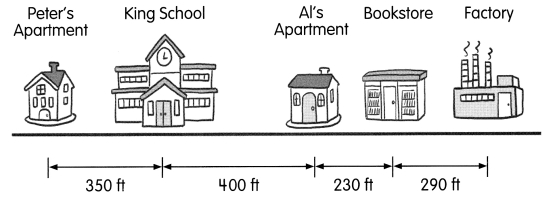
Math in Focus Grade 2 Chapter 13 Practice 5 Answer Key Real-World Problems Customary Length 1

Question 1.
How far does Al walk from his home to King School?
____________ ft
Answer:

Al walks 400 ft from his home to King School.


Question 2.
How far is Peter’s Apartment from the Bookstore?
____________ ft
Answer:

Peter’s Apartment is 980 ft  from the Bookstore. ( 350 + 400 + 230 = 980 )


Question 3.
Who lives nearer to King School, Al or Peter?
Answer:

Peter lives nearer to King School. ( 350 < 400 )


Question 4.
How much nearer?
____________ ft
Answer:

350 ft is the distance between peter’s apartment and King school.


Question 5.
Al goes to the Bookstore from his apartment and then goes to school. How far does he walk?
____________ ft
Answer:

The distance between Al’s apartment and the book store is 230 ft.

The distance between the book store and king school is 230 + 400 = 630 ft.

So, 630 + 230 = 860 ft

Therefore, Al walks 860 ft.


Question 6.
Peter left his apartment to walk to Al’s Apartment. He has walked 400 feet. How much farther does he have to walk?
____________ ft
Answer:

The distance between peter’s apartment and Al’s apartment is 550 ft

Given,

Peter walked 400 ft

Remaining = 550 – 400 = 150 ft

Therefore, He has to walk 150 ft.


Solve.

Question 7.
A flagpole is 6 feet tall. It stands on a building 26 feet tall. How high is the top of the flagpole from the ground?
The top of the flagpole is ____________ feet from the ground.
Answer:

Given,

A flagpole is 6 feet tall.

It stands on a building 26 feet tall.

Total Height = 26 + 6 = 32 feet.

Therefore, The top of the flagpole is 32 feet from the ground.


Question 8.
A rope is cut into 3 pieces. The rope pieces measure 14- feet, 16 feet, and 20 feet. How long was the rope before it was cut?
The rope was ____________ feet long.
Answer:

Given,

A rope is cut into 3 pieces.

The rope pieces measure 14- feet, 16 feet, and 20 feet.

Total length = 14 + 16 + 20 = 50 feet

Therefore, The rope was 50 feet long.


Question 9.
A flagpole 156 inches tall is driven into the ground. 38 inches of it is below the ground. How much of the flag pole is above the ground?

____________ inches of the flagpole is above the ground.
Answer:

Given,

A flagpole 156 inches tall is driven into the ground.

38 inches of it is below the ground.

Remaining length = 156 – 38 = 118 inches.

Therefore, 118 inches of the flagpole is above the ground.


Solve. Show your work. Use bar models to help you.

Example

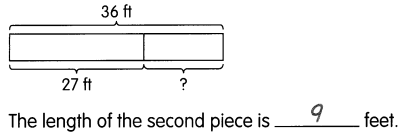
The total length of two pieces of wood is 36 feet. The first piece is 27 feet long.
a. What is the length of the second piece?

Answer:
Math in Focus Grade 2 Chapter 13 Practice 5 Answer Key Real-World Problems Customary Length 2


b. How much shorter is the second piece than the first piece?

Answer:
27 – 9 = 18
The second piece is 18 feet shorter than the first piece.


Question 10.
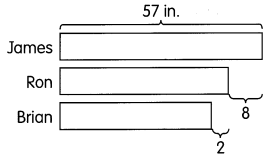
James is 57 inches tall. James is 8 inches taller than Ron. Ron is taller than Brian by 2 inches. How tall is Brian?
Math in Focus Grade 2 Chapter 13 Practice 5 Answer Key Real-World Problems Customary Length 3
Brain is __________ inches tall.
Answer:

Given,

James is 57 inches tall.

James is 8 inches taller than Ron.

Ron is taller than Brian by 2 inches.

Height of Brain =  57 – 8 – 2 = 47 inches

Therefore, Brain is 47 inches tall.


Question 11.
Marcus keeps 3 rolls of cable measuring 67 feet in all. The first roll is 32 feet. The second roll is 17 feet. How long is the third roll?
Math in Focus Grade 2 Chapter 13 Practice 5 Answer Key Real-World Problems Customary Length 4
The third roll is __________ feet long.
Answer:

Given,

Marcus keeps 3 rolls of cable measuring 67 feet in all.

The first roll is 32 feet.

The second roll is 17 feet.

Remaining length = 67 – 32 – 17 = 18 ft

Therefore, The third roll is 18 feet long.


Solve. Show your work. Draw bar models to help you.

Question 12.
A string is 500 inches long. Nicole uses 142 inches of it to tie a package. She gives 75 inches of it to Susan. How long is the string that Nicole has left?
The string is __________ inches long.
Answer:

Given,

A string is 500 inches long.

Nicole uses 142 inches of it to tie a package.

She gives 75 inches of it to Susan.

Total used = 142 + 75 = 217 in

Remaining = 500 – 217 = 283 in

Therefore, The string is 283 inches long.

Math in Focus Grade 2 Chapter 13 Practice 4 Answer Key Comparing Lengths in Inches and Feet

This handy Math in Focus Grade 2 Workbook Answer Key Chapter 13 Practice 4 Comparing Lengths in Inches and Feet detailed solutions for the textbook questions.

Math in Focus Grade 2 Chapter 13 Practice 4 Answer Key Comparing Lengths in Inches and Feet

Look at each drawing. Then fill in the blanks.

Question 1.
Which is longer? Drawing ___________
Math in Focus Grade 2 Chapter 13 Practice 4 Answer Key Comparing Lengths in Inches and Feet 1
Answer:

Drawing A is longer than Drawing B.


Question 2.
Which is the longest?
Math in Focus Grade 2 Chapter 13 Practice 4 Answer Key Comparing Lengths in Inches and Feet 2
Drawing ____________ is the shortest.
Drawing ____________ is the longest.
Explain your answers.
Answer:

Drawing B is the shortest.
Drawing C is the longest.

Because Drawing B is straight and covers the same length whereas Drawing C is not straight but has many curves than Drawing A and B and also covers the same length as others. So. Drawing B is the shortest and Drawing C is the longest.


Fill in the blanks.

Question 3.
Math in Focus Grade 2 Chapter 13 Practice 4 Answer Key Comparing Lengths in Inches and Feet 3
The marker is ___________ inches long.
Answer:

The marker is 5 inches long.


Question 4.
Math in Focus Grade 2 Chapter 13 Practice 4 Answer Key Comparing Lengths in Inches and Feet 4
The eraser is ___________ inches long.
Answer:

The eraser is 1 inch long.


Question 5.
Math in Focus Grade 2 Chapter 13 Practice 4 Answer Key Comparing Lengths in Inches and Feet 5
The key is _____________ inches long.
Answer:

The key is 2 inches long.


Fill in the blanks.

Question 6.
Math in Focus Grade 2 Chapter 13 Practice 4 Answer Key Comparing Lengths in Inches and Feet 6
The stick is ____________ inches long.
Answer:

The stick is 11 inches long.


Question 7.
Math in Focus Grade 2 Chapter 13 Practice 4 Answer Key Comparing Lengths in Inches and Feet 7
The pair of scissors is ___________ inches long.
Answer:

The pair of scissors is 6 inches long.


Use your answers for Exercises 3 to 7. Fill in the blanks with longer or shorter.

Question 8.
The stick is ____________ than the eraser.
Answer:

The stick is longer than the eraser. ( 11 > 1 )


Question 9.
The key is ____________ than the scissors.
Answer:

The key is shorter than the scissors. ( 2 < 6 )

Question 10.
The eraser is ____________ than the marker.
Answer:

The eraser is shorter than the marker. ( 1 < 5 )


Use your answers for Exercises 3 to 7. Fill in the blanks.

Question 11.
The pair of scissors is ____________ inches longer than the key.
Answer:

The pair of scissors is 4 inches longer than the key. ( 6 – 2 = 4 )


Question 12.
The marker is ____________ inches shorter than the stick.
Answer:

The marker is 6 inches shorter than the stick. ( 11 – 5 = 6 )

Question 13.
The longest object is the ____________
Answer:

The longest object is the stick ( 11 inches ).

Question 14.
The shortest object is the ____________
Answer:

The shortest object is the Eraser ( 1 inch ).


Measure each object in inches. Then measure it in feet.

Math in Focus Grade 2 Chapter 13 Practice 4 Answer Key Comparing Lengths in Inches and Feet 8

Answer:

Question 15.
Which objects are easier to measure in inches?
Answer:

The height of a bookshelf is easier to measure in inches.


Question 16.
Which objects are easier to measure in feet?
Answer:

The height of a bookshelf is easier to measure in feet.


Question 17.
Why are there more inches than feet when you measure the same object?
Answer:

Because, 1 inch = 0.0833 feet only. Hence, there are more inches than feet when we measure the same object.