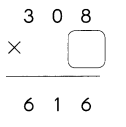
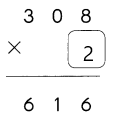
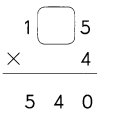
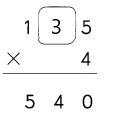
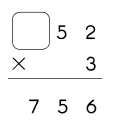
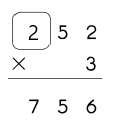
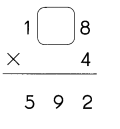
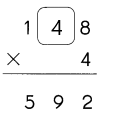
Math in Focus Grade 3 Mid Year Review Answer Key

Practice the problems of Math in Focus Grade 3 Workbook Answer Key Mid Year Review to score better marks in the exam.

Math in Focus Grade 3 Mid Year Review Answer Key

Mid-Year Review

Test Prep Multiple Choice

Fill in the circle next to the correct answer.

Question 1.
In the number 6,592, the digit 5 is in the ___ place. (Lesson 1.2)
(A) ones
(B) hundreds
(C) tens
(D) thousands
Answer: B
Explanation:
5 is in hundreds place
Each of these numerals has a different place value.
From left to right they are: thousands, hundreds, tens and ones.

Question 2.
Which number is 1,000 more than 1,629? (Lesson 1.3)
(A) 629
(B) 1,619
(C) 1,729
(D) 2,629
Answer: D
Explanation:
1000 + 1629 = 2629
Each of these numerals has a different place value.
From left to right they are: thousands, hundreds, tens and ones.

Question 3.
Estimate the sum of 342 and 525. Use front-end estimation. (Lesson 2.5)
(A) 300 + 500 = 800
(B) 300 + 530 = 830
(C) 340 + 500 = 840
(D) 340 + 530 = 870
Answer: A
Explanation:
300 + 500 = 800
Front-end estimation is a particular way of rounding numbers to estimate sums and differences. To use front- end estimation, add or subtract only the numbers in the greatest place value.

Question 4.
Estimate the difference between 828 and 535. Use rounding to the nearest hundred. (Lesson 2.4)
(A) 900 – 500 = 400
(B) 800 – 500 = 300
(C) 900 – 600 = 300
(D) 800 – 600 = 200
Answer: B
Explanation:
the difference between 828 and 535.
800 – 500 = 300
By rounding to the nearest hundred

Question 5.
0 × 9 = ____ (Lesson 6.1)
(A) 0
(B) 9
(C) 90
(D) 900
Answer: A
Explanation:
If a number is multiplied with 0 the product will be 0

Question 6.
To find the answer to 38 + 48, You can add 50 to ____ (Lesson 2.1)
(A) 38, then add 2
(B) 38, then subtract 2
(C) 48, then add 2
(D) 48, then subtract 2
Answer:  B
Explanation:
To find the answer to 38 + 48, You can add 50 to 38 and subtract 2
38 + 50 – 2 = 86

Question 7.
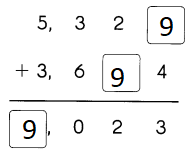
What is the missing digit? (Lesson 3.3)
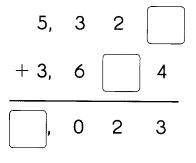
Math in Focus Grade 3 Mid Year Review Answer Key 1
(A) 1
(B) 2
(C) 5
(D) 9
Answer: D

Explanation:
5329 + 3694 = 9023
The missing digit is 9

Question 8.
There are four numbers on a whiteboard:
1,390, 1,125, 1,580, and 1,625.
The difference between two of the numbers is 235. What are the two numbers? (Lesson 4.3)
(A) 1,580 and 1,390
(B) 1,625 and 1,390
(C) 1,390 and 1,125
(D) 1,580 and 1,125
Answer: B
Explanation:
the two numbers are 1,625 and 1,390
1,625 and 1,390 = 235

Question 9.
How many numbers between 31 and 50 can be divided by 6 with no remainder? (Lesson 8.4)
(A) 1
(B) 2
(C) 3
(D) 4
Answer: C
Explanation:
the numbers between 31 and 50 = 18
18 ÷ 6 = 3

Question 10.
Add 4,786 and 1,078. (Lesson 3.3)
(A) 3,708
(B) 3,808
(C) 5,764
(D) 5,864
Answer: D
Explanation:
4,786 and 1,078. = 5864

Question 11.
Subtract 1,786 from 3,000. (Lesson 4.3)
(A) 1,204
(B) 1,214
(C) 2,786
(D) 4,786
Answer: B
Explanation:
The difference between 3000 – 1786 = 1214

Question 12.
215 × 4 = ___ (Lesson 7.3)
(A) 172
(B) 211
(C) 219
(D) 860
Answer: D
Explanation:
215 × 4 = 860
The product of 215 and 4 = 860

Question 13.
Which of the following is the same as 5 × 9? (Lesson 6.5)
(A) 9 + 5
(B) 5 + 5 + 9 + 9
(C) 5 + 5 + 5 + 5 + 5
(D) 9 + 9 + 9 + 9 + 9
Answer: D
Explanation:
5 x 9 = 9 + 9 + 9 + 9 +  9 = 45
5 x 9 = 9 + 9 + 9 + 9 +  9 are same.

Question 14.
Drew has 87 pebbles. He divides the pebbles equally into 3 bags. How many pebbles does he have in each bag? (Lesson 8.5)
(A) 29
(B) 84
(C) 90
(D) 261
Answer: A
Explanation:
Drew has 87 pebbles. He divides the pebbles equally into 3 bags.
87 ÷  3 = 29
29 pebbles that he have in each bag

Question 15.
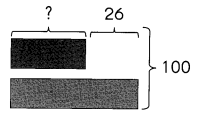
The sum of two numbers is 100. The difference between the two numbers is 26. What is the number that is less? (Lesson 5.1)
Math in Focus Grade 3 Mid Year Review Answer Key 3
(A) 13
(B) 24
(C) 37
(D) 63
Answer:  B
Explanation:
The sum of two numbers is 100
The difference between the two numbers is 26.
50 + 50 = 100
50 – 26 = 24

Short Answer
Read the questions carefully.
Write each answer in the space provided.

Question 16.
Write three thousand, fourteen in standard form. (Lesson 1.1)
_________
Answer:
3014
Explanation:
three thousand, fourteen in standard form is 3014

Question 17.
What is the value of the digit 5 in the number 5,631? (Lesson 1.2)
_________
Answer:
Thousand is the value of the digit 5 in the number 5,631
Explanation:
Each of these numerals has a different place value.
From left to right they are: thousands, hundreds, tens and ones.

Question 18.
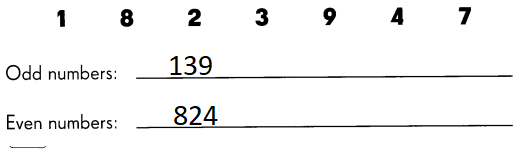
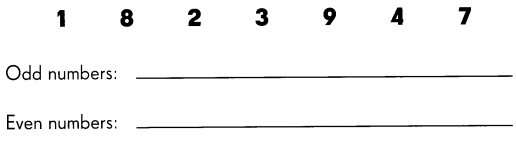
Use the digits below to make three 3-digit odd numbers and three 3-digit even numbers. Do not repeat the same digits in a number. (Lesson 8.3)
Math in Focus Grade 3 Mid Year Review Answer Key 4
Answer:

Explanation:
three 3-digit odd numbers = 139
and three 3-digit even numbers = 824
The numbers are not repeated

Question 19.
Add 1,850 + 59. (Lesson 3.2)
_________
Answer:
1909
Explanation:
The sum of 1850 + 59 = 1909

Question 20.
70 × 4 = ? (Lesson 17.1)
_________
Answer:
280
Explanation:
70 × 4 = 280
The product of 70 and 4 = 280

Question 21.
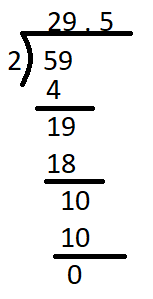
In 59 ÷ 2, the quotient is ___, and the remainder is ___ (Lesson 8.2)
Answer:
In 59 ÷ 2, the quotient is 29.5, and the remainder is 0
Explanation:
Question 22.
Shaun takes 300 photographs at the zoo. Sheena takes twice as many photographs as Shaun. How many photographs do they take in all? (Lesson 9.1)
____ photos
Answer:
900 photos
Explanation:
Shaun takes 300 photographs at the zoo.
Sheena takes twice as many photographs as Shaun.
300 x 2 = 600
600 + 300 = 900
900 photographs that they take in all

Question 23.
Shannon has 78 animal stickers. She has three times as many animal stickers as her brother, Ryan. How many animal stickers does Ryan have? (Lesson 9.3)
____ paperclips
Answer:
312 paperclips
Explanation:
Shannon has 78 animal stickers.
She has three times as many animal stickers as her brother, Ryan.
78 x 3 = 234
234 + 78 = 312
312  animal stickers that Ryan have

Question 24.
The sum of two numbers is 1,500. The difference between these two numbers is 300. Find these two numbers from the numbers provided. (Lessons 3.2 and 4.1)
1,200 600 300 700 800 900
__________
Answer:
900 + 600 = 1500
900 – 600 = 300
Explanation:
The sum of two numbers is 1,500.
The difference between these two numbers is 300.
two numbers from the numbers provided are 900 and 600

Question 25.
Caroline packs some glue sticks into 8 bags. She has 12 glue sticks left over. If there are 25 glue sticks in each bag, how many glue sticks did she have at first? (Lessons 7.3 and 3.1)
___________
Answer:
212 Glue sticks at first.
Explanation:
Caroline packs some glue sticks into 8 bags.
If there are 25 glue sticks in each bag,
25 x 8 = 200
total 200 bags
200 + 12 = 212 Glue sticks

Question 26.
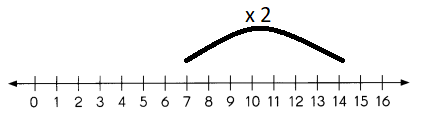
What is the product of 1 × 7 × 2?
Use the number lines to help you. (Lessons 6.1 and 6.2)
1 × 7 × 2 = 1 × ____
= ______

Math in Focus Grade 3 Mid Year Review Answer Key 5
1 × 7 × 2 = ___ × 2
= ______
Math in Focus Grade 3 Mid Year Review Answer Key 6
So, 1 × ___ = ___ × 2
= _____
Answer:
So, 1 × 14 = 7 × 2
= 14
Explanation:
1 × 7 × 2 = 1 × 14
= 14
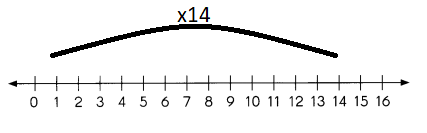
1 × 7 × 2 = 7 × 2
= 14
Question 27.
Find the sum of 938 and 8,163. (Lesson 3.3) 28. Find the difference between 6,215 and 8,356. (Lesson 4.3)
___________
Answer:
9101 , 2141
Explanation:
938 + 8,163 = 9101
the sum of 938 and 8,163 = 9101
6125 – 8356 = 2141
the difference between 6,215 and 8,356 = 2141

Question 29.
Find the product of 154 and 4. (Lesson 7.3)
_________
Answer:
616
Explanation:
The product of 154 and 4 is 616

Question 30.
Use the digits below to form two 2-digit numbers. Each number has a remainder of 1 when divided by 4. (Lesson 8.2)
1 3 7 9
__________
Answer:
17
Explanation:
The two digit number selected is 17
17 ÷ 4 = 4
and remainder = 1
4 x 4 = 16
17 – 16 = 1

Question 31.
Find the difference between 45 ÷ 5 and 5 × 7. (Lessons 4.3, 6.3, and 7.1)
___________
Answer:
26
Explanation:
45 ÷ 5 = 9
5 × 7 = 35
The difference between 45 ÷ 5 and 5 × 7
35 – 9 = 26

Question 32.
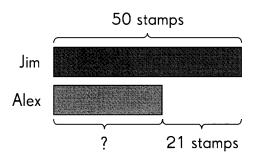
Use the model. How many stamps does Alex have? (Lesson 5.1)
Math in Focus Grade 3 Mid Year Review Answer Key 7
_____ stamps
Answer:
29 + 21 = 50
29 stamps
Explanation:
Alex and Jim has 100 stamps in all
Jim has 50 stamps
As the stamps are divided equally among Jim and Alex
both have 50 and 50
50 – 21 = 29

Question 33.
A craft store sells 1,1 24 fewer pieces of red art paper than blue art paper. It sells 2,317 pieces of red art paper. How many pieces of red and blue art paper does the craft store sell? (Lessons 3.3 and 4.3)
_____ pieces
Answer:
3510 pieces
Explanation:
A craft store sells 1,1 24 fewer pieces of red art paper than blue art paper.
It sells 2,317 pieces of red art paper.
2317 – 1124 = 1193
2317 + 1193 = 3510
3510 pieces of red and blue art paper that the craft store sell

Question 34.
Ngu walks 250 feet. She walks 65 feet more than Pauline. How far does Pauline walk? (Lesson 4.3)
____ feet
Answer:
315 feet
Explanation:
Ngu walks 250 feet.
She walks 65 feet more than Pauline.
250 +65 = 315
315 feet far that Pauline walk

Question 35.
Oomi makes 4 necklaces. She uses 156 beads for each necklace. How many beads does she use in all? (Lesson 7.3)
____ beads
Answer:
624 beads
Explanation:
Oomi makes 4 necklaces. She uses 156 beads for each necklace.
156 x 4 = 624
624 beads that she use in all

Extended Response

Solve. Show your work.

Question 36.
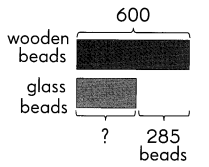
Jolene has 600 wooden beads. She has 285 fewer glass beads than wooden beads.

a. How many glass beads does Jolene have?
Math in Focus Grade 3 Mid Year Review Answer Key 8
Answer:
315 glass beads
Explanation:
The total of wooden beads and glass beads = 600 + 600 = 1200
Jolene have 600 – 285 = 315
315 glass beads that Jolene have

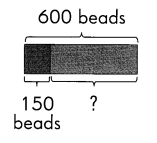
b. How many wooden beads does she have if she uses 150 of them to make necklaces?
Math in Focus Grade 3 Mid Year Review Answer Key 9
Answer:
600 – 150 = 450
Explanation:
450 wooden beads that she have if she uses 150 of them to make necklaces

Question 37.
Company A gets 3,700 hits on their website. Company B gets 450 fewer hits than Company A.

a. How many hits does Company B get?
Answer:
3700 – 450 = 3250
3250 hits that  Company B get

b. How many hits do both companies get in all?
Answer:
3700 + 3250 = 6950
6950 hits that both the companies get in all

Question 38.
Noah swims 80 laps in 5 days. He swims the same number of laps every day.

a. How many laps does he swim in a day?
Answer:
80 ÷ 5 = 16
16 laps that he swim in a day

b. How many laps does he swim in 4 days?
Answer:
16 x 4 = 64
64 laps that he swim in 4 days

Question 39.
Jose has 88 stickers. He puts 4 stickers on each bookmark. He gives all his bookmarks away to his friends. Each friend receives 2 bookmarks.

a. How many bookmarks does he put stickers on?
Answer:
Jose has 88 stickers. He puts 4 stickers on each bookmark.
88 ÷  4 = 22
He gives all his bookmarks away to his friends. Each friend receives 2 bookmarks.
22 ÷  2 = 11
22 bookmarks that he put stickers on

b. How many friends does he have?
Answer:
22 ÷  2 = 11
11 friends that he have

Question 40.
A factory delivers 5 containers of pottery to a store. Each container has 1 62 pieces of pottery. The store owner discovers 24 pieces of pottery are broken. How many pieces of pottery are not broken?
Answer:
786 pieces
Explanation:
A factory delivers 5 containers of pottery to a store.
Each container has 1 62 pieces of pottery.
162 x 5 = 810
The store owner discovers 24 pieces of pottery are broken.
810 -24 = 786
786 pieces of pottery are not broken
Math in Focus Grade 5 Chapter 1 Practice 1 Answer Key Numbers to 10,000,000

Go through the Math in Focus Grade 5 Workbook Answer Key Chapter 1 Practice 1 Numbers to 10,000,000 to finish your assignments.

Math in Focus Grade 5 Chapter 1 Practice 1 Answer Key Numbers to 10,000,000

Count on or back by ten thousand or hundred thousand. Then fill in the blanks.
Question 1.
40,000 50,000 60,000 _____ ____
Answer:
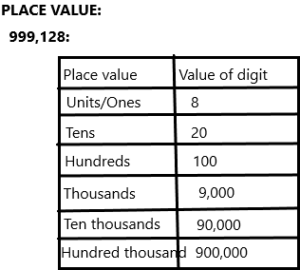
Place value in Maths describes the position or place of a digit in a number. Each digit has a place in a number. When we represent the number in the general form,  the position of each digit will be expanded. Those positions start from a unit place or we also call it one’s position. The order of place value of digits of a number of right to left is units, tens, hundreds, thousands, ten thousand, a hundred thousand, and so on.
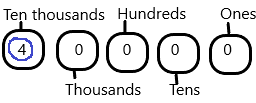
The number 40,000:
Math in Focus Grade 5 Chapter 1 Practice 1 Answer Key Numbers to 10,000,000 q1.1
The ten thousand place value for 40,000 is 4.
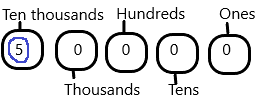
The number 50,000:
Math in Focus Grade 5 Chapter 1 Practice 1 Answer Key Numbers to 10,000,000 q1.2
The ten thousand place value for 50,000 is 5.
The number 60,000:
Math in Focus Grade 5 Chapter 1 Practice 1 Answer Key Numbers to 10,000,000 q1.3
The ten thousand place value for 60,000 is 6.

Question 2.
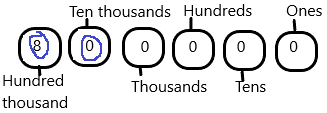
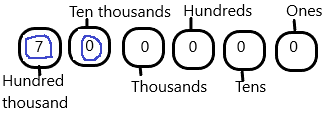
900,000 800,000 700,000 ___ _____
Answer:
Place value in Maths describes the position or place of a digit in a number. Each digit has a place in a number. When we represent the number in the general form,  the position of each digit will be expanded. Those positions start from a unit place or we also call it one’s position. The order of place value of digits of a number of right to left is units, tens, hundreds, thousands, ten thousand, a hundred thousand, and so on.
The number 900,000:
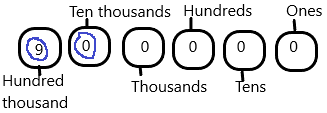
Math in Focus Grade 5 Chapter 1 Practice 1 Answer Key Numbers to 10,000,000 q2
The hundred thousand place value for 900,000 is 9
The ten thousand place value for 900,000 is 0.
The number 800,000:
Math in Focus Grade 5 Chapter 1 Practice 1 Answer Key Numbers to 10,000,000 q2.1
The hundred thousand place value for 800,000 is 8
The ten thousand place value for 800,000 is 0.
The number 700,000:
Math in Focus Grade 5 Chapter 1 Practice 1 Answer Key Numbers to 10,000,000 q2.2
The hundred thousand place value for 700,000 is 7.
The ten thousand place value for 700,000 is 0.

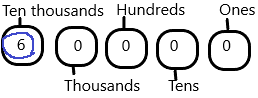
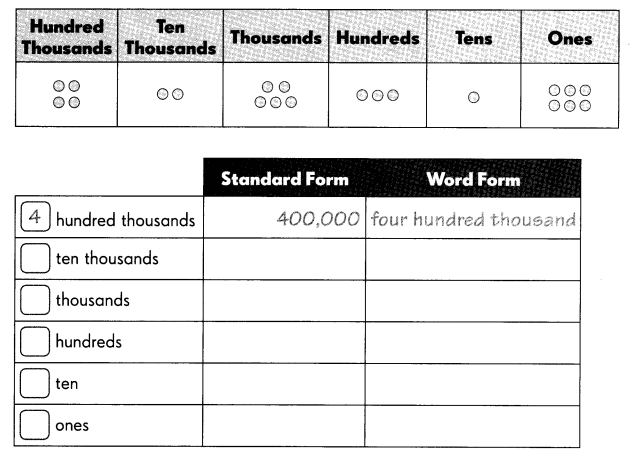
Complete the table. Then write the number in standard form and in word form.

Question 3.
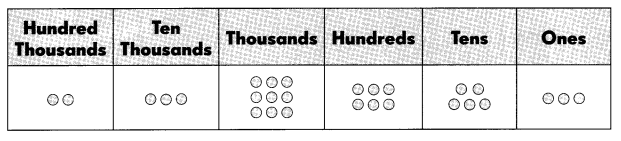
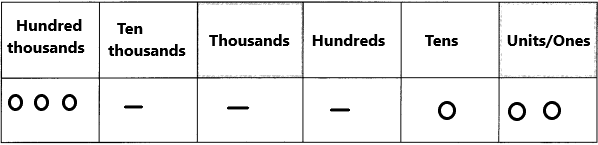
Math in Focus Grade 5 Chapter 1 Practice 1 Answer Key Numbers to 10,000,000 1
Number in standard form: ______
Number in word form: ______
Answer:
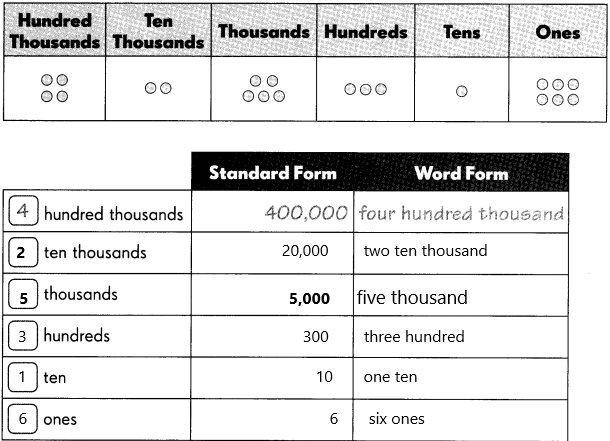
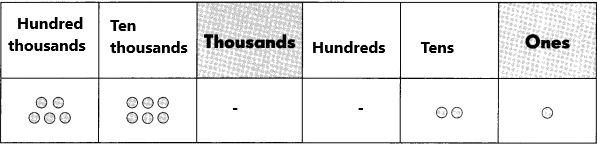
Place value in Maths describes the position or place of a digit in a number. Each digit has a place in a number. When we represent the number in the general form, the position of each digit will be expanded. Those positions start from a unit place or we also call it one’s position. The order of place value of digits of a number of right to left is units, tens, hundreds, thousands, ten thousand, a hundred thousand, and so on.
In Mathematics, place value charts help us to make sure that the digits are in the correct places. To identify the positional values of numbers accurately, first, write the digits in the place value chart and then write the numbers in the usual and the standard form.
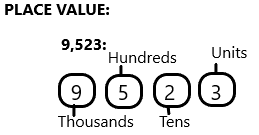
PLACE VALUE CHART:
Math in Focus Grade 5 Chapter 1 Practice 1 Answer Key Numbers to 10,000,000 q3
Number in standard form: 425,316
Number in word form: four hundred twenty-five thousand, three hundred sixteen.

Write each number in standard form.

Question 4.
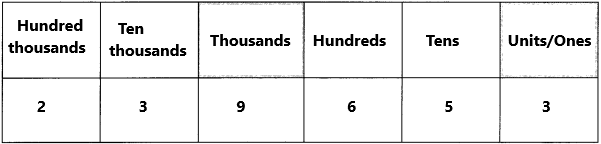
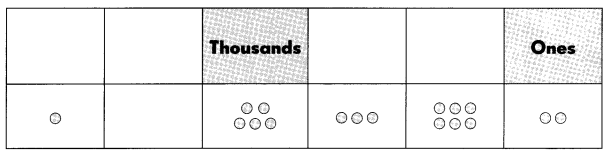
Math in Focus Grade 5 Chapter 1 Practice 1 Answer Key Numbers to 10,000,000 2
The number is ____.
Answer: 239,653
Place value in Maths describes the position or place of a digit in a number. Each digit has a place in a number. When we represent the number in the general form, the position of each digit will be expanded. Those positions start from a unit place or we also call it one’s position. The order of place value of digits of a number of right to left is units, tens, hundreds, thousands, ten thousand, a hundred thousand, and so on.
In Mathematics, place value charts help us to make sure that the digits are in the correct places. To identify the positional values of numbers accurately, first, write the digits in the place value chart and then write the numbers in the usual and the standard form.
PLACE VALUE CHART:
Math in Focus Grade 5 Chapter 1 Practice 1 Answer Key Numbers to 10,000,000 q4
Zeros may stand for nothing, but that doesn’t mean you can leave them out. They keep other digits in the correct places.
Think: 2 hundred thousands+3 ten thousands+9 thousands+6 hundreds+5 tens+3 ones
The standard form is 239,653.

Question 5.
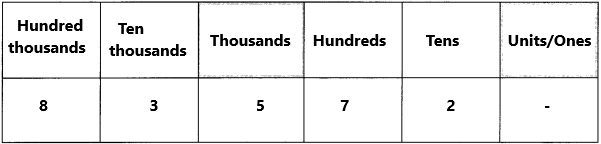
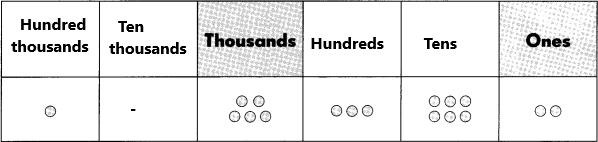
Math in Focus Grade 5 Chapter 1 Practice 1 Answer Key Numbers to 10,000,000 3
The number is ____.
Answer: 835,720
Place value in Maths describes the position or place of a digit in a number. Each digit has a place in a number. When we represent the number in the general form, the position of each digit will be expanded. Those positions start from a unit place or we also call it one’s position. The order of place value of digits of a number of right to left is units, tens, hundreds, thousands, ten thousand, a hundred thousand, and so on.
In Mathematics, place value charts help us to make sure that the digits are in the correct places. To identify the positional values of numbers accurately, first, write the digits in the place value chart and then write the numbers in the usual and the standard form.
PLACE VALUE CHART:
Math in Focus Grade 5 Chapter 1 Practice 1 Answer Key Numbers to 10,000,000 q5
Zeros may stand for nothing, but that doesn’t mean you can leave them out. They keep other digits in the correct places.
Think: 8 hundred thousands+3 ten thousands+5 thousands+7 hundreds+2 tens+0 ones
The standard form is 835,720.

Question 6.
eight hundred sixteen thousand, nine hundred forty-three _____
First, read the thousands period: eight hundred sixteen thousand – 816,000 Then, read the remaining period: nine hundred forty-three — 943
Answer: 816,943
Place value in Maths describes the position or place of a digit in a number. Each digit has a place in a number. When we represent the number in the general form, the position of each digit will be expanded. Those positions start from a unit place or we also call it one’s position. The order of place value of digits of a number of right to left is units, tens, hundreds, thousands, ten thousand, a hundred thousand, and so on.
In Mathematics, place value charts help us to make sure that the digits are in the correct places. To identify the positional values of numbers accurately, first, write the digits in the place value chart and then write the numbers in the usual and the standard form.
PLACE VALUE CHART:
Math in Focus Grade 5 Chapter 1 Practice 1 Answer Key Numbers to 10,000,000 q6
Zeros may stand for nothing, but that doesn’t mean you can leave them out. They keep other digits in the correct places.
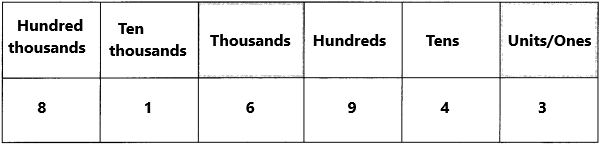
Think: 8 hundred thousands+1 ten thousands+6 thousands+9 hundreds+4 tens+3 ones
The standard form is 816,943.

Question 7.
six hundred five thousand, five hundred ____
Answer:
Place value in Maths describes the position or place of a digit in a number. Each digit has a place in a number. When we represent the number in the general form, the position of each digit will be expanded. Those positions start from a unit place or we also call it one’s position. The order of place value of digits of a number of right to left is units, tens, hundreds, thousands, ten thousand, a hundred thousand, and so on.
In Mathematics, place value charts help us to make sure that the digits are in the correct places. To identify the positional values of numbers accurately, first, write the digits in the place value chart and then write the numbers in the usual and the standard form.
PLACE VALUE CHART:
Math in Focus Grade 5 Chapter 1 Practice 1 Answer Key Numbers to 10,000,000 q7
Zeros may stand for nothing, but that doesn’t mean you can leave them out. They keep other digits in the correct places.
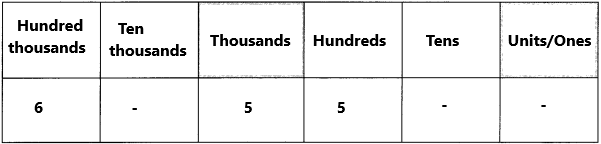
Think: 6 hundred thousands+0 ten thousands+5 thousands+5 hundreds+0 tens+0 ones
The standard form is 605,500.
First, read the thousands of period: 605,000. Then, read the remaining period: 500.

Question 8.
one hundred three thousand, thirty-one ____
Answer:
Place value in Maths describes the position or place of a digit in a number. Each digit has a place in a number. When we represent the number in the general form, the position of each digit will be expanded. Those positions start from a unit place or we also call it one’s position. The order of place value of digits of a number of right to left is units, tens, hundreds, thousands, ten thousand, a hundred thousand, and so on.
In Mathematics, place value charts help us to make sure that the digits are in the correct places. To identify the positional values of numbers accurately, first, write the digits in the place value chart and then write the numbers in the usual and the standard form.
PLACE VALUE CHART:
Math in Focus Grade 5 Chapter 1 Practice 1 Answer Key Numbers to 10,000,000 q8
Zeros may stand for nothing, but that doesn’t mean you can leave them out. They keep other digits in the correct places.
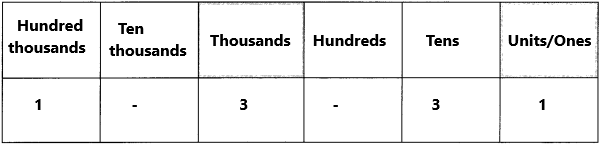
Think: 1 hundred thousands+0 ten thousands+3 thousands+0 hundreds+3 tens+1 ones
The standard form is 103,031.

Question 9.
eight hundred seventy thousand, three ____
Answer:
Place value in Maths describes the position or place of a digit in a number. Each digit has a place in a number. When we represent the number in the general form, the position of each digit will be expanded. Those positions start from a unit place or we also call it one’s position. The order of place value of digits of a number of right to left is units, tens, hundreds, thousands, ten thousand, a hundred thousand, and so on.
In Mathematics, place value charts help us to make sure that the digits are in the correct places. To identify the positional values of numbers accurately, first, write the digits in the place value chart and then write the numbers in the usual and the standard form.
PLACE VALUE CHART:
Math in Focus Grade 5 Chapter 1 Practice 1 Answer Key Numbers to 10,000,000 q9
Zeros may stand for nothing, but that doesn’t mean you can leave them out. They keep other digits in the correct places.
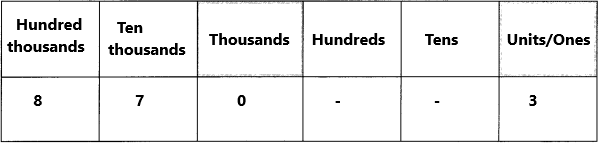
Think: 8 hundred thousands+7 ten thousands+0 thousands+0 hundreds+0 tens+3 ones
Write: 870,003.
Say: Eight hundred seventy thousand three.

Question 10.
three hundred thousand, twelve ___
Answer: 300,012
Place value in Maths describes the position or place of a digit in a number. Each digit has a place in a number. When we represent the number in the general form, the position of each digit will be expanded. Those positions start from a unit place or we also call it one’s position. The order of place value of digits of a number of right to left is units, tens, hundreds, thousands, ten thousand, a hundred thousand, and so on.
In Mathematics, place value charts help us to make sure that the digits are in the correct places. To identify the positional values of numbers accurately, first, write the digits in the place value chart and then write the numbers in the usual and the standard form.
PLACE VALUE CHART:
Math in Focus Grade 5 Chapter 1 Practice 1 Answer Key Numbers to 10,000,000 q10
Zeros may stand for nothing, but that doesn’t mean you can leave them out. They keep other digits in the correct places.
Think: 3 hundred thousands+0 ten thousands+0 thousands+0 hundreds+1 tens+2 ones
Write: 300,012
Say: Three hundred thousand twelve.

Fill in the headings. Write Tens, Hundreds, Ten Thousand, or Hundred Thousands. Then write each number in word form.

Question 11.
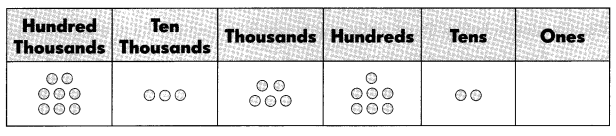
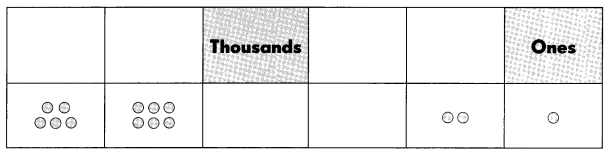
Math in Focus Grade 5 Chapter 1 Practice 1 Answer Key Numbers to 10,000,000 4
The number is _____
Answer:
Place value in Maths describes the position or place of a digit in a number. Each digit has a place in a number. When we represent the number in the general form, the position of each digit will be expanded. Those positions start from a unit place or we also call it one’s position. The order of place value of digits of a number of right to left is units, tens, hundreds, thousands, ten thousand, a hundred thousand, and so on.
In Mathematics, place value charts help us to make sure that the digits are in the correct places. To identify the positional values of numbers accurately, first, write the digits in the place value chart and then write the numbers in the usual and the standard form.
Math in Focus Grade 5 Chapter 1 Practice 1 Answer Key Numbers to 10,000,000 q11
Zeros may stand for nothing, but that doesn’t mean you can leave them out. They keep other digits in the correct places.
Think: 1 hundred thousands+0 ten thousands+5 thousands+3 hundreds+6 tens+2 ones
Write: 105,362.
Say One hundred five thousand, three hundred sixty-two.

Question 12.
Math in Focus Grade 5 Chapter 1 Practice 1 Answer Key Numbers to 10,000,000 5
The number is _____
Answer:
Place value in Maths describes the position or place of a digit in a number. Each digit has a place in a number. When we represent the number in the general form, the position of each digit will be expanded. Those positions start from a unit place or we also call it one’s position. The order of place value of digits of a number of right to left is units, tens, hundreds, thousands, ten thousand, a hundred thousand, and so on.
In Mathematics, place value charts help us to make sure that the digits are in the correct places. To identify the positional values of numbers accurately, first, write the digits in the place value chart and then write the numbers in the usual and the standard form.
Math in Focus Grade 5 Chapter 1 Practice 1 Answer Key Numbers to 10,000,000 q12
Zeros may stand for nothing, but that doesn’t mean you can leave them out. They keep other digits in the correct places.
Think: 5 hundred thousands+6 ten thousands+0 thousands+0 hundreds+2 tens+1 ones
Write:560,021.
Say five hundred sixty thousand, twenty-one.

Write each number in word form.
65,000 — sixty-five thousand
142 — one hundred forty-two

Question 13.
65, 142 _____
Answer:
Numbers in words are written using the English alphabet. Numbers can be expressed both in words and figures. For example, 100,000 in words is written as One Lakh or One hundred thousand. Numbers in words can be written for all the natural numbers, based on the place value of digits, such as ones, tens, hundreds, thousands, and so on.
The number 65,142 can be written in word form as:
sixty-five thousand, one hundred forty-two.
Zeros may stand for nothing, but that doesn’t mean you can leave them out. They keep other digits in the correct places.
Math in Focus Grade 5 Chapter 1 Practice 1 Answer Key Numbers to 10,000,000 q13
The given number 65,142: o hundred thousand+6 ten thousand+5 thousand+1 hundred+4 tens+2 ones.
Write: 65,142
Say: Sixty-five thousand, one hundred forty two.

Question 14.
368,400 _____
Answer:
Numbers in words are written using the English alphabet. Numbers can be expressed both in words and figures. For example, 100,000 in words is written as One Lakh or One hundred thousand. Numbers in words can be written for all the natural numbers, based on the place value of digits, such as ones, tens, hundreds, thousands, and so on.
The number 368,400 can be written in word form as:
Three hundred sixty-eight thousand, four hundred.
Zeros may stand for nothing, but that doesn’t mean you can leave them out. They keep other digits in the correct places.
Math in Focus Grade 5 Chapter 1 Practice 1 Answer Key Numbers to 10,000,000 q14
The given number 368,400: 3 hundred thousand+6 ten thousand+8 thousand+4 hundred+0 tens+0 ones.
Write: 368,400
Say: Three hundred sixty-eight thousand, four hundred.

Complete to express each number in word form.

Question 15.
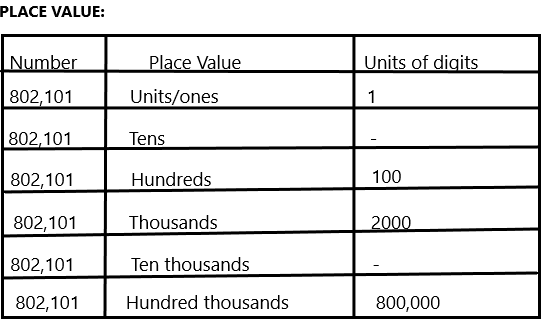
802,101 eight hundred two thousand, one hundred _________
Answer:
Numbers in words are written using the English alphabet. Numbers can be expressed both in words and figures. For example, 100,000 in words is written as One Lakh or One hundred thousand. Numbers in words can be written for all the natural numbers, based on the place value of digits, such as ones, tens, hundreds, thousands, and so on.
1. Place value tells you how much each digit stands for
2. Use a hyphen when you use words to write 2-digit numbers greater than 20 that have a digit other than zero in the one’s place.
3. A place-value chart tells you how many hundreds, tens, and ones to use.
The given number is 802,101 and this can be written in word form as:
Eight hundred two thousand, one hundred one.
Math in Focus Grade 5 Chapter 1 Practice 1 Answer Key Numbers to 10,000,000 q15

Question 16.
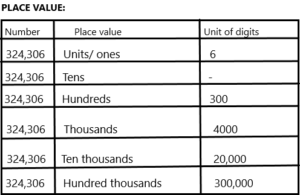
324,306 three hundred twenty-four ____, three hundred six
Answer:
Numbers in words are written using the English alphabet. Numbers can be expressed both in words and figures. For example, 100,000 in words is written as One Lakh or One hundred thousand. Numbers in words can be written for all the natural numbers, based on the place value of digits, such as ones, tens, hundreds, thousands, and so on.
1. Place value tells you how much each digit stands for
2. Use a hyphen when you use words to write 2-digit numbers greater than 20 that have a digit other than zero in the one’s place.
3. A place-value chart tells you how many hundreds, tens, and ones to use.
The given number is 324,306 and this can be written in word form as:
Three hundred twenty-four thousand, three hundred six.
Math in Focus Grade 5 Chapter 1 Practice 1 Answer Key Numbers to 10,000,000 q16

Question 17.
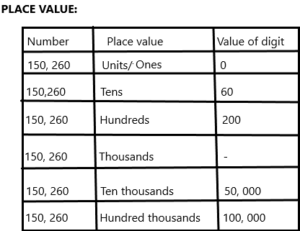
150,260 one hundred fifty thousand, ___ hundred sixty
Answer:
Numbers in words are written using the English alphabet. Numbers can be expressed both in words and figures. For example, 100,000 in words is written as One Lakh or One hundred thousand. Numbers in words can be written for all the natural numbers, based on the place value of digits, such as ones, tens, hundreds, thousands, and so on.
1. Place value tells you how much each digit stands for
2. Use a hyphen when you use words to write 2-digit numbers greater than 20 that have a digit other than zero in the one’s place.
3. A place-value chart tells you how many hundreds, tens, and ones to use.
The given number is 150, 260 and this can be written in word form as:
One hundred fifty thousand, two hundred sixty.
Math in Focus Grade 5 Chapter 1 Practice 1 Answer Key Numbers to 10,000,000 q17

Question 18.
999,1 98 nine hundred ___ thousand, one hundred ______________
Answer:
Numbers in words are written using the English alphabet. Numbers can be expressed both in words and figures. For example, 100,000 in words is written as One Lakh or One hundred thousand. Numbers in words can be written for all the natural numbers, based on the place value of digits, such as ones, tens, hundreds, thousands, and so on.

  • Place value tells you how much each digit stands for
  • Use a hyphen when you use words to write 2-digit numbers greater than 20 that have a digit other than zero in the one’s place.
  • A place-value chart tells you how many hundreds, tens, and ones to use.

The given number is 999,198 and this can be written in word form as:
Nine hundred ninety thousand, one hundred ninety-eight.
Math in Focus Grade 5 Chapter 1 Practice 1 Answer Key Numbers to 10,000,000 q20

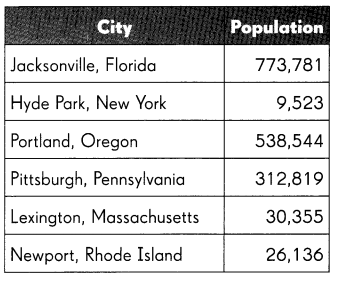
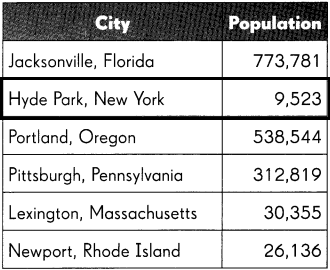
Use the table showing the populations of some cities to answer the questions.

Math in Focus Grade 5 Chapter 1 Practice 1 Answer Key Numbers to 10,000,000 6

Use the table showing the populations of some cities to answer the questions.

Question 19.
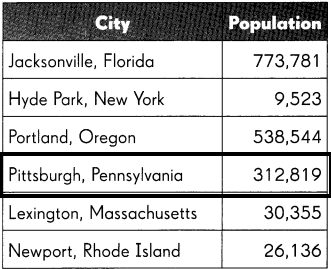
Write the population of Pittsburgh in word form.
Answer:
Numbers in words are written using the English alphabet. Numbers can be expressed both in words and figures. For example, 100,000 in words is written as One Lakh or One hundred thousand. Numbers in words can be written for all the natural numbers, based on the place value of digits, such as ones, tens, hundreds, thousands, and so on.
Math in Focus Grade 5 Chapter 1 Practice 1 Answer Key Numbers to 10,000,000
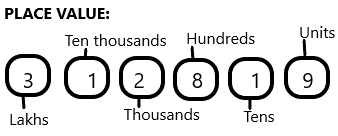
The population in Pittsburgh is 312,819.
In the word form, we can write as Three lakh twelve thousand eight hundred and nineteen.
Math in Focus Grade 5 Chapter 1 Practice 1 Answer Key Numbers to 10,000,000 q19

Question 20.
Which city has the least population? What is its population?
Answer: Hyde Park, New York.
Math in Focus Grade 5 Chapter 1 Practice 1 Answer Key Numbers to 10,000,000 q18
The least population of the city is Hyde Park, New York. And the population is 9,523.
The place value starts from thousands when compared to all the place values that’s why I choose New York which has the lowest population.
Math in Focus Grade 5 Chapter 1 Practice 1 Answer Key Numbers to 10,000,000 q18.1

Math in Focus Grade 5 Chapter 5 Practice 3 Answer Key Simplifying Algebraic Expressions

Go through the Math in Focus Grade 5 Workbook Answer Key Chapter 5 Practice 3 Simplifying Algebraic Expressions to finish your assignments.

Math in Focus Grade 5 Chapter 5 Practice 3 Answer Key Simplifying Algebraic Expressions

Simplify each expression.

Example
c + c + c + c = 4c

Question 1.
6p + 3 p =
Answer:
6p + 3 p = 9p
Explanation:
The given expression is 6p + 3p. Add 6p with 3p the sum is 9p.

Question 2.
b + 3 b + 5b =
Answer:
b + 3b + 5b = 9b
Explanation:
The given expression is b + 3b + 5b. Add b with 3b and 5b the sum is 9b.

Question 3.
10k – 3k =
Answer:
10k – 3k = 7k
Explanation:
The given expression is 10k – 3k. Subtract 3k from 10k the difference is 7k.

Question 4.
12p – 12p =
Answer:
12p – 12p = 0
Explanation:
The given expression is 12p – 12p. Subtract 12p from 12p the difference is 0.

Question 5.
6p – 2p – 3p =
Answer:
6p – 2p – 3p = 6p – 5p = 1p
Explanation:
The given expression is 6p – 2p – 3p. First add 2p and 3p the sum is 5p. Subtract 5p from 6p the difference is 1p.

Question 6.
10a – a + 2a =
Answer:
10a – a + 2a = 9a + 2a = 11a
Explanation:
The given expression is 10a – a + 2a. First subtract a from 10a the difference is 9a. Now add 9a with 2a the sum is 11a.

Question 7.
4c + c – 5c =
Answer:
4c + c – 5c = 5c – 5c = 0
Explanation:
The given expression is 4c + c – 5c. First add 4c with c the sum is 5c. Subtract 5c from 5c the difference is 0.

Question 8.
10f – 4f + f =
Answer:
10f – 4f + f = 6f + f = 7f
Explanation:
The given expression is 10f – 4f + f. First subtract 4f from 10f the difference is 6f. Add 6f with f the sum is 7f.

Simplify each expression.

Example
5x + 2x + 4 = 7x + 4

Question 9.
x + 5x – 9 =
Answer:
x + 5x – 9 = 6x – 9
Explanation:
The given expression is x + 5x – 9. Add x with 5x the sum is 6x. The simplified expression is 6x – 9.

Question 10.
2m + 4 + 6m =
Answer:
2m + 4 + 6m = 8m + 4
Explanation:
The given expression is 2m + 4 + 6m. Add 2m with 6m the sum is 8m. The simplified expression is 8m + 4.

Question 11.
10p – 4p – 5 =
Answer:
10p – 4p – 5 = 6p – 5
Explanation:
The given expression is 10p – 4p – 5. Subtract 4p from 10p the difference is 6p. The simplified expression is 6p – 5.

Question 12.
4 + 5k – 4k =
Answer:
4 + 5k – 4k = 4 + k
Explanation:
The given expression is 4 + 5k – 4k . Subtract 4k from 5k the difference is k. The simplified expression is 4 + k.

Question 13.
2 + 6b – 1 + 4b =
Answer:
2 + 6b – 1 + 4b = 1 +10b
Explanation:
The given expression is 2 + 6b – 1 + 4b. Subtract 1 from 2 the difference is 1. Add 6b with 4b the sum is 10b. The simplified expression is 1 + 10b.

Question 14.
5c + 3 – 2c + 5 =
Answer:
5c + 3 – 2c + 5 = 3c + 8
Explanation:
The given expression is 5c + 3 – 2c + 5. Subtract 2c from 5c the difference is 3c. Add 3 with 5 the sum is 8. The simplified expression is 3c + 8.

Question 15.
9e – 2e + 3 + 5e =
Answer:
9e – 2e + 3 + 5e = 7e + 5e + 3 = 12e + 3
Explanation:
The given expression is 9e – 2e + 3 + 5e. Subtract 2e from 9e the difference is 7e. Add 7e with 5e the sum is 12e. The simplified expression is 12e + 3.

Question 16.
6h + 12 + 2h – 6 =
Answer:
6h + 12 + 2h – 6 = 8h + 6
Explanation:
The given expression is 6h + 12 + 2h – 6. Subtract 6 from 12 the difference is 6. Add 6h with 2h the sum is 8h. The simplified expression is 8h + 6.

Write an algebraic expression for each situation.

Question 17.
The length of a piece of fabric is 8y yards. London cuts 7 yards from it to make some cushion covers. He then cuts another 3y yards to make a curtain. The remaining material is cut into 4 equal pieces. How long is each piece?
Answer:
The length of a piece of fabric is 8y yards. London cuts 7 yards from it to make some cushion covers.
(8y – 7) yards
He then cuts another 3y yards to make a curtain.
(8y – 7 – 3y) yards
The remaining material is cut into 4 equal pieces.
(8y – 7 – 3y)/4 yards
(5y – 7)/4 yards

Question 18.
Ling has 4m pounds of flour. She buys another 2 packages of flour, each weighing m pounds. How much flour does Ling have now in terms of m?
Answer:
The algebraic expression is 4m + 2m = 6m.
Explanation:
Ling has 4m pounds of flour. She buys another 2 packages of flour, each weighing m pounds. The 2 packages of flour is represented as 2m. Add 4m with 2m the sum is 6m. Ling have 6m pounds of flour.

Question 19.
On Monday, Linus made 5k paper cranes and gave 2k paper cranes to his friends. On Tuesday, he made another 4k paper ‘ cranes. His friend gave him 5 paper cranes. How many paper cranes does he have now in terms of k?
Answer:
On Monday, Linus made 5k paper cranes and gave 2k paper cranes to his friends.
5k – 2k = 3k
On Tuesday, he made another 4k paper ‘ cranes. His friend gave him 5 paper cranes.
4k + 5k = 9k
3k + 9k = 12k
Now, he have 12k paper cranes.

Question 20.
At the market, a pear costs b cents and an apple costs 7 cents less than a pear. Randy buys 4 pears and an apple. How much does Randy pay in terms of b?
Answer:
The cost of pears is b cents.
The cost of an apple is 7 cents less than a pear = b – 7
Randy buys 4 pears and an apple.
4b + b – 7 = 5b – 7
At the market, Randy pays 5b -7.

Math in Focus Grade 5 Chapter 10 Answer Key Percent

Practice the problems of Math in Focus Grade 5 Workbook Answer Key Chapter 10 Percent to score better marks in the exam.

Math in Focus Grade 5 Chapter 10 Answer Key Percent

Math Journal

Arnold had dinner at a restaurant with his family. The dinner cost $72. In addition, he paid 7% meals tax on the dinner. How much did Arnold pay for the dinner?

Tyrone worked out the answer using his calculator like this:
93% × $72 = $66.96
Brandon worked out the answer using his calculator like this:
107% × $72 = $77.04
Whose answer is correct? Explain why his answer is correct.
Answer:
Brandon answer is correct
Explanation:
Arnold paid
7% of tax and 100% of his bill
107% × $72 = $77.04
or
Arnold paid
$72 + $7% = $72 + $5.04 = $77.04

Put on Your Thinking Cap! 

Challenging Practice

Solve. Show your work.

Question 1.
Mr. Stanton bought a cell phone at 80% of the regular price. The regular price of the phone was $450. Mr. Wilson bought the same cell phone but paid $500 for it. How much more did Mr. Wilson pay than Mr. Stanton?
Answer:
140 more did Mr. Wilson pay than Mr. Stanton
Explanation:
Cell phone regular price is $450
Mr. Stanton paid 80% of 450 = $360
80% x $450= $360
Mr. Wilson paid $500
500 – 360 = 140
Mr. Wilson pay 140 more than Mr. Stanton.

Question 2.
Helen has 30 tickets. Gina has 20 more tickets than Helen. What percent of her tickets must Gina give Helen so that both of them have the same number of tickets?
Answer: 20%
Explanation:
Helen has 30 tickets.
Gina has 20 more tickets than Helen = 30 + 20 = 50 tickets
20 percent of her tickets must Gina give Helen so that both of them have the same number of tickets
such that both can have 40 tickets
Gina has 50 tickets
if she give 10 tickets to Helen ,now both are 40 tickets
20% of 50 is 10

Put on Your Thinking cap!

Problem Solving

Solve. Show your work.

Michelle collects U.S., Canadian, and Mexican stamps. In her collection, 80% of the stamps are U.S. and Mexican stamps. There are 3 times as many U.S. stamps as Mexican stamps. What percent of Michelle’s collection is made up of U.S. stamps?
Answer:
53.4%
Explanation:
100% of U.S. stamps + Canadian stamps + Mexican stamps
80% of the stamps are U.S. stamps + Mexican stamps
20% Canadian stamps
let Mexican stamp is x then
U.S stamps 3x
What percent of Michelle’s collection is made up of U.S. stamps?
80%  —– 3X
?       —– X
26.6 % Mexican
80% – 26.6% = 53.4%

Math in Focus Grade 5 Chapter 12 Practice 2 Answer Key Angles at a Point

This handy Math in Focus Grade 5 Workbook Answer Key Chapter 12 Practice 2 Angles at a Point provides detailed solutions for the textbook questions.

Math in Focus Grade 5 Chapter 12 Practice 2 Answer Key Angles at a Point

In each figure, the rays meet at a point. Use a protractor to find unknown angle measures.

Question 1.
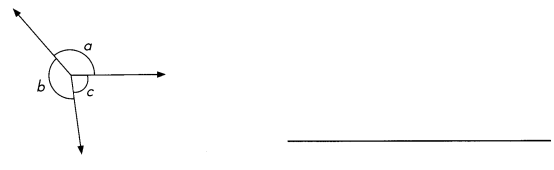
Math in Focus Grade 5 Chapter 12 Practice 2 Answer Key Angles at a Point 1
m∠a = ___
m∠b = ___
m∠c = ____
m∠a + m∠b + m∠c = ___ + ___ + ___
= ____
Answer:
m∠a = 120°
m∠b = 90°
m∠c = 150°
m∠a + m∠b + m∠c = 120° + 90° + 150° = 360°
Explanation:
Angle less than 180° is obtuse angle.
m∠a = 120°
m∠c = 150°
Angle 90° is Right angle triangle.
m∠b = 90°
Add all the angles to get a complete angle.
m∠a + m∠b + m∠c = 120° + 90° + 150° = 360°

Question 2.
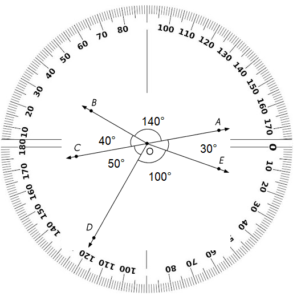
Math in Focus Grade 5 Chapter 12 Practice 2 Answer Key Angles at a Point 2
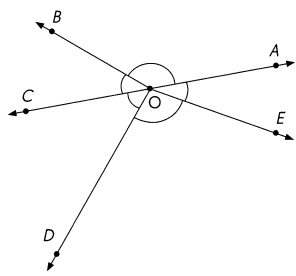
m∠AOB = ___
m∠BOC = ___
m∠COD = ____
m∠DOE = _____
m∠AOE = ____
m∠AOB + m∠BOC + m∠COD + m∠DOE + m∠AOE
= ___ + ___ + ___ + ___ + ____
= ____
Answer:
m∠AOB = 140°
m∠BOC = 40°
m∠COD = 50°
m∠DOE = 100°
m∠AOE = 30°
m∠AOB + m∠BOC + m∠COD + m∠DOE + m∠AOE
= 140°+40°+50°+100°+30°= 360° is called a complete angle.
Explanation:

m∠AOB = 140°
m∠DOE = 100°
Angle less than 180° is obtuse angle.
m∠BOC = 40°
m∠COD = 50°
m∠AOE = 30°
Angle 90° is Right angle triangle.
Add all the angles to show complete angle.
m∠AOB + m∠BOC + m∠COD + m∠DOE + m∠AOE
= 140°+40°+50°+100°+30°= 360°


Name the angles at a point.

Question 3.
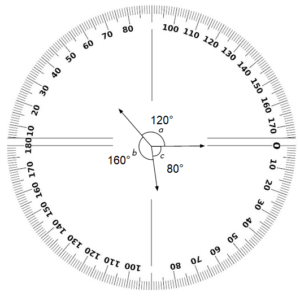
Math in Focus Grade 5 Chapter 12 Practice 2 Answer Key Angles at a Point 3
Answer:
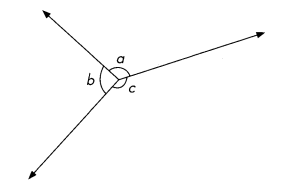
∠a = 120°
∠b= 80°
∠c = 160°
∠a + ∠b + ∠c = 120° + 80° + 160° = 360°
Explanation:
∠a = 120° and ∠c = 160° are obtuse angles.
∠b = 80° is acute angle.
∠a + ∠b + ∠c = 120° + 80° + 160° = 360°

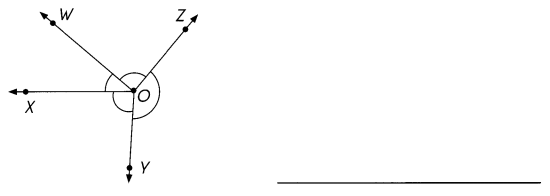
Question 4.
Math in Focus Grade 5 Chapter 12 Practice 2 Answer Key Angles at a Point 4
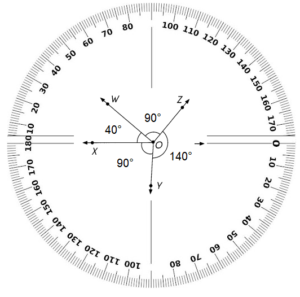
Answer:
m∠XOW = 40°
m∠ZOW = 90°
m∠ZOY = 140°
m∠XOY=90°
m∠XOY + m∠XOW + m∠ZOW + m∠ZOY + m∠XOY
= 40° + 90° + 140° + 90° = 360°
Explanation:


In the above picture
m∠ZOW = 90° and m∠XOY=90° are right angles.
m∠XOW = 40° is acute angle as the angle is less than 90°
m∠ZOY = 140° is obtuse angle as the angle is less than 180°
Add all the angles to get complete angle.
m∠XOY + m∠XOW + m∠ZOW + m∠ZOY + m∠XOY
= 40° + 90° + 140° + 90° = 360°

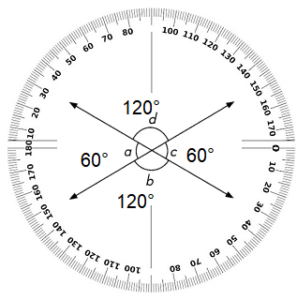
Question 5.
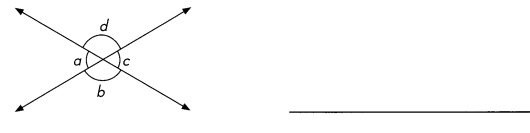
Math in Focus Grade 5 Chapter 12 Practice 2 Answer Key Angles at a Point 5
Answer:
∠a = 60°
∠b= 120°
∠c = 60°
∠d= 120°
∠a + ∠b + ∠c +∠d = 60°+ 120° + 60° + 120° = 360°
Explanation:


As shown in the above picture
∠a + ∠c= 60° are acute angles as the angle is less than 90°
∠b  and ∠d = 120° are obtuse angles as the angle is less than 180°
Add all the angles to get complete angle.
∠a + ∠b + ∠c +∠d = 60°+ 120° + 60° + 120° = 360°

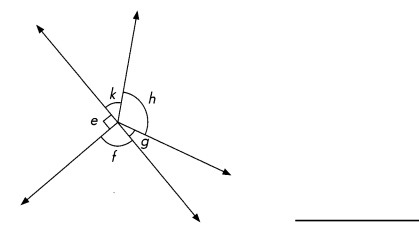
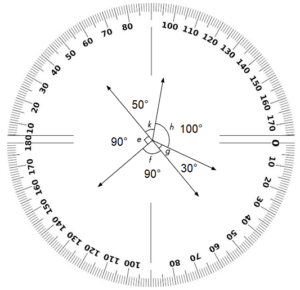
Question 6.
Math in Focus Grade 5 Chapter 12 Practice 2 Answer Key Angles at a Point 6
Answer:
∠e = 90°
∠f  = 90°
∠g = 30°
∠h = 100°
∠k = 50°
∠e + ∠f + ∠g +∠h + ∠k =  90° + 90°+ 30° + 100° + 50° = 360°
Explanation:

As shown in the above picture
∠g = 30° and ∠k= 50° are acute angles as the angle is less than 90°
∠e = 90° and ∠f= 90° are right angles as the angle is 90°
∠h = 100° is obtuse angle as the angle is less than 180°
Add all the angles to get complete angle.
∠e + ∠f + ∠g +∠h + ∠k =  90° + 90°+ 30° + 100° + 50° = 360°

Find the unknown angle measures.

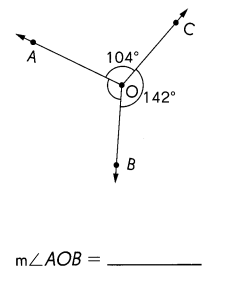
Question 7.
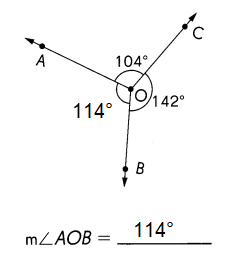
Find the measure of ∠AOB.
Math in Focus Grade 5 Chapter 12 Practice 2 Answer Key Angles at a Point 7
Answer: 114°
Explanation:
complete angle is 360°
∠AOC +∠COB = 104° + 142° = 246°
∠AOB = 360° – 246° = 114°

Question 8.
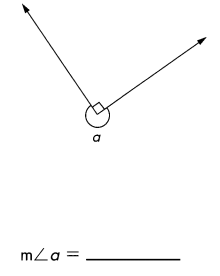
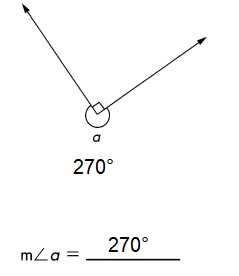
Find the measure of ∠a.
Math in Focus Grade 5 Chapter 12 Practice 2 Answer Key Angles at a Point 8
Answer: 270°
Explanation:
complete angle is 360°
360°- 90° = 270°

Question 9.
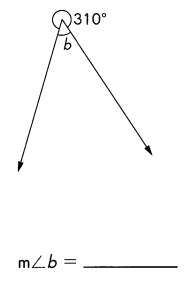
Find the measure of ∠b.
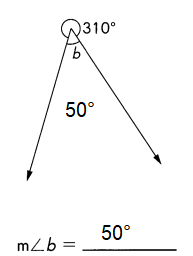
Math in Focus Grade 5 Chapter 12 Practice 2 Answer Key Angles at a Point 9
Answer: 50°
Explanation:
complete angle is 360°
360°- 310° = 50°

Question 10.
Find the measure of ∠c.
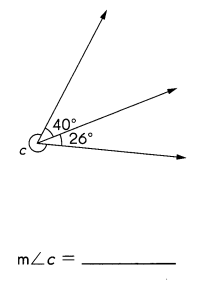
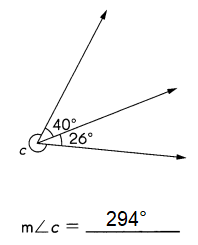
Math in Focus Grade 5 Chapter 12 Practice 2 Answer Key Angles at a Point 10
Answer: 294°
Explanation:
complete angle is 360°
given information
40°+ 26° = 66°
360°- 66° = 294°

Find the unknown angle measures.

Question 11.
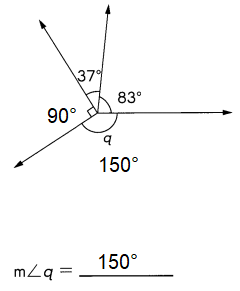
Find the measure of ∠q.
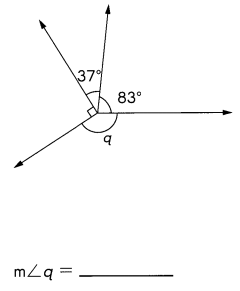
Math in Focus Grade 5 Chapter 12 Practice 2 Answer Key Angles at a Point 11
Answer: 150°
Explanation:
complete angle is 360°
given information
90°+37°+ 83° = 210°
360°- 210° = 150°

Question 12.
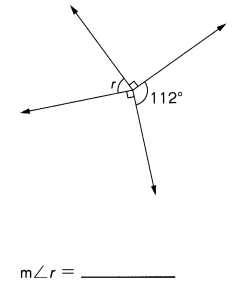
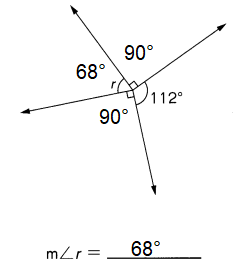
Find the measure of ∠r.
Math in Focus Grade 5 Chapter 12 Practice 2 Answer Key Angles at a Point 12
Answer: 68°
Explanation:
complete angle is 360°
given information
90°+90°+ 112° = 292°
360°- 292° = 68°

Question 13.
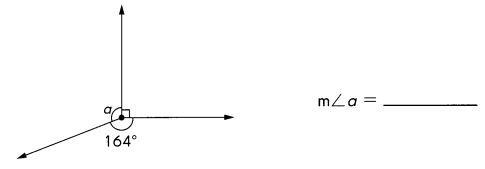
Find the measure of ∠a.
Math in Focus Grade 5 Chapter 12 Practice 2 Answer Key Angles at a Point 13
Answer: 106°
Explanation:
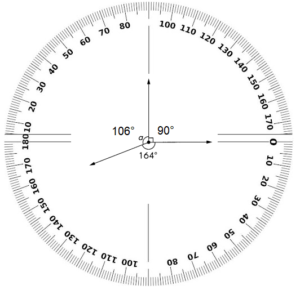
complete angle is 360°
given information
90°+164° = 254°
360°- 292° = 106°

Question 14.
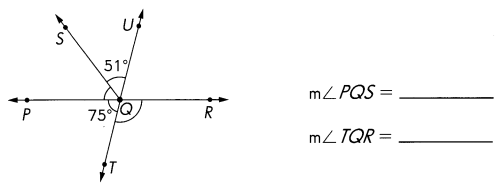
\(\overleftrightarrow{P R}\) and \(\overleftrightarrow{T U}\) meet at Q. Find the measures of ∠PQSand ∠TQR.
Math in Focus Grade 5 Chapter 12 Practice 2 Answer Key Angles at a Point 14
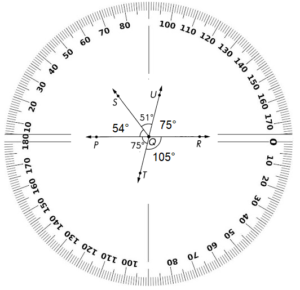
Answer:
m∠PQS = 54°
m∠TQR = 105°
Explanation:
complete angle is 360°
given information
∠PQT = 75° = ∠UQR
∠PQS = 180° – 51° + 75° = 54°
∠TQR = 180° – 75° = 105°

Math in Focus Grade 3 Chapter 16 Answer Key Time and Temperature

This handy Math in Focus Grade 3 Workbook Answer Key Chapter 16 Time and Temperature provides detailed solutions for the textbook questions.

Math in Focus Grade 3 Chapter 16 Answer Key Time and Temperature

Math Journal

Example

Question 1.
Here are the steps to do this subtraction exercise:
4 h 30 min – 2 h 45 min
Step 1: Regroup the 4 h to 3 h 60 min.
Step 2: Add 60 min to 30 min to get 90 min.
Step 3: Subtract 45 min from 90 min to get 45 min.
Step 4: Subtract 2 h from 3 h to get 1 h.
Step 5: Add 1 h and 45 min to get 1 h 45 min.

The steps to express time in hours and minutes are not in order.
Fill in the blanks.
320 min _____ h _____ min
Order the steps by writing the step numbers ¡n the boxes.
Math in Focus Grade 3 Chapter 16 Answer Key Time and Temperature 1 320 min is 5 h 20 min.
Math in Focus Grade 3 Chapter 16 Answer Key Time and Temperature 1 Subtract 300 min from 320 min to get 20 min.
Math in Focus Grade 3 Chapter 16 Answer Key Time and Temperature 1 Think 1 h = 60 mm, 5 h = 300 min. So, regroup 300 min to 5 h.
Answer:
320 can be written as 300 and 20
300 min to hours=300/60=5
5 h 20 min.
Ordered in steps:
Step 1: Think 1 h = 60 mm, 5 h = 300 min. So, regroup 300 min to 5 h.
Step 2: Subtract 300 min from 320 min to get 20 min.
Step 3: 320 min is 5 h 20 min.
Question 2.
David wanted to find out how much time Garrett took to make a kite. Garrett started at 2:20 P.M. and ended at 5:05 P.M. David drew this timeline to help him find how much time had passed:
Math in Focus Grade 3 Chapter 16 Answer Key Time and Temperature 2
The time line did not help him. Can you improve the timeline so that it is easier for him to find how much time had passed?
Math in Focus Grade 3 Chapter 16 Answer Key Time and Temperature 3
Answer:
The started time =2:20 PM
The ending time=5:05 PM
The elapsed time =?
There might be a chance of 3 h 25 min.
Math in Focus Grade 3 Chapter 16 Answer Key Time and Temperature q3
Question 3.
Imagine you and your friends are outdoors. The temperature is 90°F. Describe two activities you and your friends might want to do and the clothes that all of you should wear. Explain your thinking.
Answer:
The temperature feels like 90°F then it is hot.
– Wear protective clothing. Lightweight, light-coloured and loose-fitting clothing helps protect against heat. Change clothing if it gets completed
– Stay hydrated. Drink plenty of fluids; drink about 16 ounces before starting and 5 to 7 ounces every 15 or 20 minutes.
– Avoid dehydrating liquids. Alcohol, coffee, tea and caffeinated soft drinks can hurt more than help.
– Schedule frequent breaks. Take time for rest periods and water breaks in a shaded or air-conditioned area.

Put on Your  Thinking Cap!

Challenging Practice

Solve.

Question 1.
Math in Focus Grade 3 Chapter 16 Answer Key Time and Temperature 4
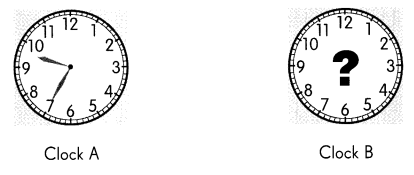
Clock A is 25 minutes slow.
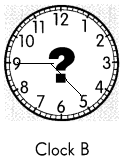
Clock B is 10 minutes fast.
a. What is the actual time?
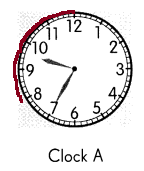
Answer: 10:00
Math in Focus Grade 3 Chapter 16 Answer Key Time and Temperature q1
From 9:35 we need to calculate up to 25 min.
We need to count forward for 25 min.
The 25 min from 9:35 is 10:00.

b. What is the time shown on Clock B?
Math in Focus Grade 3 Chapter 16 Answer Key Time and Temperature 5
Answer: 9:25
Math in Focus Grade 3 Chapter 16 Answer Key Time and Temperature q2
The time is fast in the clock B.
We need to count back by 10 min.
So the time is 9:25.
Put On Your Thinking Cap!

Problem Solving

Scientists in Snowland found that it is warmer in January than in July. It is warmer in July than in June. October is warmer than July but colder than January. List these months in order from warmest to coldest.
Math in Focus Grade 3 Chapter 16 Answer Key Time and Temperature 6
Answer:
The months which are warmer: January, July, October.
The months which are coldest: July, June, October.
The months from warmest to coldest: January, July, June, October.


Math in Focus Grade 4 Chapter 8 Practice 3 Answer Key Subtracting Decimals

Practice the problems of Math in Focus Grade 4 Workbook Answer Key Chapter 8 Practice 3 Subtracting Decimals to score better marks in the exam.

Math in Focus Grade 4 Chapter 8 Practice 3 Answer Key Subtracting Decimals

Fill in the blanks. Write each difference as a decimal.

Example
0.9 – 0.4 = 9 tenths – 4 tenths
= 5 tenths
= 0.5

Question 1.
1 – 0.3 = ___ tenths – ___ tenths
= ___ tenths
= ____
Answer:
1 – 0.3 = 0.7.

Explanation:
1 – 0.3 = 10 tenths – 3 tenths
= 7 tenths
= 0.7.

Question 2.
1.3 – 0.6 = ___ tenths – ___ tenths
= ___ tenths
= ____
Answer:
1.3 – 0.6 = 0.7.

Explanation:
1.3 – 0.6 = 13 tenths – 6 tenths
= 7 tenths
= 0.7.

Question 3.
1.8 – 0.9 = ___ tenths – ___ tenths
= ___ tenths
= ____
Answer:
1.8 – 0.9 = ___ tenths – ___ tenths
= ___ tenths
= ____

Explanation:
1.8 – 0.9 = 18 tenths – 9 tenths
= 9 tenths
= 0.9.

Fill in the blanks.
Question 4.
Step 1
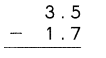
Math in Focus Grade 4 Chapter 8 Practice 3 Answer Key Subtracting Decimals 10
You cannot subtract 7 tenths from 5 tenths. So, regroup 3 ones and 5 tenths. 3 ones and 5 tenths
= ___ ones and ___ tenths
Subtract the tenths.
___ tenths – 7 tenths = ____ tenths
Step 2
Math in Focus Grade 4 Chapter 8 Practice 3 Answer Key Subtracting Decimals 11
Subtract the ones.
___ ones – ___one
= ___ one
So, 3.5 – 1.7 = ____
Answer:
3.5 – 1.7 = 1.8.

Explanation:
Step 1 :
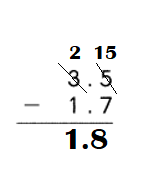
Math in Focus Grade 4 Chapter 8 Practice 3 Answer Key Subtracting Decimals 10
You cannot subtract 7 tenths from 5 tenths. So, regroup 3 ones and 5 tenths. 3 ones and 5 tenths
= 2 ones and 15 tenths
Subtract the tenths.
15 tenths – 7 tenths = 8 tenths.
Step 2 :
Math-in-Focus-Grade-4-Chapter-8-Practice-3-Answer-Key-Subtracting-Decimals-Fill in the blanks-4

Subtract the ones.
2 ones – 1 one
= 1 one.
So, 3.5 – 1.7 = 1.8.

Subtract.
Question 5.
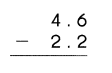
Math in Focus Grade 4 Chapter 8 Practice 3 Answer Key Subtracting Decimals 12
Answer:
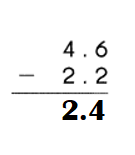
4.6 – 2.2 = 2.4.

Explanation:
Step 1 :
Math in Focus Grade 4 Chapter 8 Practice 3 Answer Key Subtracting Decimals 12

Subtract the tenths :
6 tenths – 2 tenths = 4 tenths.

Step 2 :
Math-in-Focus-Grade-4-Chapter-8-Practice-3-Answer-Key-Subtracting-Decimals-Fill in the blanks-5

Subtract the ones.
4 ones – 2 ones
= 2 ones.
So, 4.6 – 2.2 = 2.4.

Question 6.
Math in Focus Grade 4 Chapter 8 Practice 3 Answer Key Subtracting Decimals 13
Answer:
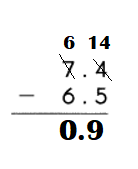
7.4 – 6.5 = 0.9.

Explanation:
Step 1 :
Math in Focus Grade 4 Chapter 8 Practice 3 Answer Key Subtracting Decimals 13
You cannot subtract 5 tenths from 4 tenths. So, regroup 7 ones and 4 tenths. 7 ones and 4 tenths
= 6 ones and 14 tenths.
Subtract the tenths.
14 tenths – 5 tenths = 9 tenths.
Step 2 :
Math-in-Focus-Grade-4-Chapter-8-Practice-3-Answer-Key-Subtracting-Decimals-Fill in the blanks-6

Subtract the ones.
6 ones – 6 ones
= 0 ones.
So, 7.4 – 6.5 = 0.9.

Write in vertical form. Then subtract.
Question 7.
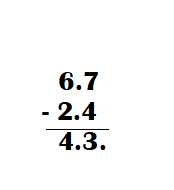
6.7 – 2.4 = ___
Answer:
6.7 – 2.4 = 4.3.

Explanation:
Math-in-Focus-Grade-4-Chapter-8-Practice-3-Answer-Key-Subtracting-Decimals-Write in vertical form-Then subtract-7


Question 8.
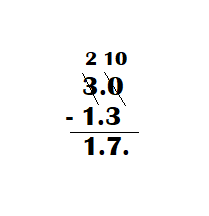
3 – 1.3 = ____
Answer:
3 – 1.3 = 1.7.

Explanation:
Math-in-Focus-Grade-4-Chapter-8-Practice-3-Answer-Key-Subtracting-Decimals-Write in vertical form-Then subtract-8

Fill in the blanks. Write each difference as a decimal.
Example
0.08 – 0.02 = 8 hundredths – 2 hundredths
= 6 hundredths
= 0.06

Question 9.
0.23 – 0.19 = ___ hundredths – ___ hundredths
= ___ hundredths
= ____
Answer:
0.23 – 0.19 = 0.04.

Explanation:
0.23 – 0.19 = 23 hundredths – 19 hundredths
= 4 hundredths
= 0.04.

Question 10.
0.1 – 0.06 = ___ hundredths – ___ hundredths
= ___ hundredths
= ____
Answer:
0.1 – 0.06 = 0.94.

Explanation:
0.1 – 0.06 = 100 hundredths – 6 hundredths
= 94 hundredths
= 0.94.

Fill in the blanks.
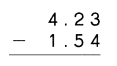
Question 11.
Step 1
Math in Focus Grade 4 Chapter 8 Practice 3 Answer Key Subtracting Decimals 14
You cannot subtract 4 hundredths from 3 hundredths. So, regroup 2 tenths 3 hundredths.
2 tenths 3 hundredths
= ___ tenth ___ hundredths
Subtract the hundredths.
___ hundredths – ___ hundredths
= ___ hundredths
Step 2
Math in Focus Grade 4 Chapter 8 Practice 3 Answer Key Subtracting Decimals 15
You cannot subtract 5 tenths from ___ tenth.
So, regroup 4 ones and ___ tenth.
4 ones and ___ tenth
= ___ ones and ___ tenths
Subtract the tenths.
___ tenths – 5 tenths = ___ tenths
Step 3
Math in Focus Grade 4 Chapter 8 Practice 3 Answer Key Subtracting Decimals 16
Subtract the ones.
___ ones – 1 one = ___ ones
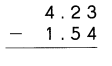
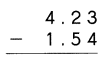
So, 4.23 – 1.54 = ___

Answer:
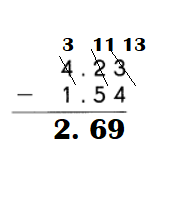
4.23 – 1.54 = 2.69.

Explanation:
Step 1:
Math in Focus Grade 4 Chapter 8 Practice 3 Answer Key Subtracting Decimals 14
You cannot subtract 4 hundredths from 3 hundredths. So, regroup 2 tenths 3 hundredths.
2 tenths 3 hundredths
= 1 tenth 13 hundredths
Subtract the hundredths.
13 hundredths – 4 hundredths
= 9 hundredths.
Step 2:
Math in Focus Grade 4 Chapter 8 Practice 3 Answer Key Subtracting Decimals 15
You cannot subtract 5 tenths from 1 tenth.
So, regroup 4 ones and 1 tenth.
3 ones and 11 tenth
= 4 ones and 11 tenths
Subtract the tenths.
11 tenths – 5 tenths = 6 tenths.
Step 3:
Math in Focus Grade 4 Chapter 8 Practice 3 Answer Key Subtracting Decimals 16
Subtract the ones.
3 ones – 1 one = 2 ones.
Math-in-Focus-Grade-4-Chapter-8-Practice-3-Answer-Key-Subtracting-Decimals-Fill in the blanks-11

Subtract.
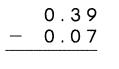
Question 12.
Math in Focus Grade 4 Chapter 8 Practice 3 Answer Key Subtracting Decimals 17
Answer:
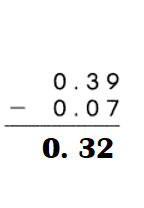
0.39 – 0.07 = 0.32.

Explanation:
Step 1:
Math in Focus Grade 4 Chapter 8 Practice 3 Answer Key Subtracting Decimals 17
Subtract the hundredths.
9 hundredths – 7 hundredths
= 2 hundredths.
Step 2:
Math in Focus Grade 4 Chapter 8 Practice 3 Answer Key Subtracting Decimals 17
Subtract the tenths.
3 tenths – 0 tenths = 3 tenths.
Step 3:
Math in Focus Grade 4 Chapter 8 Practice 3 Answer Key Subtracting Decimals 17
Subtract the ones.
0 ones – 0 one = 0 ones.
Math-in-Focus-Grade-4-Chapter-8-Practice-3-Answer-Key-Subtracting-Decimals-Fill in the blanks-12

Question 13.
Math in Focus Grade 4 Chapter 8 Practice 3 Answer Key Subtracting Decimals 18
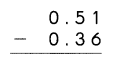
Answer:
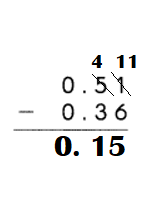
0.51 – 0.36 = 0.15.

Explanation:
Step 1
Math in Focus Grade 4 Chapter 8 Practice 3 Answer Key Subtracting Decimals 18
You cannot subtract 6 hundredths from 1 hundredths. So, regroup 5 tenths 1 hundredths.
5 tenths 1 hundredths
= 5 tenth 1 hundredths.
Subtract the hundredths.
11 hundredths – 6 hundredths
= 5 hundredths.
Step 2:
Math in Focus Grade 4 Chapter 8 Practice 3 Answer Key Subtracting Decimals 18
Subtract the tenths.
4 tenths – 3 tenths = 2 tenths.
Step 3:
Math in Focus Grade 4 Chapter 8 Practice 3 Answer Key Subtracting Decimals 18
Subtract the ones.
0 ones – 0 one = 0 ones.
Math-in-Focus-Grade-4-Chapter-8-Practice-3-Answer-Key-Subtracting-Decimals-Fill in the blanks-13

Question 14.
Math in Focus Grade 4 Chapter 8 Practice 3 Answer Key Subtracting Decimals 19
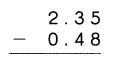
Answer:
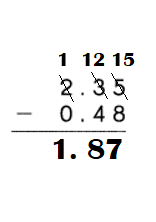
2.35 – 0.48 = 1.87.

Explanation:
Step 1:
Math in Focus Grade 4 Chapter 8 Practice 3 Answer Key Subtracting Decimals 19
You cannot subtract 8 hundredths from 5 hundredths. So, regroup 3 tenths 5 hundredths.
= 2 tenth 15 hundredths
Subtract the hundredths.
15 hundredths – 8 hundredths
= 7 hundredths.
Step 2:
Math in Focus Grade 4 Chapter 8 Practice 3 Answer Key Subtracting Decimals 19
You cannot subtract 4 tenths from 2 tenth.
So, regroup 2 ones and 2 tenth.
1 ones and  12 tenth.
Subtract the tenths.
12 tenths – 4 tenths = 8 tenths.
Step 3:
Math in Focus Grade 4 Chapter 8 Practice 3 Answer Key Subtracting Decimals 19
Subtract the ones.
1 ones – 0 one = 1 ones.
Math-in-Focus-Grade-4-Chapter-8-Practice-3-Answer-Key-Subtracting-Decimals-Fill in the blanks-14

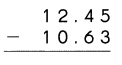
Question 15.
Math in Focus Grade 4 Chapter 8 Practice 3 Answer Key Subtracting Decimals 20
Answer:
12.45 – 10.63 = 1.82.

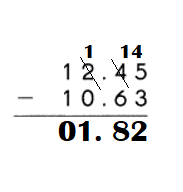
Explanation:
Step 1:
Math in Focus Grade 4 Chapter 8 Practice 3 Answer Key Subtracting Decimals 20
Subtract the hundredths.
5 hundredths – 3 hundredths
= 2 hundredths.
Step 2:
Math in Focus Grade 4 Chapter 8 Practice 3 Answer Key Subtracting Decimals 20
You cannot subtract 6 tenths from 4 tenth.
So, regroup 2 ones and 4 tenth.
= 1 ones and 14 tenths
Subtract the tenths.
14 tenths – 6 tenths = 8 tenths.
Step 3:
Math in Focus Grade 4 Chapter 8 Practice 3 Answer Key Subtracting Decimals 20
Subtract the ones.
1 ones – 0 one = 1 ones.
Step 4:
Subtract the tens.
1 tens – 1 tens = 0 tens.
Math-in-Focus-Grade-4-Chapter-8-Practice-3-Answer-Key-Subtracting-Decimals-Fill in the blanks-15

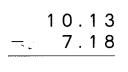
Question 16.
Math in Focus Grade 4 Chapter 8 Practice 3 Answer Key Subtracting Decimals 21
Answer:
10.13 – 7.18 = 2.95.

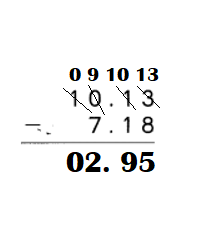
Explanation:
Step 1:
Math in Focus Grade 4 Chapter 8 Practice 3 Answer Key Subtracting Decimals 21
You cannot subtract 8 hundredths from 3 hundredths. So, regroup 1 tenths 3 hundredths.
0 tenths 13 hundredths.
Subtract the hundredths.
13 hundredths – 8 hundredths
= 5 hundredths.
Step 2:
Math in Focus Grade 4 Chapter 8 Practice 3 Answer Key Subtracting Decimals 21
You cannot subtract 1 tenths from 0 tenth.
So, regroup 0 ones and 0 tenth.
regroup 1 tens 0 tenths.
9 ones and 10 tenth.
= 9 ones and 10 tenths
Subtract the tenths.
10 tenths – 1 tenths = 9 tenths.
Step 3:
Math in Focus Grade 4 Chapter 8 Practice 3 Answer Key Subtracting Decimals 21
Subtract the ones.
9 ones – 7 one = 2 ones.
So, 4.23 – 1.54 = ___
Step 4:
Math in Focus Grade 4 Chapter 8 Practice 3 Answer Key Subtracting Decimals 21
Subtract the tens.
0 tens – 0 tens = 0 tens.
Math-in-Focus-Grade-4-Chapter-8-Practice-3-Answer-Key-Subtracting-Decimals-Fill in the blanks-16

Question 17.
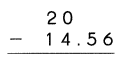
Math in Focus Grade 4 Chapter 8 Practice 3 Answer Key Subtracting Decimals 22
Answer:
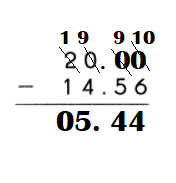
20.00 – 14.56 = 5.44.

Explanation:
Step 1:
Math in Focus Grade 4 Chapter 8 Practice 3 Answer Key Subtracting Decimals 22
You cannot subtract 6  hundredths from 0 hundredths. So, regroup 0 tenths 0 hundredths. So, regroup 0 ones 0 hundredths. So, regroup 2 tens 0 ones.
So, 1 tens. So, 10 ones. So, 10 tenths. So, 10 hundredths.
9 tenths 10 hundredths
= 9 tenth 10 hundredths.
Subtract the hundredths.
10 hundredths – 6 hundredths
= 4 hundredths
Step 2:
Math in Focus Grade 4 Chapter 8 Practice 3 Answer Key Subtracting Decimals 22
Subtract the tenths.
9 tenths – 5 tenths = 4 tenths.
Step 3:
Math in Focus Grade 4 Chapter 8 Practice 3 Answer Key Subtracting Decimals 22
Subtract the ones.
9 ones – 4 one = 5 ones.
Step 4:
Math in Focus Grade 4 Chapter 8 Practice 3 Answer Key Subtracting Decimals 22
Subtract the tens .
1 ones – 1 one = 0 ones.
Math-in-Focus-Grade-4-Chapter-8-Practice-3-Answer-Key-Subtracting-Decimals-Fill in the blanks-17

Write in vertical form. Then subtract.
Question 18.
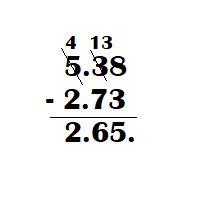
5.38 – 2.73 = ____
Answer:
5.38 – 2.73 = 2.65.

Explanation:
Math-in-Focus-Grade-4-Chapter-8-Practice-3-Answer-Key-Subtracting-Decimals-Write in vertical form-Then subtract-18

Question 19.
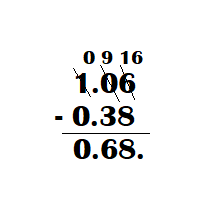
1.06 – 0.38 = ___
Answer:
1.06 – 0.38 = 0.68.

Explanation:
Math-in-Focus-Grade-4-Chapter-8-Practice-3-Answer-Key-Subtracting-Decimals-Write in vertical form-Then subtract-19

Question 20.
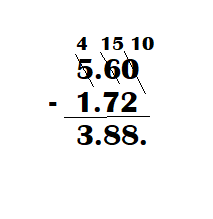
5.6 – 1.72 = ___
Answer:
5.6 – 1.72 = 3.88.

Explanation:
Math-in-Focus-Grade-4-Chapter-8-Practice-3-Answer-Key-Subtracting-Decimals-Write in vertical form-Then subtract-20
Question 21.
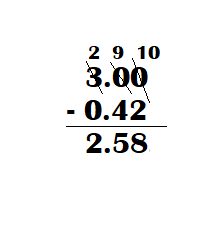
3 – 0.42 = ___
Answer:
3 – 0.42 = 2.58.

Explanation:
Math-in-Focus-Grade-4-Chapter-8-Practice-3-Answer-Key-Subtracting-Decimals-Write in vertical form-Then subtract-21

Math in Focus Grade 1 Chapter 5 Practice 2 Answer Key Exploring Plane Shapes

This handy Math in Focus Grade 1 Workbook Answer Key Chapter 5 Practice 2 Exploring Plane Shapes detailed solutions for the textbook questions.

Math in Focus Grade 1 Chapter 5 Practice 2 Answer Key Exploring Plane Shapes

Read.
Then answer the questions.

Question 1.
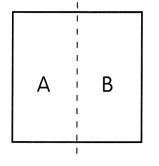
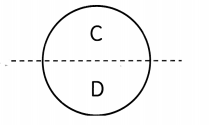
Josh has a square piece of paper. He folds it and unfolds it. Then he draws a line along the fold. Now he has two new shapes, A and B.
Math in Focus Grade 1 Chapter 5 Practice 2 Answer Key Exploring Plane Shapes 1

Write yes or no.

a. Are Shape A and Shape B the same shape? ____
Answer:
Yes, shape A and shape B both are having the same shape.

b. Are Shape A and Shape B the same size? ____
Answer:
Yes, the shape A and shape B are the same size.

Count.

c. How many sides are there?
Shape A ___ Shape B ____
Answer:
Shape A has 2 sides and shape B has 2 sides.

d. How many corners are there?
Shape A ___ Shape B ____
Answer:
Shape A has 2 corners and shape B also have 2 corners.

Write yes or no.

e. Are Shape A and Shape B different?
No, the shape A and shape B both are same.

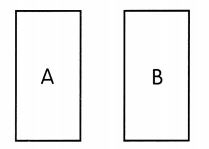
Josh then cuts out Shape A and Shape B.
Math in Focus Grade 1 Chapter 5 Practice 2 Answer Key Exploring Plane Shapes 2

f. Can Shape A fit exactly over Shape B? ________
Answer:
Yes, the shape A fits exactly over the shape B.

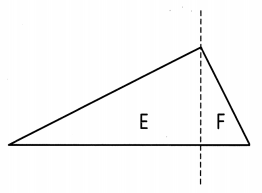
Are the shapes the same shape and size? Write yes or no.

Question 2.
Math in Focus Grade 1 Chapter 5 Practice 2 Answer Key Exploring Plane Shapes 3
Shapes C and D ____
Answer:
Here the shape C and shape D both are the same shapes.

Question 3.
Math in Focus Grade 1 Chapter 5 Practice 2 Answer Key Exploring Plane Shapes 4
Shapes E and F ____
Answer:
Here the shape E and shape F are in different shapes.

Math in Focus Grade 3 Chapter 6 Practice 1 Answer Key Multiplication Properties

Go through the Math in Focus Grade 3 Workbook Answer Key Chapter 6 Practice 1 Multiplication Properties to finish your assignments.

Math in Focus Grade 3 Chapter 6 Practice 1 Answer Key Multiplication Properties

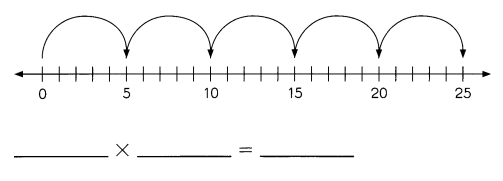
Look at each number line. Write the multiplication fact.

Question 1.
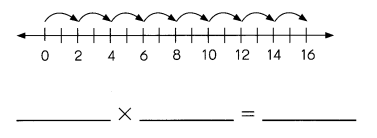
Math in Focus Grade 3 Chapter 6 Practice 1 Answer Key Multiplication Properties 1
Answer:
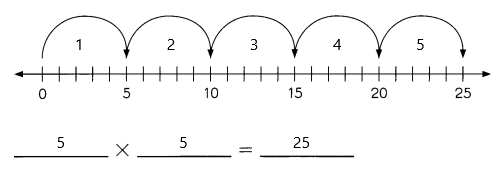
5×5 = 25.

Explanation:
In the number line, we can see that 5 jumps of 5. So the multiplication fact is 5×5 which is 25.
Math-in-Focus-Grade-3-Chapter-6-Practice-1-Answer-Key-Multiplication-Properties-1-1

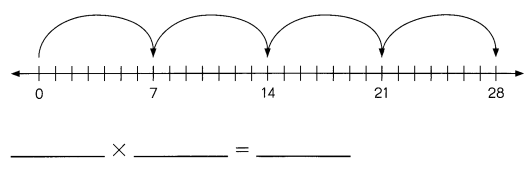
Question 2.
Math in Focus Grade 3 Chapter 6 Practice 1 Answer Key Multiplication Properties 2
Answer:
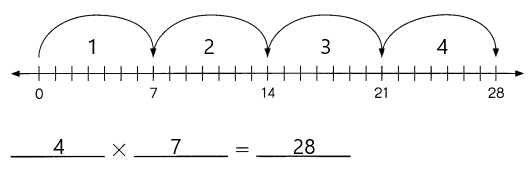
4×7 = 28.

Explanation:
In the number line, we can see that 4 jumps of 7. So the multiplication fact is 4×7 which is 28.
Math-in-Focus-Grade-3-Chapter-6-Practice-1-Answer-Key-Multiplication-Properties-2-1

Question 3.
Math in Focus Grade 3 Chapter 6 Practice 1 Answer Key Multiplication Properties 3
Answer:
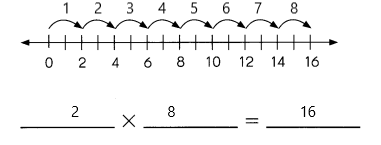
2×8 = 16.

Explanation:
In the number line, we can see that 2 jumps of 8. So the multiplication fact is 2×8 which is 16.
Math-in-Focus-Grade-3-Chapter-6-Practice-1-Answer-Key-Multiplication-Properties-3-1

Complete each multiplication fact. Then show on each number line.

Question 4.
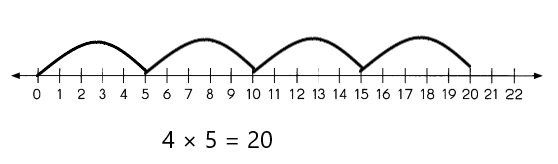
4 × 5 = ____
Math in Focus Grade 3 Chapter 6 Practice 1 Answer Key Multiplication Properties 4
Answer:
4 × 5 = 20.

Explanation:
We will represent in the number line by 4 jumps of 5 for 4 × 5 which is 20.
Math-in-Focus-Grade-3-Chapter-6-Practice-1-Answer-Key-Multiplication-Properties-4-1

Question 5.
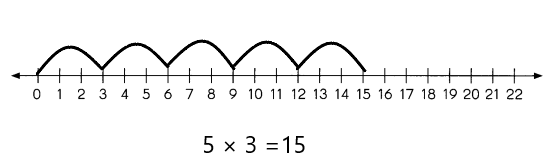
5 × 3 = ____
Math in Focus Grade 3 Chapter 6 Practice 1 Answer Key Multiplication Properties 5
Answer:
5 × 3 = 15.

Explanation:
We will represent in the number line by 5 jumps of 3 for 5 × 3 which is 15.
Math-in-Focus-Grade-3-Chapter-6-Practice-1-Answer-Key-Multiplication-Properties-4-1

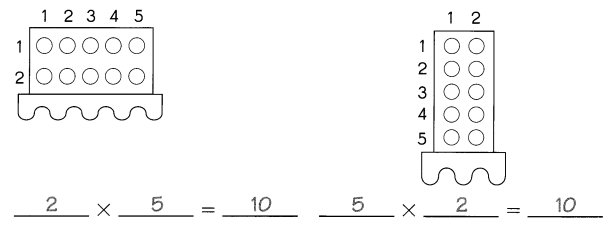
Look at the dot paper. Write the multiplication fact.

Example

Math in Focus Grade 3 Chapter 6 Practice 1 Answer Key Multiplication Properties 6

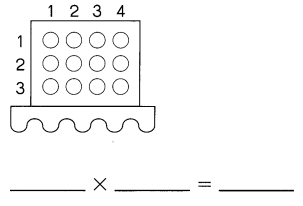
Question 6.
Math in Focus Grade 3 Chapter 6 Practice 1 Answer Key Multiplication Properties 7
Answer:
3 × 4 = 12.

Explanation:
The multiplication between 3 and 4 is 3 × 4 which is 12.

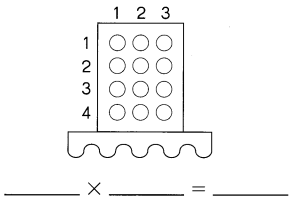
Question 7.
Math in Focus Grade 3 Chapter 6 Practice 1 Answer Key Multiplication Properties 8
Answer:
2 × 3 = 6.

Explanation:
The multiplication between 2 and 3 is 2 × 3 which is 6.

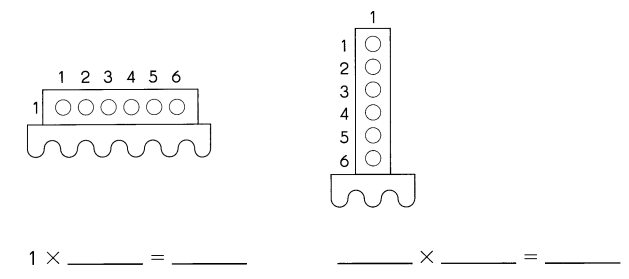
Look at the dot paper. Write the multiplication fact.

Question 7.
Math in Focus Grade 3 Chapter 6 Practice 1 Answer Key Multiplication Properties 9
Answer:
1 × 5 = 5.

Explanation:
The multiplication between 1 and 5 is 1 × 5 which is 5.

Question 8.
Math in Focus Grade 3 Chapter 6 Practice 1 Answer Key Multiplication Properties 10
Answer:
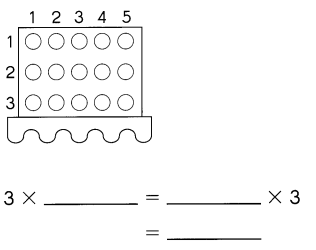
3 × 5 = 5 × 3 = 15.

Explanation:
The multiplication between 3 and 5 is 3 × 5 which is 15.

Complete the multiplication fact. Then show on each number line.

Question 9.
Math in Focus Grade 3 Chapter 6 Practice 1 Answer Key Multiplication Properties 11
Answer:

Fill in the missing numbers.

Question 10.
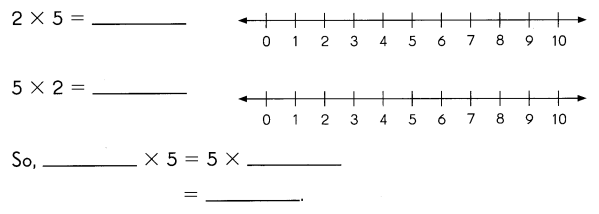
2 × __ = 0 × ___
= ____
Answer:
2 × 0 = 0 × 2 = 0.

Explanation:
Here, if we multiply 0 with anything we will get the product as 0. So
2 × 0 = 0 × 2
= 0.
So the missing letter is 0.

Question 11.
0 × ___ = 4 × ___
= _____
Answer:
0 × 4 = 4 × 0 =0.

Explanation:
Here, if we multiply 0 with anything we will get the product as 0. So
0 × 4 = 4 × 0
= 0.
So the missing letter is 4.

Question 12.
5 × ___ = 1 × ___
= ___
Answer:
5 × 1 = 1 × 5 = 5.

Explanation:
Here the missing letter is 1, as
5 × 1 = 1 × 5
= 5.
So the missing letter is 1.

Question 13.
1 × ___ = 10 × ___
= ____
Answer:
1 × 10 = 10 × 1 = 10.

Explanation:
Here the missing letter is 1, as
1 × 10 = 10 × 1
= 10.
So the missing letter is 1.

Complete each multiplication fact. Then show on the number line.

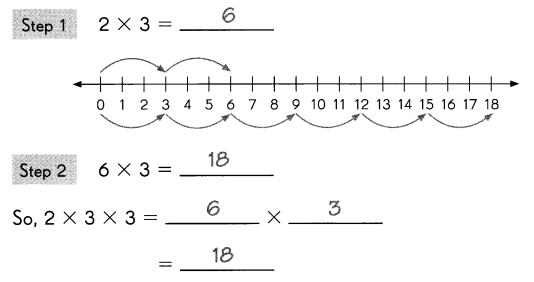
Example
2 × 3 × 3 = ?
Math in Focus Grade 3 Chapter 6 Practice 1 Answer Key Multiplication Properties 12

Question 14.
2 × 4 × 2 = ___ × ____
= _____
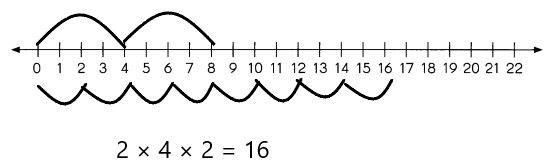
Math in Focus Grade 3 Chapter 6 Practice 1 Answer Key Multiplication Properties 13
Answer:
2 × 4 × 2 = 16.

Explanation:
Here, in Step 1 we will multiply 2 × 4 which is 8,
and in step 2 we will multiply 8 × 2 which is 16,
So, 2 × 4 × 2 = 16
Math-in-Focus-Grade-3-Chapter-6-Practice-1-Answer-Key-Multiplication-Properties-4-1

Math in Focus Grade 3 Chapter 7 Answer Key Multiplication

Go through the Math in Focus Grade 3 Workbook Answer Key Chapter 7 Multiplication to finish your assignments.

Math in Focus Grade 3 Chapter 7 Answer Key Multiplication

Math Journal

Write the steps to your answer.

Multiply 243 by 2.

Example
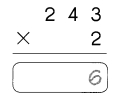
Step 1
Multiply 3 ones by 2.
2 × 3 ones = 6 ones
Math in Focus Grade 3 Chapter 7 Answer Key Multiplication 1
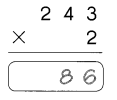
Step 2
Multiply 4 tens by 2.
2 × 4 tens = 8 tens
Math in Focus Grade 3 Chapter 7 Answer Key Multiplication 2
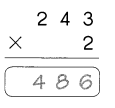
Step 3
Multiply 2 hundreds by 2.
2 × 2 hundreds = 4 hundreds
So, 2 × 243 = 486.
Math in Focus Grade 3 Chapter 7 Answer Key Multiplication 3

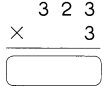
Multiply 323 by 3. Math in Focus Grade 3 Chapter 7 Answer Key Multiplication 4
Step 1 _________________
_____________________
Step 2 _________________
_____________________
Step 3 _________________
_____________________

Answer:
323 × 3 = 969.

Explanation:
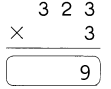
Step 1
Multiply 3 ones by 3.
3 × 3 ones = 9 ones
Math-in-Focus-Grade-3-Chapter-7-Answer-Key-Multiplication-4-1
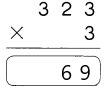
Step 2
Multiply 2 tens by 3.
2 × 3 tens = 6 tens
Math-in-Focus-Grade-3-Chapter-7-Answer-Key-Multiplication-4-2
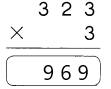
Step 3
Multiply 3 hundreds by 3.
3 × 3 hundreds = 9 hundreds
Math-in-Focus-Grade-3-Chapter-7-Answer-Key-Multiplication-4-3
So 323 × 3 is 969.

Put On Your Thinking cap!

Challenging Practice

Fill in the missing numbers.

Question 1.
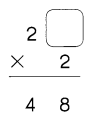
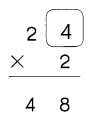
Math in Focus Grade 3 Chapter 7 Answer Key Multiplication 5
Answer:
The missing digit is 4.

Explanation:
As the product is 48 and the multiplier 2, to find the missing digit we will divide 48÷2 which is 24. So the missing digit is 4.
Math-in-Focus-Grade-3-Chapter-7-Answer-Key-Multiplication-5-1

Question 2.
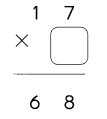
Math in Focus Grade 3 Chapter 7 Answer Key Multiplication 6
Answer:
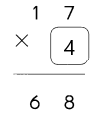
The missing digit is 4.

Explanation:
As the product is 68 and the multiplicand is 17, to find the missing digit we will divide 68÷17 which is 4. So the missing digit is 4.
Math-in-Focus-Grade-3-Chapter-7-Answer-Key-Multiplication-6-1

Question 3.
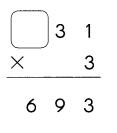
Math in Focus Grade 3 Chapter 7 Answer Key Multiplication 7
Answer:
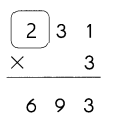
The missing digit is 2.

Explanation:
As the product is 693 and the multiplier 3, to find the missing digit we will divide 693÷3 which is 231. So the missing digit is 2.
Math-in-Focus-Grade-3-Chapter-7-Answer-Key-Multiplication-7-1

Question 4.
Math in Focus Grade 3 Chapter 7 Answer Key Multiplication 8
Answer:
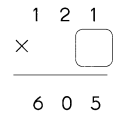
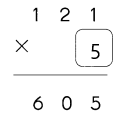
The missing digit is 5.

Explanation:
As the product is 605 and the multiplicand is 121, to find the missing digit we will divide 605÷121 which is 5. So the missing digit is 5.
Math-in-Focus-Grade-3-Chapter-7-Answer-Key-Multiplication-8-1

Math in Focus Grade 3 Chapter 7 Answer Key Multiplication 9

Question 5.
Math in Focus Grade 3 Chapter 7 Answer Key Multiplication 10
Answer:
The missing digit is 2.

Explanation:
As the product is 616 and the multiplicand is 308, to find the missing digit we will divide 616÷308 which is 2. So the missing digit is 2.
Math-in-Focus-Grade-3-Chapter-7-Answer-Key-Multiplication-10-1

Question 6.
Math in Focus Grade 3 Chapter 7 Answer Key Multiplication 11
Answer:
The missing digit is 3.

Explanation:
As the product is 540 and the multiplier 4, to find the missing digit we will divide 540÷4 which is 135. So the missing digit is 3.
Math-in-Focus-Grade-3-Chapter-7-Answer-Key-Multiplication-11-1

Question 7.
Math in Focus Grade 3 Chapter 7 Answer Key Multiplication 12
Answer:
The missing digit is 2.

Explanation:
As the product is 756 and the multiplier 3, to find the missing digit we will divide 756÷3 which is 252. So the missing digit is 2.
Math-in-Focus-Grade-3-Chapter-7-Answer-Key-Multiplication-12-1

Question 8.
Math in Focus Grade 3 Chapter 7 Answer Key Multiplication 13
Answer:
The missing digit is 4.

Explanation:
As the product is 592 and the multiplier 4, to find the missing digit we will divide 592÷4 which is 148. So the missing digit is 4.
Math-in-Focus-Grade-3-Chapter-7-Answer-Key-Multiplication-13-1

Put on Your Thinking Cap!

Problem Solving

Solve.
Frank has 100 geese and cows on his farm. The animals have a total of 340 legs. How many geese and cows does Frank have?
Math in Focus Grade 3 Chapter 7 Answer Key Multiplication 14
Frank has ___ geese and __ cows.
Math in Focus Grade 3 Chapter 7 Answer Key Multiplication 15
Answer:
Frank has 30 geese and 70 cows.

Explanation:
Given that Frank has 100 geese and cows on his farm and the animals have a total of 340 legs. So the number of geese and cows do Frank has is
Math-in-Focus-Grade-3-Chapter-7-Answer-Key-Multiplication-15-1